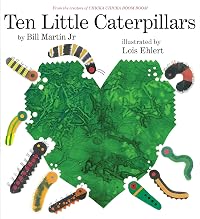
Ten Little Caterpillars
by Bill Martin, Jr.
On This Page
Description
Illustrations and rhyming text follow ten caterpillars as one wriggles up a flower stem, another sails across a garden pool, and one reaches an apple leaf, where something amazing happens.Tags
Recommendations












Member Reviews
I had mixed feelings about this book. One of the reasons I enjoyed reading the story was because of the illustrations. The pictures were very abstract and the caterpillars were very detailed. They looked cute in the story. The illustrations enhanced the story. There was one word I wasn't familiar with which was 'bower' but I guessed it was type of flower, which I was able to figure out through the illustrations. Another reason I liked this story was because of the writing. The words were very simple and they rhymed to it was easy to follow along.There was also a glossary in the back on the book that showed the different butterflies that each caterpillar turned into. It also gave facts about the caterpillars which I found very helpful show more and engaging, since they were labeled. One thing that could have made the book better was more details in the actual story. The main idea of this book was to show the different flowers and plants that caterpillars eat and to show how a caterpillar turns into a butterfly. show less
Yes, you’ve probably got enough caterpillar to butterfly books (even Ehlert’s own books), but how can you resist the combination of Bill Martin Jr. and Lois Ehlert? A rhyming, counting, nature, butterfly book illustrated in Ehlert’s signature watercolor, cut-paper collage style. Martin avoids triteness by varying the rhyme pattern to offer a final poetic metamorphosis equal to the caterpillar’s natural one.
www.shelf-employed.blogspot.com
www.shelf-employed.blogspot.com
I really like this book and the educational opportunities it provides for young children. The illustrations are vibrant and colorful. The illustrations are labeled, so children can make a connection between pictures of animals, plants, and vegetables with their words. It is sometimes hard for children to recognize that words in a sentence correspond to pictures, but with direct labels, this concept is made easier for children. For example, if the word “toad” is in a sentence with many other words, children may not understand which word corresponds with the picture. In this book, the word “toad” is placed right next to the picture of a toad, making it clear that t-o-a-d spells the word “toad”. The use of written numbers in show more this text also provides a unique educational opportunity for readers. Most children in preschool or kindergarten understand the concept of numbers, but see them as symbols. Seeing numbers in sentences such as “The third little caterpillar climbed a cabbage head” help children understand that numbers can be expressed as symbols or words. This book also helps children understand the concept of ordinal numbers. This book includes repetitive language by saying, “The second little caterpillar”, “The third little caterpillar”, “The fourth little caterpillar”, etc. The predictable language helps children recognize high frequency words and boosts their self-esteem since they will be able to identify the repeated words on every page. At the end of the book, there are facts about the animals and their names, which means that this story can be used as a cross-curricular activity and teach science as well. I would recommend this book only to young readers, since it would not be very engaging for children in upper elementary grade levels. However, it is perfect for beginning readers and could help students learn in various ways. show less
I had forgotten about this book, as well, but I remember it from when I was younger. It is a simple counting story about caterpillars, where one turns into a butterfly at the end. It is a great choice for exposing young children to numbers, caterpillars, rhythm, and rhyme. Bill Martin Jr. always has a really great melodic sound to all of his books, which is part of the strong appeal for children. This book, along with many others by this author, is an excellent choice for an early reader's library.
Bill Martin, Jr., has another winner! Cute book, indeed! Love the colorful illustrations, which include little labels of the different plants and animals/insects in the pictures. In the back of the book are illustrations of 10 different caterpillars, what they eat, and the kind of butterfly or moth they turn into. Interesting and "sciency" on a kid level.
I really enjoyed this book. One reason was how the book was written. It was written in a very organized way. It counted from the first caterpillar till the tenth one. I also liked the illustrations of the book. They were very colorful and detailed. Each illustration had a caption below them informing the readers what they were. For instance, under a picture of a fish the author put the caption “sea bass”. This informed the readers that this type of fish is a sea bass. Another thing I liked about this book was the language. The author patterned what he said by starting most of the pages off with “the ________ little caterpillar….”. The big idea of this book is to show readers what caterpillars do and that they eventually turn show more into butterflies. show less
This book has great illustrations. It is a book that has 10 caterpillars with different adventures. They each have different ways they go some fall in the sea others climb cabbage and so on. The adventure takes you through each one's exploration and what they eat determines the type of butterfly they become. Great for children and awesome illustrations.
Members
- Recently Added By
Author Information

204+ Works 73,048 Members
Children's writer Bill Martin, Jr. was born and raised in Hiawatha, Kansas. Ironically, the future early childhood educator had difficulty reading until he taught himself, before graduating with a teaching certificate from Emporia State University. After graduation, he taught high school drama and journalism in Kansas. He served in the Army Air show more Force as a newspaper editor during World War II. He wrote his first book, The Little Squeegy Bug, for his brother, Bernard, an artist, to illustrate while recuperating from war wounds. It was published in 1945 and the brothers would go on to collaborate on 10 more books by 1955. He earned a master's degree and doctorate in early childhood education from Northwestern University and became principal of an elementary school in Evanston, Ill., where he developed innovative reading programs. In 1962 Martin moved to New York City to become editor of the school division of Holt, Rhinehart and Winston where he developed the literature-based reading programs Sounds of Language and The Instant Readers. Martin returned to full-time writing in 1972 and ended up writing over three hundred children's books during his career. His titles include; Brown Bear, Brown Bear, What do You See?, Polar Bear, Polar Bear, What do you Hear?, The Ghost-Eye Tree, Barn Dance, and Chicka, Chicka, Boom, Boom. He died on August 11, 2004 at the age of 88. (Bowker Author Biography) show less
All Editions
Awards and Honors
Distinctions
Notable Lists
Classifications
Statistics
- Members
- 1,292
- Popularity
- 18,951
- Reviews
- 20
- Rating
- (3.92)
- Languages
- English, Spanish
- Media
- Paper, Audiobook, Ebook
- ISBNs
- 11
- ASINs
- 4