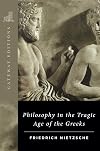
Philosophy in the Tragic Age of the Greeks
by Friedrich Wilhelm Nietzsche
On This Page
Description
For Nietzsche the Age of Greek Tragedy was indeed a tragic age. He saw in it the rise and climax of values so dear to him that their subsequent drop into catastrophe (in the person of Socrates - Plato) was clearly foreshadowed as though these were events taking place in the theater. And so in this work, unpublished in his own day but written at the same time that his The Birth of Tragedy had so outraged the German professorate as to imperil his own academic career, his most deeply felt task show more was one of education. He wanted to present the culture of the Greeks as a paradigm to his young German contemporaries who might thus be persuaded to work toward a state of culture of their own; a state where Nietzsche found sorely missing. show lessTags
Recommendations









































Member Reviews
The young Nietzsche on the impotence of Philosophy..., September 15, 2004
This book has much of interest to say about various Greek philosophers but precious little to say of Nietzsche's method of proceeding. Of that Nietzsche says, in the preface that "philosophical systems are wholly true for their founders only. For all subsequent philosophers they usually represent one great mistake, for lesser minds a sum of errors and truths. Taken as ultimate ends, in any event, they represent an error..." In this book Nietzsche focuses on one point - "a slice of personality" - in several philosophers in order to reveal ...what? - Personal mood, color, personality, as he says in the first preface? But in a second preface he refers to the show more incompleteness of this approach. Still, he says, "the only thing of interest in a refuted system is the personal element. It alone is forever irrefutable." By the time he writes Beyond Good & Evil this `personal' element (a singularity) is revealed as philosophical purpose; which is itself the revealing (or concoction) of ultimate ends.
But of that I am going to say nothing. What I have always found most remarkable in this early work by Nietzsche is the discussion of culture; I mean the relation between philosophy and culture. The healthy culture can exist with even a little philosophy, we are told. And we wonder at the contrast he then [implicitly, perhaps unconsciously] offers between the Greeks and the Romans; "the Romans during their best period lived without philosophy." - But what of non-healthy cultures? "The sick it [philosophy] made even sicker. Wherever a culture was disintegrating, wherever the tension between it and its individual components was slack, philosophy could never re-integrate the individual back into the group." Nietzsche says the Greeks did not stop philosophizing when they should have, and that it was this philosophy (of old age) that made our common philosophical tradition. ...Sigh, nothing dies at the right time, but that is another story.
But the Greeks began (to philosophize) at the right time. And they made use of the cultures around them. "Nothing would be sillier then to claim an autochthonous development for the Greeks. On the contrary, they invariably absorbed other living cultures. The very reason they got so far is that they knew how to pick up the spear and throw it onward from the point where others had left it." The Greek achievement is this throwing the spear further. The fashionable and unfashionable insistence on cultural purity is always a sign of stupidity, laziness and cowardice. "The quest for philosophy's beginnings is idle, for everywhere in all beginnings we find only the crude, the unformed, the empty and the ugly. What matters in all things is the higher levels."
But what if one lives in a sick (by that I mean the individual apart from the group) culture? Can we not go back to the beginning, ala Heidegger, retrace our steps, see what went wrong, correct it and start over? "Everywhere the way to the beginning leads to barbarism. Whoever concerns himself with the Greeks should be ever mindful that the unrestrained thirst for knowledge for its own sake barbarizes men just as much as a hatred of knowledge." Nietzsche weaves a cautionary tale about the value of philosophy and knowledge for culture in the opening pages of this essay that is often overlooked in the haste to get to what Nietzsche has to say about this or that Greek philosopher.
Haste is a dreadful thing; the ruin of so many promising beginnings. But can a poor beginning ever be made good again? show less
This book has much of interest to say about various Greek philosophers but precious little to say of Nietzsche's method of proceeding. Of that Nietzsche says, in the preface that "philosophical systems are wholly true for their founders only. For all subsequent philosophers they usually represent one great mistake, for lesser minds a sum of errors and truths. Taken as ultimate ends, in any event, they represent an error..." In this book Nietzsche focuses on one point - "a slice of personality" - in several philosophers in order to reveal ...what? - Personal mood, color, personality, as he says in the first preface? But in a second preface he refers to the show more incompleteness of this approach. Still, he says, "the only thing of interest in a refuted system is the personal element. It alone is forever irrefutable." By the time he writes Beyond Good & Evil this `personal' element (a singularity) is revealed as philosophical purpose; which is itself the revealing (or concoction) of ultimate ends.
But of that I am going to say nothing. What I have always found most remarkable in this early work by Nietzsche is the discussion of culture; I mean the relation between philosophy and culture. The healthy culture can exist with even a little philosophy, we are told. And we wonder at the contrast he then [implicitly, perhaps unconsciously] offers between the Greeks and the Romans; "the Romans during their best period lived without philosophy." - But what of non-healthy cultures? "The sick it [philosophy] made even sicker. Wherever a culture was disintegrating, wherever the tension between it and its individual components was slack, philosophy could never re-integrate the individual back into the group." Nietzsche says the Greeks did not stop philosophizing when they should have, and that it was this philosophy (of old age) that made our common philosophical tradition. ...Sigh, nothing dies at the right time, but that is another story.
But the Greeks began (to philosophize) at the right time. And they made use of the cultures around them. "Nothing would be sillier then to claim an autochthonous development for the Greeks. On the contrary, they invariably absorbed other living cultures. The very reason they got so far is that they knew how to pick up the spear and throw it onward from the point where others had left it." The Greek achievement is this throwing the spear further. The fashionable and unfashionable insistence on cultural purity is always a sign of stupidity, laziness and cowardice. "The quest for philosophy's beginnings is idle, for everywhere in all beginnings we find only the crude, the unformed, the empty and the ugly. What matters in all things is the higher levels."
But what if one lives in a sick (by that I mean the individual apart from the group) culture? Can we not go back to the beginning, ala Heidegger, retrace our steps, see what went wrong, correct it and start over? "Everywhere the way to the beginning leads to barbarism. Whoever concerns himself with the Greeks should be ever mindful that the unrestrained thirst for knowledge for its own sake barbarizes men just as much as a hatred of knowledge." Nietzsche weaves a cautionary tale about the value of philosophy and knowledge for culture in the opening pages of this essay that is often overlooked in the haste to get to what Nietzsche has to say about this or that Greek philosopher.
Haste is a dreadful thing; the ruin of so many promising beginnings. But can a poor beginning ever be made good again? show less
Ratings
Members
- Recently Added By
Author Information

1,395+ Works 78,468 Members
The son of a Lutheran pastor, Friedrich Wilhelm Nietzsche was born in 1844 in Roecken, Prussia, and studied classical philology at the Universities of Bonn and Leipzig. While at Leipzig he read the works of Schopenhauer, which greatly impressed him. He also became a disciple of the composer Richard Wagner. At the very early age of 25, Nietzsche show more was appointed professor at the University of Basel in Switzerland. In 1870, during the Franco-Prussian War, Nietzsche served in the medical corps of the Prussian army. While treating soldiers he contracted diphtheria and dysentery; he was never physically healthy afterward. Nietzsche's first book, The Birth of Tragedy Out of the Spirit of Music (1872), was a radical reinterpretation of Greek art and culture from a Schopenhaurian and Wagnerian standpoint. By 1874 Nietzsche had to retire from his university post for reasons of health. He was diagnosed at this time with a serious nervous disorder. He lived the next 15 years on his small university pension, dividing his time between Italy and Switzerland and writing constantly. He is best known for the works he produced after 1880, especially The Gay Science (1882), Thus Spake Zarathustra (1883-85), Beyond Good and Evil (1886), On the Genealogy of Morals (1887), The Antichrist (1888), and Twilight of the Idols (1888). In January 1889, Nietzsche suffered a sudden mental collapse; he lived the last 10 years of his life in a condition of insanity. After his death, his sister published many of his papers under the title The Will to Power. Nietzsche was a radical questioner who often wrote polemically with deliberate obscurity, intending to perplex, shock, and offend his readers. He attacked the entire metaphysical tradition in Western philosophy, especially Christianity and Christian morality, which he thought had reached its final and most decadent form in modern scientific humanism, with its ideals of liberalism and democracy. It has become increasingly clear that his writings are among the deepest and most prescient sources we have for acquiring a philosophical understanding of the roots of 20th-century culture. (Bowker Author Biography) show less

Friedrich Nietzsche has a Legacy Library. Legacy libraries are the personal libraries of famous readers, entered by LibraryThing members from the Legacy Libraries group.
Some Editions
Series
Belongs to Publisher Series
Work Relationships
Common Knowledge
- Canonical title
- Philosophy in the Tragic Age of the Greeks
- Original title
- Philosophie im tragischen Zeitalter der Griechen
- Original publication date
- 1873
Classifications
Statistics
- Members
- 378
- Popularity
- 83,105
- Reviews
- 2
- Rating
- (3.91)
- Languages
- 11 — Czech, English, French, German, Greek, Italian, Portuguese, Romanian, Croatian, Spanish, Turkish
- Media
- Paper, Audiobook, Ebook
- ISBNs
- 23
- ASINs
- 8