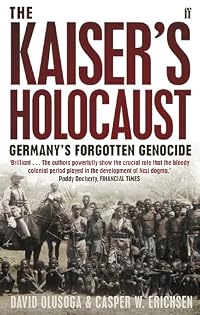
The Kaiser's Holocaust: Germany's Forgotten Genocide and the Colonial Roots of Nazism
by David Olusoga, Casper W. Erichsen
On This Page
Description
On 12 May 1883, the German flag was raised on the coast of South-West Africa, modern Namibia - the beginnings of Germany's African Empire. As colonial forces moved in, their ruthless punitive raids became an open war of extermination. By 1905, the survivors were interned in concentration camps & systematically starved & worked to death.Tags
Recommendations









































Member Reviews
German concentration camps in Namibia: a pre-cursor to those of WW2, 10 July 2015
This review is from: The Kaiser's Holocaust: Germany's Forgotten Genocide and the Colonial Roots of Nazism (Paperback)
An extremely well-written account of an event of which I certainly was unaware - namely the appalling treatment of the native peoples of German S W Africa (now Namibia) in the early years of the 20th century. Based on the Kaiser's desire to create 'lebensraum' - space for the Aryan race to flourish, separate from the 'natives' - the German colonists created horrific concentration camps, notably that of Shark Island, near Luderitz.
But the author's don't confine themselves to relating African history; after explaining the German situation show more from WW1 to the disintegration of the country in its wake, and the rise of the Third Reich, they go on to draw parallels between the racial discrimination that was used to justify the treatment of natives in Africa, and that later used against Slavs and Jews.
"So much of what took place in German SW Africa at the beginning of the twentieth century horribly prefigures the events of the 1940s: concentration camps, the bureaucratisation of killing, meticulous record-keeping of death tolls and death rates, the use of work as a means of extermination, civilians transported in cattle trucks then worked to death, their remains experimented upon by race scientists, and the identification of ethnic groups who had a future of slaves and those who had no future of any sort."
A shocking book, yet written in a very readable style, and I learned so much, both about African and European history. show less
This review is from: The Kaiser's Holocaust: Germany's Forgotten Genocide and the Colonial Roots of Nazism (Paperback)
An extremely well-written account of an event of which I certainly was unaware - namely the appalling treatment of the native peoples of German S W Africa (now Namibia) in the early years of the 20th century. Based on the Kaiser's desire to create 'lebensraum' - space for the Aryan race to flourish, separate from the 'natives' - the German colonists created horrific concentration camps, notably that of Shark Island, near Luderitz.
But the author's don't confine themselves to relating African history; after explaining the German situation show more from WW1 to the disintegration of the country in its wake, and the rise of the Third Reich, they go on to draw parallels between the racial discrimination that was used to justify the treatment of natives in Africa, and that later used against Slavs and Jews.
"So much of what took place in German SW Africa at the beginning of the twentieth century horribly prefigures the events of the 1940s: concentration camps, the bureaucratisation of killing, meticulous record-keeping of death tolls and death rates, the use of work as a means of extermination, civilians transported in cattle trucks then worked to death, their remains experimented upon by race scientists, and the identification of ethnic groups who had a future of slaves and those who had no future of any sort."
A shocking book, yet written in a very readable style, and I learned so much, both about African and European history. show less
Nazism wasn't a 20th century aberration; its ideas and practices were tested in German SW Africa (Namibia) decades earlier. Genocide against the Hereros and Nama; the first death camps at Shark Island (Lüderitz) and Swakopmund; Hermann Göring's father was the first imperial commissioner; Hitler's Brown Shirts were so named because they wore schutztruppe surplus uniform; race scientists studied the remains of victims, etc., etc. As someone who loves and thought he knew Namibia, this is an eye-opener...
A thoroughly researched, compelling, and accessible history of a near-forgotten genocide and its links to the Holocaust.
Ratings
Members
- Recently Added By
Author Information

18+ Works 1,067 Members
2 Works 197 Members
Common Knowledge
- Original title
- Kaiser's Holocaust
- Original publication date
- 2010
- Important places
- Namibia
- Important events
- World War I
- Dedication
- Dedicated to the memory of Jorn Wulff, Karen Wulff & Olorunjube Franklin Ojomo
- First words
- Sometime in the late summer of 1484 two ships slipped out of Lisbon harbour, caught the wind in their sails and turned south.
- Last words
- (Click to show. Warning: May contain spoilers.)But the Herero and Nama genocides, along with the Nazi vision of race war and settlement in Eastern Europe, can be seen as aspects of a larger phenomenon: the emergence from Europe of a terrible strain of racial colonialism that viewed human history through the prism of a distorted form of Social Darwinism, and regarded the earth as a racial battlefield on which the 'weak' were destined to be vanquished.
- Canonical DDC/MDS
- 304.66309688109041
- Canonical LCC
- DT1603
Classifications
- Genres
- History, Nonfiction, General Nonfiction
- DDC/MDS
- 304.66309688109041 — Society, Government, and Culture Social sciences, sociology & anthropology Factors affecting social behavior Population
- LCC
- DT1603 — History of Europe, Asia, Africa and Oceania Africa History of Africa Namibia. South-West Africa History
- BISAC
Statistics
- Members
- 198
- Popularity
- 164,728
- Reviews
- 3
- Rating
- (4.26)
- Languages
- English, Polish, Swedish
- Media
- Paper, Ebook
- ISBNs
- 5
- ASINs
- 3