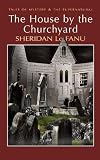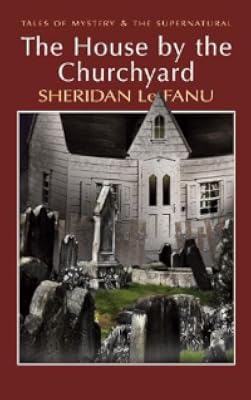
The House by the Churchyard
by Joseph Sheridan Le Fanu
On This Page
Description
Sheridan Le Fanu's historical mystery novel The House by the Churchyard was written in 1863. A skull unearthed in a churchyard show signs of violent blows to the head and, even more disturbingly, the small hole caused by trepanning. One hundred years before, a coffin is buried secretly, "R.D." the only identification on its brass plague. The House by the Churchyard was a major source of inspiration for James Joyce's Finnegans Wake..
Tags
Recommendations





















Member Reviews
'Why, I suppose there isn't so tattling, prying, lying, scandalous a little colony of Christians on earth; eyes, ears, and mouths all open, Sir; heads busy, tongues wagging; lots of old maids, by Jove; ladies' women, and gentlemen's gentlemen, and drawers and footmen; club talk, Sir, and mess-table talk, and talk on band days, talk over cards, talk at home, Sir - talk in the streets - talk - talk; by Jupiter Tonans! 'tis enough to bother one's ears, and make a man envy Robinson Crusoe!'
Firstly the placename Chapelizod is prenounced locally Chapel-lizard. Being from Dublin i had more reasons to like this than most. While viking-era dublin is something you learn about at school, this lets call it... english-dublin, a dublin of tricorn show more hats, sedan chairs and absentee landlords, i havn't heard much about.
So i got something extra from recognising all the place names and knowing the geography of everything. At one point a murder is mentioned in passing, as havng occurred in clondalkin and i got a little chuckle thinking 'wow that place hasn't changed in 200 years' :lol.
It opens in a macabre and funny way and reminded me a lot in its setting and tone, of the Tim Burton 'Sleepy Hollow' movie. I remember thinking this is a nice setup can't wait to see what the actual story is. Then the setup went on and on, and on, until it dawned on me with a shudder, that this wasn't setup this was the main text. Let me return to the 'Sleepy Hollow' movie for demonstration purposes.
Imagine if in that film the headless horseman, Johnny Depp and Christina Ricci's characters are all still in there, but pushed to the very periphery of the script. Their story is still happening but your stuck following the lives of the extras only occasionally getting a glimpse of the main characters in the hazy distance.
In the moment the incidents are readable and go from ok to good but theres no point to any of it. Tolerable while reading but an absolute struggle to convince yourself to pick the book up again once set down.
The writing if ok, see quote, is quite organic feeling, like your listening to it even while reading. There are some accents and an occasional lisp but it was neither a plus or minus for me.
Finally at the 60% stage the plot(s) start. I use the plural because 3 of them come along at once and the next 30% rushes along in what feels like a single breath, before we grind to a halt for the last 10% of clean up, which somewhat tested my patience once again.
Many might forgive the first 60% as theres some really good stuff in the latter portion but even these parts arn't without they're flaws.
The author has a remarkable knack of seeming to pick the wrong viewpoint for most situations. It almost always feels like your following the wrong character or focusing on insignificant things while missing the important ones.
Objectively based on my usual scoring this is 2 stars, what i give to failures which have some small worth, the last 40% is quite compelling, mostly. The previous 60% has a lot of charming albeit pointless incidents.
However i've taken the liberty of deducting a star based on personal hatred, it has been quite sometime since i had that dubious honour :) . More work than 'Mysteries of Udolpho' or 'Melmoth the Wanderer'. Feels similar to the work of Thomas Love Peacock... except terrible ;) . show less
Firstly the placename Chapelizod is prenounced locally Chapel-lizard. Being from Dublin i had more reasons to like this than most. While viking-era dublin is something you learn about at school, this lets call it... english-dublin, a dublin of tricorn show more hats, sedan chairs and absentee landlords, i havn't heard much about.
So i got something extra from recognising all the place names and knowing the geography of everything. At one point a murder is mentioned in passing, as havng occurred in clondalkin and i got a little chuckle thinking 'wow that place hasn't changed in 200 years' :lol.
It opens in a macabre and funny way and reminded me a lot in its setting and tone, of the Tim Burton 'Sleepy Hollow' movie. I remember thinking this is a nice setup can't wait to see what the actual story is. Then the setup went on and on, and on, until it dawned on me with a shudder, that this wasn't setup this was the main text. Let me return to the 'Sleepy Hollow' movie for demonstration purposes.
Imagine if in that film the headless horseman, Johnny Depp and Christina Ricci's characters are all still in there, but pushed to the very periphery of the script. Their story is still happening but your stuck following the lives of the extras only occasionally getting a glimpse of the main characters in the hazy distance.
In the moment the incidents are readable and go from ok to good but theres no point to any of it. Tolerable while reading but an absolute struggle to convince yourself to pick the book up again once set down.
The writing if ok, see quote, is quite organic feeling, like your listening to it even while reading. There are some accents and an occasional lisp but it was neither a plus or minus for me.
Finally at the 60% stage the plot(s) start. I use the plural because 3 of them come along at once and the next 30% rushes along in what feels like a single breath, before we grind to a halt for the last 10% of clean up, which somewhat tested my patience once again.
Many might forgive the first 60% as theres some really good stuff in the latter portion but even these parts arn't without they're flaws.
The author has a remarkable knack of seeming to pick the wrong viewpoint for most situations. It almost always feels like your following the wrong character or focusing on insignificant things while missing the important ones.
Objectively based on my usual scoring this is 2 stars, what i give to failures which have some small worth, the last 40% is quite compelling, mostly. The previous 60% has a lot of charming albeit pointless incidents.
However i've taken the liberty of deducting a star based on personal hatred, it has been quite sometime since i had that dubious honour :) . More work than 'Mysteries of Udolpho' or 'Melmoth the Wanderer'. Feels similar to the work of Thomas Love Peacock... except terrible ;) . show less
I had to abandon this tiresome plodding mystery. Not at all what I expected, complicated and full of comic diversions that have little to do with the main mystery plot. Absolutely devoid of atmosphere. I cannot understand why [a:M.R. James|2995925|M.R. James|http://images.gr-assets.com/authors/1254798756p2/2995925.jpg] considered this Le Fanu's best novel over [b:Uncle Silas|49190|Uncle Silas|J. Sheridan Le Fanu|http://images.gr-assets.com/books/1367864839s/49190.jpg|2847087].
Well, not every great classic is great. I managed to get about 110 pages into the story and really had no idea what I was reading. I know what the story is about by the blurb on the back of the book, but as to what I read, I just got lost.
I'm afraid I have to agree with the other reviewer on this. I didn't even reach my 50 page rule before putting it on Book Mooch. Not every classic is gripping or relatively readable.
On my to read list thanks to recommendations by both M. R. James and H. P. Lovecraft. (Hmm, not 100% sure on the Lovecraft, now that I think of it.)
Ratings
Members
- Recently Added By
Lists

Works Referenced in The League of Extraordinary Gentlemen
122 works; 6 members
Books mentioned in Julian Symons’ Bloody Murder
438 works; 6 members
Talk Discussions
Past Discussions
For those interested in Joseph Sheridan Le Fanu in Thing(amabrarian)s That Go Bump in the Night (August 2010)
Author Information

262+ Works 12,314 Members
The greatest author of supernatural fiction during the nineteenth century was undoubtedly J. Sheridan Le Fanu. Le Fanu was born in Dublin and, as with so many other English popular fiction authors of his time, entered the genre of fiction by way of journalism, working on such publications as the Evening Mail and the Dublin University Magazine. Le show more Fanu came from a middle-class background; his family was of Huguenot descent. He graduated from Trinity College and married in 1844. After his wife died in 1858, until his own death, Le Fanu was known as a recluse, creating his ghost fiction late at night in bed. Probably he began writing ghost fiction in 1838; his earliest supernatural story is often cited as being either "The Ghost and the Bone-Setter" or the "Fortunes of Sir Robert Ardagh," both of which were later collected in the anthology entitled The Purcell Papers (1880). Writing most effectively in the short story form, Le Fanu's tales such as "Carmilla" (a vampire story that is thought possibly to have influenced Bram Stoker's Dracula) and the problematic "Green Tea" are considered by many literary scholars to be classics of the supernatural genre. His lengthy Gothic novels, such as Uncle Silas (1864), though less highly regarded than his shorter fiction, are nonetheless wonderfully atmospheric. Le Fanu's particular brand of literary horror tends toward the refined, subtle fright rather than the graphic sensationalism of Matthew Gregory Lewis. His work influenced other prominent horror fiction authors, including M. R. James. (Bowker Author Biography) show less
Series
Belongs to Publisher Series
Work Relationships
Common Knowledge
- Canonical title
- The House by the Churchyard
- Original publication date
- 1863
- Publisher's editor
- Davies, David Stuart
Classifications
Statistics
- Members
- 270
- Popularity
- 119,604
- Reviews
- 5
- Rating
- (2.86)
- Languages
- English, French, Polish, Spanish
- Media
- Paper, Audiobook, Ebook
- ISBNs
- 44
- ASINs
- 9