They Called Themselves the K.K.K.: The Birth of an American Terrorist Group
by Susan Campbell Bartoletti
On This Page
Description
Boys, let us get up a club. With those words, six restless young men raided the linens at a friend's mansion, pulled pillowcases over their heads, hopped on horses, and cavorted through the streets of Pulaski, Tennessee in 1866. The six friends named their club the Ku Klux Klan, and, all too quickly, their club grew into the self-proclaimed Invisible Empire with secret dens spread across the South. This is the story of how a secret terrorist group took root in America's democracy. Filled show more with chilling and vivid personal accounts unearthed from oral histories, congressional documents, and diaries, this account from Newbery Honor-winning author Susan Campbell Bartoletti is a book to read and remember. A YALSA Award for Excellence in Nonfiction for Young Adults Finalist. show lessTags
Recommendations





Member Recommendations
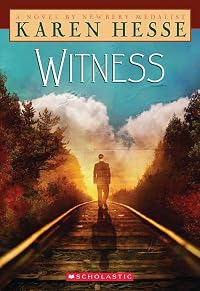
fountainoverflows A novel in which a youth bears witness to the doings of the K.K.K. Short but potent.
Member Reviews
On a May evening in 1866, in Pulaski, Tenn., six men lounged about a law office. “Boys, let us get up a club or society,” John Lester said. And they did. Two of the men suggested that they call themselves “Kuklos,” the Greek word for “circle” or “band,” but that wasn’t mysterious enough, so they made up a variation: Ku Klux Klan, which literally means “circle circle.” They delighted in dressing up in flowing white robes, riding about town pretending to be ghosts of Confederate dead and playing pranks, but they also understood the power of anonymity to stir up fear and thwart the new Freedmen’s Bureau programs to help former slaves. Balancing the stories of the Klan and the former slaves’ determination to remake show more their lives, Bartoletti makes extensive use of congressional testimony, interviews, journals, diaries and slave narratives to allow the players to speak in their own voices as much as possible. Documentation is superb, and even the source notes are fascinating. An exemplar of history writing and a must for libraries and classrooms. (a note to the reader, time line, quote attributions, bibliography) (Nonfiction. 12 & up)
-Kirkus Review show less
-Kirkus Review show less
"Boys, let us get up a club."
With those words, six restless young men raided the linens at a friend’s mansion in 1866. They pulled white sheets over their heads, hopped on horses, and cavorted through the streets of Pulaski, Tennessee. Soon, the six friends named their club the Ku Klux Klan and began patterning their initiations after fraternity rites, with passwords and mysterious handshakes. All too quickly, this club would grow into the self-proclaimed “Invisible Empire,” with secret dens spread across the South. On their brutal raids, the nightriders would claim to be ghosts of Confederate soldiers and would use psychological and physical terror against former slaves who dared to vote, own land, attend school, or worship as show more they pleased.
This is the story of how a secret terrorist group took root in America’s democracy. Filled with chilling and vivid personal accounts unearthed from oral histories, congressional documents, and other primary sources, this is a book to read and remember. show less
With those words, six restless young men raided the linens at a friend’s mansion in 1866. They pulled white sheets over their heads, hopped on horses, and cavorted through the streets of Pulaski, Tennessee. Soon, the six friends named their club the Ku Klux Klan and began patterning their initiations after fraternity rites, with passwords and mysterious handshakes. All too quickly, this club would grow into the self-proclaimed “Invisible Empire,” with secret dens spread across the South. On their brutal raids, the nightriders would claim to be ghosts of Confederate soldiers and would use psychological and physical terror against former slaves who dared to vote, own land, attend school, or worship as show more they pleased.
This is the story of how a secret terrorist group took root in America’s democracy. Filled with chilling and vivid personal accounts unearthed from oral histories, congressional documents, and other primary sources, this is a book to read and remember. show less
An excellent resource for both young adults and adults, They called Themselves the K.K.K. presents a distillation of considerable scholarly material and witness testimony. In Bartoletti's work we are given a concise and understandable treatment of the topic. The many brief narratives that are included add genuine human interest to the work (and bear homage to the many Klan victims, including "uppity" sharecroppers who had the drive to see the modest fruits of their own labor on the land and teachers who traveled from the North to aid in the education of freedman hungering for literacy and independence. Even those who housed such teachers were in danger). The author's note at the end of the text in which she discusses her research show more process, including her visit to Pulaski, Tennessee, and her attendance at a contemporary Klan gathering are well worth reading. Until I read this book, I simply had no idea about the huge early membership in this "home-grown" terrorist group and its resurgence in the 1920s. Bartoletti helps the reader understand how the KKK, like present day terrorist organizations, sprouted in the fertile ground of the resentment, poverty, humiliated pride, and post-war devastation of the reconstructionist South. This would be an excellent title for students to use. Recommended for grades 7 and up. show less
What I appreciated most about this book was that it was not simply a history of the KKK but a history of the reconstruction era and its failures. I learned more about the origins of the terrorist organization, its popularity, its definition of itself, its justifications for atrocities, but, more importantly, I learned about the national consciousness that produced such an organization in the first place.
This was not easy reading. Fascinating, but it's a difficult history to bear. The author writes with such an objective style that the contents of the book sometimes take one by surprise. Just as fascinating as the text is are the cartoons of the era included to illustrate public perception. Additionally, the end of each chapter features show more a photograph and a quote from African Americans who lived through slavery and reconstruction. These resources are invaluable in illuminating the truth and proximity of this shameful history.
I am teaching fiction next year, but I would recommend this as a classroom text for English or history. One of the most important things about this book is the perspective it gives its reader. We love to talk about the Emancipation Proclamation as a glowing moment in American history; however, Bartoletti ends her narrative with a quote from Mittie Williams Freeman, an African American woman who remembered the day of emancipation saying, "It seem like it tuck a long time for freedom to come." That is the central theme of this book. Every step toward civil rights has faced virulent opposition. Opposition which resorts, even, to violence and murder. Looking at the civil rights timeline at the end of the book, the reader understands how directly connected this brutally unjust era is to our current struggle against violence and injustice toward the African American community in the United States. show less
This was not easy reading. Fascinating, but it's a difficult history to bear. The author writes with such an objective style that the contents of the book sometimes take one by surprise. Just as fascinating as the text is are the cartoons of the era included to illustrate public perception. Additionally, the end of each chapter features show more a photograph and a quote from African Americans who lived through slavery and reconstruction. These resources are invaluable in illuminating the truth and proximity of this shameful history.
I am teaching fiction next year, but I would recommend this as a classroom text for English or history. One of the most important things about this book is the perspective it gives its reader. We love to talk about the Emancipation Proclamation as a glowing moment in American history; however, Bartoletti ends her narrative with a quote from Mittie Williams Freeman, an African American woman who remembered the day of emancipation saying, "It seem like it tuck a long time for freedom to come." That is the central theme of this book. Every step toward civil rights has faced virulent opposition. Opposition which resorts, even, to violence and murder. Looking at the civil rights timeline at the end of the book, the reader understands how directly connected this brutally unjust era is to our current struggle against violence and injustice toward the African American community in the United States. show less
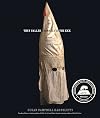
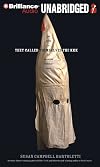
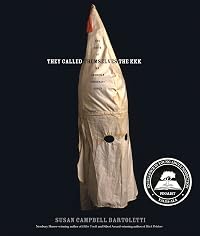
A shocking and widely recognized hook embellishes the cover of this book: that of a white hood worn by a clansman. (It is noteworthy that the only splash of color in the otherwise entirely black-and-white book is the small red tassel on the front cover. It resembles dripping blood.) The reader is immediately pulled in by this costume to find numerous additional and sometimes equally shocking photographs and illustrations relating to the Ku Klux Klan, or the “circle circle” (p. 25). While photography was well-established in the mid-19th century, newspapers and magazines only published engravings. Because these engravings were directly based off of photographs, the result is a book filled with visual primary sources that support and show more are supported by a myriad of written/oral primary sources. All of this creates and excellent non-fiction work, while the supporting time line, quote attributions, bibliography, source notes, and index make this work accessible to adults and students alike. It is an excellent teaching tool whose use I highly encourage in any classroom, though it must be delicately approached.
Through primary sources, both sides of the dramatically polarized population of America during the Civil War and the subsequent decade of reconstruction are well-represented. Photographs of former slaves are accompanied by poignant recollections, recorded in their dialect. The opinions of those who abused and oppressed slaves and freedmen are not edited for the modern reader, but contain all of the slurs and vulgarity which was spewed forth. Sometimes, such brutal aspects of history are ignored in discussions of the time period, or otherwise cleaned up for modern consumption. I disagree with purifying history, regardless of how uncomfortable it may be to acknowledge and discuss some facts.
This book took me on a rollercoaster of emotions, from shock and anger, to sadness, and to hope. I teared up upon viewing the final photograph of the book, one of President Barack Obama. This raw presentation is a must-read so that we can all recognize the situations that lead to such horror, strive to prevent their full recurrence, and courageously fight those who actively seek to revive such norms. show less
Through primary sources, both sides of the dramatically polarized population of America during the Civil War and the subsequent decade of reconstruction are well-represented. Photographs of former slaves are accompanied by poignant recollections, recorded in their dialect. The opinions of those who abused and oppressed slaves and freedmen are not edited for the modern reader, but contain all of the slurs and vulgarity which was spewed forth. Sometimes, such brutal aspects of history are ignored in discussions of the time period, or otherwise cleaned up for modern consumption. I disagree with purifying history, regardless of how uncomfortable it may be to acknowledge and discuss some facts.
This book took me on a rollercoaster of emotions, from shock and anger, to sadness, and to hope. I teared up upon viewing the final photograph of the book, one of President Barack Obama. This raw presentation is a must-read so that we can all recognize the situations that lead to such horror, strive to prevent their full recurrence, and courageously fight those who actively seek to revive such norms. show less
“They Called Themselves the K.K.K.” by Susan Campbell Bartoletti is the story of the origins and rise of one of the most notorious and influential hate groups in American history. This is story is compiled utilizing interviews, testimonies, and historical documents. The complex social dynamic of the Reconstruction Era inspired the birth and rise of the Klan. Bartoletti traces their origins all the way back to six Confederate soldiers in a small Tennessee town. They established a name, a redundant one consisting of two words meaning “band or circle.” They established equally ridiculous uniforms and rituals. Their message resonated with many whites across the South afraid of the direction of their country and the impact of the show more freed people, and the Klan’s propaganda was successful. She traces the impact of the K.K.K up to as recent as 2008.
As usual, Bartoletti’s book is well-written and engaging. It is filled with illustrations, documents, and photographs, many of which are quite chilling. Towards the end of the book, there is also Civil Rights timeline, which is informative and providers a nice balance. I would consider this book most appropriate for high school students. The language in this book is probably accessible for middle school age. However, there is some graphic content. Also, the author pulls no punches. She acknowledges that she did not censor the language, and as a result, the language in the book reflects the language of the time and of the people it is about. It is nothing I have not read or heard elsewhere, but it still turns my stomach.
It is painful to read about this particularly awful group of inferior, subhuman scum (and I say this knowing that I have ancestors who were sympathetic to their cause). That is not to ignore the fact that equally despicable groups have existed elsewhere in the world, some of them much more successful in implementing their insidious agenda, but the story of this group hits close to home. That is why this is an important topic. We also cannot ignore that this group still exists. They have a website. They run politicians for office. They have moderated their image.
I would certainly be willing to teach this book in a classroom, and it is a fairly quick. The information about the Reconstruction Period would be particularly useful in studying that time period. However, I would tread lightly. The language is offensive at times, and the content is emotional. Stories of the Civil Rights Movement shows us that individuals and small groups of people can organize in a democracy and influence change for the better. However, the story of the K.K.K. demonstrates that organization is a tool of regressive hate as well, and our nation is not immune to their influence. show less
As usual, Bartoletti’s book is well-written and engaging. It is filled with illustrations, documents, and photographs, many of which are quite chilling. Towards the end of the book, there is also Civil Rights timeline, which is informative and providers a nice balance. I would consider this book most appropriate for high school students. The language in this book is probably accessible for middle school age. However, there is some graphic content. Also, the author pulls no punches. She acknowledges that she did not censor the language, and as a result, the language in the book reflects the language of the time and of the people it is about. It is nothing I have not read or heard elsewhere, but it still turns my stomach.
It is painful to read about this particularly awful group of inferior, subhuman scum (and I say this knowing that I have ancestors who were sympathetic to their cause). That is not to ignore the fact that equally despicable groups have existed elsewhere in the world, some of them much more successful in implementing their insidious agenda, but the story of this group hits close to home. That is why this is an important topic. We also cannot ignore that this group still exists. They have a website. They run politicians for office. They have moderated their image.
I would certainly be willing to teach this book in a classroom, and it is a fairly quick. The information about the Reconstruction Period would be particularly useful in studying that time period. However, I would tread lightly. The language is offensive at times, and the content is emotional. Stories of the Civil Rights Movement shows us that individuals and small groups of people can organize in a democracy and influence change for the better. However, the story of the K.K.K. demonstrates that organization is a tool of regressive hate as well, and our nation is not immune to their influence. show less
"The strongest chains with which the body of a man can be bound are the chains of ignorance. You keep a man ignorant and you've got him. You don't have to stand guard over him with a shotgun. You don't have to lock him up at night. Just turn him aloose and he isn't going anyplace." - William Pickens
If this book accomplishes anything, that thing is taking away any American's excuse of ignorance. While I was familiar with the Ku Klux Klan and the idea of it as a racial hate group, I had no idea to what extent this group left American history bleeding and broken. One of this book's greatest strengths is that it is not sensationalized; instead it presents a chapter of history that I am amazed isn't presented more often. They Called show more Themselves the K.K.K. takes the reader through a history of this hate group, from its birth shortly after the Civil War to its activism today.
The book is easily accessible and a reliable source of information. In telling the story, Susan Campbell Bartoletti relies heavily on firsthand accounts and other primary sources. She includes direct quotes from witnesses, publications from the time period, and photographs from more recent events. The text is also supported with several appendices: a timeline, quote attributions, source notes and bibliography, acknowledgements, and an index. Pictures are scattered throughout the text and each one is complete with a caption, some longer than others, providing purpose and context.
Though this book is a heavy read - for its subject matter, not its writing style - and though it includes potentially offensive material (the n--- word, references to brutality and rape, differing views on historical events), I would not hesitate to include it in my classroom library. This book is an eyeopening read and I cannot think of a potential student who would not benefit from it. Specifically, I can think of students I have now who are very interested in social justice who would appreciate a book like this. If I had the chance to teach American literature again, I could also see myself including it as a supplementary resource on specialized topics. show less
If this book accomplishes anything, that thing is taking away any American's excuse of ignorance. While I was familiar with the Ku Klux Klan and the idea of it as a racial hate group, I had no idea to what extent this group left American history bleeding and broken. One of this book's greatest strengths is that it is not sensationalized; instead it presents a chapter of history that I am amazed isn't presented more often. They Called show more Themselves the K.K.K. takes the reader through a history of this hate group, from its birth shortly after the Civil War to its activism today.
The book is easily accessible and a reliable source of information. In telling the story, Susan Campbell Bartoletti relies heavily on firsthand accounts and other primary sources. She includes direct quotes from witnesses, publications from the time period, and photographs from more recent events. The text is also supported with several appendices: a timeline, quote attributions, source notes and bibliography, acknowledgements, and an index. Pictures are scattered throughout the text and each one is complete with a caption, some longer than others, providing purpose and context.
Though this book is a heavy read - for its subject matter, not its writing style - and though it includes potentially offensive material (the n--- word, references to brutality and rape, differing views on historical events), I would not hesitate to include it in my classroom library. This book is an eyeopening read and I cannot think of a potential student who would not benefit from it. Specifically, I can think of students I have now who are very interested in social justice who would appreciate a book like this. If I had the chance to teach American literature again, I could also see myself including it as a supplementary resource on specialized topics. show less
Members
- Recently Added By
Published Reviews
ThingScore 100
It's tough reading, but Bartoletti presents this sobering slice of history with essential background information, memorable testimony from KKK members and victims alike, and plenty of edifying period engravings.
added by Shortride
Lists

Kansas Book Ban List
29 works; 1 member

School library books removed after TX state legislator inquiry
429 works; 6 members
Author Information

25+ Works 8,029 Members
A former 8th-grade English teacher, Susan Campbell Bartoletti writes fiction and nonfiction for all ages. Black Potatoes is the winner of the ALA Sibert Award for Best Information book, the NCTE Orbis Pictus Award for Distinguished Nonfiction, and the SCBWI Golden Kite Nonfiction award. She lives with her family in Moscow, PA.
Awards and Honors
Awards
Distinctions
Common Knowledge
- Canonical title
- They Called Themselves the K.K.K.: The Birth of an American Terrorist Group
- Original title
- They Called Themselves the K.K.K.: The Birth of an American Terrorist Group
- Alternate titles
- They Called Themselves the K.K.K.
- Original publication date
- 2010
- Important places
- Pulaski, Tennessee, USA; Tennessee, USA
- Canonical DDC/MDS
- 322.420973
- Canonical LCC
- HS2330.K63
Classifications
- Genres
- Nonfiction, Teen
- DDC/MDS
- 322.420973 — Society, government, & culture Political science Relation of the state to organized groups and their members Political action groups Revolutionary and subversive groups Biography And History North America Revolutionary and subversive groups in the United States
- LCC
- HS2330 .K63 — Social sciences Societies: secret, benevolent, etc. Societies: secret, benevolent, etc. Other societies. By classes Political and "patriotic" societies
- BISAC
Statistics
- Members
- 492
- Popularity
- 61,598
- Reviews
- 63
- Rating
- (4.06)
- Languages
- English
- Media
- Paper, Audiobook, Ebook
- ISBNs
- 17
- UPCs
- 1
- ASINs
- 5