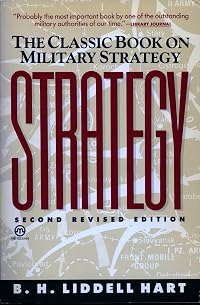
Strategy
by B. H. Liddell Hart
On This Page
Description
This is the classic book on war as we know it. During his long life, Basil H. Liddell Hart was considered one of the world's foremost military thinkers-a man generally regarded as the "Clausewitz of the 20th century." Liddell Hart stressed movement, flexibility, surprise. He saw that in most military campaigns dislocation of the enemy's psychological and physical balance is prelude to victory. This dislocation results from a strategic indirect approach. Reflect for a moment on the results of show more direct confrontation (trench war in World War I) versus indirect dislocation (Blitzkreig in World II). Liddell Hart is also tonic for business and political planning: just change the vocabulary and his concepts fit. show lessTags
Recommendations








Member Reviews
This is a great book on military history and strategy. First of all, it’s easily the most readable book on topic that I have yet encountered. It’s short, clear and concise. The book is divided into 2 sections by Liddell Hart. The first is a survey of the military history of the western world with brief commentary on the efficacy of the strategy used. I would actually further divide the history section into everything before WWI and then WWI and WWII. Necessarily, given the vastness of the topic, Liddell Hart selected battles and campaigns that fit his theories particularly well. However, WWI and WWII are given a much fuller treatment and we get a glimpse of situations where strategic and theater commanders make decisions utilizing show more his theories (both consciously and unconsciously). The second section is where Liddell Hart expands on and expounds on his theories of strategy. This is probably his best work. Unlike many theoretical writers (Clausewitz and Jomini leap to mind), his writing is clear and concise and to the point. Prophetically, the section ends with a chapter on Guerilla warfare (remember Liddell Hart died before Vietnam) that should be read carefully in light of recent military history. Speaking of Clausewitz, incautious readers might interpret some of Liddell Hart’s comments as criticism of Clausewitz and they are not. There are several problems with reading On War and trying to apply the principals set there. First of all, that book was assembled posthumously and scholars of Clausewitz believe that he was about to give the entire manuscript a revision prior to getting it published when he died. Secondly, the dense and Jungian style of Clausewitz’s writing is hard to understand and easy to misinterpret. A careful reading of the text will allow you to see how so many of Clausewitz’s theories and comments are taken horribly out of context. I wouldn’t recommend the book as a text on military history, but I can’t think of any book on the theory of warfare that is as engaging and readable. It’s certainly one I would highly recommend for the study of strategy. Maps are an area near and dear to my heart and every military book gets examined in this context. Strategy does maps better than most; there are several good maps in the book. But, there should be more of them. Also, this reprint edition did a particularly poor job of printing them clearly. Overall map score: B-. show less
He has a tendency to hammer on his theory about the importance of indirection, so it can be oddly tedious to read. But his description of individual battles is always cogent and clear, and the end part about Clausewitz is fascinating.
Classic text on strategy written by one of the creators of modern armored warfare. The clear discussion of Liddell Hart's signature concept of the "indirect approach". Also presents a good critique of the theories of Clausewitz although there are good arguments in other books that Liddell Hart misunderstood Clausewitz himself and was really being critical of how Clausewitz was interpreted by others.
I read this book probably in college. I was impressed by the idea of the "indirect approach" to strategy, the idea of taking a position that the enemy had to attack, and defending it with superior force. I have often thought of this as a strategy not in war but in life, tending to be comfortable with defense as a habit.
This is generally considered an almost classic, ranked almost as highly as Sun Tzu or Carl Philipp Gottfried von Clausewitz. Liddell though takes Clausewitz and shows that most of the aphorisms associated with him are misunderstandings of his central ideas. Liddell also is an advocate of indirect warfare in order to surprise or disorient your enemy. The book is wide in scope and provides examples from the ancient world through more recent guerrilla actions.
Never finished; the bad history in the first volume of the two-book set I own (cherry-picking and manipulating facts to fit his conclusion) turned me off. Stick with Sun Tzu; there's nothing new here.
Hart talks about the standard concept of using indirect strategy to succeed, and draws from some very interesting examples through history. An outstanding book for military history in general.
Members
- Recently Added By
Author Information

107+ Works 5,016 Members
Captain B. H. Liddell Hart is the foremost authority on World War I. In The Real War, the author has fused exhaustive research and creative brilliance with brevity and precision. Thus we have in one volume the war transformed into literature -- an understandable, kaleidoscopic masterwork of military history.

B. H. Liddell Hart has a Legacy Library. Legacy libraries are the personal libraries of famous readers, entered by LibraryThing members from the Legacy Libraries group.
Common Knowledge
- Canonical title
- Strategy
- Original publication date
- 1954
- Dedication
- To Ivor Maxse Trainer of Troops for War
- First words
- Fools say that they learn by experience.
- Last words
- (Click to show. Warning: May contain spoilers.)In any case, those who frame policy and apply it need a better understanding of the subject than has been shown in the past.
Classifications
Statistics
- Members
- 1,213
- Popularity
- 20,502
- Reviews
- 12
- Rating
- (4.01)
- Languages
- 7 — English, French, Hungarian, Russian, Spanish, Turkish, Chinese, traditional
- Media
- Paper, Audiobook, Ebook
- ISBNs
- 31
- ASINs
- 28