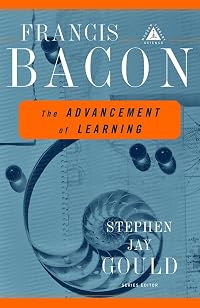
The Advancement of Learning (Modern Library Science)
by Francis Bacon
On This Page
Description
Philosopher, statesman, scientist, jurist, lawyer, and prolific author -- Francis Bacon was a true polymath and Renaissance man, and is regarded as one of the progenitors of the school of thought known as Empiricism, as well as the scientific method. In this volume, Bacon discusses a remarkably wide-ranging array of philosophical and scientific subjects, putting the mind-boggling breadth of his knowledge on full display.Tags
Recommendations


















Member Reviews
Bacon is much underrated as a philosopher. His vision for the reform of philosophy and science - well, of learning in general - is quite breathtaking in its scope and audacity. He's also a great writer.
The one thing that spoils it is the quality of this edition. There are no notes, no translation of the extremely frequent Latin quotations with which Bacon illustrates his points, all of which makes for a very frustrating experience.
Also, this is the original English text. Bacon later translated and augmented The AoL, so it might be an easier and more enjoyable read in an English translation of the later Latin edition.
Gareth Southwell is a philosopher, writer and illustrator.
The one thing that spoils it is the quality of this edition. There are no notes, no translation of the extremely frequent Latin quotations with which Bacon illustrates his points, all of which makes for a very frustrating experience.
Also, this is the original English text. Bacon later translated and augmented The AoL, so it might be an easier and more enjoyable read in an English translation of the later Latin edition.
Gareth Southwell is a philosopher, writer and illustrator.
This is a treatise on philosophy that epitomizes the nature of Renaissance thought. In it the author extols the pursuit of learning and critically surveys the existing state of knowledge. He continued to write on these subjects throughout his life, expanding his exposition.
Bacon's argument for developing knowledge.
Ratings
Members
- Recently Added By
Lists

Filosofía - Clásicos
217 works; 1 member

Trinity College Booklist (1951): Class Three, Philosophy and Religion
80 works; 3 members

How to Read a Book's Recommended Reading List
309 works; 10 members

Greatest Books, allegedly
484 works; 9 members

Philip Ward's Lifetime Reading Plan
592 works; 22 members
Author Information

368+ Works 8,279 Members
Francis Bacon was born on January 22, 1561 in London. After studying at Cambridge, Bacon began a legal career, ultimately becoming a barrister in 1582. Bacon continued his political ascent, and became a Member of Parliament in 1584. In 1600, he served as Queen Elizabeth's Learned Counsel in the trial of Robert Devereaux, the Earl of Essex. After show more numerous appointments under James I, Bacon admitted to bribery and fell from power. Much of Bacon's fame stems from the belief by some that he was the actual author of the plays of William Shakespeare. While many critics dismissed that belief, Bacon did write several important works, including a digest of laws, a history of Great Britain, and biographies of the Tudor monarchy, including Henry VII. Bacon was also interested in science and the natural world. His scientific theories are recorded in Novum Organum, published in 1620. Bacon's interest in science ultimately led to his death. After stuffing a fowl with snow to study the effect of cold on the decay of meat, he fell ill, and died of bronchitis on April 9, 1626. (Bowker Author Biography) show less
Some Editions
Awards and Honors
Notable Lists
Series
Belongs to Publisher Series
Work Relationships
Has as a student's study guide
Common Knowledge
- Canonical title
- The Advancement of Learning (Modern Library Science) (Modern Library Science)
- Original publication date
- 1605
- People/Characters
- Francis Bacon; Stephen Jay Gould
- Dedication
- To the King [sc. James I]
- First words
- There were under the law, excellent King, both daily sacrifices and freewill offerings; the one proceeding upon ordinary observance, the other upon a devout cheerfulness: in like manner there belongeth to kings from their ser... (show all)vants both tribute of duty and presents of affection.
- Last words
- (Click to show. Warning: May contain spoilers.)The good, it any be, is due tanquam adeps sacrificii, to be incensed to the honour, first of the Divine Majesty, and next of your Majesty, to whom on earth I am most bounden.
Classifications
- Genres
- Philosophy, Nonfiction, Science & Nature, History, General Nonfiction
- DDC/MDS
- 121 — Philosophy & psychology Epistemology (how do you know what you know?) Epistemology (Theory of knowledge)
- LCC
- B1190 — Philosophy, Psychology and Religion Philosophy (General) By period Modern By region or country
- BISAC
Statistics
- Members
- 441
- Popularity
- 69,770
- Reviews
- 3
- Rating
- (3.48)
- Languages
- 5 — English, French, Latin, Portuguese, Spanish
- Media
- Paper, Ebook
- ISBNs
- 48
- ASINs
- 18