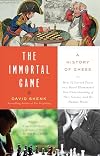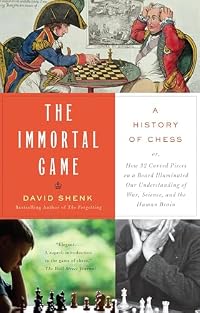
The Immortal Game: A History of Chess, or How 32 Carved Pieces on a Board Illuminated Our Understanding of War, Art, Science and the Human Brain
by David Shenk
On This Page
Description
Why has one game, alone among the thousands of games invented and played throughout human history, not only survived but thrived within every culture it has touched? What is it about its thirty-two figurative pieces, moving about its sixty-four black and white squares according to very simple rules, that has captivated people for nearly 1,500 years? Why has it driven some of its greatest players into paranoia and madness, and yet is hailed as a remarkably powerful intellectual tool? Nearly show more everyone has played chess at some point in their lives. Its rules and pieces have served as a metaphor for society, influencing military strategy, mathematics, artificial intelligence, and literature and the arts. It has been condemned as the devil’s game by popes, rabbis, and imams, and lauded as a guide to proper living by other popes, rabbis, and imams. Marcel Duchamp was so absorbed in the game that he ignored his wife on their honeymoon. Caliph Muhammad al-Amin lost his throne (and his head) trying to checkmate a courtier. Ben Franklin used the game as a cover for secret diplomacy. In his wide-ranging and ever-fascinating examination of chess, David Shenk gleefully unearths the hidden history of a game that seems so simple yet contains infinity. From its invention somewhere in India around 500 A.D., to its enthusiastic adoption by the Persians and its spread by Islamic warriors, to its remarkable use as a moral guide in the Middle Ages and its political utility in the Enlightenment, to its crucial importance in the birth of cognitive science and its key role in the aesthetic of modernism in twentieth-century art, to its twenty-first-century importance in the development of artificial intelligence and use as a teaching tool in inner-city America, chess has been a remarkably omnipresent factor in the development of civilization. show lessTags
Recommendations


















Member Reviews
At this point in my life, I'm comfortable with the idea that I'll be a patzer forever. I like chess a lot, but the idea of sitting down with a book of openings and studying it seriously, like it was for a test, somehow makes the game seem too much like work, even though it's impossible to become even a mediocre player without giving chess some real thought. This attitude probably says something about how I view games as a whole, and in fact maybe even about my view on life in general, and Shenk, who's descended from marginally famous 19th century master Samuel Rosenthal, would agree whole-heartedly that your attitude towards chess says a lot about you. Chess metaphors are nearly ubiquitous in many fields of life, and no other game has show more captured the enthusiasm as well as the imagination of people.
In fact, that's a constant theme of the book, which traces the history of chess as well as its role as a sort of mirror for many literary, artistic, or cultural movements. The title is a reference to one of the most famous chess games in history, which film buffs will recognize from its appearance in Blade Runner. Shenk describes the players' moves and strategies in short chunks of a few moves at a time, interweaving episodes from the development of the game with broader changes in society. Some of Shenk's connections are interesting, others seem like stretches; it's one thing to conjecture that a possible source of the transformation of the limited Minister piece into the modern Queen piece was the rise of powerful female monarchs like Isabella, and another to assert a connection between prodigy François-André Danican Philidor's novel use of pawn structure to John Locke's theories of natural rights. Yet chess has been a favorite pastime of so many influential people that he can write that the development of the Hypermodern style was "closely connected to the early twentieth-century intellectual ferment that spawned the fiction of Joyce, Proust, and Kafka, the theater of Brecht and Pirandello, the fabulist tales of Jorge Luis Borges, the slapstick of Charlie Chaplin and the Marx Brothers, the experimental music of John Cage, and the conceptual art of Marcel Duchamp" and not be exaggerating.
Interspersed with funny examples of chess in history, like Benjamin Franklin's chess diplomacy in London trying to prevent the Revolutionary War, are a few mini-biographies of some expected greats (I personally will never cease being fascinated with Bobby Fischer's saddening descent into ludicrous anti-Semitism), and also some really interesting stories I had never heard before. When discussing the nature-nurture question of whether chess genius can be taught or is merely an inborn endowment, Shenk relates the story of Laszlo Polgar:
"Perhaps the best-known example of mentored genius comes from Budapest, Hungary. There, in the late 1960s, psychologist Laszlo Polgar embarked on an unusual experiment in order to prove that any healthy baby can be nurtured into a genius: he publicly declared that he would do this with his own children, who were not yet born. He and his wife forged a plan to school their children at home and focus them intensely on a few favorite disciplines - among them chess. From a very early age, the three Polgar daughters, Zsuzsa, Zsófia, and Judit, studied chess for an average of eight to ten hours every day - perhaps a total of some 20,000 hours from age eight to eighteen.
Lo and behold, they all became chess "geniuses." In 1991, at age twenty-one, Zsuzsa (who later Westernized her name to Susan) became the first woman in history to earn a grandmaster title through qualifying tournaments. The second child, Zsófia, also became a world-class player. Judit, the youngest, became at age fifteen the youngest grandmaster in history (a record previously held by Bobby Fischer), and was considered a strong candidate to eventually become world chess champion."
That's fascinating. The later parts of the book concentrate on the relationship between chess programs and AI. From Alan Turing onwards, many of the most prominent AI researchers have used the problem of chess to focus on different aspects of artificial intelligence, and many now-fundamental techniques such as alpha-beta pruning were given test runs in chess programs. Shenk discusses the question of what exactly Deep Blue's victory over Kasparov means in terms of "true" AI - given the rise in Freestyle competition, which he doesn't mention, I personally don't see that the rise of computers means people are obsolete at all - but it's an interesting question to ponder. Games like checkers have been definitely solved to where AIs can't lose, but no one would argue that AI success in one domain means that it's "smarter" than people. That will take a lot more sophistication on a computer's part, and I don't expect there to be a bright line. Chess, as Shenk movingly and convincingly shows in this book, may be an excellent metaphor for all kinds of things, but it is also our tool, as are the computers that play it, even if our attitude towards it reveals more about us than we might like. Here's the second half of Borges' poem The Game of Chess:
"Slight king, oblique bishop, and a queen
Blood-lusting; upright tower, crafty pawn--
Over the black and the white of their path
They foray and deliver armed battle.
They do not know it is the artful hand
Of the player that rules their fate,
They do not know that an adamant rigor
Subdues their free will and their span.
But the player likewise is a prisoner
(The maxim is Omar's) on another board
Of dead-black nights and of white days.
God moves the player and he, the piece.
What god behind God originates the scheme
Of dust and time and dream and agony?" show less
In fact, that's a constant theme of the book, which traces the history of chess as well as its role as a sort of mirror for many literary, artistic, or cultural movements. The title is a reference to one of the most famous chess games in history, which film buffs will recognize from its appearance in Blade Runner. Shenk describes the players' moves and strategies in short chunks of a few moves at a time, interweaving episodes from the development of the game with broader changes in society. Some of Shenk's connections are interesting, others seem like stretches; it's one thing to conjecture that a possible source of the transformation of the limited Minister piece into the modern Queen piece was the rise of powerful female monarchs like Isabella, and another to assert a connection between prodigy François-André Danican Philidor's novel use of pawn structure to John Locke's theories of natural rights. Yet chess has been a favorite pastime of so many influential people that he can write that the development of the Hypermodern style was "closely connected to the early twentieth-century intellectual ferment that spawned the fiction of Joyce, Proust, and Kafka, the theater of Brecht and Pirandello, the fabulist tales of Jorge Luis Borges, the slapstick of Charlie Chaplin and the Marx Brothers, the experimental music of John Cage, and the conceptual art of Marcel Duchamp" and not be exaggerating.
Interspersed with funny examples of chess in history, like Benjamin Franklin's chess diplomacy in London trying to prevent the Revolutionary War, are a few mini-biographies of some expected greats (I personally will never cease being fascinated with Bobby Fischer's saddening descent into ludicrous anti-Semitism), and also some really interesting stories I had never heard before. When discussing the nature-nurture question of whether chess genius can be taught or is merely an inborn endowment, Shenk relates the story of Laszlo Polgar:
"Perhaps the best-known example of mentored genius comes from Budapest, Hungary. There, in the late 1960s, psychologist Laszlo Polgar embarked on an unusual experiment in order to prove that any healthy baby can be nurtured into a genius: he publicly declared that he would do this with his own children, who were not yet born. He and his wife forged a plan to school their children at home and focus them intensely on a few favorite disciplines - among them chess. From a very early age, the three Polgar daughters, Zsuzsa, Zsófia, and Judit, studied chess for an average of eight to ten hours every day - perhaps a total of some 20,000 hours from age eight to eighteen.
Lo and behold, they all became chess "geniuses." In 1991, at age twenty-one, Zsuzsa (who later Westernized her name to Susan) became the first woman in history to earn a grandmaster title through qualifying tournaments. The second child, Zsófia, also became a world-class player. Judit, the youngest, became at age fifteen the youngest grandmaster in history (a record previously held by Bobby Fischer), and was considered a strong candidate to eventually become world chess champion."
That's fascinating. The later parts of the book concentrate on the relationship between chess programs and AI. From Alan Turing onwards, many of the most prominent AI researchers have used the problem of chess to focus on different aspects of artificial intelligence, and many now-fundamental techniques such as alpha-beta pruning were given test runs in chess programs. Shenk discusses the question of what exactly Deep Blue's victory over Kasparov means in terms of "true" AI - given the rise in Freestyle competition, which he doesn't mention, I personally don't see that the rise of computers means people are obsolete at all - but it's an interesting question to ponder. Games like checkers have been definitely solved to where AIs can't lose, but no one would argue that AI success in one domain means that it's "smarter" than people. That will take a lot more sophistication on a computer's part, and I don't expect there to be a bright line. Chess, as Shenk movingly and convincingly shows in this book, may be an excellent metaphor for all kinds of things, but it is also our tool, as are the computers that play it, even if our attitude towards it reveals more about us than we might like. Here's the second half of Borges' poem The Game of Chess:
"Slight king, oblique bishop, and a queen
Blood-lusting; upright tower, crafty pawn--
Over the black and the white of their path
They foray and deliver armed battle.
They do not know it is the artful hand
Of the player that rules their fate,
They do not know that an adamant rigor
Subdues their free will and their span.
But the player likewise is a prisoner
(The maxim is Omar's) on another board
Of dead-black nights and of white days.
God moves the player and he, the piece.
What god behind God originates the scheme
Of dust and time and dream and agony?" show less
It's not often that I take a chance on a book, despite tepid (at best) reviews, but this one was exactly the book I wanted. Perhaps it's because I'm an chess neophyte who tires easily with dry history and leans more towards the artistic bent of life than the merely formulaic, but overall this book is as satisfying a perspective of the game of the chess as I could hope for.
First off, dispense with the sub-titular segment "A History of Chess." Yes, it is a history of chess; it makes no qualms about being the history of chess--in fact, it makes clear the contested origins and development of the game--but it should not be approached as a history of chess in the rigorous academic sense. It should rather be approached as a journalist's show more fascination with the game, fueled by his famous chess master ancestor. I believe this fact is what divides the satisfaction from a chess aficionado and someone who is interested in a guided tour of a heavily anecdotal celebration of the game and some of its more notable players and enthusiasts. In the book, the author makes the point that he never really had the urge to become a great chess player, but he did have the drive to become a great chess writer.
The structure of the book is the selling point for me. Between the 12 chapters of quintessential journalistic volubility, we get a step-by-step breakdown and commentary of the so-called "immortal game," which took place in London in 1851. Having never heard of this game before (remember, I'm a novice at best), these interpolated developments kept the main text of the book fresh and the unfolding game intriguing. Delaying the game like this also set up the final move for maximal effect. I leaned back in my chair with a grin, saying, "Ahhhh!"
I also must say that I'm pleased the text didn't just turn into a fanboy homage to Bobby Fischer. Of course, Fischer has his time on the stage--how could he not?--but Marcel Duchamp shows up perhaps more than anyone else. It seems David Shenk made the right move (thank you, thank you) in leaving it to Frank Brady to offer the wanting public some Fischer fodder.
If you're an amateur chess player, looking to know a little more about the game you're learning, this is it. If you don't know anything about chess and are looking for a starting point, this is definitely the book (it even includes the rules of the game in the appendix). If you simply like anecdotal histories that cull quotes and interesting tableaux from famous figures, this is it. Entertaining, engaging, inspiring. having read the coda and written this review, I'm ready to play some chess! show less
First off, dispense with the sub-titular segment "A History of Chess." Yes, it is a history of chess; it makes no qualms about being the history of chess--in fact, it makes clear the contested origins and development of the game--but it should not be approached as a history of chess in the rigorous academic sense. It should rather be approached as a journalist's show more fascination with the game, fueled by his famous chess master ancestor. I believe this fact is what divides the satisfaction from a chess aficionado and someone who is interested in a guided tour of a heavily anecdotal celebration of the game and some of its more notable players and enthusiasts. In the book, the author makes the point that he never really had the urge to become a great chess player, but he did have the drive to become a great chess writer.
The structure of the book is the selling point for me. Between the 12 chapters of quintessential journalistic volubility, we get a step-by-step breakdown and commentary of the so-called "immortal game," which took place in London in 1851. Having never heard of this game before (remember, I'm a novice at best), these interpolated developments kept the main text of the book fresh and the unfolding game intriguing. Delaying the game like this also set up the final move for maximal effect. I leaned back in my chair with a grin, saying, "Ahhhh!"
I also must say that I'm pleased the text didn't just turn into a fanboy homage to Bobby Fischer. Of course, Fischer has his time on the stage--how could he not?--but Marcel Duchamp shows up perhaps more than anyone else. It seems David Shenk made the right move (thank you, thank you) in leaving it to Frank Brady to offer the wanting public some Fischer fodder.
If you're an amateur chess player, looking to know a little more about the game you're learning, this is it. If you don't know anything about chess and are looking for a starting point, this is definitely the book (it even includes the rules of the game in the appendix). If you simply like anecdotal histories that cull quotes and interesting tableaux from famous figures, this is it. Entertaining, engaging, inspiring. having read the coda and written this review, I'm ready to play some chess! show less
The Immortal Game is an interesting and fascinating book. It is a beguiling mixture: bare-bones instructions on how chess pieces move (with some interesting history on how pieces and their powers developed), a history of the origins, the development and the spread in the popularity of chess, and an argument that sees chess as a reflection of broader social and historical developments. By 1565, Shenk argues:
"Chess's allegorical clout, its ability to symbolize a wide variety of social and political situations, was reaching a new summit. The game was now approaching the end of its first millennium. It had been an extension of sixth-century Indian warfare and mathematics, a seventh-century Persian cultural mainstay, a useful thought tool show more for the eighth-century Muslim warrior-philosophers, a favorite occupation of the ninth- and tenth-century Spanish Muslims, and a social mirror for the knights, kings, and clerics of medieval Europe in the eleventh through fourteenth centuries. Now, as society became more enlightened, the game's metamorphic use mushroomed, moving in several directions at once".
For Shenk, tracking the migration of chess is a way of tracking the larger transmission of knowledge through Europe up to 1200; for moralists of that time, chess stood for the new empowerment, the idea of making one's way in the world based on one's own efforts and ability, rather than dice, a game of chance that represented a consciousness resigned to a world dominated by fate. Shenk argues that the greatest paradox of chess over the many centuries is that it was, on the one hand, an icon of the status quo, a favorite of rulers and of traditional moralists seeking to reinforce social obligations and yet, at the same time, it was an agent of change: "Any tool that encourages new ways to think is inherently subversive because it challenges the intellectual status quo." In Shenk's view:
"Anyone in need of dynamic symbol to explore and convey elements of war, competition, hierarchy, political power, battle for resources, control by a higher power, meritocracy, the nature of thought, futility, abstract movement, complexity, or infinity had a choice vehicle standing by for metaphoric flight."
Shenk traces the influence, and use, of chess in the development of cognitive science, studies of memory, and the man-machine competition of artificial intelligence. And then, there are the absurdities of Freudian interpretations that saw chess as, "so well adapted to gratify at the same time the homosexual and the antagonistic aspects of the father-son contest." (I'm not making this up.)
Interspersed through the book is a very interesting analysis of what came to be known as the "Immortal Game" between Andolf Anderssen and Lionel Kieseritzky, June 21, 1851, in London. Both men were in London for a tournament, but this was a friendly, pick-up game, that came to be identified with the sheer brilliance of play by Anderssen to win despite the sacrifices of both rooks and his queen.
Part of the exquisite appeal of chess is that there are fixed and very clear rules for the movement of the pieces, but within these structures, the scope for innovation and movement and change are almost limitless. It is somewhat startling to learn that after three moves, the players have settled on one of approximately nine MILLION possible board positions. After four moves, the number is 315 BILLION. The total number of possible chess games is 10 to the 120th power. The total number of electrons in the universe is thought to be 10 to the 79th power. Amazing. show less
"Chess's allegorical clout, its ability to symbolize a wide variety of social and political situations, was reaching a new summit. The game was now approaching the end of its first millennium. It had been an extension of sixth-century Indian warfare and mathematics, a seventh-century Persian cultural mainstay, a useful thought tool show more for the eighth-century Muslim warrior-philosophers, a favorite occupation of the ninth- and tenth-century Spanish Muslims, and a social mirror for the knights, kings, and clerics of medieval Europe in the eleventh through fourteenth centuries. Now, as society became more enlightened, the game's metamorphic use mushroomed, moving in several directions at once".
For Shenk, tracking the migration of chess is a way of tracking the larger transmission of knowledge through Europe up to 1200; for moralists of that time, chess stood for the new empowerment, the idea of making one's way in the world based on one's own efforts and ability, rather than dice, a game of chance that represented a consciousness resigned to a world dominated by fate. Shenk argues that the greatest paradox of chess over the many centuries is that it was, on the one hand, an icon of the status quo, a favorite of rulers and of traditional moralists seeking to reinforce social obligations and yet, at the same time, it was an agent of change: "Any tool that encourages new ways to think is inherently subversive because it challenges the intellectual status quo." In Shenk's view:
"Anyone in need of dynamic symbol to explore and convey elements of war, competition, hierarchy, political power, battle for resources, control by a higher power, meritocracy, the nature of thought, futility, abstract movement, complexity, or infinity had a choice vehicle standing by for metaphoric flight."
Shenk traces the influence, and use, of chess in the development of cognitive science, studies of memory, and the man-machine competition of artificial intelligence. And then, there are the absurdities of Freudian interpretations that saw chess as, "so well adapted to gratify at the same time the homosexual and the antagonistic aspects of the father-son contest." (I'm not making this up.)
Interspersed through the book is a very interesting analysis of what came to be known as the "Immortal Game" between Andolf Anderssen and Lionel Kieseritzky, June 21, 1851, in London. Both men were in London for a tournament, but this was a friendly, pick-up game, that came to be identified with the sheer brilliance of play by Anderssen to win despite the sacrifices of both rooks and his queen.
Part of the exquisite appeal of chess is that there are fixed and very clear rules for the movement of the pieces, but within these structures, the scope for innovation and movement and change are almost limitless. It is somewhat startling to learn that after three moves, the players have settled on one of approximately nine MILLION possible board positions. After four moves, the number is 315 BILLION. The total number of possible chess games is 10 to the 120th power. The total number of electrons in the universe is thought to be 10 to the 79th power. Amazing. show less
The Immortal Game is an excellent debut novel. Right out of the gate Joannah Miley hooked me. I immediately identified with Ruby, the main character. Her loneliness and drive to make it through college, study and get good grades at the expense of her social life, makes her sympathetic.
Then she plays a simple game of Chess with the handsome boy all the other college girls are crushing on. That simple game plays out throughout the book. Just like a chess master is god over the chessmen so might we have gods who ‘move’ us. Soon we learn of the ancient gods, some of who are among us, who have chosen to place Mt. Olympus “above” Mt. Olympus in Washington State.
The setting is unobtrusive and lived in, the Pacific Northwest setting is show more a near future place where the world’s wars have once again come to the North American continent.
As Ruby learns of the gods and finds that her relationship may be as a pawn in game of gods and goddesses we follow her, understanding why she makes her choices even when we don’t like them.
There is a calm interlude in the book where everything is and heavenly, I found myself wanting some action. Then all Hell broke loose and I was left wishing for the quiet vistas, lovely settings, the calm coffee shop and the ambrosia bars. Enjoy the calm while you have it. Don't worry. Things will get worse!
The book crosses a number of genre’s Young Adult, Romance, Paranormal/Fantasy/Science Fiction. It has some sexy scenes, but they are tame and not especially explicit.
Favorite moment: In regards to remembering her Greek Mythology: “Who could have known that would be the important class?”
I love the juxtaposition of Love and War, two very traditional topics when interacting with the gods. Though Miley has suggested this is the first book in a series, this book works as a total standalone. Thanks for that, Joannah.
Write on. show less
Then she plays a simple game of Chess with the handsome boy all the other college girls are crushing on. That simple game plays out throughout the book. Just like a chess master is god over the chessmen so might we have gods who ‘move’ us. Soon we learn of the ancient gods, some of who are among us, who have chosen to place Mt. Olympus “above” Mt. Olympus in Washington State.
The setting is unobtrusive and lived in, the Pacific Northwest setting is show more a near future place where the world’s wars have once again come to the North American continent.
As Ruby learns of the gods and finds that her relationship may be as a pawn in game of gods and goddesses we follow her, understanding why she makes her choices even when we don’t like them.
There is a calm interlude in the book where everything is and heavenly, I found myself wanting some action. Then all Hell broke loose and I was left wishing for the quiet vistas, lovely settings, the calm coffee shop and the ambrosia bars. Enjoy the calm while you have it. Don't worry. Things will get worse!
The book crosses a number of genre’s Young Adult, Romance, Paranormal/Fantasy/Science Fiction. It has some sexy scenes, but they are tame and not especially explicit.
Favorite moment: In regards to remembering her Greek Mythology: “Who could have known that would be the important class?”
I love the juxtaposition of Love and War, two very traditional topics when interacting with the gods. Though Miley has suggested this is the first book in a series, this book works as a total standalone. Thanks for that, Joannah.
Write on. show less
Shenk, David. The Immortal Game: A History of Chess, or How 32 Carved Pieces on a Board Illuminated our Understanding of War, Art, Science, and the Human Brain. Doubleday, 2006.
Game addiction is a hot subject these days, whether it is poker, fantasy sports, or the computer game of your choice. In The Immortal Game, David Shenk makes a good case that chess was the first truly addictive game with worldwide impact. He opens with a story about the painter Marcel Duchamp, who at the peak of his career gave up painting for chess. On his honeymoon he so infuriated his bride by spending his time studying chess problems that she glued the pieces to the board and divorced him weeks later. Chess, more than any other game, has become a meme in show more almost every aspect of culture. Chess pieces adorn the coats of arms of Medieval European families. Chess became the focus of a controversy over representational art in Islamic culture. Its effect on the mind, for good or ill, has long been a matter of debate. Benjamin Franklin, the best chess player among our founding fathers, said, “We learn by chess,” and the game is frequently used as a teaching tool. Its addictive properties have also been a matter of concern: paranoia and schizophrenia seem to occur rather frequently among chess masters. One researcher has said that chess is the “fruit fly” for experiments in human cognition and machine learning. The book has some chess notation, but a reader who doesn’t play can ignore it. Informative. 4 stars. show less
Game addiction is a hot subject these days, whether it is poker, fantasy sports, or the computer game of your choice. In The Immortal Game, David Shenk makes a good case that chess was the first truly addictive game with worldwide impact. He opens with a story about the painter Marcel Duchamp, who at the peak of his career gave up painting for chess. On his honeymoon he so infuriated his bride by spending his time studying chess problems that she glued the pieces to the board and divorced him weeks later. Chess, more than any other game, has become a meme in show more almost every aspect of culture. Chess pieces adorn the coats of arms of Medieval European families. Chess became the focus of a controversy over representational art in Islamic culture. Its effect on the mind, for good or ill, has long been a matter of debate. Benjamin Franklin, the best chess player among our founding fathers, said, “We learn by chess,” and the game is frequently used as a teaching tool. Its addictive properties have also been a matter of concern: paranoia and schizophrenia seem to occur rather frequently among chess masters. One researcher has said that chess is the “fruit fly” for experiments in human cognition and machine learning. The book has some chess notation, but a reader who doesn’t play can ignore it. Informative. 4 stars. show less
There are some books that you read in life that are unforgettable and you wouldn’t expect a book on the history of chess to be one of them. This book flies in the face of that.
This piece of literature is wonderful from beginning to end. Shenk manages to cram the essential history of the game, the complete historical game ‘The Immortal Game’, his personal experiences with chess, the future of the game and so much more into 327 pages. None of it feels cramped, rushed or slap dash. It is a truly engaging and thrilling ride through one of the most under rated and unexplored games in the world. His light, fluffy and yet extremely professional and encompassing writing style. Wonderful mix of history lesson and personal voyage, create show more what should be mandatory reading; if you play or not.
In a world where Call of Duty 4 is hailed as a gaming masterpiece, maybe it’s time to look a little further in order to see the reality of limitless possibility that is Chess. show less
This piece of literature is wonderful from beginning to end. Shenk manages to cram the essential history of the game, the complete historical game ‘The Immortal Game’, his personal experiences with chess, the future of the game and so much more into 327 pages. None of it feels cramped, rushed or slap dash. It is a truly engaging and thrilling ride through one of the most under rated and unexplored games in the world. His light, fluffy and yet extremely professional and encompassing writing style. Wonderful mix of history lesson and personal voyage, create show more what should be mandatory reading; if you play or not.
In a world where Call of Duty 4 is hailed as a gaming masterpiece, maybe it’s time to look a little further in order to see the reality of limitless possibility that is Chess. show less
This entertaining and enlightening book uses the "Immortal Game of Anderssen vs Kieseritzky (1851) as a clothesline to tell a history of the game. No deep knowledge of chess is required, all necessary chess knowledge down to piece movements is related when relevant. There is a lot of history here on famous people taken in by the game such as Duchamp, Napoleon, the band Phish as well as famous players like Bobby Fischer, Kasparov, and the author's great-great-grandfather Samuel Rosenthal, once the champion of France. The view steps back from the board to encompass legends, famous instances of games in diplomacy (Benjamin Franklin in France, etc.), players losing their sanity (Morphy, Fischer, etc.), teaching chess in schools, and more. show more From the famous game, a move or two forms the introduction to each chapter so it can be helpful to have handy the game itself to best understand the analysis. show less
Members
- Recently Added By
Author Information

13+ Works 1,806 Members
David Shenk a former fellow at the Freedom Forum Media Studies Center at Columbia University, he has written for Harper's Wired, Salon, The New Republic, The Washington Post, and The New Yorker, and is an occasional commentator for NPR's "All Things Considered". He lives in Brooklyn, New York. (Bowker Author Biography)
Series
Belongs to Publisher Series
Common Knowledge
- Canonical title
- The Immortal Game: A History of Chess, or How 32 Carved Pieces on a Board Illuminated Our Understanding of War, Art, Science and the Human Brain
- People/Characters
- Adolf Anderssen; Lionel Kieseritzky; Garry Kasparov; Bobby Fischer
- Epigraph
- Caliph Ar-Radi was walking in the country, and stopped in a lovely garden, replete with lawns and flowers. His courtiers immediately began to dilate on the wonders of the garden, to extol its beauty, and to place it above al... (show all)l the wonders of the world.
"Stop," cried the Caliph, "As-Suli's skill at chess charms me more."
--al-Masudi, tenth century - First words
- (Prologue): Think of a virus so advanced, it infects not the blood but the thoughts of its human host.
(Introduction): Large rocks, severed heads, and flaming pots of oil rained down on Baghdad, capital of the vast Islamic Empire, as its weary defenders scrambled to reinforce gates, ditches, and the massive stone walls surrou... (show all)nding the city's many brick and teak palaces.
Stories do not exist to tell the facts, but to convey the truth. - Last words
- (Click to show. Warning: May contain spoilers.)He seemed to be staring into infinity.
- Blurbers
- Dubner, Stephen J.; Winchester, Simon; Fatsis, Stefan; Pandolfini, Bruce
Classifications
- Genres
- Nonfiction, General Nonfiction, History
- DDC/MDS
- 794.109 — Arts & recreation Recreation, sports, and performing arts Chess, Computer Games / Card Games Chess Biography And History
- LCC
- GV1317 .S44 — Geography, Anthropology and Recreation Recreation. Leisure Recreation. Leisure Games and amusements Indoor games and amusements Board games. Move games
- BISAC
Statistics
- Members
- 702
- Popularity
- 40,411
- Reviews
- 18
- Rating
- (3.83)
- Languages
- English, Italian, Portuguese, Spanish
- Media
- Paper, Audiobook, Ebook
- ISBNs
- 17
- ASINs
- 8