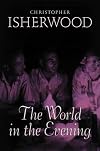
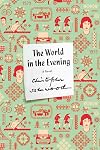
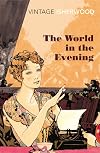
The World in the Evening
by Christopher Isherwood
On This Page
Description
"Against the backdrop of World War II, The World in the Evening charts the emotional development of Stephen Monk, an aimless Englishman living in California. After his second marriage suddenly ends, Stephen finds himself living with a relative in a small Pennsylvania Quaker town, haunted by memories of his prewar affair with a younger man during a visit to the Canary Islands. The world traveler comes to a gradual understanding of himself and of his newly adopted homeland."--BOOK JACKET.Tags
Recommendations

























Member Reviews
The story of [The World in The Evening] by [[Christopher Isherwood]]moves back and forth between 1940-41 as America enters the war, and the 1920’s following the story of Stephen Monk, an anglo-american with a Quaker Philadelphia background. When Steve’s second marriage falls apart he returns to his childhood home on the Main Line where his guardian, Sarah Pennington lives. He breaks his hip and has to spend ten weeks in bed -- and that is where he finally takes reckoning of his life.
Written in 1954, the novel moves in fits and starts, toward and away from the issues of bisexuality, homosexuality and the larger issue of the absolute moral necessity being honest with oneself -- that anything less leads to disaster.
The best writing show more is in the ‘letters’ that Steve’s first wife, a writer named Elizabeth Rydal, wrote to her friends and that he has been slowly reading with a view to publishing. There is also much humor, the funniest of which is several pages on the Quaker lack of style, and the a disquisition on High and Low camp, the joys and perils of each. The weakest writing is in the dialogue, of which there is plenty. The dialogue is dull and sturdy and does necessary work, but I found my eyes flying over it, knowing in advance exactly what everyone was going to say, no surprises. In some ways that is the greater weakness of the book, a sentimentality, of which I think Isherwood might have even been aware. Steve’s bisexuality with a leaning toward the hetero isn’t quite believable -- he feels more repressed, more like a man whose need to conform is so extreme he can’t even begin to delve into himself seriously. Although to be fair, I expect that there are more people who live in this part of the spectrum than one might think, ambiguous and ambivalent, and nothing so simple as gay or straight.
In one of the most moving passages of the novel, Stephen writes to his second, soon to be ex-wife, “One night... I had an amazing experience: I can only describe it as a hate-nightmare. I saw my hatred as something objective: it was a kind of black stinking bog. And I realized, just for a moment, that it had an existence all of its own.....I had developed it myself, and even if you were to disappear out of my life, I knew, it would still be inside of me. Unless I got rid of it, I would have to use it. I would have to hate somebody else, or a whole lot of people; and in the end it would spread through my body right out to my fingertips and the hairs on my head....” For 1954 it’s an awkward but brave book. **** show less
Written in 1954, the novel moves in fits and starts, toward and away from the issues of bisexuality, homosexuality and the larger issue of the absolute moral necessity being honest with oneself -- that anything less leads to disaster.
The best writing show more is in the ‘letters’ that Steve’s first wife, a writer named Elizabeth Rydal, wrote to her friends and that he has been slowly reading with a view to publishing. There is also much humor, the funniest of which is several pages on the Quaker lack of style, and the a disquisition on High and Low camp, the joys and perils of each. The weakest writing is in the dialogue, of which there is plenty. The dialogue is dull and sturdy and does necessary work, but I found my eyes flying over it, knowing in advance exactly what everyone was going to say, no surprises. In some ways that is the greater weakness of the book, a sentimentality, of which I think Isherwood might have even been aware. Steve’s bisexuality with a leaning toward the hetero isn’t quite believable -- he feels more repressed, more like a man whose need to conform is so extreme he can’t even begin to delve into himself seriously. Although to be fair, I expect that there are more people who live in this part of the spectrum than one might think, ambiguous and ambivalent, and nothing so simple as gay or straight.
In one of the most moving passages of the novel, Stephen writes to his second, soon to be ex-wife, “One night... I had an amazing experience: I can only describe it as a hate-nightmare. I saw my hatred as something objective: it was a kind of black stinking bog. And I realized, just for a moment, that it had an existence all of its own.....I had developed it myself, and even if you were to disappear out of my life, I knew, it would still be inside of me. Unless I got rid of it, I would have to use it. I would have to hate somebody else, or a whole lot of people; and in the end it would spread through my body right out to my fingertips and the hairs on my head....” For 1954 it’s an awkward but brave book. **** show less
Recuerdo vagamente este libro, que sin duda vendí por lo malo, malísimo que era. Un hombre, inmovilizado en cama por una fractura de fémur, se dedica a filosofar sobre la vida y sus circunstancias, dándose cuenta a mitad de la novela de que es un perdedor y siempre lo será. Se deprime y tal, y no recuerdo más. Por algo será.
I won this book in a giveaway in exchange of my honest review.
This really wasn't my thing, it was written a while ago, I found the writing a bit dull.
This really wasn't my thing, it was written a while ago, I found the writing a bit dull.
Isherwood, Christopher (1904-1986) English-American novelist
hardback book in dust-jacket , signed by author on title page with note to "see page 94"
Young-#1977
hardback book in dust-jacket , signed by author on title page with note to "see page 94"
Young-#1977
Ratings
Members
- Recently Added By
Lists

Pre-1969 LGBTQ Literature
184 works; 70 members
Author Information

88+ Works 14,870 Members
Christopher Isherwood, born in Cheshire, England, in 1904, wrote both novels and nonfiction. He was a lifelong friend of W.H. Auden and wrote several plays with him, including Dog Beneath the Skin and The Ascent of F6. He lived in Germany from 1928 until 1933 and his writings during this period described the political and social climate of show more pre-Hitler Germany. Isherwood immigrated to the United States in 1939 and became a U.S. citizen in 1946. He lived in California, working on film scripts and adapting plays for television. The musical Cabaret is based on several of Isherwood's stories and on his play, I Am a Camera. His other works include Mr. Norris Changes Trains, about life in Germany in the early 1930s; Down There on a Visit, an autobiographical novel; and Where Joy Resides, published after his death in 1986. (Bowker Author Biography) show less
Awards and Honors
Distinctions
Series
Belongs to Publisher Series
Work Relationships
Is contained in
Common Knowledge
- Original title
- The World in the evening
- Original publication date
- 1954
- People/Characters
- Stephen Monk; Jane Armstrong; Elizabeth Rydal; Sarah Pennington; Gerda Mannheim; Michael Drummond (show all 7); Bob Wood
- Dedication
- To Dodie and Alec Beesley
- First words
- The party, that evening, was at the Novotnys'.
- Last words
- (Click to show. Warning: May contain spoilers.)'I'll even forgive myself. As a matter of fact, I just have. Do you know something, Jane,' I said, as I emptied my glass, 'I really do forgive myself, from the bottom of my heart?'
- Canonical DDC/MDS
- 823.912
- Canonical LCC
- PR6017.S5
Classifications
Statistics
- Members
- 381
- Popularity
- 82,551
- Reviews
- 4
- Rating
- (3.61)
- Languages
- 6 — Catalan, English, French, Italian, Spanish, Swedish
- Media
- Paper, Ebook
- ISBNs
- 19
- ASINs
- 15