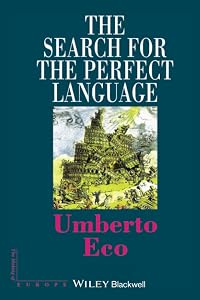
The Search for the Perfect Language
by Umberto Eco
On This Page
Description
The idea that there once existed a language which perfectly andunambiguously expressed the essence of all possible things andconcepts has occupied the minds of philosophers, theologians,mystics and others for at least two millennia. This is aninvestigation into the history of that idea and of its profoundinfluence on European thought, culture and history. From the early Dark Ages to the Renaissance it was widelybelieved that the language spoken in the Garden of Eden was justsuch a language, show more and that all current languages were its decadentdescendants from the catastrophe of the Fall and at Babel. Therecovery of that language would, for theologians, express thenature of divinity, for cabbalists allow access to hidden knowledgeand power, and for philosophers reveal the nature of truth.Versions of these ideas remained current in the Enlightenment, andhave recently received fresh impetus in attempts to create anatural language for artificial intelligence. The story that Umberto Eco tells ranges widely from the writingsof Augustine, Dante, Descartes and Rousseau, arcane treatises oncabbalism and magic, to the history of the study of language andits origins. He demonstrates the initimate relation betweenlanguage and identity and describes, for example, how and why theIrish, English, Germans and Swedes - one of whom presented Godtalking in Swedish to Adam, who replied in Danish, while theserpent tempted Eve in French - have variously claimed theirlanguage as closest to the original. He also shows how the lateeighteenth-century discovery of a proto-language (Indo-European)for the Aryan peoples was perverted to support notions of racialsuperiority. To this subtle exposition of a history of extraordinarycomplexity, Umberto Eco links the associated history of the mannerin which the sounds of language and concepts have been written andsymbolized. Lucidly and wittily written, the book is, in sum, atour de force of scholarly detection and culturalinterpretation, providing a series of original perspectives on twothousand years of European History. The paperback edition of this book is not available throughBlackwell outside of North America. show lessTags
Recommendations






Member Recommendations
Member Reviews
Thorough treatise on the 2000 years of a quest for a language that will not only provide signs for the things around us but a perfect, "natural" relationship. Entertaining, deep, intelligent and at times hilariously funny when it comes to all the erratic dead-end ideas and proposal that had been developed over the centuries.
Since ancient times and right down into the present, mankind has been searching for (1) the original language of humans, (2) the holy language that God and Adam used, (3) language that reveals the mystical essence of the universe and things, and (4) a language that eliminates the problems of ambiguity and ill logic so common to natural language, that reveals in its very form the scientific essence of things and (4) a simpler language that all people can learn and communicate with, and so achieve Utopian peace and harmony. Eco tells this story with his usual erudition and intimate knowledge of European cultural history.
For me, most of the story since the Enlightenment was known to me, but prior to that the story was wholly new. There's a show more whole world of European civilization that I (and I suspect most Americans) have never known, primarily due to the fact that most of us don't read Latin and Italian.
The most negative thing I can say about the book is that, while most of the time foreign language citations are translated, sometimes they are not -- and at crucial places for understanding. I assume this is an oversight, since Eco is so comfortable in so many languages. He probably has difficulty remembering the limitations of us mere intellectual mortals! show less
For me, most of the story since the Enlightenment was known to me, but prior to that the story was wholly new. There's a show more whole world of European civilization that I (and I suspect most Americans) have never known, primarily due to the fact that most of us don't read Latin and Italian.
The most negative thing I can say about the book is that, while most of the time foreign language citations are translated, sometimes they are not -- and at crucial places for understanding. I assume this is an oversight, since Eco is so comfortable in so many languages. He probably has difficulty remembering the limitations of us mere intellectual mortals! show less
I so wanted to like this book. I looked forward to reading it. I was happy the day I came home from Borders with it. (Remember Borders?) It was so boring I had trouble finishing it. I like the topic, I should have liked this book. I threw it on my closet floor for a long time before I could bring myself to finish the last chapter. I still have this book. I keep thinking if I was perhaps smarter I would have appreciated it more so I hang onto it in some misguided attempt to make me feel good (or perhaps bad?).
good as a european historical review. wish there’d been more theoretical asides. plenty of fun details and anecdotes though
A clever topic, well explored.
Wasn't really about what I wanted it to be about.
La búsqueda de la lengua perfecta es la historia de una utopía, la persecución de un sueño imposible que se ha mantenido a lo largo de los siglos. Cuando la unidad política y lingüística del mundo romano se viene abajo y comienzan a formarse las distintas lenguas que todavía hoy se hablan en Europa, la cultura europea rememora el episodio bíblico de la confusio linguarum babélica tratado de recuperar y reconstruir la lengua perfecta.
Aug 29, 2022Spanish
Members
- Recently Added By
Author Information

512+ Works 115,548 Members
Umberto Eco was born in Alessandria, Italy on January 5, 1932. He received a doctorate of philosophy from the University of Turin in 1954. His first book, Il Problema Estetico in San Tommaso, was an extension of his doctoral thesis on St. Thomas Aquinas and was published in 1956. His first novel, The Name of the Rose, was published in 1980 and won show more the Premio Strega and the Premio Anghiar awards in 1981. In 1986, it was adapted into a movie starring Sean Connery. His other works include Foucault's Pendulum, The Island of the Day Before, Baudolino, The Prague Cemetery, and Numero Zero. He also wrote children's books and more than 20 nonfiction books including Serendipities: Language and Lunacy. He taught philosophy and then semiotics at the University of Bologna. He also wrote weekly columns on popular culture and politics for L'Espresso. He died from cancer on February 19, 2016 at the age of 84. (Bowker Author Biography) show less
Some Editions
Series
Belongs to Publisher Series
Common Knowledge
- Canonical title
- The Search for the Perfect Language
- Original title
- La ricerca della lingua perfetta nella cultura europea
- Original publication date
- 1992
- Epigraph
- I would certainly never advise you to pursue the bizarre conceit which has taken hold of you to follow the dream about universal language.
- Francesco Soave, Riflessioni intorno all'istituzione di una lingua universale, 17... (show all)74 - First words
- The dream of a perfect language did not only obsess European culture.
- Last words
- (Click to show. Warning: May contain spoilers.)Thus the legacy that he has left to all his sons and daughters is the task of winning for themselves the full and reconciled mastery of the Tower of Babel.
- Original language
- Italian
- Disambiguation notice
- Lecture delivered at the College 1992/10/02. Please, do not combine with The Search for the Perfect Language, thank you.
[What does this disambiguation notice mean ? I presume that it’s in the wrong place ... DAB]
Classifications
- Genres
- Nonfiction, History, General Nonfiction, Philosophy, Literature Studies and Criticism
- DDC/MDS
- 401.3 — Language Language Philosophy and theory; international languages International languages
- LCC
- P106 .E2813 — Language and Literature Philology. Linguistics Language. Linguistic theory. Comparative grammar
- BISAC
Statistics
- Members
- 980
- Popularity
- 26,933
- Reviews
- 7
- Rating
- (3.67)
- Languages
- 17 — Czech, Dutch, English, Esperanto, French, German, Greek, Hungarian, Italian, Japanese, Lithuanian, Polish, Portuguese, Romanian, Russian, Spanish, Turkish
- Media
- Paper
- ISBNs
- 39
- ASINs
- 1