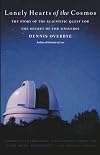
Lonely Hearts of the Cosmos: The Scientific Quest for the Secret of the Universe
by Dennis Overbye
On This Page
Description
An examination of the events, people and discoveries made in the field of cosmology and toward understanding of the nature of the universe.Tags
Recommendations

















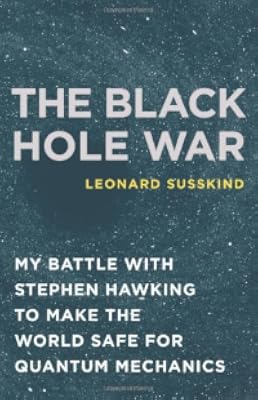
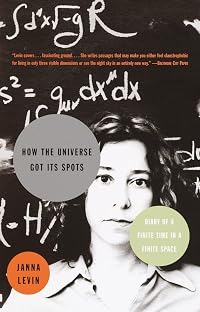

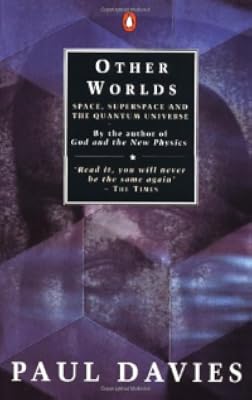
Member Reviews
First published in 1991 and now a little dated, but easily one of the best accounts of the pre dark matter / dark energy era in cosmology around. Overbye (currently Deputy Science Editor of The New York Times) is a former assistant editor at Sky & Telescope, and his familiarity with his subject matter shows. Lonely Hearts is based on the career of Allan Sandage, who Overbye met in 1985 and subsequently interviewed many times. Its central theme is the debate over the Hubble constant – the Hubble Wars – in which Sandage is usually identified as leading the school of thought favouring a closed Universe. Sandage constantly weaves in and out of the narrative, interacting with and arguing with just about every other leading astronomer of show more the latter 20th century. Beatrice Tinsley and her Gang of Four (J Richard Gott, Jim Gunn, Dave Schramm and Tinsley) who were the first to argue strongly for an unbound Universe merit a sympathetic chapter, but just about every other name you are likely to have heard is in there too.
Overbye’s Prologue acknowledges the help of Sandage, Stephen Hawking, John Wheeler, Schramm, Gustav Tamman, Jim Peebles, Vera Rubin, Alan Guth, Gunn, John Huchra, and Kip Thorne, to name only a few, and all of these merit at least a vignette and sometimes a chapter. As a who’s who of the people who laid the foundations of modern cosmology, Lonely Hearts is engaging, thorough, and very human.
It’s hard to pick a favourite from the many stories and anecdotes with which Lonely Hearts abounds, but one from the Prologue particularly tickled my fancy, and gives the flavour of the book as well as any. Overbye recounts the story of Huston Smith, a US religious scholar who was granted an audience with the Dalai Lama while travelling through India. On discovering that Smith had some knowledge of astronomy, the Dalai Lama immediately abandoned formality and pressed Smith to give him the latest news on the debate currently raging over the age and origin of the Universe. Had there been a Big Bang or was the Steady State theory the current favourite? Smith told him that at that time (c. 1960) the jury was still out, but the evidence seemed to be shifting in favour of the Big Bang. The Dalai Lama nodded and smiled ironically. “Of course”, he said, “we have a position on that”. show less
Overbye’s Prologue acknowledges the help of Sandage, Stephen Hawking, John Wheeler, Schramm, Gustav Tamman, Jim Peebles, Vera Rubin, Alan Guth, Gunn, John Huchra, and Kip Thorne, to name only a few, and all of these merit at least a vignette and sometimes a chapter. As a who’s who of the people who laid the foundations of modern cosmology, Lonely Hearts is engaging, thorough, and very human.
It’s hard to pick a favourite from the many stories and anecdotes with which Lonely Hearts abounds, but one from the Prologue particularly tickled my fancy, and gives the flavour of the book as well as any. Overbye recounts the story of Huston Smith, a US religious scholar who was granted an audience with the Dalai Lama while travelling through India. On discovering that Smith had some knowledge of astronomy, the Dalai Lama immediately abandoned formality and pressed Smith to give him the latest news on the debate currently raging over the age and origin of the Universe. Had there been a Big Bang or was the Steady State theory the current favourite? Smith told him that at that time (c. 1960) the jury was still out, but the evidence seemed to be shifting in favour of the Big Bang. The Dalai Lama nodded and smiled ironically. “Of course”, he said, “we have a position on that”. show less
This is a great topic both as science and for the lives of scientists, but I wish someone else had written it. Overbye's prose often reaches for the dramatic. His writing is heavy with imagery and metaphor. Some passages read well but can't be trusted for details. For example, pp19-20
"Hubble observed steadily in April [1949], clicking off photographic plates of the galaxies brought to new full-blooded starry brilliance by the giant mirror." The plates are long exposures, as Overbye knows. "Clicking off" implies something more like briefly open camera shutter.
"Hubble observed steadily in April [1949], clicking off photographic plates of the galaxies brought to new full-blooded starry brilliance by the giant mirror." The plates are long exposures, as Overbye knows. "Clicking off" implies something more like briefly open camera shutter.
Ignore the silly title and note the subtitle. This is a good overview of the efforts over the last century to find out what the universe is, how it began and how it evolved. The author tells the story of the men and women who devoted their careers to this quest: astronomers, cosmologists and particle physicists. He describes the rivalries and friendships among the groups and between individuals, between the observers and the theorists. It is the kind of interplay usually involved in producing good science.
The author is a physicist, and the reader with a strong science background may wish for more science and less about professional foibles. Those without the science may experience the right balance and not be bothered that the book is show more slightly dated by now. The science seems to be made as simple as possible without sacrificing flavor in favor of nebulosity.
The amazing picture that scientists have painted of the universe during this last century is an incredible triumph of the human spirit and should be known by everyone with an interest in the world. This is a good introduction. It may spark the reader's curiosity about astrophysics and prepare and encourage one to look further, such as into the Wikipedia article "Universe" and its many links. They have good pictures. There still is much to learn. show less
The author is a physicist, and the reader with a strong science background may wish for more science and less about professional foibles. Those without the science may experience the right balance and not be bothered that the book is show more slightly dated by now. The science seems to be made as simple as possible without sacrificing flavor in favor of nebulosity.
The amazing picture that scientists have painted of the universe during this last century is an incredible triumph of the human spirit and should be known by everyone with an interest in the world. This is a good introduction. It may spark the reader's curiosity about astrophysics and prepare and encourage one to look further, such as into the Wikipedia article "Universe" and its many links. They have good pictures. There still is much to learn. show less
One of the most interesting and thought provoking books I've read Ina very long time. And this review is being written 22 years after my first reading. For those fascinated by science - not just the answers, but the search, the personalities and the process that all happens in the background, this is a must read. You won't be disappointed.
Overbye, a journalist, has presented here an account of the 20th century developments in astronomy. His account shows how the "physical" astronomers' and the "theoretical" astronomers' different approaches are often at odds with each other, leading to divergent conception of the universe in which we live.
This is about the human side of pioneering astronomy; about the excitement and imagination that accompany a project. It makes for exciting reading and is based on real popple in real projects.
Now out-of-date (1987) description of then-current controversies in cosmology with a good dose of particle physics; focused on not-very-interesting Allan Sandage (Hubble's protégé); very realistic view of academic competition
Members
- Recently Added By
Author Information

5+ Works 560 Members
Dennis Overbye is Deputy Science Editor of "The New York Times" & a critically acclaimed science writer who has contributed to "Time," "The New York Times Magazine," & many other publications. His first book, "Lonely Hearts of the Cosmos," was nominated for a National Book Critics' Circle Award in Nonfiction & a "Los Angeles Times" Book Award in show more Science. He lives in New York City. (Bowker Author Biography) show less
Awards and Honors
Common Knowledge
- People/Characters
- Jane Hawking; Stephen Hawking; Alan Sandage
Classifications
Statistics
- Members
- 306
- Popularity
- 104,374
- Reviews
- 8
- Rating
- (4.07)
- Languages
- English, Finnish, Italian, Spanish
- Media
- Paper, Ebook
- ISBNs
- 11
- ASINs
- 6