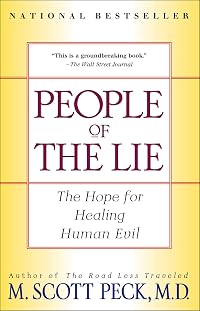
People of the Lie, Volume 2: The Encounter with Evil in Everyday Life [Audio]
by M. Scott Peck
On This Page
Description
In this [book, the author] probes ... into the essence of human evil. People who are evil attack others instead of facing their own failures. [He] demonstrates the havoc these People of the Lie work in the lives of those around them. He presents, from ... incidents encountered in his psychiatric practice, examples of evil in everyday life.-Back cover.Tags
Recommendations
























Member Reviews
Poor George, what bad luck he had to find this therapist. George was clever. He played his OCD off itself, he played his core delusion that his thoughts had an effect on the world off itself so that the compulsions would self-destruct..
He said, ok, if I don't do my compulsion, I will die, but I am going to make myself believe that if I do my compulsion my SON will die, and he is so much more important, so I won't do the compulsion. And POOF the OCD tendencies self-destructed. I doubt it would work for everyone, but it seemed to work for him, and it worked precisely because he was a good person and loved his son.
It was very clever and then this EVIL GOOSE tells George he has an evil character because he made a deal with the devil to hurt show more his son...!? Makes him believe he is a bad person who wants harm to come to his son (Again, something people with OCD are vulnerable to believing, as Peck well knew)! And then, having made him feel terrible about himself and completely undoing his self-healing attempt, he charged him for 2 years of therapy and then took the credit for curing him, when more than anything what he'd done was to hurt him.
He also suggests that if someone is "evil" it's morally advisable to force treatment on them, regardless of whether they recognize they are sick or whether they have ever commit ed a crime. And, as you might expect in view of what I've written already, he believes in demonic possession and promotes exorcism, a type of torture for the mentally ill or non-conforming that kills hundreds of people per year.
Good business man, bad person. This guy is lecturing us on evil when he cheated on his wives? show less
He said, ok, if I don't do my compulsion, I will die, but I am going to make myself believe that if I do my compulsion my SON will die, and he is so much more important, so I won't do the compulsion. And POOF the OCD tendencies self-destructed. I doubt it would work for everyone, but it seemed to work for him, and it worked precisely because he was a good person and loved his son.
It was very clever and then this EVIL GOOSE tells George he has an evil character because he made a deal with the devil to hurt show more his son...!? Makes him believe he is a bad person who wants harm to come to his son (Again, something people with OCD are vulnerable to believing, as Peck well knew)! And then, having made him feel terrible about himself and completely undoing his self-healing attempt, he charged him for 2 years of therapy and then took the credit for curing him, when more than anything what he'd done was to hurt him.
He also suggests that if someone is "evil" it's morally advisable to force treatment on them, regardless of whether they recognize they are sick or whether they have ever commit ed a crime. And, as you might expect in view of what I've written already, he believes in demonic possession and promotes exorcism, a type of torture for the mentally ill or non-conforming that kills hundreds of people per year.
Good business man, bad person. This guy is lecturing us on evil when he cheated on his wives? show less
I've been fascinated by the question of evil ever since learning about the Nazis and the Holocaust as a child. I've never lost the part of me that wonders, "Why?" and that was only reinforced post-9/11. This approaches the question of evil from a psychological point of view--for Peck is a practicing psychiatrist--but also a Christian point of view--for Peck is a believing Christian. A blurb from the Wall Street Journal on the back cover says the "long-overdue discussion between psychology and religion has begun, and nowhere does that beginning bear better fruit than in Dr. M. Scott Peck's People of the Lie." That does come to the fore from time to time--Peck takes the idea of demonic possession and exorcism seriously--I do not. I'm an show more atheist.
Yet I found plenty to consider, to highlight and dog-ear and think about in this book. Certainly the case studies made for a fascinating read, though some certainly seemed to me more troubled than evil, and I wonder how effective therapy can be if that is how psychiatrists see their patients. How can they expect to help them? I'm also dubious about Peck's analysis of My Lai, which I think has more to do with his political views than his psychological expertise. But there's plenty in the book that doesn't require religious faith to accept as insightful:
Mental health requires that the human will submit itself to something higher than itself. To function decently in this world we must submit ourselves to some principle that takes precedence over what we might want at any given moment. For the religious this principle is God... But if they are sane, even the nonreligious submit themselves, whether they know it or not, to some "higher power"--be it truth or love, the needs of others, or the demands of reality... Mental health is an ongoing process of dedication to reality at all costs.
And that's why evil resides in the people of the lie. Even Ayn Rand, an atheist who many would accuse of advocating a form of narcissism, would agree with this in essentials--above all for her the first commandment would be "Thou Shalt Not Fake Reality." The rest is commentary. So all evil, from emotional manipulation to mass murder start to finish comes down to refusing to honor reality---and to change that, to face reality, is what psychology is supposed to help us to do. Although I have to say, I question just how in touch with reality is a therapist who believes in supernatural explanations for human behavior. show less
Yet I found plenty to consider, to highlight and dog-ear and think about in this book. Certainly the case studies made for a fascinating read, though some certainly seemed to me more troubled than evil, and I wonder how effective therapy can be if that is how psychiatrists see their patients. How can they expect to help them? I'm also dubious about Peck's analysis of My Lai, which I think has more to do with his political views than his psychological expertise. But there's plenty in the book that doesn't require religious faith to accept as insightful:
Mental health requires that the human will submit itself to something higher than itself. To function decently in this world we must submit ourselves to some principle that takes precedence over what we might want at any given moment. For the religious this principle is God... But if they are sane, even the nonreligious submit themselves, whether they know it or not, to some "higher power"--be it truth or love, the needs of others, or the demands of reality... Mental health is an ongoing process of dedication to reality at all costs.
And that's why evil resides in the people of the lie. Even Ayn Rand, an atheist who many would accuse of advocating a form of narcissism, would agree with this in essentials--above all for her the first commandment would be "Thou Shalt Not Fake Reality." The rest is commentary. So all evil, from emotional manipulation to mass murder start to finish comes down to refusing to honor reality---and to change that, to face reality, is what psychology is supposed to help us to do. Although I have to say, I question just how in touch with reality is a therapist who believes in supernatural explanations for human behavior. show less
A fascinating and riveting work on human evil. I was most interested in the case studies that formed the bulk of the first half of the book, and far less interested in the theoretical application of group psychology that formed the last half. The case studies in the book could well describe someone you know. I appreciated the honesty of Peck regarding his feelings about his patients. I could well relate to his frustration and revulsion, it gave his accounts more verisimilitude.
I remain unconvinced of Peck's identification of evil with a specific form of personality disorder. While the people he describes certainly were evil, albeit of a mundane, domestic variety, I found the definition flat and truncated. It just seemed to be missing show more something. I found it very interesting that Peck thinks that Augustine's idea of evil as an absence of good has been discarded, when in fact it remains a part of Aristotelian philosophy and Thomistic philosophy and theology in this day. It is even more surprising given that his attempt to define evil as disease is a subset of the idea that evil is a privation.
The attempt to explain the group psychology behind the MyLai massacre was ultimately unconvincing, but it did remind me of the mimetic theory of Rene Girard, specifically the necessity of a scapegoat for group cohesion. However, on the terms of Peck's argument, what I found remarkable was that so few massacres occured. His analysis made the events seem inevitable, so the real question becomes not why MyLai happened, but why there weren't hundreds more My Lais.
Overall a very interesting read. One of the most notable insights of this book is nicely summed up by the reviewer who brought my attention to this book, John J. Reilly. "The people whose cases Peck describes were seriously sick and hated their sickness, but they could not get better because in some fundamental sense they had chosen to be that way." A psychological insight with shades of Dante. show less
I remain unconvinced of Peck's identification of evil with a specific form of personality disorder. While the people he describes certainly were evil, albeit of a mundane, domestic variety, I found the definition flat and truncated. It just seemed to be missing show more something. I found it very interesting that Peck thinks that Augustine's idea of evil as an absence of good has been discarded, when in fact it remains a part of Aristotelian philosophy and Thomistic philosophy and theology in this day. It is even more surprising given that his attempt to define evil as disease is a subset of the idea that evil is a privation.
The attempt to explain the group psychology behind the MyLai massacre was ultimately unconvincing, but it did remind me of the mimetic theory of Rene Girard, specifically the necessity of a scapegoat for group cohesion. However, on the terms of Peck's argument, what I found remarkable was that so few massacres occured. His analysis made the events seem inevitable, so the real question becomes not why MyLai happened, but why there weren't hundreds more My Lais.
Overall a very interesting read. One of the most notable insights of this book is nicely summed up by the reviewer who brought my attention to this book, John J. Reilly. "The people whose cases Peck describes were seriously sick and hated their sickness, but they could not get better because in some fundamental sense they had chosen to be that way." A psychological insight with shades of Dante. show less
The case histories presented seem to be more of a low-grade, everyday sort of evil rather than a study of the personalities of major bad guys. Couldn't get through the chapter on My Lai so am pleased to find other readers here didn't find it all that. This book was useful to me in that it described how bad people lie to themselves before they lie to everyone else, so it is natural to be confused in their company. Just that factoid alone was worth the price of admission for me.
The information about narcissism seemed quite relevant and garnered painfully over a lifetime of actual clinical experience. The author freely admitted that if he could go back to Then with what he knows Now, he might have acted differently. Also the religion show more presented here was not off-putting but informative to me. I prefer religion that is not about castigating those who don't live up to the church's expectations; I like to think God's grace is available to all who wish for it, whatever their affiliation.
The evil parents are unforgettable. Imagine giving your son the rifle his older brother used to commit suicide - and as his Christmas gift. People find that one especially shocking and don't understand why such weapons are not melted down into slag. This pair of parents were almost as scary as poor Roger's parents, masters of selective insensitivity. I wouldn't have believed that story if I didn't know people who behave that way. It's called "Splitting" - some folks,who are Good, get all the sugar; while others, who are Bad, get nothing but shit, leftovers and blame. show less
The information about narcissism seemed quite relevant and garnered painfully over a lifetime of actual clinical experience. The author freely admitted that if he could go back to Then with what he knows Now, he might have acted differently. Also the religion show more presented here was not off-putting but informative to me. I prefer religion that is not about castigating those who don't live up to the church's expectations; I like to think God's grace is available to all who wish for it, whatever their affiliation.
The evil parents are unforgettable. Imagine giving your son the rifle his older brother used to commit suicide - and as his Christmas gift. People find that one especially shocking and don't understand why such weapons are not melted down into slag. This pair of parents were almost as scary as poor Roger's parents, masters of selective insensitivity. I wouldn't have believed that story if I didn't know people who behave that way. It's called "Splitting" - some folks,who are Good, get all the sugar; while others, who are Bad, get nothing but shit, leftovers and blame. show less
Though this book is dated (1983) and shows it in its lack of the knowledge we have now in 2016, still its advice for understanding"people of the lie" is timeless and invaluable. I started this book looking for hope to stop hating people who have harmed me (a family member) and people who practice cognitive dissonance. I found through reading this book that they are more to be pitied than to be hated.
M. Scott Peck joins the pantheon of psychiatrists who have sought to use tools and truths drawn from both Science and Theology to aid the helping professions.
Since this 1983 work, the author's subsequent publishing history reflects his own process theology -- he lived a pilgrimage of faith publications while largely neglecting the "science" he insists he claims to engage. There is no question he has left a Newtonian stamp upon the vast beach of Mystery as a serious and widely acclaimed writer, thinker, psychiatrist, and spiritual guide. Still, he provides no actual "calculus" -- no qualifying contribution to science, such as a measurement, tool, experiment, or indulgence in laboratory studies, chemical investigation. Not even show more semiotics.
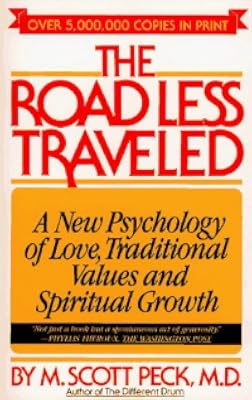
This work brings us into his clinical sessions with patients he has selected for the proximity they experienced with "evil". The "people of the lie" are folks who have given themselves to satan. Peck briefly shares his exorcisms, his eye-witnessing of the devil as a spirit in a writhing "snakelike" body. His first book, The Road Less Traveled (1978), is far more of a spiritual guide than this one, which tries to answer the question of How to Heal humans who are evil.
Beginning with the medical model, Dr. Peck assesses what makes it difficult to heal patients who are "possessed' by evil. For example, one patient struggling with guilt and "magical thinking", was "suffering from a very specific disease, an obsessive-compulsive disorder" about which "we know a good deal". [36] For example, its origins are in early childhood, "beginning almost always in a less than ideal toilet-training". But instead of the medical model, "How would it seem if we viewed it instead in terms of a traditional Christian religious model?" He turns to this model as a battleground struggle for the human soul. "The entire meaning of human life revolves around the battle. The only question of ultimate significance is whether the individual soul will be won to God or won to the devil." [37]
Doctor Peck presents his theo/psychology of evil as a multi-faceted exploration inclusive of both science and Christ. We can approach, but will never understand, basic reality, which is mysterious to us. Yet if we fail to try to penetrate the darkness, we are reduced to nihilism, "since time immemorial a diabolic voice". [39] He brings science to task for failing to study evil--although central to religious thought for millenia, it is "virtually absent from our science of psychology". Why? "The major reason for this strange state of affairs is that the scientific and the religious models have hitherto been considered totally immiscible--like oil and water, mutually incompatible and rejecting".
He keenly observes that this is changing, and it must. Science without "religious values" gives us the Strangelovian lunacy of the arms race; and Religion without scientific self-doubt and scrutiny gives us the Rasputin lunacy of Jonestown. [40] The separation no longer works for us. Reintegration of the two models is "the most exciting event in the intellectual history of the late twentieth century." The two can be united around the Mystery of Good and Evil. [41] He defines evil as that force that seeks to kill life and liveliness, and good as that which promotes it. [43] Here he draws from Eric Fromm. Healing is a function, and result, of love. [44] The focus of this book is on "bad" people who want to control and diminish others.
Drawing from his clinical practice, Doctor Peck fills in his diagnostic profile of evil people. He calls them "people of the lie" because this form of mental illness needs to be named in order to gain power over it. [68] The basis for this name is that those afflicted with it, repeatedly resort to deception, hiding and covertness. [69] Layers of self-deception in the clinical presentation often engender revulsion, "confusion" and create chaos. [66] Guilt may save some. (Doctor Peck calls Guilt "a blessing" [71].)
The varieties of wicked people are manifold, virtual "grab bags of sin". They are "remarkably greedy", and Laziness is basic. [71] A predominant characteristic is "scapegoating"--they lash out at any reproach, often using what psychiatrists call "projection"; they blame others for what is within themselves. They are often destructive. Lacking conscience (sociopaths), and dedicated to preserving a self-hating self-image of perfection, they are acutely sensitive to social norms and what others might think of them. Lacking any motivation to BE good, they desire to appear good. [75]
Evil people have a pathological and malignant Narcissism which overwhelms the demands of conscience and guilt with a willful determination to have their own way. "There is a remarkable power in the manner in which they attempt to control others." [78] Citing Buber's study of Narcissism, he notes that evil people insist upon "affirmation independent of all findings"; utterly disregarding facts. [80]
Church authorities understand that a self-absorbed diseased arrogant overweening Pride is often at the root of evil. [79-80] In addition, in the doctor's experience, "evil seems to run in families". [81]
The Oedipal complex is discussed in detail. Many children "experience sexual desire for the parent of the opposite sex" usually reaching a peak around the age of four. The evil seeks nurturance, and the infantile often irresponsible and inappropriate sexuality repeats into adulthood.[161] It seeks conquest, often in pettiness and tastelessness. [176] Give such an evil one "a nation" and they become a "Hitler or an Idi Amin". [177]
At this point I was reflecting upon how our nation was recently taken over by an evil person who constantly lies. How could this happen? It happened with Church support--the Church functioning as a Trojan Horse used by a very wealthy tyrant who hates republics: Vladimir Putin.
The Evangelical Church was transformed between the time Doctor Peck passed away with Parkinson's in 2005, and the Betrayal of November 2016. So much of the gentle wisdom we all relied upon was quickly lost to the Church. During the Bush II administration, Cheney, Rove and Reed were transforming the institutions that the plutocrats had seized during the Reagan administration. The evangelical Church was virtually weaponized with dog-whistles of racist and tribal fears. In the destructive foreign Wars and the Collapse of 2008, the rich became richer. $40 trillion dollars of middle class equity was liquidated in offshore bank accounts for the wealthy, in a paroxysm of greed. The wealthiest preachers in America are evangelicals preying upon the poorest most uneducated and vulnerable "believers". https://www.etinside.com/?p=539 .
Although he was widely-read and influential in his day, Doctor Peck's informed, inclusive and fearless Christianity was replaced by a fear-driven fact-averse political party that wants more guns and violence. By 2018, the leading old-school evangelist Billy Graham was dead, his son was giving speeches for the NRA which was subsidized by Putin's oligarchs, and a greedy infantile Narcissistic puppet pretends to be President, with the support of the evangelical Church. This spectacle is anathema to the author of People of the Lie. His book was a warning to us.
Back to our text, Doctor Peck identifies the issue of Free Will as a paradox: We can be free to choose, but the choice is between submission to God, or refusal, and automatically becoming enslaved to the forces of evil. [83] Christ said "Whosoever will save his life shall lose it." As CS Lewis put it, "There is no neutral ground in the universe."
Doctor Peck examines the impact of evil. "The evil create for those under their domination a miniature sick society." [124] He clearly shows that bullies and evil-doers victimize society.
He also questions the impact of pathologizing evil, with the power of naming. He suggests that the designation of evil as a disease "obligates us to approach the evil with compassion". In other words, to NOT approach them with the hate which they inspire. [127]
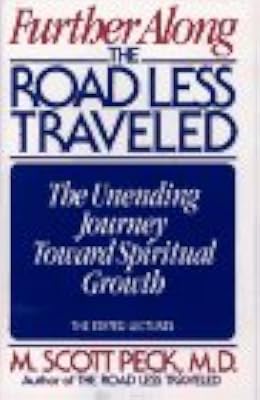
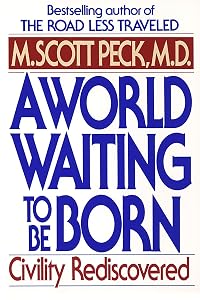
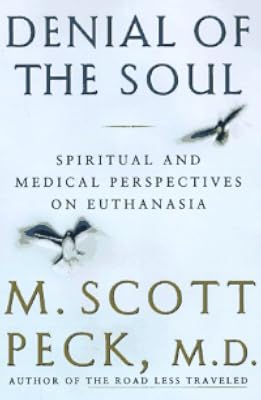
I appreciate the fact that the author went on to write other "Christian" testimonials which strive to include Science. He beautifully describes an inclusive community in The Different Drum (1987); the role of civility in personal relationships and society in A World Waiting to Be Born (1993); an examination of the complexities of life and the paradoxical nature of belief in Further Along the Road Less Traveled (1993); and an exploration of the medical, ethical, and spiritual issues of euthanasia in Denial of the Soul (1999). Doctor Peck also wrote a novel, a children's book, and other works.
Among the last of the educated Christians who was not science and fact-averse, Doctor Peck was a graduate of both Harvard University and Case Western Reserve. Like almost none of the "conservatives" who took over the "church of the GOP" recently, Dr. Peck served in both the military and the sciences. He was an officer in the Army Medical Corps. I found his insights as a practicing theologian and psychiatrist helpful in chaplaincy. Sadly, Doctor Peck's work for the Foundation for Community Encouragement, a nonprofit organization that he helped found in 1984, is now virtually defunct. https://www.fce-community.org/ . The "evangelical" Church has not survived its takeover by wealthy tyrants. show less
Since this 1983 work, the author's subsequent publishing history reflects his own process theology -- he lived a pilgrimage of faith publications while largely neglecting the "science" he insists he claims to engage. There is no question he has left a Newtonian stamp upon the vast beach of Mystery as a serious and widely acclaimed writer, thinker, psychiatrist, and spiritual guide. Still, he provides no actual "calculus" -- no qualifying contribution to science, such as a measurement, tool, experiment, or indulgence in laboratory studies, chemical investigation. Not even show more semiotics.
This work brings us into his clinical sessions with patients he has selected for the proximity they experienced with "evil". The "people of the lie" are folks who have given themselves to satan. Peck briefly shares his exorcisms, his eye-witnessing of the devil as a spirit in a writhing "snakelike" body. His first book, The Road Less Traveled (1978), is far more of a spiritual guide than this one, which tries to answer the question of How to Heal humans who are evil.
Beginning with the medical model, Dr. Peck assesses what makes it difficult to heal patients who are "possessed' by evil. For example, one patient struggling with guilt and "magical thinking", was "suffering from a very specific disease, an obsessive-compulsive disorder" about which "we know a good deal". [36] For example, its origins are in early childhood, "beginning almost always in a less than ideal toilet-training". But instead of the medical model, "How would it seem if we viewed it instead in terms of a traditional Christian religious model?" He turns to this model as a battleground struggle for the human soul. "The entire meaning of human life revolves around the battle. The only question of ultimate significance is whether the individual soul will be won to God or won to the devil." [37]
Doctor Peck presents his theo/psychology of evil as a multi-faceted exploration inclusive of both science and Christ. We can approach, but will never understand, basic reality, which is mysterious to us. Yet if we fail to try to penetrate the darkness, we are reduced to nihilism, "since time immemorial a diabolic voice". [39] He brings science to task for failing to study evil--although central to religious thought for millenia, it is "virtually absent from our science of psychology". Why? "The major reason for this strange state of affairs is that the scientific and the religious models have hitherto been considered totally immiscible--like oil and water, mutually incompatible and rejecting".
He keenly observes that this is changing, and it must. Science without "religious values" gives us the Strangelovian lunacy of the arms race; and Religion without scientific self-doubt and scrutiny gives us the Rasputin lunacy of Jonestown. [40] The separation no longer works for us. Reintegration of the two models is "the most exciting event in the intellectual history of the late twentieth century." The two can be united around the Mystery of Good and Evil. [41] He defines evil as that force that seeks to kill life and liveliness, and good as that which promotes it. [43] Here he draws from Eric Fromm. Healing is a function, and result, of love. [44] The focus of this book is on "bad" people who want to control and diminish others.
Drawing from his clinical practice, Doctor Peck fills in his diagnostic profile of evil people. He calls them "people of the lie" because this form of mental illness needs to be named in order to gain power over it. [68] The basis for this name is that those afflicted with it, repeatedly resort to deception, hiding and covertness. [69] Layers of self-deception in the clinical presentation often engender revulsion, "confusion" and create chaos. [66] Guilt may save some. (Doctor Peck calls Guilt "a blessing" [71].)
The varieties of wicked people are manifold, virtual "grab bags of sin". They are "remarkably greedy", and Laziness is basic. [71] A predominant characteristic is "scapegoating"--they lash out at any reproach, often using what psychiatrists call "projection"; they blame others for what is within themselves. They are often destructive. Lacking conscience (sociopaths), and dedicated to preserving a self-hating self-image of perfection, they are acutely sensitive to social norms and what others might think of them. Lacking any motivation to BE good, they desire to appear good. [75]
Evil people have a pathological and malignant Narcissism which overwhelms the demands of conscience and guilt with a willful determination to have their own way. "There is a remarkable power in the manner in which they attempt to control others." [78] Citing Buber's study of Narcissism, he notes that evil people insist upon "affirmation independent of all findings"; utterly disregarding facts. [80]
Church authorities understand that a self-absorbed diseased arrogant overweening Pride is often at the root of evil. [79-80] In addition, in the doctor's experience, "evil seems to run in families". [81]
The Oedipal complex is discussed in detail. Many children "experience sexual desire for the parent of the opposite sex" usually reaching a peak around the age of four. The evil seeks nurturance, and the infantile often irresponsible and inappropriate sexuality repeats into adulthood.[161] It seeks conquest, often in pettiness and tastelessness. [176] Give such an evil one "a nation" and they become a "Hitler or an Idi Amin". [177]
At this point I was reflecting upon how our nation was recently taken over by an evil person who constantly lies. How could this happen? It happened with Church support--the Church functioning as a Trojan Horse used by a very wealthy tyrant who hates republics: Vladimir Putin.
The Evangelical Church was transformed between the time Doctor Peck passed away with Parkinson's in 2005, and the Betrayal of November 2016. So much of the gentle wisdom we all relied upon was quickly lost to the Church. During the Bush II administration, Cheney, Rove and Reed were transforming the institutions that the plutocrats had seized during the Reagan administration. The evangelical Church was virtually weaponized with dog-whistles of racist and tribal fears. In the destructive foreign Wars and the Collapse of 2008, the rich became richer. $40 trillion dollars of middle class equity was liquidated in offshore bank accounts for the wealthy, in a paroxysm of greed. The wealthiest preachers in America are evangelicals preying upon the poorest most uneducated and vulnerable "believers". https://www.etinside.com/?p=539 .
Although he was widely-read and influential in his day, Doctor Peck's informed, inclusive and fearless Christianity was replaced by a fear-driven fact-averse political party that wants more guns and violence. By 2018, the leading old-school evangelist Billy Graham was dead, his son was giving speeches for the NRA which was subsidized by Putin's oligarchs, and a greedy infantile Narcissistic puppet pretends to be President, with the support of the evangelical Church. This spectacle is anathema to the author of People of the Lie. His book was a warning to us.
Back to our text, Doctor Peck identifies the issue of Free Will as a paradox: We can be free to choose, but the choice is between submission to God, or refusal, and automatically becoming enslaved to the forces of evil. [83] Christ said "Whosoever will save his life shall lose it." As CS Lewis put it, "There is no neutral ground in the universe."
Doctor Peck examines the impact of evil. "The evil create for those under their domination a miniature sick society." [124] He clearly shows that bullies and evil-doers victimize society.
He also questions the impact of pathologizing evil, with the power of naming. He suggests that the designation of evil as a disease "obligates us to approach the evil with compassion". In other words, to NOT approach them with the hate which they inspire. [127]
I appreciate the fact that the author went on to write other "Christian" testimonials which strive to include Science. He beautifully describes an inclusive community in The Different Drum (1987); the role of civility in personal relationships and society in A World Waiting to Be Born (1993); an examination of the complexities of life and the paradoxical nature of belief in Further Along the Road Less Traveled (1993); and an exploration of the medical, ethical, and spiritual issues of euthanasia in Denial of the Soul (1999). Doctor Peck also wrote a novel, a children's book, and other works.
Among the last of the educated Christians who was not science and fact-averse, Doctor Peck was a graduate of both Harvard University and Case Western Reserve. Like almost none of the "conservatives" who took over the "church of the GOP" recently, Dr. Peck served in both the military and the sciences. He was an officer in the Army Medical Corps. I found his insights as a practicing theologian and psychiatrist helpful in chaplaincy. Sadly, Doctor Peck's work for the Foundation for Community Encouragement, a nonprofit organization that he helped found in 1984, is now virtually defunct. https://www.fce-community.org/ . The "evangelical" Church has not survived its takeover by wealthy tyrants. show less
One of the most chilling books I've read. Real life examples of truly evil people passing as regular folk, who have come into contact with the author through his practice. The most memorable: parents of a suicide who give their remaining, and less-favored son, as a Christmas present, the rifle used in the suicide.
Members
- Recently Added By
Lists

Books on My Journey
18 works; 1 member

Blue Pyramid 1,276 Best Books of All Time
1,248 works; 32 members
Author Information

80+ Works 15,469 Members
M. Scott Peck was born on May 22, 1936 in New York City. He attended Phillips Exeter Academy and was attending Middlebury College before being expelled for refusing to attend mandatory R.O.T.C. sessions. He transferred to Harvard University, where he received a bachelor's degree in 1958, and then received a medical degree in 1963 from Case Western show more Reserve University School of Medicine. He was a psychiatrist in the United States Army for nearly 10 years, was the director of the New Milford Hospital Mental Health Clinic, and worked in a private psychiatric practice in Connecticut. In 1984, he helped establish the Foundation for Community Encouragement, whose mission is to promote and teach the principles of Community. He was among the founding fathers of the self-help genre of books. His works include The Road Less Traveled, Further Along the Road Less Traveled, The Road Less Traveled and Beyond, People of the Lie, and The Different Drum. He also wrote a novel entitled A Bed by the Window. He received the 1984 Kaleidoscope Award for Peacemaking, the 1994 Temple International Peace Prize, and the Learning, Faith and Freedom Medal from Georgetown University in 1996. He died from complications of pancreatic and liver duct cancer on September 25, 2005 at the age of 69. (Bowker Author Biography) show less
Common Knowledge
- Canonical title
- People of the Lie, Volume 2: The Encounter with Evil in Everyday Life [Audio]
- Original title
- People of the lie
- Original publication date
- 1983
- Dedication
- For Lily, who serves so many ways, only one of which has been to wrestle with demons.
- First words
- This is a dangerous book.
- Blurbers
- Theroux, Phyliss
- Original language
- English
- Disambiguation notice
- First published in 1983, People of the Lie: Toward a Psychology of Evil [subsequent vols subtitled The Hope For Healing Human Evil and Possession and Group Evil] (Wikipedia)
Classifications
- Genres
- Religion & Spirituality, Nonfiction, General Nonfiction
- DDC/MDS
- 616.89 — Applied science & technology Medicine & health Diseases, Allergies, Skin Conditions Nervous Disorders: Autism, Anorexia, OCD Mental disorders: bi-polar/schizophrenia
- LCC
- BF51 .P43 — Philosophy, Psychology and Religion Psychology Psychology Philosophy. Relation to other topics
- BISAC
Statistics
- Members
- 2,043
- Popularity
- 10,271
- Reviews
- 22
- Rating
- (3.69)
- Languages
- 8 — Czech, English, French, German, Japanese, Portuguese, Serbian, Swedish
- Media
- Paper, Audiobook, Ebook
- ISBNs
- 20
- ASINs
- 18