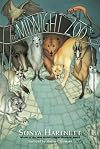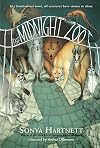
The Midnight Zoo
by Sonya Hartnett
On This Page
Description
Master storyteller Sonya Hartnett crafts a magical and moving fable about war and redemption . . . and what it means to be free.When the Germans attack their Romany encampment during World War II, Andrej and his younger brother, Tomas, flee through a ravaged countryside under cover of darkness, guarding a secret bundle. Their journey leads to a bombed-out town, where the boys discover a hidden wonder: a zoo filled with creatures in need of hope. Like Andrej and Tomas, the animals—wolf and show more eagle, monkey and bear, lioness and seal, kangaroo and llama— have stories to share and a mission to reclaim their lives.
. show less
Tags
Recommendations













Member Reviews
Goodness. Not for everyone. Poignant is far too weak a word. Think of the darker works of Hans Christian Andersen, like [b:The Little Match Girl|595948|The Little Match Girl|Hans Christian Andersen|https://i.gr-assets.com/images/S/compressed.photo.goodreads.com/books/1360519957l/595948._SX50_.jpg|1773894]. Gorgeous illustrations.
"There was a grace in accepting death when it came, even if it seemed to come too early, or too cruelly. Accepting death meant cherishing what remained of life."
"Somewhere out there, there's a gap in the water, a place which is hollow because the seal isn't there."
"There was a grace in accepting death when it came, even if it seemed to come too early, or too cruelly. Accepting death meant cherishing what remained of life."
"Somewhere out there, there's a gap in the water, a place which is hollow because the seal isn't there."
Sonya Hartnett’s The Midnight Zoo is as complex, layered and morose as fans of her writing have come to expect from her fiction for adult and young adult audiences. When three young siblings come across an abandoned small private zoo in the midst of their quest for survival during the Second World War, the reader is as intrigued as they are as to how these animals have come to be here, and how they too have survived. This novella reads like A Life of Pi for young readers, with the audience never quite comprehending what is real, what is imagined and where the danger lies. An engaging exploration as the animalistic survival instinct of humans and the horrors of the holocaust, this novella offers a starkly critical exploration of human show more behaviour through the eyes of the caged animals whilst also challenging the reader to re-evaluate their relationship with animals.
Whilst the plot and content of The Midnight Zoo is undeniably confronting and Hartnett does not hold back from the atrocities of war, bullying or violence, it can certainly be read and appreciated as a children’s book and somehow hearing home truths about human psychology from the perspective of an embittered lioness makes the observations more palatable. Whilst written and marketed as a book for children, like much of Hartnett’s other writing this book has so much to offer an adult audience that there is certainly a place for it amongst the adult fiction collection in bookstores and libraries alongside Hartnett’s Butterfly and not too far away from Yan Martell’s Life of Pi perhaps. show less
Whilst the plot and content of The Midnight Zoo is undeniably confronting and Hartnett does not hold back from the atrocities of war, bullying or violence, it can certainly be read and appreciated as a children’s book and somehow hearing home truths about human psychology from the perspective of an embittered lioness makes the observations more palatable. Whilst written and marketed as a book for children, like much of Hartnett’s other writing this book has so much to offer an adult audience that there is certainly a place for it amongst the adult fiction collection in bookstores and libraries alongside Hartnett’s Butterfly and not too far away from Yan Martell’s Life of Pi perhaps. show less
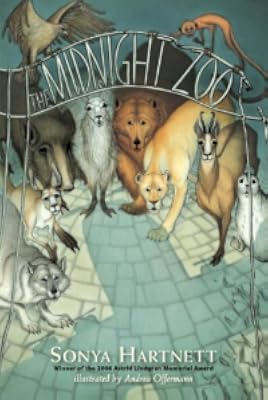
A strange and heartbreaking tale, The Midnight Zoo is the latest literary gem from author Sonya Hartnett and features lovely illustrations by Andrea Offermann. Two young boys, Andrej and his younger brother Tomas, are walking through a war-ravaged countryside, scrounging up whatever they can to survive while they protect the precious bundle they carry -- their baby sister Wilma. As gypsies (known as Rom), the boys are used to the life of wandering, where every day brings them to a new place, but taking care of themselves is a very new responsibility and obviously has its roots in tragedy. While wandering through a destroyed and empty town, the boys stumble upon a very small zoo, whose animals are still captive in their cages despite the show more near-total annihilation of the human dwellings. The zoo contains a wolf, an eagle, a monkey, a bear, a lioness, a seal, a chamois, and a llama. Shortly after identifying the animals that surround them, airplanes appear and a sudden air raid threatens all their lives. When Andrej and Tomas wake up, the animals are speaking to them. Nearly everyone has a turn at telling his or her own stories of captivity, including the boys, but when everyone has been displaced and there's no way to return them to the lives they should have been living, what can possibly be done to go on?
Yes, the main human characters are children; yes, it's relatively short; yes, there's a fable-like quality to the story; but does this mean this book could only be classified as exclusively (or even primarily) a book for children? Most certainly not! As I read, I found myself thinking of this as an introduction to magical realism more than a story which depicted the magic of a children's book. Of course, magical realism is certainly not a concept that can exclusively be applied to books for adults, but somehow I feel like this novel merits the acknowledgement of providing a beautiful and quiet illustration of the concept for those (children or otherwise) who might otherwise only have encountered fantasy depictions of magic. It subtly creeps in, begging the question of what is real and asking the reader to suspend his or her disbelief for the sake of coming to a deeper understanding of what it means for any creature to be safe and free. Children and adults would have similar reactions to the emotions brought forth in this novel of war, tragedy, and flickering hope. Technically, the setting for this tale is obviously World War II, but after reading it, one feels as though this could be a theme that applies to any war which ravages countries and lives, putting innocents in danger. It is a novel to be read with a heart that aches for the world and its inhabitants... and at the core of all that is the desire to shape one's own destiny and the longing for freedom from many different kinds of cages.
I imagine that The Midnight Zoo is destined to be taught in classrooms or suggested for book reports. I can even see the prompted questions now, revolving around the meaning of freedom, the logic behind a story told largely by talking animals, the lack of explicit closure and open-endedness of the final chapter, and the possibility that the children and animals actually died in the air raid. It is a novel that easily yields itself up to questions because that is its goal -- to provoke the reader in to asking questions. I would urge adults to treat this as a novella and enjoy the multitude of topics which will undoubtedly now stir in their minds... topics which might not otherwise have large purchase, even for sensitive souls: the animal nature of human beings; the questionable justification for wild animals being tamed; the definition of a cage; the repercussions of even our well-intentioned actions on the lives of those around us, human or otherwise. The Midnight Zoo will stay with you long after you finish reading and reflection upon the story and its themes only makes it feel richer. I'm delighted to have been exposed to this beautiful novel and I look forward to discovering Sonya Hartnett's other work. show less
Yes, the main human characters are children; yes, it's relatively short; yes, there's a fable-like quality to the story; but does this mean this book could only be classified as exclusively (or even primarily) a book for children? Most certainly not! As I read, I found myself thinking of this as an introduction to magical realism more than a story which depicted the magic of a children's book. Of course, magical realism is certainly not a concept that can exclusively be applied to books for adults, but somehow I feel like this novel merits the acknowledgement of providing a beautiful and quiet illustration of the concept for those (children or otherwise) who might otherwise only have encountered fantasy depictions of magic. It subtly creeps in, begging the question of what is real and asking the reader to suspend his or her disbelief for the sake of coming to a deeper understanding of what it means for any creature to be safe and free. Children and adults would have similar reactions to the emotions brought forth in this novel of war, tragedy, and flickering hope. Technically, the setting for this tale is obviously World War II, but after reading it, one feels as though this could be a theme that applies to any war which ravages countries and lives, putting innocents in danger. It is a novel to be read with a heart that aches for the world and its inhabitants... and at the core of all that is the desire to shape one's own destiny and the longing for freedom from many different kinds of cages.
I imagine that The Midnight Zoo is destined to be taught in classrooms or suggested for book reports. I can even see the prompted questions now, revolving around the meaning of freedom, the logic behind a story told largely by talking animals, the lack of explicit closure and open-endedness of the final chapter, and the possibility that the children and animals actually died in the air raid. It is a novel that easily yields itself up to questions because that is its goal -- to provoke the reader in to asking questions. I would urge adults to treat this as a novella and enjoy the multitude of topics which will undoubtedly now stir in their minds... topics which might not otherwise have large purchase, even for sensitive souls: the animal nature of human beings; the questionable justification for wild animals being tamed; the definition of a cage; the repercussions of even our well-intentioned actions on the lives of those around us, human or otherwise. The Midnight Zoo will stay with you long after you finish reading and reflection upon the story and its themes only makes it feel richer. I'm delighted to have been exposed to this beautiful novel and I look forward to discovering Sonya Hartnett's other work. show less
Two gypsy boys are fleeing through a war-ravaged country-side during the night carrying a secret bundle. The boys stumble across a town that has been reduced to smoking rubble, and a zoo that is still intact. When the boys take shelter in the zoo, they discover a menagerie of talking animals. Both the boys and the animals tell their tales and their desire for freedom.
Like The Silver Donkey and The Ghost's Child, this is another beautiful fable-like tale that will move you to tears. It's a story that will appeal to all ages; as with any fine book that merges history with fantasy, adults will enjoy reading this as much as children.
Like The Silver Donkey and The Ghost's Child, this is another beautiful fable-like tale that will move you to tears. It's a story that will appeal to all ages; as with any fine book that merges history with fantasy, adults will enjoy reading this as much as children.
Lovely, poetic. Also strange -- I can see how this would have a tough time finding an audience. Don't be fooled by the slim page count and animal illustrations; this is not a book for little kids. Eminently teachable: we might try teaching this in 8th grade alongside excerpts of Anne Frank and social studies' Holocaust unit.
Set in WWII, two young (Rom) gypsy boys witness the killing of their community by the hands of soldiers. Deep in the woods, they seek refuge. Walking by night and hiding my day they adhere to their mother's last works "run!"
They carry a bundle containing their baby sister. While it would have been easier to leave her behind, their moral/ethical base commands them to take care of her.
Tired, weary and hungry the bedraggled, motley family stumble upon a zoo deep in the woods.
This book contains magical realism and makes a strong statement regarding freedom. The animals in cages have no one to care for them. While the three children are not in cages, they also have no one to feed or shelter them. They trapped by war, cruelty and the need to show more escape bigotry and hatred.
While at times it felt as though the author was pounding home the theme in a heavy handled overdose of a striking message, still I recommend this book.
It is indeed a winner. show less
They carry a bundle containing their baby sister. While it would have been easier to leave her behind, their moral/ethical base commands them to take care of her.
Tired, weary and hungry the bedraggled, motley family stumble upon a zoo deep in the woods.
This book contains magical realism and makes a strong statement regarding freedom. The animals in cages have no one to care for them. While the three children are not in cages, they also have no one to feed or shelter them. They trapped by war, cruelty and the need to show more escape bigotry and hatred.
While at times it felt as though the author was pounding home the theme in a heavy handled overdose of a striking message, still I recommend this book.
It is indeed a winner. show less
I am undecided about this book. I sympathised with the animals and the Rom children, and wanted to find out what happened to them, but I was left unsatisfied with the end. The setting hinted at but never named is the 2nd World War in Europe, and there was little uplifting in that situation. There is also very little uplifting in this book. Actually it's quite depressing. I think the author assumes the reader knows about this history, that the war was a hatred and genocide, not just a territorial war. It is also assumed that the child reading the book can work out the implied ending. It's certainly not a book I could give to every child to read.
Members
- Recently Added By
Lists

Children's Books about World War II (1939-1945)
143 works; 12 members

Carnegie Medal books I've read (shortlist and winners)
86 works; 17 members
Author Information

28+ Works 3,529 Members
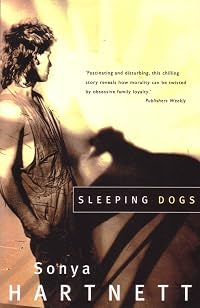
Sonya Hartnett was born on March 23, 1968 in Victoria. She is an Australian author of fiction for adults, young adults, and children. She was thirteen years old when she wrote her first novel and fifteen when it was published for the adult market in Australia, Trouble All the Way. For years she has written about one novel annually. According to show more the National Library of Australia, "The novel for which Hartnett has achieved the most critical (and controversial) acclaim was Sleeping Dogs" (1995). "A book involving incest between brother and sister and often critiqued as 'without hope', Sleeping Dogs generated enormous discussion within Australia. For her book Thursday's Child, she won the annual Guardian Children's Fiction Prize, a once-in-a-lifetime book award judged by a panel of British children's writers. Her titles include: The Boy and the Toy, Come Down, Cat!, Sadie and Ratz and The Children of the King. She will be attending the Sydney Writers Festival 2015. She made the shortlist for the Miles Franklin Literary Award with her title Golden Boys. This title also made the 2015 Prime Minister's Literary Awards shortlist. (Bowker Author Biography) show less
Some Editions
Awards and Honors
Awards
Notable Lists
Common Knowledge
- Canonical title
- The Midnight Zoo
- Original title
- The Midnight Zoo
- Original publication date
- 2010
- People/Characters
- Andrej; Tomas; Wilma
- Dedication
- This for Laura
- First words
- If the old bell had been hanging in the steeple it would have rung to announce midnight, twelve solemn iron klongs which would have woken the villagers from their sleep and startled any small creature new to the village and u... (show all)naccustomed to the noise.
- Quotations
- Having courage, Tomas had learned, didn't mean things would turn out well, and that you would be all right. Sometimes, Tomas knew, being courageous was the least safe thing in the world.
Classifications
Statistics
- Members
- 242
- Popularity
- 133,974
- Reviews
- 10
- Rating
- (3.68)
- Languages
- English, Korean
- Media
- Paper, Audiobook, Ebook
- ISBNs
- 29
- ASINs
- 4