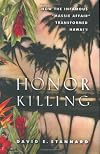
Honor Killing: Race, Rape, and Clarence Darrow's Spectacular Last Case
by David E. Stannard
On This Page
Description
In the fall of 1931, Thalia Massie, the bored, aristocratic wife of a young naval officer stationed in Honolulu, accused six nonwhite islanders of gang rape. The ensuing trial let loose a storm of racial and sexual hysteria, but the case against the suspects was scant and the trial ended in a hung jury. Outraged, Thalia's socialite mother arranged the kidnapping and murder of one of the suspects. In the spectacularly publicized trial that followed, Clarence Darrow came to Hawai'i to defend show more Thalia's mother, a sorry epitaph to a noble career. It is one of the most sensational criminal cases in American History, Stannard has rendered more than a lurid tale. One hundred and fifty years of oppression came to a head in those sweltering courtrooms. In the face of overwhelming intimidation from a cabal of corrupt military leaders and businessmen, various people involved with the case-the judge, the defence team, the jurors, a newspaper editor, and the accused themselves-refused to be cowed. show lessTags
Recommendations




























Member Reviews
This is a fascinating book about the 1931 Massie affair in which a white Navy wife accused a group of islanders of rape. Navy and business people acted swiftly to try to railroad the alleged rapists, with help from the conservative press, but the prosecution couldn't succeed in getting the jury to convict. Mrs Massie's mother and some sailors who worked for the Massies then kidnapped and killed on of the accused rapists. Clarence Darrow came from the mainland to defend them, arguing that there is a "higher law" that allows a husband to execute his wife's rapist.
I love this kind of history - he describes Hawaii and its politics at the time, and goes into the background of every character in this story. I'd known the history of how Hawaii show more was taken over by American businesses but hadn't realized the extent to which the Navy controlled things, too.
Stannard argues that this case was the beginning of a liberal trend in Hawaii, as Hawaiians, Japanese, Chinese, and mixed people came together to support each other and fight discrimination. After the Massie case unions began to organize as mixed-race groups and conservatives were voted out and replaced by liberals.
It's a terrific history and an absorbing mystery. show less
I love this kind of history - he describes Hawaii and its politics at the time, and goes into the background of every character in this story. I'd known the history of how Hawaii show more was taken over by American businesses but hadn't realized the extent to which the Navy controlled things, too.
Stannard argues that this case was the beginning of a liberal trend in Hawaii, as Hawaiians, Japanese, Chinese, and mixed people came together to support each other and fight discrimination. After the Massie case unions began to organize as mixed-race groups and conservatives were voted out and replaced by liberals.
It's a terrific history and an absorbing mystery. show less
An historical account of race relations in Hawaii in the early part of the 20th Century set against the backdrop of an alleged gang rape and lynching. I was interested to learn how progressive Hawaii could be and just how grotesquely racist the dominant culture could be both in the islands and on the continent. The author hypothesizes that the case in question dramatically changed politics and society in Hawaii for good.
Excellent book! The descriptions of Honolulu in the 1930s were fascinating, as were the trial narrations. Reads like a great fiction novel!
Ratings
Members
- Recently Added By
Author Information

7+ Works 785 Members
Some Editions
Common Knowledge
- People/Characters
- Clarence Darrow; Thalia Massie; Grace Fortesque; Joseph Kahahawai; Ben Ahakuelo; Thomas Massie (show all 14); David Hao; Nelson McIntosh; Patrick K. Gleason; Horace Ida; Yates Stirling; Edward J. Lord; Albert Jones; Lawrence Judd
- Dedication
- For Susan Rabiner
- First words
- This year, like the year before it and the year to follow, about seven million people will vacation in Hawai'i, more than six tourists for every resident. -Introduction
Today, Ala Moana Boulevard, on the south shore of the island of Oahu, is a busy six-lane divided thoroughfare that emerges from Waikiki's western end and sweeps along the coast line for several miles toward downtown Honolulu.... (show all) -Chapter One, Nothing But Trouble - Canonical DDC/MDS
- 364.15230969
- Canonical LCC
- KF224
Classifications
- Genres
- Nonfiction, History, General Nonfiction, Politics and Government, Biography & Memoir
- DDC/MDS
- 364.15230969 — Society, government, & culture Social problems and social services Crime Criminal offenses Offenses against the person Homicide Murder History, geographic treatment, biography
- LCC
- KF224 — Law Law of the United States Law of the United States (Federal) Criminal trials
- BISAC
Statistics
- Members
- 118
- Popularity
- 270,095
- Reviews
- 3
- Rating
- (4.37)
- Languages
- English
- Media
- Paper, Ebook
- ISBNs
- 3
- ASINs
- 2