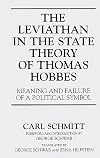
The Leviathan in the State Theory of Thomas Hobbes: Meaning and Failure of a Political Symbol
by Carl Schmitt
139 Members (3.92)
On This Page
Description
Carl Schmitt, the Thomas Hobbes of the 20th century, joined the Nazi party in 1933 and aspired to become the crown jurist and political philosopher of the Third Reich. But, because of his anti-Nazi past, friendships with Jews and Marxists, and contempt for biological racism, Schmitt was severely attacked by the SS in 1936 and warned to stop posing as a National Socialist thinker. Fearful of what this might imply in the rapidly evolving one-party SS state, Schmitt began to distance himself show more from his National Socialist adventure--even tempered his recently acquired anti-Semitism--and carefully started to reconnect himself in 1937 and 1938 to the pre-1933 Schmitt. Writing in 1938 under the pretext of studying the significance of the symbol of the leviathan in Hobbes's theory of state, Schmitt alluded to the demise of the Third Reich because of its rapid transformation into a totalitarian polity. As Schmitt recognized, in this state, the Hobbesian protection-obedience axiom was being heavily tilted in favor of obedience at the expense of protection. When this occurred, Schmitt observed, the soul of a people...betakes itself on the 'secret road' that leads inward. Then grows the counterforce of silence and stillness, and Public power and force may be ever so completely and emphatically recognized and ever so loyally respected, but only as a public and only an external power, it is hollow and already dead from within. Schmitt survived the fall of the Third Reich, and in the postwar years came to be recognized as one of the most significant political philosophers of the century. This is the first translation available of this important work which will be of great value to scholars and students of modern political philosophy, legal theory, and the history of Weimar and Nazi Germany. show lessTags
Recommendations

















































Member Reviews
Members
- Recently Added By
Author Information

101+ Works 3,273 Members
Carl Schmitt (1888-1985) is widely acknowledged to be one of the most important and influential political theorists of the twentieth century.
Common Knowledge
- Canonical title
- The Leviathan in the State Theory of Thomas Hobbes: Meaning and Failure of a Political Symbol
- People/Characters
- Hobbes, Thomas, 1588-1679
Classifications
- Genres
- Philosophy, Politics and Government, Nonfiction, Religion & Spirituality, General Nonfiction
- DDC/MDS
- 320.1 — Society, government, & culture Political science Types of Government The State
- LCC
- JC153 .H659 .S3513 — Political Science Political theory Political theory. The state. Theories of the state Modern state
- BISAC
Statistics
- Members
- 139
- Popularity
- 236,317
- Rating
- (3.92)
- Languages
- 7 — English, French, German, Italian, Polish, Russian, Spanish
- Media
- Paper
- ISBNs
- 13