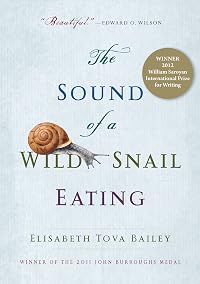
The Sound of a Wild Snail Eating
by Elisabeth Tova Bailey
On This Page
Description
In a work that beautifully demonstrates the rewards of closely observing nature, Elisabeth Tova Bailey shares an inspiring and intimate story of her encounter with a Neohelix albolabris--a common woodland snail. While an illness keeps her bedridden, Bailey watches a wild snail that has taken up residence on her nightstand. As a result, she discovers the solace and sense of wonder that this mysterious creature brings and comes to a greater understanding of her own place in the world. show more Intrigued by the snail's molluscan anatomy, cryptic defenses, clear decision making, hydraulic locomotion, and courtship activities, Bailey becomes an astute and amused observer, offering a candid and engaging look into the curious life of this underappreciated small animal. The Sound of a Wild Snail Eating is a remarkable journey of survival and resilience, showing us how a small part of the natural world can illuminate our own human existence, while providing an appreciation of what it means to be fully alive. show lessTags
Recommendations

















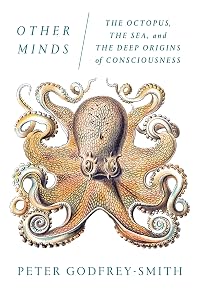
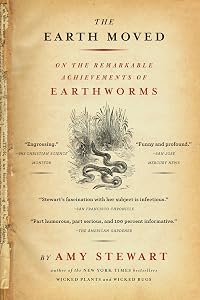
Member Recommendations
Member Reviews
This was simply one of the most beautiful reading experiences I've ever had. I'm reminded of discovering M. F. K. Fisher's food writing, or Annie Dillard's Pilgrim at Tinker Creek, or certain passages from Thoreau's Walden which I read for the first time as an impressionable teenager and have never forgotten. The set-up is this: the author, bed-ridden with a relapse of a (then) unidentified debilitating virus, and without even the energy to sit up or the concentration for reading, is presented with a woodland snail by a friend. Over the course of a year, she watches this tiny creature live its life in a large terrarium at eye level beside her bed with fascination and awe. During an extended slow recovery, she researched the subject of show more mollusks (malocology), as well as the surprising wealth of art and literature praising the slimy little wonders, and wrote this miraculous book. Food for the soul. show less
Writer Elisabeth Tova Bailey was felled by a mysterious illness, leaving her unable even to get out of bed. When a friend finds a forest snail and sets it up in a terrarium near her bedside, she suddenly has an activity to occupy her hungry senses as she becomes familiar with her new mollusk companion and its habits and quirks over the course of what must have been a very lonely year. This gentle read was a heartwarming palate-cleanser, and as a fan of natural history I loved learning more about these moist, charming creatures.
A beautiful miniature, in several senses. Elisabeth Tova Bailey packs a great deal into a scant two hundred pages here. "The Sound of a Wild Snail Eating" takes place almost entirely in her sickroom, and the its plot kicks off when one of her caregivers picks a bunch of wild violets on which a snail has hitched a ride. From that rather unexciting premise, the author builds the experience of sharing space with a common woodland snail into a tiny, yet intellectually adventurous, literary universe, managing to connect it with ideas about time, illness, design, companionship, survival, evolution beauty and much, much more. This book often reminded me of Emily Dickinson's brief, incisive poems: as in Dickinson's works, in which the briefest show more encounter with a bee or a flower provides an opportunity for an exploration of something much larger and more profound, Bailey manages to extract an enormous amount of meaning from her companionship with a common mollusk.
It is quite obvious that the author did extensive, meticulous research on the world and nature of snails as she was writing this book. I have to admit that I thought I'd learn so much about these these funny little animals, and much of what I learned was delightfully interesting. But because the author is a literary type and not a scientist, "The Sound of a Wild Snail Eating" reminded me of Richard Holmes's "Age of Wonder", book that explores how several scientists of the romantic period sought to employ their own preferences and circumstances to influence the direction that modern science would take. The fact that the author includes a wide range of quotations from non-scientific or now-outdated sources — ranging from Japanese poets to eighteenth-century naturalists — seems to suggest that the author's journey with her guest is as much a personal journey as a scientific one. The author, bedridden for months at a time, had little more to do than to watch her snail move around its terrarium: she develops both an emotional attachment to it and and takes advantage of her alarmingly weakened condition to watch her gastropod friend extremely closely. It's the author's experience of living with a snail that is, in the end, most important here. Her body in complete collapse, her life slows to — and I hope you'll forgive me here — a snail's pace, making her and her woodland friend natural allies and companions. Her recovery and the snail's own evolutionary success also seem intimately related: "The Sound of a Wild Snail Eating" is, in a sense, a book about survival in the face of almost impossible odds. The author draws much of her emotional strength from watching how a tiny animal devises so many different ways to feed, hide, move, and, ultimately, breed. Life, as Jeff Goldblum taught us, finds a way.
"The Sound of a Wild Snail Eating" is also noteworthy because it earns a place in the canon of what we might call illness or convalescence literature. Considering that may of us live with pain or illness, there's a surprising shortage of books that deal with bodily dysfunction as a major theme, though I don't want to slight first-class works like Elizabeth McCracken's "The Giant's House." But "The Sound of a Wild Snail Eating" is very much a book about what it feels like to be profoundly ill and isolated, and while I've got my own physical issues, reading about the author's extreme fatigue — she often lacks the energy even to turn herself over in bed — certainly made me appreciate what I am able to do. The author, to her immense credit, has managed to turn the extreme limitations imposed on her illness into an opportunity for a thoughtful and well-crafted meditation on her — and her snail friend's — struggle for survival, and on much more besides. Recommended. show less
It is quite obvious that the author did extensive, meticulous research on the world and nature of snails as she was writing this book. I have to admit that I thought I'd learn so much about these these funny little animals, and much of what I learned was delightfully interesting. But because the author is a literary type and not a scientist, "The Sound of a Wild Snail Eating" reminded me of Richard Holmes's "Age of Wonder", book that explores how several scientists of the romantic period sought to employ their own preferences and circumstances to influence the direction that modern science would take. The fact that the author includes a wide range of quotations from non-scientific or now-outdated sources — ranging from Japanese poets to eighteenth-century naturalists — seems to suggest that the author's journey with her guest is as much a personal journey as a scientific one. The author, bedridden for months at a time, had little more to do than to watch her snail move around its terrarium: she develops both an emotional attachment to it and and takes advantage of her alarmingly weakened condition to watch her gastropod friend extremely closely. It's the author's experience of living with a snail that is, in the end, most important here. Her body in complete collapse, her life slows to — and I hope you'll forgive me here — a snail's pace, making her and her woodland friend natural allies and companions. Her recovery and the snail's own evolutionary success also seem intimately related: "The Sound of a Wild Snail Eating" is, in a sense, a book about survival in the face of almost impossible odds. The author draws much of her emotional strength from watching how a tiny animal devises so many different ways to feed, hide, move, and, ultimately, breed. Life, as Jeff Goldblum taught us, finds a way.
"The Sound of a Wild Snail Eating" is also noteworthy because it earns a place in the canon of what we might call illness or convalescence literature. Considering that may of us live with pain or illness, there's a surprising shortage of books that deal with bodily dysfunction as a major theme, though I don't want to slight first-class works like Elizabeth McCracken's "The Giant's House." But "The Sound of a Wild Snail Eating" is very much a book about what it feels like to be profoundly ill and isolated, and while I've got my own physical issues, reading about the author's extreme fatigue — she often lacks the energy even to turn herself over in bed — certainly made me appreciate what I am able to do. The author, to her immense credit, has managed to turn the extreme limitations imposed on her illness into an opportunity for a thoughtful and well-crafted meditation on her — and her snail friend's — struggle for survival, and on much more besides. Recommended. show less
This is a lovely (and scary) little book about a woman who contracts some sort of viral or bacterial infection that decimates her health, leaving her unable to care for herself or even to sit up in bed. One day, one of her friends brings her a snail that she finds outside and the author's obsession with the life of this snail begins. She observes it and gets to know it, watches it give birth to new snails, and releases it. Her health improves slowly, but with relapses.
I found this brief book meditative and calming. I loved really delving in to the life of this one snail. There is lots of info about snails, some info about the woman's health journey, and lots of meditation on what we can learn from the life of a snail.
Highly show more recommended when you want something to set a slower pace. show less
I found this brief book meditative and calming. I loved really delving in to the life of this one snail. There is lots of info about snails, some info about the woman's health journey, and lots of meditation on what we can learn from the life of a snail.
Highly show more recommended when you want something to set a slower pace. show less
The Sound of a Wild Snail Eating is a book I didn’t expect to move me as much as it did. I loved the way it slowed everything down, allowing me to experience, if only for a brief moment, time as the author did: lying still, watching a snail live its life at its own deliberate pace. In that respect in reminded me of Moby-Dick. Both books make time and experiences tangible by realaying what a character learns: Ishmael about catching whales, this book's author about her snail.
I found myself fascinated by what I learned along the way: that a snail has more than two thousand teeth on its tongue, that it can sleep through drought or winter by sealing itself off, and that its shell grows in perfect logarithmic spirals.
Reading this felt like show more being granted access to another rhythm of existence. It reminded me that attention is a form of love and that even the smallest life, observed closely, can open vast worlds of wonder. A gentle and luminous book. show less
I found myself fascinated by what I learned along the way: that a snail has more than two thousand teeth on its tongue, that it can sleep through drought or winter by sealing itself off, and that its shell grows in perfect logarithmic spirals.
Reading this felt like show more being granted access to another rhythm of existence. It reminded me that attention is a form of love and that even the smallest life, observed closely, can open vast worlds of wonder. A gentle and luminous book. show less
"...the snail had emerged from its shell into the alien territory of my room, with no clue as to where it was or how it had arrived; the lack of vegetation and the desertlike surroundings must have seemed strange. The snail and I were both living in altered landscapes not of our choosing; I figured we shared a sense of loss and displacement."
Elisabeth Tova Bailey was in her mid-thirties when struck with a mysterious illness that soon led to her complete incapacitation. Without knowing the cause, much less the cure or the course that it might take, the disease was a frightening visitor. One day, a friend stops by with a rather odd gift. A snail, from out in the yard. First placed in a flower pot and eventually a terrarium, the snail show more becomes Bailey's constant companion. Because of her lack of mobility and energy, much of her time was spent observing the creature.
You might think this would be dull, or worse, that you'd be stuck listening to someone bleakly describing their every physical complaint. Not so. This book has very little to do with health issues and far more to do with curiosity and resilience. Bailey is not a complainer, actual details of her health are few and without self-pity. She doesn't simply give up either, she makes clear she wants to fight this unknown assailant on her life. That she does so with the help of a small snail is astounding.
The first surprise is that snails have a daily routine. They have certain times to eat and sleep and travel. They often return to the same place to sleep, and they sleep on their side. (!!!) As she watches the daily activities of the snail, she manages to study research on snails in general and in detail. Turns out snail research is pretty deep...volumes have been written on every tiny detail. As in: snails have teeth, 2200+ of them! Seriously, if they were bigger you'd think twice about stepping on one. They also have a special talent for when the going gets tough in their little world: they start a process called estivation. It's not hibernation (they do that too!) but instead it allows them to become dormant when the weather goes bad, or they lose their preferred food source, etc. Some snails have been known to estivate more than a few years. The process of sealing off their little shell is fascinating, and a study in insulation.
Then there's the romance. Researchers have studied that too, and I won't go into too much detail, but let's just say lady snails are not complaining about romance in their life! Male snails really knock themselves out on the charm aspect. So much of the research that is out there is fascinating, and Bailey sorts through it and shares the most interesting details. This isn't just a science project for her, she sees parallels in her condition as well as the snail's. Illness took her out of her social circle, and her life seemed slow and inconsequential. And snails usually are a typical example of slow and inconsequential living:
"Everything about a snail is cryptic, and it was precisely this air of mystery that first captured my interest. y own life, I realized, was becoming just as cryptic. From the severe onset of my illness and through its innumerable relapses, my place in the world has been documented more by my absence than by my presence. While close friends understood my situation, those who didn't know me well found my disappearance from work and social circles inexplicable.
...it wasn't that I had truly vanished; I was simply homebound, like a snail pulled into its shell. But being homebound in the human world is a sort of vanishing."
What makes this memoir unique, besides her indomitable spirit, is that she doesn't push any sort of religious or spiritual agenda for her positive outlook. There is no implied message, which is often a feature of such an inspiring book. Her facts are based on solid research, and she doesn't waste words; her prose is clear and precise. Additionally, and this may be trivial, but the book is exceptionally beautiful: little snail insignias, and designs, poetic quotes, and the actual fonts and design layout make it lovely.
One word of warning. Some inspirational "illness" stories often end up being the 'go to' gift choice for a sick friend. I know of one gentleman, who, when diagnosed with a serious illness, received eight copies of Tuesdays with Morrie from well-meaning friends. This is not that kind of book. It would be a far better gift for a Type-A personality that needs to slow down in their hectic life, or a book just to savor for yourself. It actually might make a great gift for a young person interested in science (the "romance" portions are tame). In any case, this book made me want to reconsider how much of my hectic life could be slowed down to enjoy the smaller but ultimately relevant details in the natural world around me. show less
Elisabeth Tova Bailey was in her mid-thirties when struck with a mysterious illness that soon led to her complete incapacitation. Without knowing the cause, much less the cure or the course that it might take, the disease was a frightening visitor. One day, a friend stops by with a rather odd gift. A snail, from out in the yard. First placed in a flower pot and eventually a terrarium, the snail show more becomes Bailey's constant companion. Because of her lack of mobility and energy, much of her time was spent observing the creature.
You might think this would be dull, or worse, that you'd be stuck listening to someone bleakly describing their every physical complaint. Not so. This book has very little to do with health issues and far more to do with curiosity and resilience. Bailey is not a complainer, actual details of her health are few and without self-pity. She doesn't simply give up either, she makes clear she wants to fight this unknown assailant on her life. That she does so with the help of a small snail is astounding.
The first surprise is that snails have a daily routine. They have certain times to eat and sleep and travel. They often return to the same place to sleep, and they sleep on their side. (!!!) As she watches the daily activities of the snail, she manages to study research on snails in general and in detail. Turns out snail research is pretty deep...volumes have been written on every tiny detail. As in: snails have teeth, 2200+ of them! Seriously, if they were bigger you'd think twice about stepping on one. They also have a special talent for when the going gets tough in their little world: they start a process called estivation. It's not hibernation (they do that too!) but instead it allows them to become dormant when the weather goes bad, or they lose their preferred food source, etc. Some snails have been known to estivate more than a few years. The process of sealing off their little shell is fascinating, and a study in insulation.
Then there's the romance. Researchers have studied that too, and I won't go into too much detail, but let's just say lady snails are not complaining about romance in their life! Male snails really knock themselves out on the charm aspect. So much of the research that is out there is fascinating, and Bailey sorts through it and shares the most interesting details. This isn't just a science project for her, she sees parallels in her condition as well as the snail's. Illness took her out of her social circle, and her life seemed slow and inconsequential. And snails usually are a typical example of slow and inconsequential living:
"Everything about a snail is cryptic, and it was precisely this air of mystery that first captured my interest. y own life, I realized, was becoming just as cryptic. From the severe onset of my illness and through its innumerable relapses, my place in the world has been documented more by my absence than by my presence. While close friends understood my situation, those who didn't know me well found my disappearance from work and social circles inexplicable.
...it wasn't that I had truly vanished; I was simply homebound, like a snail pulled into its shell. But being homebound in the human world is a sort of vanishing."
What makes this memoir unique, besides her indomitable spirit, is that she doesn't push any sort of religious or spiritual agenda for her positive outlook. There is no implied message, which is often a feature of such an inspiring book. Her facts are based on solid research, and she doesn't waste words; her prose is clear and precise. Additionally, and this may be trivial, but the book is exceptionally beautiful: little snail insignias, and designs, poetic quotes, and the actual fonts and design layout make it lovely.
One word of warning. Some inspirational "illness" stories often end up being the 'go to' gift choice for a sick friend. I know of one gentleman, who, when diagnosed with a serious illness, received eight copies of Tuesdays with Morrie from well-meaning friends. This is not that kind of book. It would be a far better gift for a Type-A personality that needs to slow down in their hectic life, or a book just to savor for yourself. It actually might make a great gift for a young person interested in science (the "romance" portions are tame). In any case, this book made me want to reconsider how much of my hectic life could be slowed down to enjoy the smaller but ultimately relevant details in the natural world around me. show less
As someone comforted by the presence of animals and wildness of every biological sort, including a great affection for slugs, and as someone with a chronic illness that leeches much of my energy, a book about a life-saving relationship with a snail 🐌 by a woman literally levelled by a pathogen 🦠 could only be of interest. The fact that my relationship with the small things just out my door has replaced earlier hikes and woodland walks almost entirely because of fatigue makes it all the easier to slip into the author's perspective and see as she sees, love as she loves.
But I don’t think you need to be ill to love this book. It is beautifully written, gently unfolding at the pace of its subject, the woodland snail that lives for a show more year beside the author’s bed. It is a meditation and an exploration, of relationship to doing, of relationship to self and illness and another creature barely aware of your existence. She explores the habits and biology of her snail friend in fascinating short chapters, while pondering the changes that not only her illness but the snail have brought to her life.
A beautiful book. show less
But I don’t think you need to be ill to love this book. It is beautifully written, gently unfolding at the pace of its subject, the woodland snail that lives for a show more year beside the author’s bed. It is a meditation and an exploration, of relationship to doing, of relationship to self and illness and another creature barely aware of your existence. She explores the habits and biology of her snail friend in fascinating short chapters, while pondering the changes that not only her illness but the snail have brought to her life.
A beautiful book. show less
Members
- Recently Added By
Lists

Recommended Nature Writing
346 works; 180 members

Best Biographies, Autobiographies and Memoirs
465 works; 160 members

Best Autobiographies and Memoirs
370 works; 66 members

Unlikely Pets
7 works; 6 members

Top Five Books of 2020
982 works; 350 members

Top Five Books of 2015
811 works; 240 members

wish list
61 works; 3 members

Best books read in 2011
200 works; 51 members

Amusing Book Titles
146 works; 39 members

thinking of reading in 2016
99 works; 1 member

Short Nonfiction Collections
51 works; 4 members

Five star books
1,755 works; 107 members

Favourite Books
1,819 works; 316 members
Club Read's Recommended Nonfiction Written by Women
618 works; 30 members

Favorite Animal Non-Fiction
293 works; 144 members

Books Read in 2017
4,249 works; 130 members
Author Information

1+ Work 1,581 Members
Awards and Honors
Common Knowledge
- Canonical title
- The Sound of a Wild Snail Eating
- Original publication date
- 2010-08-24
- Epigraph
- A small pet is often an excellent companion.
— Florence Nightingale, Notes on Nursing, 1912
The natural world is the refuge of the spirit... richer even than human imagination.
—Edward O. Wilson, Biophilia, 1984 - Dedication
- To biophilia
- First words
- In early spring, a friend went for a walk in the woods, and glancing down at the path, saw a snail. Picking it up, she held it gingerly in the palm of her hand and carried it back toward the studio where I was convalescing.
FROM MY HOTEL WINDOW I look over the deep glacial lake to the foothills and the Alps beyond. (Prologue) - Quotations
- ...my grandfather settled into life as a country doctor...when he answered a patient's call, even in the middle of the night, his very first words were always, "I am so sorry that you are not feeling well." How rare is it to ... (show all)hear a doctor express such empathy.
It seemed far more sensible to belong to a species that had evolved natural tooth replacement than to belong to one that had developed the dental profession. - Last words
- (Click to show. Warning: May contain spoilers.)I hope the terrestrial snails, secreted away in their burrows by day across the earth’s vast landscapes, will continue their mysterious lives, gliding slowly and gracefully through the night, millions of years into the future.
- Blurbers
- Fadiman, Anne; Hamilton, Jane; Kumin, Maxine
Classifications
- Genres
- Biography & Memoir, Science & Nature, General Nonfiction, Nonfiction
- DDC/MDS
- 594.38 — Natural sciences & mathematics Animals Mollusca: Clams, Snails, Squids, Octopuses Gastropoda; Univalves: snails, slugs
- LCC
- SF459 .S48 .B35 — Agriculture Animal husbandry. Animal science Animal culture Pets Other animals
- BISAC
Statistics
- Members
- 1,578
- Popularity
- 14,420
- Reviews
- 108
- Rating
- (4.17)
- Languages
- 5 — English, French, German, Italian, Spanish
- Media
- Paper, Audiobook, Ebook
- ISBNs
- 19
- ASINs
- 16