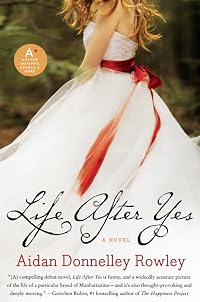
Life After Yes
by Aidan Donnelley Rowley
On This Page
Description
"Life After Yes is the story of Quinn, a strong soul thriving in the beautiful chaos of New York City, whose life begins to unravel when events beyond her control force her to stop polishing her resume and start living her life. A modern and honest tale about the beauty of doubt and the inscrutability of love and loss, Life After Yes offers a unique and compelling snapshot of the disillusioned and booze-addled existence of young professionals in post-9/11 Manhattan"--Provided by publisher.Tags
Recommendations















Member Recommendations
Member Reviews
There are some books that are important because of what they have to say. There are others that are important because of how they make one feel. While it would be easy to classify Life After Yes as a book that is meant to teach readers a bit about life and becoming an adult, the true import of it lies in its emotional pull. For, it is the type of book that is easily forgotten a day or two after finishing it but it is the emotions felt while reading it that are the only thing to linger. Readers may not be able to discuss specifics months, weeks, or even days after, but they can discuss how the book made them feel. Confusion, blissful happiness, concern, dread, anxiety, hope, love, fear, sorrow – it is all there as Quinn undergoes a show more massive transformation from a selfish, superficial girl into someone mature enough to move on to the next stage of adulthood.
It may be a forgettable plot, but there are some redeeming qualities to Life After Yes, not including the powerful emotional connections one feels towards Quinn. Life After Yes is remarkably well-written with a depth to it that is as welcome as it is unexpected. The philosophical discussions about becoming a grown-up are brilliant as well as eye-opening, regardless of the age of the reader. The devastation and lasting trauma from September 11th are also pitch-perfect. Quinn’s trauma will dredge up memories and the strong emotions everyone felt on that fatal day. Most importantly, Quinn is so alive. She is vibrant, massively flawed, and very real. Love her or hate her, she is a force of nature.
Life After Yes has all of the hallmarks of a cute, flippant, coming-of-age romance and does teeter on that edge several times. However, Ms. Rowley’s brilliant characterizations and stellar writing save the novel from becoming too clichéd and create something more serious and philosophical than any romance story ever is. The details behind Quinn’s journey are not as important as the impressions and emotions one gets from following her on her journey and even those are not nearly as important as the lessons one learns and can adapt for one’s own life. show less
It may be a forgettable plot, but there are some redeeming qualities to Life After Yes, not including the powerful emotional connections one feels towards Quinn. Life After Yes is remarkably well-written with a depth to it that is as welcome as it is unexpected. The philosophical discussions about becoming a grown-up are brilliant as well as eye-opening, regardless of the age of the reader. The devastation and lasting trauma from September 11th are also pitch-perfect. Quinn’s trauma will dredge up memories and the strong emotions everyone felt on that fatal day. Most importantly, Quinn is so alive. She is vibrant, massively flawed, and very real. Love her or hate her, she is a force of nature.
Life After Yes has all of the hallmarks of a cute, flippant, coming-of-age romance and does teeter on that edge several times. However, Ms. Rowley’s brilliant characterizations and stellar writing save the novel from becoming too clichéd and create something more serious and philosophical than any romance story ever is. The details behind Quinn’s journey are not as important as the impressions and emotions one gets from following her on her journey and even those are not nearly as important as the lessons one learns and can adapt for one’s own life. show less
Every now and then, a novel like Aidan Donnelley Rowley’s Life After Yes finds its way into my life, and it’s moments when I’m reading a book like this — where I feel like my own face is reflected back at me — that I experience what I can only call literary magic.
Maybe it’s that Quinn is a mere two years older than me, grappling with mortality and love and “prudence,” with safety. Maybe it’s that the book is set and firmly ensconced in New York City — and I started it on the train ride back from a long weekend there. Maybe it’s that, as I was reading last night, I had my own “Sage” napping next to me with one arm firmly around my back. And I felt happy. And safe.
Whatever it was, I’ll say this loud and proud: show more Life After Yes spoke to me. Shouted at me, really, in a way that I haven’t experienced with a novel in a long, long time. For all her moral issues, uncertainties, flaws, contradictions and need for direction, Quinn — or Prudence, as some know her — felt like a real person. Human. Blood. She felt like me.
I sped through this novel in record time, unwilling to put it down, and found myself dog-earing passage after passage about happiness, love, moving forward. Rowley’s prose was deft and poignant, always striking the perfect balance between telling and showing. Nothing is worse than a book that’s all thought and no action, a story where I’m told to care about the characters simply because it’s easier for the author.
This wasn’t that book.
What could have become a sad, maudlin tale — especially given Quinn’s emotional vulernability — became, instead, a story of perseverance, of unexpected moments of joy, of choosing happiness instead of just waiting for it to wash over you. Life After Yes also served as a big “screw you!” to conventional ideas about what our lives “should” be — filled with prudence, balance, careful thinking — and not being afraid to take the giant leaps. Those are the ones that matter.
Do I sound silly, over-the-top and way too excited about this book? Probably. But that’s just because I feel silly, over-the-top and excited just thinking about it. It’s rare to find a novel that seems to stretch its thin, cool fingers into the cockles of your heart and pull out every little thought and doubt you have in there, but Aidan Donnelley Rowley did that. For me.
Fans of women’s fiction, family dynamics, contemporary fiction, just plain good books — pick this one up. I think she’ll do that for you, too. show less
Maybe it’s that Quinn is a mere two years older than me, grappling with mortality and love and “prudence,” with safety. Maybe it’s that the book is set and firmly ensconced in New York City — and I started it on the train ride back from a long weekend there. Maybe it’s that, as I was reading last night, I had my own “Sage” napping next to me with one arm firmly around my back. And I felt happy. And safe.
Whatever it was, I’ll say this loud and proud: show more Life After Yes spoke to me. Shouted at me, really, in a way that I haven’t experienced with a novel in a long, long time. For all her moral issues, uncertainties, flaws, contradictions and need for direction, Quinn — or Prudence, as some know her — felt like a real person. Human. Blood. She felt like me.
I sped through this novel in record time, unwilling to put it down, and found myself dog-earing passage after passage about happiness, love, moving forward. Rowley’s prose was deft and poignant, always striking the perfect balance between telling and showing. Nothing is worse than a book that’s all thought and no action, a story where I’m told to care about the characters simply because it’s easier for the author.
This wasn’t that book.
What could have become a sad, maudlin tale — especially given Quinn’s emotional vulernability — became, instead, a story of perseverance, of unexpected moments of joy, of choosing happiness instead of just waiting for it to wash over you. Life After Yes also served as a big “screw you!” to conventional ideas about what our lives “should” be — filled with prudence, balance, careful thinking — and not being afraid to take the giant leaps. Those are the ones that matter.
Do I sound silly, over-the-top and way too excited about this book? Probably. But that’s just because I feel silly, over-the-top and excited just thinking about it. It’s rare to find a novel that seems to stretch its thin, cool fingers into the cockles of your heart and pull out every little thought and doubt you have in there, but Aidan Donnelley Rowley did that. For me.
Fans of women’s fiction, family dynamics, contemporary fiction, just plain good books — pick this one up. I think she’ll do that for you, too. show less
Summary: Prudence Quinn O'Malley, the protagonist of Life After Yes, is whisked off to Paris by her boyfriend for a romantic weekend and a proposal. Back in her New York lawyer life with a sparkly diamond on her hand, she has doubts about her future, her fiancé and herself. Her father, recently killed in the September 11 attacks, is very present in her memory and she desperately wishes for his wisdom as she navigates that rocky period between the giving of one ring and the giving of a second.
Full disclosure: Aidan Donnelley Rowley is the author of the Ivy League Insecurities blog, which I read daily without fail. Thus the fact that I "know" her a fraction and have some measure of interaction with her, compared to all those anonymous show more authors out there, may colour my review slightly; although I have tried not to let it. I would definitely recommend the blog!
Quinn is of course ex-Ivy League, a lawyer, slim, beautiful, fashionable, with a good salary and an investment banker partner. So far, so standard. But Quinn is not a black-and-white protagonist, she definitely has her flaws: her drinking verges on the alcoholic, she's clearly not yet over her long-term boyfriend whom she dumped not all that long ago in order to take up with her now fiancé, and she fails quite a few moral tests during the course of the book. I savoured this very realistic character - not the perfect athletic superwoman so many authors choose, and not the ditzy airhead (see Bridget Jones, Confessions of a Shopaholic...). I wanted to believe better of her on several occasions, and it's not often you feel let down by the heroine. (Although Jane Eyre and I are going to have words one day about her running off into the wilderness without any money and leaving her belonging on the coach. Because that was all pretty stupid and not really worthy of Jane). Quinn's grief is crippling and real, and this (as many of the reviewers pointed out on the cover) gives depth and texture to what could otherwise be passed off as chick-lit fluff.
I loved Quinn's mother - wise, feisty, suffering her grief in private, but clearly a woman who knows how to have her fun, and knows her daughter very well. Sage didn't convince me - he seemed pretty dull. What did Quinn see in him? His mother is terrible, truly awful, but there is a beautiful moment towards the end which does eventually endear her to the reader. His father, like Quinn's, is absent, although for very different reasons, and I think Rowley didn't particularly want Sage's father to contend with the strength of the void left by Quinn's father's death. I struggled with most of the minor characters - Kayla was too extreme, Avery too pale - I didn't really understand why Quinn would be friends with them. Quinn's brother Michael was very interesting and I was sorry not to see more of him in the plot.
Rowley has chosen a particularly unusual period of life about which to write - I am far more used to "getting the guy" being the resolution of the story. We follow Quinn from near-commitment to actual commitment and it permits us to live her doubts, her fears - all those emotions that brides-to-be are supposed to suffer through, but silently.
All in all, a very enjoyable read, most commendable as a debut, and I hope to read plenty more of Rowley's writing (not just on her blog!) show less
Full disclosure: Aidan Donnelley Rowley is the author of the Ivy League Insecurities blog, which I read daily without fail. Thus the fact that I "know" her a fraction and have some measure of interaction with her, compared to all those anonymous show more authors out there, may colour my review slightly; although I have tried not to let it. I would definitely recommend the blog!
Quinn is of course ex-Ivy League, a lawyer, slim, beautiful, fashionable, with a good salary and an investment banker partner. So far, so standard. But Quinn is not a black-and-white protagonist, she definitely has her flaws: her drinking verges on the alcoholic, she's clearly not yet over her long-term boyfriend whom she dumped not all that long ago in order to take up with her now fiancé, and she fails quite a few moral tests during the course of the book. I savoured this very realistic character - not the perfect athletic superwoman so many authors choose, and not the ditzy airhead (see Bridget Jones, Confessions of a Shopaholic...). I wanted to believe better of her on several occasions, and it's not often you feel let down by the heroine. (Although Jane Eyre and I are going to have words one day about her running off into the wilderness without any money and leaving her belonging on the coach. Because that was all pretty stupid and not really worthy of Jane). Quinn's grief is crippling and real, and this (as many of the reviewers pointed out on the cover) gives depth and texture to what could otherwise be passed off as chick-lit fluff.
I loved Quinn's mother - wise, feisty, suffering her grief in private, but clearly a woman who knows how to have her fun, and knows her daughter very well. Sage didn't convince me - he seemed pretty dull. What did Quinn see in him? His mother is terrible, truly awful, but there is a beautiful moment towards the end which does eventually endear her to the reader. His father, like Quinn's, is absent, although for very different reasons, and I think Rowley didn't particularly want Sage's father to contend with the strength of the void left by Quinn's father's death. I struggled with most of the minor characters - Kayla was too extreme, Avery too pale - I didn't really understand why Quinn would be friends with them. Quinn's brother Michael was very interesting and I was sorry not to see more of him in the plot.
Rowley has chosen a particularly unusual period of life about which to write - I am far more used to "getting the guy" being the resolution of the story. We follow Quinn from near-commitment to actual commitment and it permits us to live her doubts, her fears - all those emotions that brides-to-be are supposed to suffer through, but silently.
All in all, a very enjoyable read, most commendable as a debut, and I hope to read plenty more of Rowley's writing (not just on her blog!) show less
I was given an ARC of this novel by the publisher, Avon, an imprint of Harper Collins.
Life After Yes chronicles the emotions that overwhelm Prudence Quinn O’Malley, a 27 year-old Manhattan attorney, after she accepts her boyfriend Sage’s marriage proposal. Her anxieties about what her “yes” will mean for the rest of her life are played out amidst her struggle to reconcile the loss of her father a year earlier in the terrorist attack on the World Trade Center. Along the way we meet her friends, one of whom is a fellow lawyer with a brash exterior that hides massive insecurities, and the other, an eternal optimist pursuing her own conventional dreams of happily ever after. Her friends play to the dueling aspects of Quinn’s show more personality that, all truth be told, are most likely present in us all: the prudent, careful nature that can keep us tied to jobs we don’t like or partners who are not all what we had hoped for, and the competing inclination to take a risk and move into unfamiliar territory that can allow us to find happiness in unexpected ways. Rounding out the cast of characters are Quinn’s wisecracking personal trainer, old flames, assorted partners and associates at Quinn’s firm, and members of both their families, including the image of Quinn’s father that the reader gains from her recollections. As the novel progresses, the reader is introduced to the world of big firm lawyering with all its warts and the genteel South that is Sage’s home, and made aware (if he or she was not already) of the peculiar pull that the world of technology has on this generation, as personified by the ubiquitous blackberry.
I have to admit that when I received this book I was afraid that I might not be able to relate to Quinn and her “issues” given that I am technically old enough to be her mother, although my daughter is only beginning college. While I have no doubt that those of Quinn’s generation and younger will find much to identify with in Ms. Rowley‘s sharp and well-written dialogue, I was a little skeptical for myself. Much to my pleasant surprise, however, I enjoyed Life After Yes, in large part due to Ms. Rowley’s insightful depictions of the emotions experienced by Quinn’s mother and future mother-in-law at the prospect of the impending marriage. Without revealing too much of the story, there is a passage toward the end of the novel in which Quinn’s future mother-in-law opens up in a way that will powerfully resonate with any mother out there who has experienced on some level letting go of her child. As well, Quinn’s inability at times to decipher what is right for her is not limited to her generation, as I daresay that there are few among us who have not felt at one time or another that we may be on the wrong road. Finally, I appreciated that Ms. Rowley remained true to her characters by resisting the escape of a happily ever after ending.
If you’re looking for a summer read that is above and beyond the type of books that show up on “best beach read” lists, I would try Life After Yes. show less
Life After Yes chronicles the emotions that overwhelm Prudence Quinn O’Malley, a 27 year-old Manhattan attorney, after she accepts her boyfriend Sage’s marriage proposal. Her anxieties about what her “yes” will mean for the rest of her life are played out amidst her struggle to reconcile the loss of her father a year earlier in the terrorist attack on the World Trade Center. Along the way we meet her friends, one of whom is a fellow lawyer with a brash exterior that hides massive insecurities, and the other, an eternal optimist pursuing her own conventional dreams of happily ever after. Her friends play to the dueling aspects of Quinn’s show more personality that, all truth be told, are most likely present in us all: the prudent, careful nature that can keep us tied to jobs we don’t like or partners who are not all what we had hoped for, and the competing inclination to take a risk and move into unfamiliar territory that can allow us to find happiness in unexpected ways. Rounding out the cast of characters are Quinn’s wisecracking personal trainer, old flames, assorted partners and associates at Quinn’s firm, and members of both their families, including the image of Quinn’s father that the reader gains from her recollections. As the novel progresses, the reader is introduced to the world of big firm lawyering with all its warts and the genteel South that is Sage’s home, and made aware (if he or she was not already) of the peculiar pull that the world of technology has on this generation, as personified by the ubiquitous blackberry.
I have to admit that when I received this book I was afraid that I might not be able to relate to Quinn and her “issues” given that I am technically old enough to be her mother, although my daughter is only beginning college. While I have no doubt that those of Quinn’s generation and younger will find much to identify with in Ms. Rowley‘s sharp and well-written dialogue, I was a little skeptical for myself. Much to my pleasant surprise, however, I enjoyed Life After Yes, in large part due to Ms. Rowley’s insightful depictions of the emotions experienced by Quinn’s mother and future mother-in-law at the prospect of the impending marriage. Without revealing too much of the story, there is a passage toward the end of the novel in which Quinn’s future mother-in-law opens up in a way that will powerfully resonate with any mother out there who has experienced on some level letting go of her child. As well, Quinn’s inability at times to decipher what is right for her is not limited to her generation, as I daresay that there are few among us who have not felt at one time or another that we may be on the wrong road. Finally, I appreciated that Ms. Rowley remained true to her characters by resisting the escape of a happily ever after ending.
If you’re looking for a summer read that is above and beyond the type of books that show up on “best beach read” lists, I would try Life After Yes. show less
I started this book a little ambivalent. I thought it was going to be another Chick-lit/"Sex in the City" clone with New York girls perpetually dissatisfied with the mostly perfect lives.
Well, it was and it wasn't. Quinn/Prudence, our heroine is leads a somewhat "only in books" like. Great job, perfect boyfriend, great New York apartment, and no money worries what so ever. So, what's she got to complain about, right?
First off, she lost her beloved father in 9/11. A plot device which could have been schmaltzy or just plain gimmicky. But instead is handled with care and restraint and really does work in this story. Second, she's not a "Oh, I can't wait to get married" kind of girl and a little panicked about whether or not she's happy show more about it. Finally, she's not sure she's over her first love, she's not sure her fiance hasn't just cheated on her with her best friend, she's not sure she loves her career, and she's really not sure what she thinks of her future Mother-in-law.
Now, I'm not usually a big fan of books where the girl has everything but she's "just not happy" (that part should be said in a whiny voice). But, this book works. Rowley makes her main character some one to whom you can relate and all the secondary characters are believable and endearing. I ended up stating you way to late to finish which is always the sign of a good book.
I know this book just came out yet, I'm still looking forward to see what Rowley does next. show less
Well, it was and it wasn't. Quinn/Prudence, our heroine is leads a somewhat "only in books" like. Great job, perfect boyfriend, great New York apartment, and no money worries what so ever. So, what's she got to complain about, right?
First off, she lost her beloved father in 9/11. A plot device which could have been schmaltzy or just plain gimmicky. But instead is handled with care and restraint and really does work in this story. Second, she's not a "Oh, I can't wait to get married" kind of girl and a little panicked about whether or not she's happy show more about it. Finally, she's not sure she's over her first love, she's not sure her fiance hasn't just cheated on her with her best friend, she's not sure she loves her career, and she's really not sure what she thinks of her future Mother-in-law.
Now, I'm not usually a big fan of books where the girl has everything but she's "just not happy" (that part should be said in a whiny voice). But, this book works. Rowley makes her main character some one to whom you can relate and all the secondary characters are believable and endearing. I ended up stating you way to late to finish which is always the sign of a good book.
I know this book just came out yet, I'm still looking forward to see what Rowley does next. show less
I was fascinated by this hard working, hard drinking young woman, who was far more obsessed with looking good on her wedding day than she was with her groom.Quinn's groom was a sweet mama's boy, but the book wasn't really about him. I had trouble keeping Quinn's friends straight, but the book wasn't about them either. All the supporting characters (her family, her coworkers, her personal trainer/therapist) were fun and worked well enough.The odd thing about this book was that I kept thinking that a happy ending would consist of Quinn and Sage realizing that neither of them was ready to get married-- they both needed to grow up a little. You'd think that I'd hope that they'd do that growing up, because it seems like they could make a show more nice couple down the road, but that wasn't what I was thinking. show less
Ratings
Members
- Recently Added By
Author Information
2 Works 209 Members
Common Knowledge
- Canonical title
- Life After Yes
- Original publication date
- 2010
- People/Characters
- Prudence Quinn O'Malley; Sage McIntyre; Kayla Waters; Avery; Mrs. McIntyre; Mrs. O'Malley (show all 9); Mr. McIntyre; Phelps; Victor
- Important places
- New York, New York, USA; Wisconsin, USA
- Important events
- September 11 Attacks (2001-09-11)
- Epigraph
- "It is never prudent to start a novel with a dream. No, it is cliched, a telltale sign of amateur craft." -- Everyone
"Prudence is an attitude that keeps life safe, but does not often make it happy." -- Samuel Johnson
... (show all)"Nothing happens unless first a dream." -- Carl Sandburg - Dedication
- For Mom and Dad Here, Gone, Forever
- First words
- I'm choking. I can't breathe.
- Quotations
- Growing up doesn't just happen. It's not a fact; it's a decision.
Maybe honesty is just another one of those things we strive for and banter about, a glittering cliche like prudence, which necessarily eludes us.
This is how happiness comes -- in small moments, in fierce flashes. It's not a state of being, not remotely permanent.
. . . I think that maybe this is what we can both hope for and achieve; moments when everything seems okay, even a bit better than okay. - Last words
- (Click to show. Warning: May contain spoilers.)And, prudently, she swims away, disappearing into the murky depths of a future wonderfully uncertain.
Classifications
Statistics
- Members
- 72
- Popularity
- 435,516
- Reviews
- 6
- Rating
- (3.58)
- Languages
- English
- Media
- Paper, Ebook
- ISBNs
- 2
- ASINs
- 2