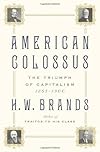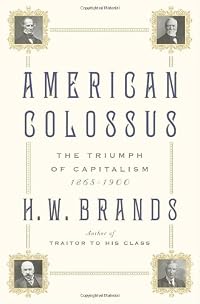
American Colossus: The Triumph of Capitalism, 1865-1900
by H. W. Brands
On This Page
Description
From bestselling historian H. W. Brands, a sweeping chronicle of how a few wealthy businessmen reshaped America from a land of small farmers and small businessmen into an industrial giant.Tags
Recommendations




Member Recommendations
Member Reviews
Brand is an excellent writer. He has excellent style and pacing. American Colossus is an enjoyable read.
However, he is a lefty with all that entails. Like most, he has a checklist of subjects to cover whether or not they are germane to the topic at hand. The topic is the Gilded Age and the author's belief that there exists a dichotomy between capitalism and democracy. His characters and setting were the Capitalist Revolution, the great capitalists, the political leaders, and the reactions for and against them. Brand's brief treatment of gays didn't even bother linking to the overall subject in any way. The decline of the African-American status after Reconstruction was tenuously linked to the greater capitalist changes, mostly through show more the person of Booker T. Washington. Outside the Washington link, the other stories were not conducive to the subject matter or forwarding the narrative. I do feel he could have come at this from a different angle or different treatment and made their inclusion into the narrative more relevant, but that he didn't do so is a strike. If you're going to include it, do it right. The changes in the status of women were included in the general narrative by and large and not in asides or subsections like the gays and African Americans. It is evident that this information was more pertinent than the others and therefore more successfully included.
Finally, the author states from the beginning that democracy and capitalism are at odds at the most fundamental level and therefore contradictory. He states this as a fact and not as a belief. I do not share this belief, but I find it refreshing that it was stated in a straightforward manner. As Brand goes through his narrative every so often he has to circle back and attempt to tie his thesis in with the events. I did not find those attempts successful. Most seemed "bolted on." You can see the seams.
I appreciated that he didn't paint caricatures. Rockefeller, Carnegie, Morgan, Grant, Roosevelt, etc. were treated as well-rounded human beings with complex motives. Regardless of how one views them, they DID contribute greatly to America and the world at large.
As a layman's narrative, I believe this is a good introduction to the Gilded Age. show less
However, he is a lefty with all that entails. Like most, he has a checklist of subjects to cover whether or not they are germane to the topic at hand. The topic is the Gilded Age and the author's belief that there exists a dichotomy between capitalism and democracy. His characters and setting were the Capitalist Revolution, the great capitalists, the political leaders, and the reactions for and against them. Brand's brief treatment of gays didn't even bother linking to the overall subject in any way. The decline of the African-American status after Reconstruction was tenuously linked to the greater capitalist changes, mostly through show more the person of Booker T. Washington. Outside the Washington link, the other stories were not conducive to the subject matter or forwarding the narrative. I do feel he could have come at this from a different angle or different treatment and made their inclusion into the narrative more relevant, but that he didn't do so is a strike. If you're going to include it, do it right. The changes in the status of women were included in the general narrative by and large and not in asides or subsections like the gays and African Americans. It is evident that this information was more pertinent than the others and therefore more successfully included.
Finally, the author states from the beginning that democracy and capitalism are at odds at the most fundamental level and therefore contradictory. He states this as a fact and not as a belief. I do not share this belief, but I find it refreshing that it was stated in a straightforward manner. As Brand goes through his narrative every so often he has to circle back and attempt to tie his thesis in with the events. I did not find those attempts successful. Most seemed "bolted on." You can see the seams.
I appreciated that he didn't paint caricatures. Rockefeller, Carnegie, Morgan, Grant, Roosevelt, etc. were treated as well-rounded human beings with complex motives. Regardless of how one views them, they DID contribute greatly to America and the world at large.
As a layman's narrative, I believe this is a good introduction to the Gilded Age. show less
For almost a decade now, one of my father's hobbies has been restoring pocket watches used on the American railroad in the late eighteen hundreds. Understandably, he's learned more about the history of that era. A while back he mentioned to me that railroads had invented standardized time zones. This was fascinating to me.
For as long as I can remember, I've liked trains. Not riding on new trains [I don't particularly like public transportation]. But learning about old trains.
I asked my dad about a book recommendation about robber barons and the railroad, but he didn't have much for me. So I started doing my own research.
Donald Drumpf is running for president right now. "Make America Great Again" is his slogan. Many people ask, "but when show more was that?" It's quite clear to me: he's referring to the Gilded Age of the United States, the late 1800s. It was a terrible era, but it was also great.
Silicon Valley these days is the epitome of wealth inequality. Some have been drawing parallels between today's era and that of the Gilded Age. I could get behind such a claim.
I came across this book, by renown historian H. W. Brands. Some reviewers though it didn't have a coherent enough centerline, instead falling back on the cliché "Democracy vs. Capitalism." Yes, the book has a ton in it, but we're talking about an era here, not a piece of fiction. A plot line that's too easy to follow would be an oversimplification.
I absolutely loved the book. It tells story after story, each one as interesting as the next.
Did you know that we had a trans-Atlantic cable line before we had a transcontinental railroad? Or did you know that New York invented the apartment building during this era? Or that Chicago invented the sky scraper? Little tidbits like this are endless.
I found the story of our treatment of blacks and Native Americans particularly riveting [if revolting]. Why did we free the blacks from slavery while slaughtering the remaining Native Americans? Because blacks were the single most valuable asset of the South. And the Union wanted to prevent the South from succession, both during the Civil War, and anytime thereafter. What's the best way to do that? Make them economically incapable of war. If you doubt that the sentiment could be this barbaric, consider this: Civil War leaders openly stated that they didn't think much of blacks, and once the war was completed, went right on to go killing Native Americans.
Who were the big names of the era? John D. Rockefeller [oil], Andrew Carnegie [steel], and J. P. Morgan [finance] and the ones that stick with me. show less
For as long as I can remember, I've liked trains. Not riding on new trains [I don't particularly like public transportation]. But learning about old trains.
I asked my dad about a book recommendation about robber barons and the railroad, but he didn't have much for me. So I started doing my own research.
Donald Drumpf is running for president right now. "Make America Great Again" is his slogan. Many people ask, "but when show more was that?" It's quite clear to me: he's referring to the Gilded Age of the United States, the late 1800s. It was a terrible era, but it was also great.
Silicon Valley these days is the epitome of wealth inequality. Some have been drawing parallels between today's era and that of the Gilded Age. I could get behind such a claim.
I came across this book, by renown historian H. W. Brands. Some reviewers though it didn't have a coherent enough centerline, instead falling back on the cliché "Democracy vs. Capitalism." Yes, the book has a ton in it, but we're talking about an era here, not a piece of fiction. A plot line that's too easy to follow would be an oversimplification.
I absolutely loved the book. It tells story after story, each one as interesting as the next.
Did you know that we had a trans-Atlantic cable line before we had a transcontinental railroad? Or did you know that New York invented the apartment building during this era? Or that Chicago invented the sky scraper? Little tidbits like this are endless.
I found the story of our treatment of blacks and Native Americans particularly riveting [if revolting]. Why did we free the blacks from slavery while slaughtering the remaining Native Americans? Because blacks were the single most valuable asset of the South. And the Union wanted to prevent the South from succession, both during the Civil War, and anytime thereafter. What's the best way to do that? Make them economically incapable of war. If you doubt that the sentiment could be this barbaric, consider this: Civil War leaders openly stated that they didn't think much of blacks, and once the war was completed, went right on to go killing Native Americans.
Who were the big names of the era? John D. Rockefeller [oil], Andrew Carnegie [steel], and J. P. Morgan [finance] and the ones that stick with me. show less
A stunning reminder that the obsession with capitalism, lack of welfare, corrupt politicians, stolen elections, voter suppression, and immoral court rulings were as recognizable and called out in the US of the 1800s as they are today.
Like all of the narrative histories written by Brands, this is workmanlike, solid, broad, engaging, interesting, and easy-to-read. Brands breaks no new research here, it is almost all secondary sources and printed primary sources, but Brands gives an insightful account of the era, which allows the public and historians alike to have a proper grounding in the history of this important time in American history. I thought it balanced well enough and well written.
Pleasant, but rather random history of US from post civil war to 1900. I enjoyed the capsule histories of Tammany Hall, Grover Cleveland, JP Morgan/Rockefeller, WJ Bryan and so forth- and glad to have read them, but author is at pains to point out how this is another win for capitalism. Ummm... ok. sometimes i guess that seemed true (vs. what? uncapitalism? socialism? communism? liberalism?) but it didn't particularly hang together for me as a theme.
Excellent, really brings the Gilded Age to life.
Various chapters discuss everything from politics to business to labor to city life, etc...
The highlight is a train chase scene. A freakin' train chase!
Various chapters discuss everything from politics to business to labor to city life, etc...
The highlight is a train chase scene. A freakin' train chase!
Read several weeks ago; it had to be "returned" before I was finished, and it wasn't available to be checked out again. :(
Less of a coherent narrative than a series of historical vignettes, taking aspects of American life in the late 19th century and examining them through a lens of the growth of modern capitalism. Most interesting to me were the chapters that looked at areas that aren't normally associated with big business: cowboys and Indians (so to speak) were particularly intriguing.
I was somewhat disappointed by the disjointed nature of the book, but once I accepted that, I enjoyed it, and I'd like to read this again.
Less of a coherent narrative than a series of historical vignettes, taking aspects of American life in the late 19th century and examining them through a lens of the growth of modern capitalism. Most interesting to me were the chapters that looked at areas that aren't normally associated with big business: cowboys and Indians (so to speak) were particularly intriguing.
I was somewhat disappointed by the disjointed nature of the book, but once I accepted that, I enjoyed it, and I'd like to read this again.
Members
- Recently Added By
Published Reviews
ThingScore 75
The nature of both ruin and success is the subject of "American Colossus," H.W. Brands's account of, as the subtitle has it, "The Triumph of Capitalism" during the period 1865-1900. Mr. Brands paints a vivid portrait of both this understudied age and those industrialists still introduced by high-school teachers as "robber barons"—Vanderbilt, Andrew Carnegie, John D. Rockefeller and J.P. Morgan.
added by atbradley
Author Information

55+ Works 12,024 Members
H.W. Brands was born Henry William Brands in Oregon. He graduated from Stanford University in 1975 with a B.A. in history, and from Jesuit High School in Portland, Oregon. He went on to earn his graduate degree in mathematics and history in Oregon and Texas. He taught at Vanderbilt University and Texas A&M University before he joined the faculty show more at the University of Texas at Austin. He acquired the title of Dickson Allen Anderson Centennial Professor of History at the U of Texas. He specializes in American History and politics, with books including Traitor to His Class, Andrew Jackson, The Age of Gold, the First American, and TR. Several of his books have been best sellers, including one recently published, The General vs. the President. Two of them - Traitor to His Class and The First American were finalist for the Pulitzer Prize. He lectures often on historical and current events and he can be seen and heard on national television and radio programs. (Bowker Author Biography) H. W. Brands lives in Austin, Texas. (Publisher Provided) H. W. Brands is Distinguished Professor of History and Ralph R. Thomas '21 Professor in Liberal Arts, Texas A&M University. (Bowker Author Biography) show less
Work Relationships
Common Knowledge
- Original publication date
- 2010
- People/Characters
- John D. Rockefeller; John Pierpont Morgan; Andrew Carnegie; Jay Cooke; Cornelius Vanderbilt; Daniel Drew (show all 12); Adam Smith; John Jacob Astor; Andrew Jackson; Ulysses S. Grant; Andrew Carnegie; Jay Gould
- First words
- (Prologue) John Pierpont Morgan enjoyed an excellent Civil War.
The capitalist revolution was a matter of technique and technology. - Last words
- (Click to show. Warning: May contain spoilers.)"Pierpont Morgan is apparently trying to swallow th sun," Henry Adams remarked.
(Click to show. Warning: May contain spoilers.)(Epilogue) "You will if you get in," Ford muttered.
Classifications
Statistics
- Members
- 636
- Popularity
- 45,437
- Reviews
- 9
- Rating
- (3.61)
- Languages
- English, French
- Media
- Paper, Audiobook, Ebook
- ISBNs
- 10
- ASINs
- 5