On This Page
Description
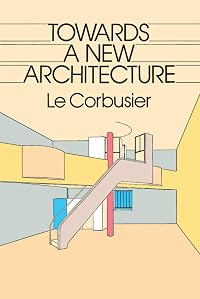
For the Swiss-born architect and city planner Le Corbusier (Charles-Édouard Jeanneret, 1887-1965), architecture constituted a noble art, an exalted calling in which the architect combined plastic invention, intellectual speculation, and higher mathematics to go beyond mere utilitarian needs, beyond "style," to achieve a pure creation of the spirit which established "emotional relationships by means of raw materials." The first major exposition of his ideas appeared in Vers une Architecture show more (1923), a compilation of articles originally written by Le Corbusier for his own avant-garde magazine, L'Esprit Nouveau. The present volume is an unabridged English translation of the 13th French edition of that historic manifesto, in which Le Corbusier expounded his technical and aesthetic theories, views on industry, economics, relation of form to function, the "mass-production spirit," and much else. A principal prophet of the "modern" movement in architecture, and a near-legendary figure of the "International School," he designed some of the twentieth century's most memorable buildings: Chapel at Ronchamp; Swiss dormitory at the Cité Universitaire, Paris; Unité d'Habitation, Marseilles; and many more. Le Corbusier brought great passion and intelligence to these essays, which present his ideas in a concise, pithy style, studded with epigrammatic, often provocative, observations: "American engineers overwhelm with their calculations our expiring architecture." "Architecture is stifled by custom. It is the only profession in which progress is not considered necessary." "A cathedral is not very beautiful . . ." and "Rome is the damnation of the half-educated. To send architectural students to Rome is to cripple them for life." Profusely illustrated with over 200 line drawings and photographs of his own works and other structures he considered important, Towards a New Architecture is indispensable reading for architects, city planners, and cultural historians ? but will intrigue anyone fascinated by the wide-ranging ideas, unvarnished opinions, and innovative theories of one of this century's master builders. show lessTags
Recommendations








Member Reviews
Passionate writing. The rhetoric of the last chapter made me think of Mon Oncle as a reaction. Corbusier does lay it on thickly. As a rural Midwesterner, his appreciation of grain elevators gladdened me. There are lots of ideas for contemplation buried inside.
This translation of Towards a New Architecture, originally written in 1923, is prophetic in many ways. Le Corbusier writes of the “machine age” much like someone now might write of the “information age”. But he is somewhat poetic, repetitive and I would not be surprised if Tom Peters (ex-Harvard innovation guru) adopted something of Le Corbusier's style. While many of the architect's ideas were controversial, and may not have functioned as desired, he foresaw many of the things that are happening today in terms of construction materials. Although I do not doubt that the way these materials have been used meet the "cheapness" but not necessarily the "good work" he envisaged (p. 284). My favourite quote: "There is no such thing as show more primitive man. There are primitive resources. The idea is constant, strong from the start" (p. 70). show less
Le Corbusier's first book (a compilation of essays from his magazine L'Esprit Nouveau) lays out many of the ideas that have persevered both in terms of his oeuvre and modernism as a whole, particularly the inspiration found in industrial buildings (grain elevators) and machines (cars, airplanes, ships). The book is required reading in most early-level architecture classes, so most architects have read it and are familiar with his "unvarnished opinions and innovative theories."
From my blog post on Le Corbusier: https://archidose.blogspot.com/2013/06/so-you-want-to-learn-about-le-corbusier.h...
From my blog post on Le Corbusier: https://archidose.blogspot.com/2013/06/so-you-want-to-learn-about-le-corbusier.h...
Le Corbusier's first book (a compilation of essays from his magazine L'Esprit Nouveau) lays out many of the ideas that have persevered both in terms of his oeuvre and modernism as a whole, particularly the inspiration found in industrial buildings (grain elevators) and machines (cars, airplanes, ships). The book is required reading in most early-level architecture classes, so most architects have read it and are familiar with his "unvarnished opinions and innovative theories."
From my blog post on Le Corbusier: https://archidose.blogspot.com/2013/06/so-you-want-to-learn-about-le-corbusier.h...
From my blog post on Le Corbusier: https://archidose.blogspot.com/2013/06/so-you-want-to-learn-about-le-corbusier.h...
This is a must read for any architect. It explains all of modernism and also gives you a window into its problems. It is also concise which is strange for most architects’ writings.
Ratings
Members
- Recently Added By
Lists

Le Corbusier
11 works; 1 member

el
1,139 works; 1 member
Author Information

204+ Works 3,693 Members
Le Corbusier is considered by many to be the leading architect of modern architecture. Born of Swiss parentage near Geneva, but a lifelong Parisian by choice, he started his practice in 1922. In 1923 he published his startling manifesto of what he called "the aesthetics of modern life," Vers une architecture (Towards a New Architecture). Le show more Corbusier worked first at simplifying and liberating house design through the revolutionary use of new materials---particularly, reinforced concrete---and new technical ideas for mass production, which he applied in the so-called Dom-Ino and the Citrohan House. In his widely influential book La Ville Radieuse (The Radiant City) (1935), he laid down his urban planning ideas:a city of high-rise buildings set among trees and grass. His designs for large building groups proved to be as influential as his domestic designs had been. These include the famous housing project in Marseilles (the Unite d'Habitation), his League of Nations project in Geneva (unexecuted), and, toward the end of his life, the startling designs for the capital city of Punjab, Chandigarh. He also participated---controversially---in the designs for the U.N. headquarters in New York. In his last years, Le Corbusier turned away from the geometry and pure logic of his first designs and adopted sculptural and dramatic forms, as in Chandigarh. The almost mystical complexities of Le Corbusier's Pilgrim Church of Ronchamps in the French Jura opened another chapter in the history of twentieth-century architecture. (Bowker Author Biography) show less
Some Editions
Series

Belongs to Publisher Series
Common Knowledge
- Canonical title
- Towards a New Architecture
- Original title
- Vers une architecture
- Original publication date
- 1923
- First words
- The Engineer’s Aesthetic, and Architecture, are two things that march together and follow one from the other: the one being now at its full height, the other in an unhappy state of retrogression.
- Last words
- (Click to show. Warning: May contain spoilers.)Revolution can be avoided.
- Original language*
- Français
*Some information comes from Common Knowledge in other languages. Click "Edit" for more information.
Classifications
Statistics
- Members
- 1,203
- Popularity
- 20,682
- Reviews
- 5
- Rating
- (3.72)
- Languages
- 14 — Catalan, English, Finnish, French, German, Greek, Hungarian, Italian, Japanese, Norwegian (Bokmål), Polish, Portuguese, Spanish, Turkish
- Media
- Paper, Ebook
- ISBNs
- 44
- UPCs
- 1
- ASINs
- 23