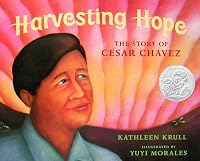
Harvesting Hope: The Story of Cesar Chavez
by Kathleen Krull
On This Page
Description
A biography of Cesar Chavez, from age ten when he and his family lived happily on their Arizona ranch, to age thirty-eight when he led a peaceful protest against California migrant workers' miserable working conditions.Tags
Recommendations











Member Reviews
The inspiring life-story of Cesar Chavez, the founder of the United Farm Workers - the first organization to fight for the rights of America's underpaid and mistreated migrant farm laborers - is told in Kathleen Krull's wonderful picture-book, Harvesting Hope. From his early childhood on his family's Arizona ranch, lost when drought and depression forced them to sell, to his days as a young migrant worker in the California fields, Krull's narrative follows Chavez as he slowly developed from a shy young boy into the labor leader who would force agribusiness to treat its workers like human beings.
Chavez's devotion to peaceful methods, despite the violence meted out by his enemies; the three-thousand mile walk to Sacramento he organized show more (the longest protest march in U.S. history); and the periodic hunger strikes in which he participated (an activity which would eventually kill him), are all covered. Krull's engaging narrative is greatly enhanced by Yuyi Morales' gorgeous artwork, created with acrylic paint, stamps, and computer cutouts. Her colors are vibrant and appealing, her figures stylized but expressive, making Harvesting Hope both a visual and a textual treat. Highly recommended! show less
Chavez's devotion to peaceful methods, despite the violence meted out by his enemies; the three-thousand mile walk to Sacramento he organized show more (the longest protest march in U.S. history); and the periodic hunger strikes in which he participated (an activity which would eventually kill him), are all covered. Krull's engaging narrative is greatly enhanced by Yuyi Morales' gorgeous artwork, created with acrylic paint, stamps, and computer cutouts. Her colors are vibrant and appealing, her figures stylized but expressive, making Harvesting Hope both a visual and a textual treat. Highly recommended! show less
I find it especially fascinating how Cesar's Hispanic identity is integrated throughout the entire book; not only are a few choice Spanish phrases peppered in throughout the text, but his Mexican heritage is reflected in the compelling and vivid illustrations from Yuyi Morales that imitate the murals of some of Mexico’s most famous painters. As a reader flips through the pages, they might notice that Cesar is never depicted alone; either his family, friends, or followers are featured in the background supporting him throughout his fight for the rights of Hispanic farm workers. There is a great deal of factual biographical information in this book, but what really shook me were the detailed descriptions of living in poverty: eating show more weeds off the side of the road, sharing a single bathroom with multiple families, and performing back-breaking farm work for thirty cents per day as a child. There is no sugarcoating in this book, and this in combination with the complexity of concepts like collective bargaining and labor strikes make this book more suitable for older, middle-school aged children. show less
[b:Harvesting Hope: The Story of Cesar Chavez|640476|Harvesting Hope The Story of Cesar Chavez|Kathleen Krull|http://photo.goodreads.com/books/1272843078s/640476.jpg|626671] is one of the most informative and moving non-fiction picture books I have ever read. While I had heard of Cesar Chavez before reading this book, I knew next to nothing about either his life or "La Causa." This might be primarily because I am a resident of Canada, but when one considers the fact that so much of the produce in Canadian grocery stores is not grown in Canada, but in the United States and other areas, the living and working conditions of farm labourers everywhere should be of prime importance, should be of global significance.
I was very much amazed that show more a non-fiction picture book could have such an engaging, enthralling and informative narrative, combined with illustrations both luminous and evocative. This book is truly a treasure and represents not only a wonderfully moving story, but also a valuable teaching tool, as it shows not only the life, struggles and contributions of Cesar Chavez, but also the living/working conditions of migrant farm workers in general.
However, for me, the most important message of [b:Harvesting Hope: The Story of Cesar Chavez|640476|Harvesting Hope The Story of Cesar Chavez|Kathleen Krull|http://photo.goodreads.com/books/1272843078s/640476.jpg|626671] is the book's description and promotion of non-violent confrontation and protest. The book clearly shows how civil courage and a refusal to embrace violence often has a much more positive and long-lasting impact than violent confrontations or violent reactions. Because Chavez and his fellow farm workers engaged in a non-violent strike, the important message about the often slave-like living and working conditions of many farm labourers reached a much wider and sympathetic audience, and received much more support from the American public than any violence, any vandalism could have ever achieved. This is not only an important general message, it is also one that needs to be promoted both in the classroom and in the home. Namely, that it is both a civic and moral duty to speak out against and confront racism, bigotry, and all forms of social injustice, but to do this without resorting to violence, to encourage and embrace non-violent criticism and protest. show less
I was very much amazed that show more a non-fiction picture book could have such an engaging, enthralling and informative narrative, combined with illustrations both luminous and evocative. This book is truly a treasure and represents not only a wonderfully moving story, but also a valuable teaching tool, as it shows not only the life, struggles and contributions of Cesar Chavez, but also the living/working conditions of migrant farm workers in general.
However, for me, the most important message of [b:Harvesting Hope: The Story of Cesar Chavez|640476|Harvesting Hope The Story of Cesar Chavez|Kathleen Krull|http://photo.goodreads.com/books/1272843078s/640476.jpg|626671] is the book's description and promotion of non-violent confrontation and protest. The book clearly shows how civil courage and a refusal to embrace violence often has a much more positive and long-lasting impact than violent confrontations or violent reactions. Because Chavez and his fellow farm workers engaged in a non-violent strike, the important message about the often slave-like living and working conditions of many farm labourers reached a much wider and sympathetic audience, and received much more support from the American public than any violence, any vandalism could have ever achieved. This is not only an important general message, it is also one that needs to be promoted both in the classroom and in the home. Namely, that it is both a civic and moral duty to speak out against and confront racism, bigotry, and all forms of social injustice, but to do this without resorting to violence, to encourage and embrace non-violent criticism and protest. show less
"Harvesting Hope" tells the inspirational story of Cesar Chavez from his childhood in Arizona up until his leadership in a protest march for farm workers' rights. After a drought, Cesar and his family move to California in search for a job since they were unable to make money from their crops due to the lack of water. The Chavez family becomes a group of migrant workers, changing Cesar's whole life. When the Chavez family begins to work on other peoples' farms, Cesar realizes how poorly paid and badly treated his family is. Therefore, Cesar aims at making a difference for workers. He begins to speak out for migrant workers' rights and wins the fight peacefully for La Causa (The Cause). This picture book is beautifully illustrated with show more detailed, evocative images that bring the story of Cesar to life. This book, which won a Pura Belpré Award, can be used in a variety of ways in a classroom including topics such as biographies, human rights, social action, etc. show less
The story of Cesar Chavez is an important story for children of all ages to read. Most do not even know who Cesar Chavez was or that he took a non-violent approach to ending the injustice of his people working in the grape vineyards of California. Although Chavez was joined by only 67 field workers at first, eventually thousands joined in a march all the way to Sacramento.
With a strong moral message of supporting social justice "Harvesting Hope: The Story of Cesar Chavez" teaches young readers to treat everyone equally. "Harvesting Hope" is a nonfiction picture book about the life of Cesar Chavez, starting from his childhood in Arizona to becoming a well-known farm worker who fought for equality in California. I personally enjoyed reading this book for three reasons. First, the book pushes readers to think of issues of equality through the message Chavez created when he stood up for the farm workers. Learning from Chavez, students can use persistence to stand up for what is right in their own classrooms and treat everyone fairly and respectfully. Additionally, I thought the plot was well organized, show more starting at Chavez’s life as a child in Arizona: the story describes “the eighty acres of their ranch” that Chavez lived on as “an island in the shimmering Arizona desert.” It progressed through his teenage years, “after eighth grade he dropped out to work in the fields full-time,” and ended in his adult years when he became responsible for organizing a peaceful protest that changed the lives of millions. The progressive plot aided in the reader’s understanding of Chavez’s hardships. Additionally, the illustrations used throughout the book helped the reader visualize the magnitude of Chavez’s protest and the steps in which he took to succeed. The illustrations were colorful and were appropriate for the mood of the text. Also, the people depicted in the illustrations used facial expressions that fit the plot of the text. Overall, I enjoyed reading and learning from this text and would recommend "Harvesting Hope: The Story of Cesar Chavez" to students and teachers to use in the classroom. show less
When Cesar Chavez led a 340-mile peaceful protest march through California, he ignited a cause and improved the lives of thousands of migrant farmworkers. But Cesar wasn't always a leader. As a boy, he was shy and teased at school. His family slaved in the fields for barely enough money to survive. Cesar knew things had to change, and he thought that—maybe—he could help change them. So he took charge. He spoke up. And an entire country listened.
Members
- Recently Added By
Lists

Picture Books About Civil Rights
51 works; 4 members

4th Grade Books
312 works; 5 members
Author Information

All Editions
Some Editions
Awards and Honors
Awards
Distinctions
Notable Lists
Common Knowledge
- People/Characters
- César Chávez
Classifications
- Genre
- Nonfiction
- DDC/MDS
- 331.88 — Society, government, & culture Economics Labor economics Labor unions, labor-management bargaining and disputes Labor unions (Trade unions)
- LCC
- HD6509 .C48 .K78 — Social sciences Industries. Land use. Labor Industries. Land use. Labor Labor. Work. Working class Trade unions. Labor unions. Workers'
- BISAC
Statistics
- Members
- 1,509
- Popularity
- 15,316
- Reviews
- 73
- Rating
- (4.21)
- Languages
- English, Spanish
- Media
- Paper, Audiobook, Ebook
- ISBNs
- 19
- ASINs
- 4