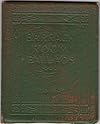
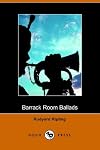
Barrack-Room Ballads
by Rudyard Kipling 
On This Page
Description
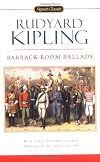
Barrack-Room Ballads (1892) brought Rudyard Kipling instant success and established him as a "friend of the soldier." At the time, British men generally enlisted to escape dire poverty, and the common soldier was held in low regard by the Victorian public--until he was needed to fight. Kipling had great compassion for the British soldier and chose to celebrate him while criticizing the Empire for its treatment of its fighting men. Told in the London Cockney dialect, Barrack-Room Ballads show more provided the public with a more insightful, sympathetic view of its soldiers. Featuring such famous poems as Tommy , Danny Deever , Fuzzy-Wuzzy , Mandalay, and the immortal Gunga Din, Barrack-Room Ballads eloquently demonstrates Kipling's reputation as the poet laureate of the British Empire. With anintroduction and annotations by Andrew Lycett show lessTags
Recommendations








Member Recommendations

Member Reviews
Read with context, these are a brilliant portrayal of the individuals who comprised the “thin red line” of the British infantry.
Published in 1892 at the height of the British Empire, these verses do include racial epithets and record the military forces that maintained colonialism, but they are written in colloquial English about the ordinary soldier (private), not the officers and gentlemen.
The verses are set mainly in the Indian subcontinent, but they try to capture the experience of the infantry in any war, the boredom, senselessness of orders and arbitrary death, for little warmth and reward. This selection most famously starts with Danny Deever, whose hanging is witnessed by Files-on-Parade, who recalls drinking his beer a show more score of times, and also includes Gunga Din, the regimental bhisti who carries water for the soldiers and dies rescuing an injured soldier, and Mandalay, with a time-expired soldier in drizzling London recalling the “Burma girl” he left behind in Mandalay.
But there is no shying away from the likelihood of death, this from The Young British Soldier:
When you're wounded and left on Afghanistan's plains,
And the women come out to cut up what remains,
Jest roll to your rifle and blow out your brains
An' go to your Gawd like a soldier.
And should the soldier survive to return to Britain, then there is little to look forward to, with the Troop-Sergeant-Major reduced to being a hotel doorman in Shillin’ a Day:
Oh, it drives me half crazy to think of the days I
Went slap for the Ghazi, my sword at my side,
When we rode Hell-for-leather
Both squadrons together,
That didn't care whether we lived or we died.
But it's no use despairin', my wife must go charin'
An' me commissairin' the pay-bills to better,
So if me you be'old
In the wet and the cold,
By the Grand Metropold, won't you give me a letter? show less
Published in 1892 at the height of the British Empire, these verses do include racial epithets and record the military forces that maintained colonialism, but they are written in colloquial English about the ordinary soldier (private), not the officers and gentlemen.
The verses are set mainly in the Indian subcontinent, but they try to capture the experience of the infantry in any war, the boredom, senselessness of orders and arbitrary death, for little warmth and reward. This selection most famously starts with Danny Deever, whose hanging is witnessed by Files-on-Parade, who recalls drinking his beer a show more score of times, and also includes Gunga Din, the regimental bhisti who carries water for the soldiers and dies rescuing an injured soldier, and Mandalay, with a time-expired soldier in drizzling London recalling the “Burma girl” he left behind in Mandalay.
But there is no shying away from the likelihood of death, this from The Young British Soldier:
When you're wounded and left on Afghanistan's plains,
And the women come out to cut up what remains,
Jest roll to your rifle and blow out your brains
An' go to your Gawd like a soldier.
And should the soldier survive to return to Britain, then there is little to look forward to, with the Troop-Sergeant-Major reduced to being a hotel doorman in Shillin’ a Day:
Oh, it drives me half crazy to think of the days I
Went slap for the Ghazi, my sword at my side,
When we rode Hell-for-leather
Both squadrons together,
That didn't care whether we lived or we died.
But it's no use despairin', my wife must go charin'
An' me commissairin' the pay-bills to better,
So if me you be'old
In the wet and the cold,
By the Grand Metropold, won't you give me a letter? show less
"Making mock o' uniforms
That guard you while you sleep
Is cheaper than them uniforms
And they're starvation cheap."
Somehow it doesn't matter to me that Kipling is jingoist and a patronizing racist and that occasionally I can't understand what he's talking about. Barrack room ballads was written for soldiers and Kipling understodd the soldier's experience and is not always complimentary to the Army command or to "The Widow of Windsor" and her wars. Readers will also find many phrases that have become commonplace in the language. While it lacks the some personal favorites ("If", "The Ballad of East and West"), this is a good collection to get an introduction to Kipling's poetry.
That guard you while you sleep
Is cheaper than them uniforms
And they're starvation cheap."
Somehow it doesn't matter to me that Kipling is jingoist and a patronizing racist and that occasionally I can't understand what he's talking about. Barrack room ballads was written for soldiers and Kipling understodd the soldier's experience and is not always complimentary to the Army command or to "The Widow of Windsor" and her wars. Readers will also find many phrases that have become commonplace in the language. While it lacks the some personal favorites ("If", "The Ballad of East and West"), this is a good collection to get an introduction to Kipling's poetry.
I love Kipling's poetry and find that some of his apparently jingoistic stuff is quite thoughtful underneath, putting forth the view of the ordinary soldier. Some of his war poems have quite an anti-war sentiment.
These aren’t pleasant little ditties or bawdy cadences. They are all gut punches of the soldier’s experience.
Kipling's verse, written in a popular style, still has the power both to charm and to amuse. This is a demotic language, but it is also able to cut across the lines of class and culture.
A collection of ballads written by Rudyard Kipling.
Members
- Recently Added By
Lists

Publisher's Weekly Bestsellers Prior to 1895 in Chronological Order
95 works; 6 members
Author Information

2,472+ Works 91,309 Members
Kipling, who as a novelist dramatized the ambivalence of the British colonial experience, was born of English parents in Bombay and as a child knew Hindustani better than English. He spent an unhappy period of exile from his parents (and the Indian heat) with a harsh aunt in England, followed by the public schooling that inspired his "Stalky" show more stories. He returned to India at 18 to work on the staff of the Lahore Civil and Military Gazette and rapidly became a prolific writer. His mildly satirical work won him a reputation in England, and he returned there in 1889. Shortly after, his first novel, The Light That Failed (1890) was published, but it was not altogether successful. In the early 1890s, Kipling met and married Caroline Balestier and moved with her to her family's estate in Brattleboro, Vermont. While there he wrote Many Inventions (1893), The Jungle Book (1894-95), and Captains Courageous (1897). He became dissatisfied with life in America, however, and moved back to England, returning to America only when his daughter died of pneumonia. Kipling never again returned to the United States, despite his great popularity there. Short stories form the greater portion of Kipling's work and are of several distinct types. Some of his best are stories of the supernatural, the eerie and unearthly, such as "The Phantom Rickshaw," "The Brushwood Boy," and "They." His tales of gruesome horror include "The Mark of the Beast" and "The Return of Imray." "William the Conqueror" and "The Head of the District" are among his political tales of English rule in India. The "Soldiers Three" group deals with Kipling's three musketeers: an Irishman, a Cockney, and a Yorkshireman. The Anglo-Indian Tales, of social life in Simla, make up the larger part of his first four books. Kipling wrote equally well for children and adults. His best-known children's books are Just So Stories (1902), The Jungle Books (1894-95), and Kim (1901). His short stories, although their understanding of the Indian is often moving, became minor hymns to the glory of Queen Victoria's empire and the civil servants and soldiers who staffed her outposts. Kim, an Irish boy in India who becomes the companion of a Tibetan lama, at length joins the British Secret Service, without, says Wilson, any sense of the betrayal of his friend this actually meant. Nevertheless, Kipling has left a vivid panorama of the India of his day. In 1907, Kipling became England's first Nobel Prize winner in literature and the only nineteenth-century English poet to win the Prize. He won not only on the basis of his short stories, which more closely mirror the ambiguities of the declining Edwardian world than has commonly been recognized, but also on the basis of his tremendous ability as a popular poet. His reputation was first made with Barrack Room Ballads (1892), and in "Recessional" he captured a side of Queen Victoria's final jubilee that no one else dared to address. (Bowker Author Biography) show less
Rudyard Kipling has a Legacy Library. Legacy libraries are the personal libraries of famous readers, entered by LibraryThing members from the Legacy Libraries group.
Some Editions
Series
Belongs to Publisher Series
Work Relationships
Common Knowledge
- Canonical title
- Barrack-Room Ballads
- Original publication date
- 1892
Classifications
Statistics
- Members
- 364
- Popularity
- 86,627
- Reviews
- 7
- Rating
- (3.68)
- Languages
- English
- Media
- Paper, Ebook
- ISBNs
- 37
- ASINs
- 33