Aani and the Tree Huggers
by Jeannine Atkins
On This Page
Description
Based on true events in India in the 1970s, young Aani and the other women in her village defend their forest from developers by wrapping their arms around the trees, making it impossible to cut them down.Tags
Recommendations


















Member Reviews
When Aani, resting underneath her favorite tree - a peaceful spot to which she would withdraw, in order to find peace and quiet, and temporarily escape from the tumult of her crowded home - hears the roar of trucks in the forest, the young girl runs to find her mother, and the other village women. It is from Kalawati, the village elder, that she and the other women learn that men from the city have come to cut down their forest, irrespective of the fact that their community relies upon it for survival. Determined not to let them destroy the trees, Aani leaps into action, placing herself between the loggers and her arboreal friend, and inspiring the women to similar action...
An engaging tale that highlights both the importance of the show more forests for human welfare, and the importance of human activism for forest welfare, Aani and the Tree Huggers is based on a true story which, according to the author's afterword, occurred in the 1970s, and launched the Chipko Andolan (the "Hug the Tree Movement") in India. I appreciated this afterword, although I wish the author had given more historical background, and mentioned the much earlier movement and story - the tale of Amrita Devi and the Bishnois people who sacrificed themselves to save the Khejri trees of India's Jodhpur District in the early 1700s - that inspired these more recent events. I couldn't help but wonder whether Atkins took that earlier story, which does involve a young girl as catalyst, and used it in a more contemporary context, to make the modern Chipko Andolan movement more accessible to young readers. Whatever the case may be, I would recommend reading this title in conjunction with a story about that earlier movement, such as The People Who Hugged the Trees: An Environmental Folk Tale. show less
An engaging tale that highlights both the importance of the show more forests for human welfare, and the importance of human activism for forest welfare, Aani and the Tree Huggers is based on a true story which, according to the author's afterword, occurred in the 1970s, and launched the Chipko Andolan (the "Hug the Tree Movement") in India. I appreciated this afterword, although I wish the author had given more historical background, and mentioned the much earlier movement and story - the tale of Amrita Devi and the Bishnois people who sacrificed themselves to save the Khejri trees of India's Jodhpur District in the early 1700s - that inspired these more recent events. I couldn't help but wonder whether Atkins took that earlier story, which does involve a young girl as catalyst, and used it in a more contemporary context, to make the modern Chipko Andolan movement more accessible to young readers. Whatever the case may be, I would recommend reading this title in conjunction with a story about that earlier movement, such as The People Who Hugged the Trees: An Environmental Folk Tale. show less
I liked this book a lot because it demonstrated peaceful resistance, much like some of history's greatest people- Martin Luther King Jr and Gandhi. The story begins with Aani, a young Indian girl, laying out in the forest admiring her land when the sound of loud machinery approaches her village. Developers want to tear down their trees for resources, but what they do not understand is that Aani and her people rely on the trees for multiple things such as firewood, tools, land holders, animal homes, and shade. To stop the developers from cutting down the trees Aani and the rest of the village women wrap themselves around the trees, stopping the men from cutting them down. This book was based off of true events that had happened in India show more in the 1970's. The big idea of this book was to inspire its readers to stand up for what they believe in. show less
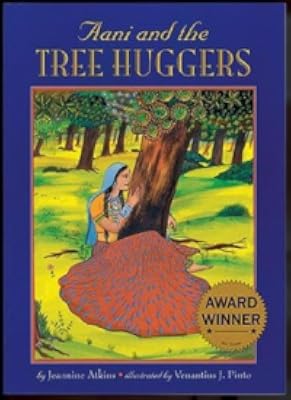
There are three reasons that I liked this book. First, I thought it had two very important messages. It is important to stand up for and protect what you believe in, just as Aani and the other women is her village did. And just as the men from the city learned, it is very important to be able to admit when you are wrong. Second, I thought that the illustrations were breathtakingly beautiful and really contributed to my understanding of the book. The colors and style were both pleasing and true to the area in which the story is set. Third, I liked that the book encouraged its young readers to think about the harmful effects of deforestation—sometimes, it means taking away the home of a person (or animal).
I really enjoyed reading “Aani and The Tree Huggers” because it gave me a very new perspective and culture to think about. Normally when I think about people living in a “village” I think of poor, uneducated people who probably live in a developing country and need help. This is not the case for the women in this book. I loved that they stood up for what they believed in and stood their ground. These women were not helpless, which changed my perspective on how I should view people living in an “undeveloped” country. I also really liked this book because I found it empowering. Even though the women were scared, they cared so deeply about the environment that they lived in that they were willing to risk their lives for it. show more Lastly, I really loved this book because it has beautiful illustrations. I think the main message of this books is bravery and fighting for things you feel passionate about. show less
Monti C. Katrib
EDUC 417.006
Reading Log #1
Aani and the Tree Huggers
Written by: Jeannine Atkins
Illustrated by: Venantius J. Pinto
Published by: Lee & Low Books (2000)
I liked this book for several reasons. One of the major reasons why I liked this book was the overall message that the book presents to the reader, which was that the environment is important and it equally as important to take action to protect it. Aani, the main character, has grown up in the same village her entire life, and spends a lot of her time amidst the trees. When men come into the village in attempt to cut down the trees, Aani and the older women of the village protest against the cutting down of the trees. Aani went as far as to hug one of the trees begging the show more men to not cut them down. I liked how this book emphasized how important the village forest was to Aani and the other women in the village, Atkins did a good job of giving life to the trees almost as if they were friends to the women in the village. The women’s protests and the part of the book where Aani quite literally is a tree hugger pushes the reader to think hard about the environment and what a huge role it plays in our lives.
I also liked this book because the author included cultural context to the story and the characters in an imaginative way. For example Aani crushes a red berry to make a red dot on her forehead, similar to the red dot married women in her village wear. The illustrations by Venantius J. Pinto also provide a good visual of what women in this culture typically wear, and how they present themselves. This encourages the reader to think about other cultures around the world that may not be similar to theirs, which is important in becoming a successful reader and learner! show less
EDUC 417.006
Reading Log #1
Aani and the Tree Huggers
Written by: Jeannine Atkins
Illustrated by: Venantius J. Pinto
Published by: Lee & Low Books (2000)
I liked this book for several reasons. One of the major reasons why I liked this book was the overall message that the book presents to the reader, which was that the environment is important and it equally as important to take action to protect it. Aani, the main character, has grown up in the same village her entire life, and spends a lot of her time amidst the trees. When men come into the village in attempt to cut down the trees, Aani and the older women of the village protest against the cutting down of the trees. Aani went as far as to hug one of the trees begging the show more men to not cut them down. I liked how this book emphasized how important the village forest was to Aani and the other women in the village, Atkins did a good job of giving life to the trees almost as if they were friends to the women in the village. The women’s protests and the part of the book where Aani quite literally is a tree hugger pushes the reader to think hard about the environment and what a huge role it plays in our lives.
I also liked this book because the author included cultural context to the story and the characters in an imaginative way. For example Aani crushes a red berry to make a red dot on her forehead, similar to the red dot married women in her village wear. The illustrations by Venantius J. Pinto also provide a good visual of what women in this culture typically wear, and how they present themselves. This encourages the reader to think about other cultures around the world that may not be similar to theirs, which is important in becoming a successful reader and learner! show less
I will be honest, I was not sure about this book by Jeannine Atkins especially, since this was her first picture book, but I was pleasantly surprised. I was inspired by this story how Aani took a peaceful yet active stand for the beautiful trees in her village, remembering this was so many animals home, and for her village needed these trees to live. Aani’s heroism saved her special tree and the beloved forest. I believe when all is going wrong in the world everyone just wants peace.
Pretty good book. This was based on a true story, which is always enjoyable to me. The book portrayed real cultural events and descriptions. For example, on page 3 Aani crushes a red berry to make a red spot on her forehead and weave grass around her ankle like the silver bracelets that married women wore. By the cover of the book, I thought it was going to be about the 60s and the environmental movement that "hippies" were a part of. Although it was not exactly what I had thought, it was still a book about saving and preserving trees for life. I really enjoyed reading it and would recommend it to anyone.
Members
- Recently Added By
Lists

A Child's Book Tour of India
71 works; 3 members
Author Information

19+ Works 1,587 Members
All Editions
Awards and Honors
Awards
Common Knowledge
- Important places
- India
Classifications
Statistics
- Members
- 159
- Popularity
- 206,729
- Reviews
- 21
- Rating
- (3.60)
- Languages
- English
- Media
- Paper
- ISBNs
- 6