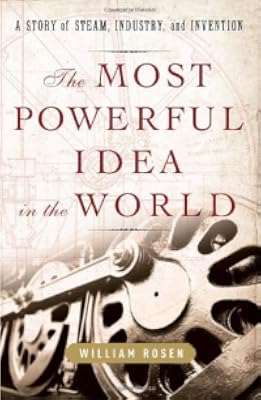
The Most Powerful Idea in the World: A Story of Steam, Industry, and Invention
by William Rosen
On This Page
Description
If all measures of human advancement in the last hundred centuries were plotted on a graph, they would show an almost perfectly flat line-until the eighteenth century, when the Industrial Revolution would cause the line to shoot straight up, beginning an almost uninterrupted march of progress.In The Most Powerful Idea in the World, William Rosen tells the story of the men responsible for the Industrial Revolution and the machine that drove it-the steam engine. In the process he tackles the show more question that has obsessed historians ever since: What made eighteenth-century Britain such fertile soil for inventors? Rosen's answer focuses on a simple notion that had become enshrined in British law the century before: that people had the right to own and profit from their ideas.The result was a period of frantic innovation revolving particularly around the promise of steam power. Rosen traces the steam engine's history from its early days as a clumsy but sturdy machine, to its coming-of-age driving the wheels of mills and factories, to its maturity as a transporter for people and freight by rail and by sea. Along the way we enter the minds of such inventors as Thomas Newcomen and James Watt; scientists, including Robert Boyle and Joseph Black; and philosophers John Locke and Adam Smith-all of whose insights, tenacity, and ideas transformed first a nation and then the world.Rosen is a masterly storyteller with a keen eye for the "aha!" moments of invention and a gift for clear and entertaining explanations of science. The Most Powerful Idea in the World will appeal to anyone who is fascinated with history, science, and the hows and whys of innovation itself. show lessTags
Recommendations
















Member Reviews
A precis of the industrial revolution using the early locomotive Stephenson's Rocket as an organizing principle via the innovations needed to make that locomotive possible. I had always thought that the biggest innovation of the industrial revolution was something sort of abstract like separation of labor, and this book explicitly suggests that it's the culture of invention. But coming away from the book I wondered if the most naive answer of all, steam power itself, wasn't the right one.
A very interesting excursion through the history of invention, like a leisurely ramble through the countryside led by a true aficianado, with side trips that may seem to be taking you out of your way but will certainly enrich your journey.
The author uses the device of the Rocket, the first steam locomotive on display in the British Museum, as the unifying thread for the journey, and explores the development of every significant technological invention that led to it. This doesn't mean just the mechanical parts that go into a steam engine, but the technological infrastructure required to forge iron into pure reliable steel in the first place. The scientific and technological history is embedded in its social, economic, and legal show more contexts, which developed right along with it, and we hear the human stories of the inventors as well.
The author's motivating question was, What made the Industrial Revolution so special? What was it about that time and place that led to such an explosion of invention, and such widespread adoption of technology? He considers this question repeatedly along the way, and argues persuasively that it was what he considers "the most powerful idea in the world", rather than any particular technological development, that made the difference.
That most powerful idea is the idea of intellectual property, and the legal mechanism of the patent that allowed the inventor to transform the intellectual capital of the idea into economic capital.
The epilogue of the book is notable for its substance: not a mere afterthought or closing reflections, but an overview and assessment of the book's main argument, and an application of its findings to the contemporary question of human-induced global warming.
I listened to the audio book, which is narrated in the almost bombastic tones of a 1950s science reporter. This was a little wearing to listen to at times, but it rendered the author's occasional witty asides even more amusing.
I'd recommend this book to anyone interested in the history of science or technology, scientific progress, the Industrial Revolution, or the legal and social constructs that were developed along with it. show less
The author uses the device of the Rocket, the first steam locomotive on display in the British Museum, as the unifying thread for the journey, and explores the development of every significant technological invention that led to it. This doesn't mean just the mechanical parts that go into a steam engine, but the technological infrastructure required to forge iron into pure reliable steel in the first place. The scientific and technological history is embedded in its social, economic, and legal show more contexts, which developed right along with it, and we hear the human stories of the inventors as well.
The author's motivating question was, What made the Industrial Revolution so special? What was it about that time and place that led to such an explosion of invention, and such widespread adoption of technology? He considers this question repeatedly along the way, and argues persuasively that it was what he considers "the most powerful idea in the world", rather than any particular technological development, that made the difference.
The epilogue of the book is notable for its substance: not a mere afterthought or closing reflections, but an overview and assessment of the book's main argument, and an application of its findings to the contemporary question of human-induced global warming.
I listened to the audio book, which is narrated in the almost bombastic tones of a 1950s science reporter. This was a little wearing to listen to at times, but it rendered the author's occasional witty asides even more amusing.
I'd recommend this book to anyone interested in the history of science or technology, scientific progress, the Industrial Revolution, or the legal and social constructs that were developed along with it. show less
I thought this was a good mix of a big idea "what makes some countries/societies more innovative than others," and the detailed history of the development of steam power form ancient beginnings through the first practical locomotives.
I rarely write reviews, but I had to write one for this book.
I thought I was going to read a book about the steam engine and the industrial revolution.
Instead this is a book of tangents in which the author talks about everything but the steam engine until the final chapter. Sure, all the inventions are part of the steam engine and the steam engine could not exist without them, but the book is not about the steam engine.
The author spends more time talking about property and invention rights than the stream engine and spends several pages talking about the brains chemistry and what happens in the brain when someone has a “Eureka Moment”, all very fascinating if that is what you want to read about, but it’s not steam engines. If you show more want a book that meanders all over the place then it’s for you, but don’t expect to read about steam engines and their use in the industrial revolution. show less
I thought I was going to read a book about the steam engine and the industrial revolution.
Instead this is a book of tangents in which the author talks about everything but the steam engine until the final chapter. Sure, all the inventions are part of the steam engine and the steam engine could not exist without them, but the book is not about the steam engine.
The author spends more time talking about property and invention rights than the stream engine and spends several pages talking about the brains chemistry and what happens in the brain when someone has a “Eureka Moment”, all very fascinating if that is what you want to read about, but it’s not steam engines. If you show more want a book that meanders all over the place then it’s for you, but don’t expect to read about steam engines and their use in the industrial revolution. show less
Quite a slog in reviewing the steam technology that gave rise to the industrial revolution. Binary thinking pervades this book. Its all one thing or another, never a blend of influences. I suspect its all in the service of showing how important intellectual property rights are in the modern world. But I would have liked to have a more balanced view of the influence of war, mathematics and communication on the subject.
Scientific thinking began to advance in the 16th century throughout Europe, but why did so many of the technological and economic advances derived from this new scientific outlook come disproportionally from England? That's the basic question this book attempts to answer.
The argument that it was largely due to legally enforceable patents is interesting. They gave innovators the expectation that they could benefit from their ideas, which encouraged them to spend the time, effort, and money needed to develop them. Patents were not sufficient by themselves, of course, but in England an inventor had cause to believe that a great idea could pay off in the end rather than being squelched by established interests or stolen by others.
There is a show more lot of well presented history of science and technology in this book. I recommend it. show less
The argument that it was largely due to legally enforceable patents is interesting. They gave innovators the expectation that they could benefit from their ideas, which encouraged them to spend the time, effort, and money needed to develop them. Patents were not sufficient by themselves, of course, but in England an inventor had cause to believe that a great idea could pay off in the end rather than being squelched by established interests or stolen by others.
There is a show more lot of well presented history of science and technology in this book. I recommend it. show less
Rosen's book was mostly excellent, although I found the sections on philosophy and economics a bit trying. Still, overall definitely a five star book.
Members
- Recently Added By
Published Reviews
The book’s premise is that the Anglophone world – England, Scotland, Wales and America – was the epicenter of the Industrial Revolution because it “democratized the nature of invention.” Rosen makes a compelling argument that the steam engine is the quintessential example of that democratization at work.
added by Strategic_Innovation
Author Information

4 Works 1,886 Members
Awards and Honors
Classifications
Statistics
- Members
- 470
- Popularity
- 65,105
- Reviews
- 10
- Rating
- (3.78)
- Languages
- English, French
- Media
- Paper, Audiobook, Ebook
- ISBNs
- 11
- ASINs
- 6