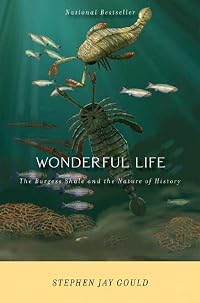
Wonderful Life: The Burgess Shale and the Nature of History
by Stephen Jay Gould
On This Page
Description
"[An] extraordinary book . . . Mr. Gould is an exceptional combination of scientist and science writer . . . He is thus exceptionally well placed to tell these stories, and he tells them with fervor and intelligence."-James Gleick, New York Times Book Review High in the Canadian Rockies is a small limestone quarry formed 530 million years ago called the Burgess Shale. It holds the remains of an ancient sea where dozens of strange creatures lived-a forgotten corner of evolution preserved in show more awesome detail. In this book, Stephen Jay Gould explores what the Burgess Shale tells us about evolution and the nature of history. show lessTags
Recommendations










Member Recommendations
Noisy Read the first part of Wonderful Life for the description of its discovery, and then switch to The Crucible of Creation for the real story behind the creatures of the pre-Cambrian by one of the researchers who delved into their mysteries.
40
Member Reviews
There's a trap that a lot of science writing falls into: when the author finds the subject matter beautiful and awe-inspiring, they tell you "this is beautiful and awe-inspiring!". To give you context for some fact, they'll tell you numbers of Olympic swimming pools or football stadiums or Earth masses or lightyears. This is not interesting! You can't make me feel awe by telling me how much awe I should be feeling, and you have to do more than just say a very large or very small number.
Gould is the best writer I know at letting the awe build up organically. Here, he takes you through the whole story of how we know what we do about the Burgess Shale and the Cambrian explosion of animal diversity. He explains in great detail how the show more original workers were constrained by their worldview, and he presents that worldview in a compelling way, so that you can buy into it. Then, piece by piece, he reveals and explains the new evidence that nibbles away at that worldview, and eventually overturns it.
Because he really feels the need to convince you of what he's saying, he makes the case in considerable detail. There's such a huge volume of background information needed to explain, for example, why it's remarkable that Marella splendens, which looks a lot like a trilobite, is not a trilobite. Gould trusts that, if he gives you that information, the payoff will be sweeter and your understanding richer. It's this level of trust in the reader that I really appreciate. show less
Gould is the best writer I know at letting the awe build up organically. Here, he takes you through the whole story of how we know what we do about the Burgess Shale and the Cambrian explosion of animal diversity. He explains in great detail how the show more original workers were constrained by their worldview, and he presents that worldview in a compelling way, so that you can buy into it. Then, piece by piece, he reveals and explains the new evidence that nibbles away at that worldview, and eventually overturns it.
Because he really feels the need to convince you of what he's saying, he makes the case in considerable detail. There's such a huge volume of background information needed to explain, for example, why it's remarkable that Marella splendens, which looks a lot like a trilobite, is not a trilobite. Gould trusts that, if he gives you that information, the payoff will be sweeter and your understanding richer. It's this level of trust in the reader that I really appreciate. show less
The Burgess Shale's creatures, with their anatomies as striking as bizarre, are a perfect illustration of the history of life on Earth: just a matter of contingency. We are, but we could never have been, owning our survival only to chance in the darwinian sense of the word.
Indeed, among the multitude of all these organisms since long extinct (according to Gould) were found, alongside the ancestors of the arthropods, Pikaia that is, the oldest known chordate -OUR ancestor, then. Modify one detail, just a single one, imagine Pikaia not surviving the Cambrian era and, homo sapiens would have never existed at all. Looking at these fossils, towering at a mere 545 million of years, it's all our fragility that we contemplate in here, in a show more majestic and breathtaking vision.
Gould turns science into poetry. Yet, this book is not without defects.
The descritpions of the said fossils are far too long, and, if they are necessary so as to fully show their repercussions, quite a bore over more than 350 pages. He also argues for his punctuated equilibrium hypothesis, which may annoy some readers (for example, when he claims such fossils to be the remains of previous species having evolved suddenly). As for the idea that most of these creatures are since long extinct, it's false -two of the paleontologists having worked on them (Derek Briggs and Simon Convey Morris) having corrected that mistake since then.
The main idea of the book (life as a matter of contingency) stays intact, but a careful reading remains thus necessary.
Despite it all, it's a real pleasure to read thanks to Gould and his inimitable writing style. show less
Indeed, among the multitude of all these organisms since long extinct (according to Gould) were found, alongside the ancestors of the arthropods, Pikaia that is, the oldest known chordate -OUR ancestor, then. Modify one detail, just a single one, imagine Pikaia not surviving the Cambrian era and, homo sapiens would have never existed at all. Looking at these fossils, towering at a mere 545 million of years, it's all our fragility that we contemplate in here, in a show more majestic and breathtaking vision.
Gould turns science into poetry. Yet, this book is not without defects.
The descritpions of the said fossils are far too long, and, if they are necessary so as to fully show their repercussions, quite a bore over more than 350 pages. He also argues for his punctuated equilibrium hypothesis, which may annoy some readers (for example, when he claims such fossils to be the remains of previous species having evolved suddenly). As for the idea that most of these creatures are since long extinct, it's false -two of the paleontologists having worked on them (Derek Briggs and Simon Convey Morris) having corrected that mistake since then.
The main idea of the book (life as a matter of contingency) stays intact, but a careful reading remains thus necessary.
Despite it all, it's a real pleasure to read thanks to Gould and his inimitable writing style. show less
Several of the reviews of this book are critical of it and I can't figure out why. Now, Gould makes some far reaching conclusions, or better yet, possibilities, based on fossils from a single shale bed on a lonely mountain in British Colombia. The deal is, the Burgess Shale is one of a very few fossil beds that preserve soft-bodied creatures, anywhere in the world. (Another is the Mazon Creek formation, a about sixty miles from Chicago.) The other thing is that these fossils are from the Cambrian Period, the first named span of time that is based on fossil remnants. All rock layers below and before the Cambrian have no visible fossils, Cambrian and later rocks do (or can.) There are fossil remains in older rocks but nothing obviously show more from multicellular life. In fact, the sudden appearance of blatantly obvious fossils is referred to as the Cambrian explosion, so suddenly do they appear, relatively speaking.
Now, the trick is that, almost universally, only hard shells, bones and teeth are preserved. In the Burgess shale, soft creatures from the very dawn of multi-cellular organisms are preserved in great detail. (Fossils are only as detailed as the surrounding rock allow them to be and shale is very finely grained. Sandstone only preserves details bigger than the sand grains it is made of.) The interpretation of the shale itself is that it is formed from a mudslide that dragged all of the little bugs and worms down into the depths with it. This is called a turbidite and is based on the specific way the different sized grains sort themselves as the mud settles. Through fortunate happenstance this shale bed is exposed for study.
The interesting thing about the Burgess fauna is that there are around twenty different types of arthropods (insects, crabs, trilobites, spiderey things, etc.) that have no counterpart today, and are only known from this one isolated fossil bed. These are theoretically regarded as completely new and unique phyla with no relatives today. Gould's hypothesis challenges the traditional view of evolutionary progress. Not the mechanics of change over time, but the origins of different phyla and classes. He proposes that a wide range of basic plans were able to try their hand at populating an empty ecosystem and that the phyla we have today are the few survivors of this original Cambrian explosion. He refers to the commonly taught 'cone of diversity', one point branching out and up, as probably being off base. Strictly based on this fortunate preservation and a few others, he proposes a concept of decimation, where one point branches out into many parallel branches, some of which survive and thrive but most don't. There are no five eyed arthropods around today, for example, but there is one in the Burgess record. I know, I know, this is a big jump based on such a small sample, but when that small sample is completely contrary to common theory, then that theory needs a good tweaking. Obviously, any topic of evolution is stirring the pot of controversy in the first place.
Gould goes into great detail as he is an evolutionary biologist and high ranking paleontologist. Also in Wonderful Life, Gould discusses the people involved in deciphering the Burgess fossils, including Charles Walcott, the discoverer and apparently a forgotten titan of American Science. All in all, I have to rank this as one of the best science books that I have read, right up there with Sagan's Dragons of Eden and Gleik's Chaos: Making a New Science. show less
Now, the trick is that, almost universally, only hard shells, bones and teeth are preserved. In the Burgess shale, soft creatures from the very dawn of multi-cellular organisms are preserved in great detail. (Fossils are only as detailed as the surrounding rock allow them to be and shale is very finely grained. Sandstone only preserves details bigger than the sand grains it is made of.) The interpretation of the shale itself is that it is formed from a mudslide that dragged all of the little bugs and worms down into the depths with it. This is called a turbidite and is based on the specific way the different sized grains sort themselves as the mud settles. Through fortunate happenstance this shale bed is exposed for study.
The interesting thing about the Burgess fauna is that there are around twenty different types of arthropods (insects, crabs, trilobites, spiderey things, etc.) that have no counterpart today, and are only known from this one isolated fossil bed. These are theoretically regarded as completely new and unique phyla with no relatives today. Gould's hypothesis challenges the traditional view of evolutionary progress. Not the mechanics of change over time, but the origins of different phyla and classes. He proposes that a wide range of basic plans were able to try their hand at populating an empty ecosystem and that the phyla we have today are the few survivors of this original Cambrian explosion. He refers to the commonly taught 'cone of diversity', one point branching out and up, as probably being off base. Strictly based on this fortunate preservation and a few others, he proposes a concept of decimation, where one point branches out into many parallel branches, some of which survive and thrive but most don't. There are no five eyed arthropods around today, for example, but there is one in the Burgess record. I know, I know, this is a big jump based on such a small sample, but when that small sample is completely contrary to common theory, then that theory needs a good tweaking. Obviously, any topic of evolution is stirring the pot of controversy in the first place.
Gould goes into great detail as he is an evolutionary biologist and high ranking paleontologist. Also in Wonderful Life, Gould discusses the people involved in deciphering the Burgess fossils, including Charles Walcott, the discoverer and apparently a forgotten titan of American Science. All in all, I have to rank this as one of the best science books that I have read, right up there with Sagan's Dragons of Eden and Gleik's Chaos: Making a New Science. show less
Gould's discussion of the wonderful Burgess Shale, a veritable treasure trove of fossils that have given us a lot of information about the Cambrian explosion. A great read, even if you don't agree with all of his ideas about the shale.
A wonderful account of palaeontological discovery on a cliff in the Rockies in British Columbia in the early 20th century, and meticulous analysis of previously unknown lifeforms decades later. Gould was the best popular writer and scientific expert on evolution, and the book exemplifies his curiosity and enthusiasm.
Wonderful Life by Stephen Jay Gould compared with Crucible of Creation by Simon Conway Morris
Successful science popularizers always seem to evoke sour grapes among their colleagues. (Not Isaac Asimov, for some reason – perhaps because he dropped his career as a scientist once he became a popular writer). Carl Sagan wasn’t popular among the Cornell faculty, although I knew one of his grad students who said he was a decent guy. When I mentioned Zahi Hawass’ name to my Egyptian guides, their immediate response was “He’s an idiot!”. I had one close encounter with Stephen Jay Gould, at a reception after a talk he gave at the Paleontological Research Institute; I didn’t see anything out of the ordinary, but my companion latter show more commented that Gould had an enormous ego. I knew one of Gould’s grad students, too, who had nothing against him (she did say he was big fan of acrostic puzzles, which is a plus in my book).
Gould certainly did raise hackles in the paleontological community; perhaps partially because of his success as a popularizer but also perhaps because was not exactly gentle in handling some of his colleagues – particularly Richard Dawkins and E. O. Wilson. That makes this pair of books especially ironic, since Gould goes out of his way to praise Morris for his work on the Burgess Shale fauna, and Morris turns around and jumps on Gould with both feet.
The Burgess Shale fauna was discovered by American paleontologist and scientific administrator Charles Walcott in 1909. (Ironically, even though the locality is in British Columbia, the bulk of collected material is in the Smithsonian; to “preserve” the site, Parks Canada will not allow any further collection, which means all remaining fossils will weather away into silt). The Burgess Shale is one of those rare fossil sites known as Konservat-Lagerstätten, where unusual conditions preserve soft body parts. When first discovered, it was the earliest such site known, dating from the Middle Cambrian. Walcott never got around to thoroughly studying the specimens he’d collected; his cursory examination “shoehorned” (Gould’s term) things into existing taxonomic groups. Later reappraisal in the 1970s and 1980s – by Harry Whittington, Derek Briggs, and Simon Conway Morris, all at Cambridge – showed that while there are familiar forms such as trilobites and brachiopods, much of the Burgess fauna is (Gould’s term) “weird wonders” – animals that didn’t fit easily into conventional taxonomic schemes. Some initially had no discernible affinities with any modern animal – the poster child for this group was Hallucigenia sparsa.
Others, while clearly (for example) arthropods, didn’t fit the characteristics of any modern arthropod group; they weren’t uniramians (insects and myriapods), crustaceans, chelicerates, or trilobites (those are Gould’s major groups; the high level classification of arthropods has been rearranged since, based on molecular genetics – several times, in fact). Gould goes great lengths to show the effort that went into the Cambridge studies; the book is liberally illustrated with camera lucida drawings of squished weird thingees.
Gould takes the weirdness of the Burgess Shale Fauna and runs with it. His main themes are disparity and contingency. “Disparity” is divergence in body plans, and it’s Gould’s contention that it was at a maximum in the Cambrian and has been decreasing ever since (“Disparity” is not to be confused with “diversity”, which is the number of species; there are, for example, a hundred or so species of fruit flies which means they are highly diverse – but they all look more or less the same, meaning they have low disparity). “Contingency” is the idea that the history of life is high dependent on chance – one tiny thing lives or dies in the Cambrian and 550 million years later the whole biosphere looks completely difference. Gould uses the metaphor of “rewinding the tape” and cites the film It’s a Wonderful Life as an example of how a small change can make a difference – and also as the source for his title.
Wonderful Life is full of incorrect information. It’s not that Gould makes errors of fact, but rather that facts change rapidly in science. The most egregious error isn’t his fault; the original hardback edition used a painting of the Burgess Shale fauna by famous paleontological artist Charles Knight for the cover painting. When the paperback was reissued after Gould’s death, the publishers must have thought the original cover was too dull and changed it to a dramatic view of a pair of pterygotid eurypterids attacking a school of anaspid fish. The catch is that neither group shows up until the Silurian while the book is illustrating the Middle Cambrian; rather like having a squadron of F-16s at the Battle of Hastings. Other errors illustrate the advance of science; Gould comments that the metazoans are polyphyletic, based on molecular genetics studies; these turned out to be incorrect. He taps lungfish for the origin of tetrapods while more recent work suggests crossopterygians. The original reconstruction of Hallucigenia cited by Gould turned out to be upside down (and possibly backwards; it’s still not clear which end is the front). In his later chapters on contingency, Gould cites the Eocene bird Diatryma as a predator when suggesting that if things had gone a little differently the dominant life form in the Cenozoic could have been birds rather than mammals; Diatryma is now believed to be a herbivore. A little later, the South American phorusrhacids are given as an example of a South American species that was doing quite well until placental mammals arrived; as it happens phorusrhacids continued to do well, moving northward along with opossums, armadillos and sloths; their fossils are found in Texas and Florida. (Although Gould doesn’t mention it, they’re also possibly an example of a violation of an evolutionary “law” – the idea that once a feature is lost it never reappears; phorusrhacids appear to have begun to change their wings back into arms).
That brings us to Simon Conway Morris and his book on the Burgess Shale, which is both a general discussion of the fauna and a direct refutation of Gould (Morris apologizes in his introduction, noting that Gould had nothing but praise for the Cambridge groups work on the Burgess Shale animals). Morris, alas, is not as good a writer as Gould, although he seems to adopt some of Gould’s mannerisms – references to classical literature and namedropping. He also uses an unfortunate device to explain Burgess Shale ecology – a time-travelling submarine – to the extent that one of the illustrations shows a sampling device scooping up Middle Cambrian priapulids. This ends up being annoying rather than illustrative. Gould has much better illustrations; he uses camera lucida drawings, which show the critical parts of the animals while emphasizing that the fossils aren’t perfect; Morris tends to go with color reconstructions – which perhaps make the animals look better understood than they actually are – or photographs, which often don’t show much more than an incomprehensible blob. Finally, Morris does a little straw-man erection, accusing Gould of abandoning Darwinian evolution. Gould was known, of course, for minimizing the importance of adaptation compared to the influence of random events, and also for suggesting that there might some sort of unknown “forces” at work in macroevolution. However, Gould doesn’t invoke either of these ideas – at least not overtly – in Wonderful Life.
In the end, though, despite a less comfortable writing style and distracting time travelers, it’s Morris that’s right and Gould that’s wrong (in my opinion, at least). Morris has the advantage of being in on the discovery of additional “Burgess Shale type” localities, particularly Sirius Passet in north Greenland and Chengjiang in China. There are now “Burgess Shale-like” faunal assemblages known from Poland, China, additional sites in Canada, Greenland, and several locations in the USA; in fact, there’s some suggestion that preservation conditions (possibly due to clay mineralogy) were different in the Cambrian. Specimens from the additional sites elucidate a lot of the “weird wonders”; many (including Hallucigenia) are shown to belong to a group called “lobopods”, which Morris convincingly groups with the arthropods. Morris also has a second advantage: he’s a lot more specialized than Gould; while Gould was known for “big picture” works, Morris’ bibliography is heavy on Cambrian invertebrate paleontology and includes some fairly obscure publications (many in Chinese).
Once he gets to work, Morris does a good job going after Gould’s main points. He takes Gould to task over “disparity”, noting that it never really gets defined. Gould’s argument that there was more “disparity” in the Cambrian is based on arthropod taxonomy; the modern concept of main arthropod groups (below the phylum but above the class) is based on the type of appendages and where they attach on the body. Many of the Burgess Shale arthropods don’t fit into this scheme, and in Gould’s view that makes them more “disparate”. Morris counters with cladistics. Cladistic phylogenies work based on bifurcations; a stem divided into two branches. Although cladistic diagrams have “stem”, “crown” and “sister” groups, there really isn’t anything corresponding to classical phyletic taxonomic groups above the species. The supposed increased disparity in the Cambrian is just an artifact of the way humans formerly interpreted evolution. In fact, Morris provides a cladogram that incorporates all the Burgess Shale arthropod fauna and the main modern groups. (I note Gould was never comfortable with cladistics; Morris isn’t either, citing the problems of convergence and character selection – but he’s more comfortable than Gould).
Morris’ response to Gould’s “contingency” segues nicely with his critique of “disparity”. There are a lot of “body plans” – potential morphospace occupants – that just won’t work. If you are going to swim fast in the ocean, you’re going to end up looking like a squid or a fish or an ichthyosaur or a cetacean or a penguin; the physical world will eliminate some of the possible body plans an organism can have and thus reduce “disparity”, and “rewinding the tape” won’t change the physical constraints. Thus even if you time travel back to the Cambrian and obliterate some lineage, something else will step up to the plate. Gould’s ideas on contingency may have been influenced by his minimization of the role of adaptation; perhaps it might not be as important as the most ultra-adaptationists make it, but an organism still has to live in its environment and there’s only so many ways you can do that (Morris actually cites some science fiction “alternate histories” here, specifically Kingsley Amis’ The Alteration and Keith Robert’s Pavane; I wonder if he has encountered Harry Turtledove).
There are a number of other works and the Burgess Shale and similar fauna; these are the only two I know of that get into evolutionary philosophy. Sadly, it’s excruciatingly difficult to visit the classic sites; the Chengjiang locality is probably the easiest – although you have to get to China first. You can go to Walcott’s site in Canada, but only under escort and actually collecting anything would involve a character-building experience with the authorities, even if you are an accredited professional. Sirius Passet can only be done by a major Arctic expedition. The American sites are possibilities, although they don’t have the faunal richness of the others. The nearest to me would be the Wheeler Shale in Millard County, Utah; probably as close as you can get to the Middle of Nowhere in the continental US. I’m getting a little old to spend days hammering rocks apart in the desert, but having my own Hallucigenia or Anomalocaris would make it worthwhile. show less
Successful science popularizers always seem to evoke sour grapes among their colleagues. (Not Isaac Asimov, for some reason – perhaps because he dropped his career as a scientist once he became a popular writer). Carl Sagan wasn’t popular among the Cornell faculty, although I knew one of his grad students who said he was a decent guy. When I mentioned Zahi Hawass’ name to my Egyptian guides, their immediate response was “He’s an idiot!”. I had one close encounter with Stephen Jay Gould, at a reception after a talk he gave at the Paleontological Research Institute; I didn’t see anything out of the ordinary, but my companion latter show more commented that Gould had an enormous ego. I knew one of Gould’s grad students, too, who had nothing against him (she did say he was big fan of acrostic puzzles, which is a plus in my book).
Gould certainly did raise hackles in the paleontological community; perhaps partially because of his success as a popularizer but also perhaps because was not exactly gentle in handling some of his colleagues – particularly Richard Dawkins and E. O. Wilson. That makes this pair of books especially ironic, since Gould goes out of his way to praise Morris for his work on the Burgess Shale fauna, and Morris turns around and jumps on Gould with both feet.
The Burgess Shale fauna was discovered by American paleontologist and scientific administrator Charles Walcott in 1909. (Ironically, even though the locality is in British Columbia, the bulk of collected material is in the Smithsonian; to “preserve” the site, Parks Canada will not allow any further collection, which means all remaining fossils will weather away into silt). The Burgess Shale is one of those rare fossil sites known as Konservat-Lagerstätten, where unusual conditions preserve soft body parts. When first discovered, it was the earliest such site known, dating from the Middle Cambrian. Walcott never got around to thoroughly studying the specimens he’d collected; his cursory examination “shoehorned” (Gould’s term) things into existing taxonomic groups. Later reappraisal in the 1970s and 1980s – by Harry Whittington, Derek Briggs, and Simon Conway Morris, all at Cambridge – showed that while there are familiar forms such as trilobites and brachiopods, much of the Burgess fauna is (Gould’s term) “weird wonders” – animals that didn’t fit easily into conventional taxonomic schemes. Some initially had no discernible affinities with any modern animal – the poster child for this group was Hallucigenia sparsa.
Others, while clearly (for example) arthropods, didn’t fit the characteristics of any modern arthropod group; they weren’t uniramians (insects and myriapods), crustaceans, chelicerates, or trilobites (those are Gould’s major groups; the high level classification of arthropods has been rearranged since, based on molecular genetics – several times, in fact). Gould goes great lengths to show the effort that went into the Cambridge studies; the book is liberally illustrated with camera lucida drawings of squished weird thingees.
Gould takes the weirdness of the Burgess Shale Fauna and runs with it. His main themes are disparity and contingency. “Disparity” is divergence in body plans, and it’s Gould’s contention that it was at a maximum in the Cambrian and has been decreasing ever since (“Disparity” is not to be confused with “diversity”, which is the number of species; there are, for example, a hundred or so species of fruit flies which means they are highly diverse – but they all look more or less the same, meaning they have low disparity). “Contingency” is the idea that the history of life is high dependent on chance – one tiny thing lives or dies in the Cambrian and 550 million years later the whole biosphere looks completely difference. Gould uses the metaphor of “rewinding the tape” and cites the film It’s a Wonderful Life as an example of how a small change can make a difference – and also as the source for his title.
Wonderful Life is full of incorrect information. It’s not that Gould makes errors of fact, but rather that facts change rapidly in science. The most egregious error isn’t his fault; the original hardback edition used a painting of the Burgess Shale fauna by famous paleontological artist Charles Knight for the cover painting. When the paperback was reissued after Gould’s death, the publishers must have thought the original cover was too dull and changed it to a dramatic view of a pair of pterygotid eurypterids attacking a school of anaspid fish. The catch is that neither group shows up until the Silurian while the book is illustrating the Middle Cambrian; rather like having a squadron of F-16s at the Battle of Hastings. Other errors illustrate the advance of science; Gould comments that the metazoans are polyphyletic, based on molecular genetics studies; these turned out to be incorrect. He taps lungfish for the origin of tetrapods while more recent work suggests crossopterygians. The original reconstruction of Hallucigenia cited by Gould turned out to be upside down (and possibly backwards; it’s still not clear which end is the front). In his later chapters on contingency, Gould cites the Eocene bird Diatryma as a predator when suggesting that if things had gone a little differently the dominant life form in the Cenozoic could have been birds rather than mammals; Diatryma is now believed to be a herbivore. A little later, the South American phorusrhacids are given as an example of a South American species that was doing quite well until placental mammals arrived; as it happens phorusrhacids continued to do well, moving northward along with opossums, armadillos and sloths; their fossils are found in Texas and Florida. (Although Gould doesn’t mention it, they’re also possibly an example of a violation of an evolutionary “law” – the idea that once a feature is lost it never reappears; phorusrhacids appear to have begun to change their wings back into arms).
That brings us to Simon Conway Morris and his book on the Burgess Shale, which is both a general discussion of the fauna and a direct refutation of Gould (Morris apologizes in his introduction, noting that Gould had nothing but praise for the Cambridge groups work on the Burgess Shale animals). Morris, alas, is not as good a writer as Gould, although he seems to adopt some of Gould’s mannerisms – references to classical literature and namedropping. He also uses an unfortunate device to explain Burgess Shale ecology – a time-travelling submarine – to the extent that one of the illustrations shows a sampling device scooping up Middle Cambrian priapulids. This ends up being annoying rather than illustrative. Gould has much better illustrations; he uses camera lucida drawings, which show the critical parts of the animals while emphasizing that the fossils aren’t perfect; Morris tends to go with color reconstructions – which perhaps make the animals look better understood than they actually are – or photographs, which often don’t show much more than an incomprehensible blob. Finally, Morris does a little straw-man erection, accusing Gould of abandoning Darwinian evolution. Gould was known, of course, for minimizing the importance of adaptation compared to the influence of random events, and also for suggesting that there might some sort of unknown “forces” at work in macroevolution. However, Gould doesn’t invoke either of these ideas – at least not overtly – in Wonderful Life.
In the end, though, despite a less comfortable writing style and distracting time travelers, it’s Morris that’s right and Gould that’s wrong (in my opinion, at least). Morris has the advantage of being in on the discovery of additional “Burgess Shale type” localities, particularly Sirius Passet in north Greenland and Chengjiang in China. There are now “Burgess Shale-like” faunal assemblages known from Poland, China, additional sites in Canada, Greenland, and several locations in the USA; in fact, there’s some suggestion that preservation conditions (possibly due to clay mineralogy) were different in the Cambrian. Specimens from the additional sites elucidate a lot of the “weird wonders”; many (including Hallucigenia) are shown to belong to a group called “lobopods”, which Morris convincingly groups with the arthropods. Morris also has a second advantage: he’s a lot more specialized than Gould; while Gould was known for “big picture” works, Morris’ bibliography is heavy on Cambrian invertebrate paleontology and includes some fairly obscure publications (many in Chinese).
Once he gets to work, Morris does a good job going after Gould’s main points. He takes Gould to task over “disparity”, noting that it never really gets defined. Gould’s argument that there was more “disparity” in the Cambrian is based on arthropod taxonomy; the modern concept of main arthropod groups (below the phylum but above the class) is based on the type of appendages and where they attach on the body. Many of the Burgess Shale arthropods don’t fit into this scheme, and in Gould’s view that makes them more “disparate”. Morris counters with cladistics. Cladistic phylogenies work based on bifurcations; a stem divided into two branches. Although cladistic diagrams have “stem”, “crown” and “sister” groups, there really isn’t anything corresponding to classical phyletic taxonomic groups above the species. The supposed increased disparity in the Cambrian is just an artifact of the way humans formerly interpreted evolution. In fact, Morris provides a cladogram that incorporates all the Burgess Shale arthropod fauna and the main modern groups. (I note Gould was never comfortable with cladistics; Morris isn’t either, citing the problems of convergence and character selection – but he’s more comfortable than Gould).
Morris’ response to Gould’s “contingency” segues nicely with his critique of “disparity”. There are a lot of “body plans” – potential morphospace occupants – that just won’t work. If you are going to swim fast in the ocean, you’re going to end up looking like a squid or a fish or an ichthyosaur or a cetacean or a penguin; the physical world will eliminate some of the possible body plans an organism can have and thus reduce “disparity”, and “rewinding the tape” won’t change the physical constraints. Thus even if you time travel back to the Cambrian and obliterate some lineage, something else will step up to the plate. Gould’s ideas on contingency may have been influenced by his minimization of the role of adaptation; perhaps it might not be as important as the most ultra-adaptationists make it, but an organism still has to live in its environment and there’s only so many ways you can do that (Morris actually cites some science fiction “alternate histories” here, specifically Kingsley Amis’ The Alteration and Keith Robert’s Pavane; I wonder if he has encountered Harry Turtledove).
There are a number of other works and the Burgess Shale and similar fauna; these are the only two I know of that get into evolutionary philosophy. Sadly, it’s excruciatingly difficult to visit the classic sites; the Chengjiang locality is probably the easiest – although you have to get to China first. You can go to Walcott’s site in Canada, but only under escort and actually collecting anything would involve a character-building experience with the authorities, even if you are an accredited professional. Sirius Passet can only be done by a major Arctic expedition. The American sites are possibilities, although they don’t have the faunal richness of the others. The nearest to me would be the Wheeler Shale in Millard County, Utah; probably as close as you can get to the Middle of Nowhere in the continental US. I’m getting a little old to spend days hammering rocks apart in the desert, but having my own Hallucigenia or Anomalocaris would make it worthwhile. show less
I appreciate the author's delving into the history of this dig and related topics, but I did skim through a huge chunk of the text. My memory for history details is deplorable, so I didn't waste time reading stuff that ultimately I don't care about.
That said, I appreciated the take on what the Cambrian Explosion meant for evolution generally, and the further musings on what it meant for humans specifically, much much later.
If you want to read this, know the text is 85%, the rest appendices. Since I skimmed so much, I'm glad I could borrow the ebook via my library. :)
That said, I appreciated the take on what the Cambrian Explosion meant for evolution generally, and the further musings on what it meant for humans specifically, much much later.
If you want to read this, know the text is 85%, the rest appendices. Since I skimmed so much, I'm glad I could borrow the ebook via my library. :)
Members
- Recently Added By
Lists

Best Science Books for Non-Scientists
113 works; 57 members

Geology - Fossils/Palentology
12 works; 3 members

A Good Read (Radio 4)
221 works; 1 member

Books Cited in Blueprint by Nicholas Christakis
261 works; 1 member
Author Information

116+ Works 30,482 Members
Born in New York City in 1941, Stephen Jay Gould received his B.A. from Antioch College in New York in 1963 and a Ph.D. in paleontology from Columbia University in 1967. Gould spent most of his career as a professor at Harvard University and curator of invertebrate paleontology at Harvard's Museum of Comparative Zoology. His research was mainly in show more the evolution and speciation of land snails. Gould was a leading proponent of the theory of punctuated equilibrium. This theory holds that few evolutionary changes occur among organisms over long periods of time, and then a brief period of rapid changes occurs before another long, stable period of equilibrium sets in. Gould also made significant contributions to the field of evolutionary developmental biology, most notably in his work, Ontogeny and Phylogeny. An outspoken advocate of the scientific outlook, Gould had been a vigorous defender of evolution against its creation-science opponents in popular magazines focusing on science. He wrote a column for Natural History and has produced a remarkable series of books that display the excitement of science for the layperson. Among his many awards and honors, Gould won the National Book Award and the National Book Critics Circle Award. His titles include; Ever Since Darwin, The Panda's Thumb, Hen's Teeth and Horse's Toes, Time's Arrow, Time's Cycle, Wonderful Life: The Burgess Shale and the Nature of History, The Structure of Evolutionary Theory and Full House: The Spread of Excellence from Plato to Darwin. Stephen Jay Gould died on May 20, 2002, following his second bout with cancer. (Bowker Author Biography) show less
Awards and Honors
Awards
Distinctions
Notable Lists
Series
Belongs to Publisher Series
Work Relationships
Has as a student's study guide
Common Knowledge
- Canonical title
- Wonderful Life: The Burgess Shale and the Nature of History
- Original title
- Wonderful Life. The Burgess Shale and Nature of History
- Original publication date
- 1989
- People/Characters
- Harry Whittington; Louis Agassiz; J. D. Aitken; Warren Allmon; Luis Alvarez; David Backus (show all 41); George Bailey; Bob Bakker; Charles Barrois; Franz Boas; Derek E. G. Briggs; David Bruton; William Jennings Bryan; Nicholas Murray Butler; Frank Capra; Andrew Carnegie; T. C. Chamberlin; Edward Grant Conklin; Simon Conway Morris; Charles Darwin [Charles Robert: 1809-1882]; N. C. Davis; Bill Day; J. Dzik; Niles Eldredge; W. P. Eno; Y. O. Fortier; R. B. Fosdick; Sigmund Freud; Martin Glaessner; Libby Glenn; Robert H. Goddard; A. M. Gombos, Jr.; W. Granger; Asa Gray; Ernst Haeckel; James Hall; Joseph Henry; A. K. Higgins; R. T. Hill; Anna Horsey; Hou Xian-guang
- Important places
- Burgess Shale, British Columbia, Canada
- Epigraph
- And I will lay sinews upon you, and will bring up flesh upon you, and cover you with skin, and put breath in you, and ye shall live.--Ezekiel 37:6
- Dedication
- To Norman D. Newell
Who was, and is, in the most noble word of all human speech, my teacher. - First words
- Not since the Lord himself showed his stuff to Ezekiel in the valley of dry bones had anyone brought such grace and skill to the reconstruction of animals from disarticulated skeletons.
- Last words
- (Click to show. Warning: May contain spoilers.)We are the offspring of history, and must establish our own paths in this most diverse and interesting of conceivable universes—one indifferent to our suffering, and therefore offering us maximum freedom to thrive, or to fail, in our own chosen way.
- Original language
- English
Classifications
Statistics
- Members
- 2,958
- Popularity
- 6,044
- Reviews
- 34
- Rating
- (4.10)
- Languages
- 10 — Dutch, English, Finnish, French, German, Italian, Korean, Portuguese, Spanish, Swedish
- Media
- Paper, Audiobook, Ebook
- ISBNs
- 34
- ASINs
- 18