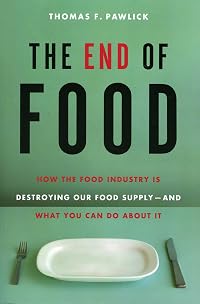
The End of Food: How the Food Industry is Destroying Our Food Supply--And What We Can Do About It
by Thomas F. Pawlick
On This Page
Description
This book is based on hard scientific research, most of which has been conducted outside of the United States, where food production lobbies have fought hard against this kind of research. Pawlick exposes an alarming trend in the food available in our grocery stores. This is not an argument about unhealthy, processed foods, rather it exposes the problems with all foods, including fruits and vegetables that people commonly assume are healthy..
Tags
Recommendations

Member Reviews
This book was full of anecdotal, fear-mongering "facts" quoted (in very long blocks) from small town newspapers and Google searches. Information from more credible sources (e.g. USDA nutritional information) was flogged for pages and pages and then the facts are extrapolated to the point of ridiculousness.
The author bio states that Pawlick is an "investigative science journalist" but this book reads nothing like the author has any experience in science. I can't figure out if the author is an idiot or (more likely) thinks his readers are. When describing anti-oxidants, he says, "Like so many microscopic Buffys stamping out vampires without becoming vampires, they de-fang the radicals, rendering them harmless" (p22). When he discusses show more the preventive use of antibiotics in feedlots (p43), he insists on saying the animals "catch cold" (with quotation marks even) on more than one occasion, as if readers cannot grasp the concept of an animal getting minorly ill in a way other than to "catch cold".
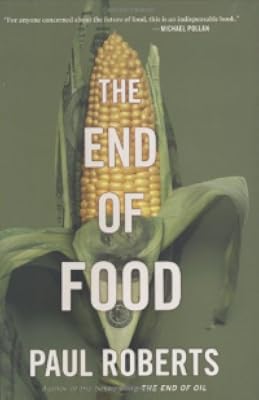
If you are totally new to the problems in our current food system, this will have some interesting facts hidden in the lines of ranting and bitterness, but The End of Food by Paul Roberts (same title, different book) gives even more information in a much more informative, non-ranting way that still manages to be interesting and very readable. show less
The author bio states that Pawlick is an "investigative science journalist" but this book reads nothing like the author has any experience in science. I can't figure out if the author is an idiot or (more likely) thinks his readers are. When describing anti-oxidants, he says, "Like so many microscopic Buffys stamping out vampires without becoming vampires, they de-fang the radicals, rendering them harmless" (p22). When he discusses show more the preventive use of antibiotics in feedlots (p43), he insists on saying the animals "catch cold" (with quotation marks even) on more than one occasion, as if readers cannot grasp the concept of an animal getting minorly ill in a way other than to "catch cold".
If you are totally new to the problems in our current food system, this will have some interesting facts hidden in the lines of ranting and bitterness, but The End of Food by Paul Roberts (same title, different book) gives even more information in a much more informative, non-ranting way that still manages to be interesting and very readable. show less
I am finding this book too alarmist. The topic (how the quality of our food is steadily declining) is important enough, but the style does not help at all.
He always starts by naming a problem (vitamin C in our potatoes is declining!), then elaborating on the worst case scenario from that (description of all the symptoms of scurvy), en then saying: "Is it really going to be that bad? Well, we don't really know, actually. But I've got another problem here." And then he moves on to the next one.
It never becomes clear how bad any single problem actually is, and some things are definitely exaggerated: I am sure the point that all food becomes more poisonous than nutritious (the End of Food of the title) is not near at all.
He is also very show more un-nuanced about the role of corporations - they all did this to us unsuspecting customers because they are so greedy. If only things were that simple.
There is a lot of information hidden in the polemic, but I am not enjoying it. show less
He always starts by naming a problem (vitamin C in our potatoes is declining!), then elaborating on the worst case scenario from that (description of all the symptoms of scurvy), en then saying: "Is it really going to be that bad? Well, we don't really know, actually. But I've got another problem here." And then he moves on to the next one.
It never becomes clear how bad any single problem actually is, and some things are definitely exaggerated: I am sure the point that all food becomes more poisonous than nutritious (the End of Food of the title) is not near at all.
He is also very show more un-nuanced about the role of corporations - they all did this to us unsuspecting customers because they are so greedy. If only things were that simple.
There is a lot of information hidden in the polemic, but I am not enjoying it. show less
A book on an important subject that I wish were better written. Pawlick describes how the industrialization of food production has resulted in cheaper food, but at a high cost that includes lower nutrition, taste, and variety; environmental degradation; rampant food toxins; and the destruction of the family farm, to name just a few of the horrors he details. His arguments would carry more weight if they weren't so strident; he seems incapable of writing "corporation" without preceding it with "greedy", and he sees a heartless conspirator behind every suit. For such a short book, there are a lot of lengthy quotes from source materials, including one that runs over 3 pages. I like his idea of planting a garden as an "act of subversion", show more but his suggestion that we fight the multinational domination of the food supply by growing our own food or only buying it from local farmers' markets just isn't practical for a time-strapped North American, especially one in a country where nothing grows for 6 months. Redeemed a little by an excellent annotated bibliography. Paul Roberts' book by the same name (The End of Food) covers much of the same territory with the same sense of urgency, but minus the near-hysterical tone. show less
Why yes, I am terrified of agribusiness and monocultures, why do you ask?
Ratings
Members
- Recently Added By
Author Information
7 Works 181 Members
Classifications
- Genres
- Nonfiction, General Nonfiction, Economics, Food & Cooking, Science & Nature, Health & Wellness
- DDC/MDS
- 338.19 — Society, government, & culture Economics Production Agricultural products Food supply
- LCC
- HD9000.5 .P285 — Social sciences Industries. Land use. Labor Industries. Land use. Labor Special industries and trades Agricultural industries
- BISAC
Statistics
- Members
- 149
- Popularity
- 219,253
- Reviews
- 4
- Rating
- (3.83)
- Languages
- English
- Media
- Paper, Ebook
- ISBNs
- 5
- ASINs
- 1