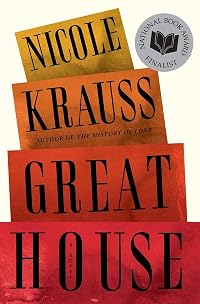
Great House
by Nicole Krauss
On This Page
Description
Connected solely by a desk of enormous dimension and many drawers that exerts a power over those who possess it or give it away, three people--a lonely American novelist clinging to the memory of a poet who has mysteriously vanished in Chile, an old man in Israel facing the imminent death of his wife of 51 years, and an esteemed antiques dealer tracking down the things stolen from his father by the Nazis--struggle to create a meaningful permanence in the face of inevitable loss.Tags
Recommendations











Member Recommendations
Member Reviews
Great House is an unusual novel that makes considerable demands of the reader. The book is made up of four loosely connected stories, but I didn't pick up on that at first. Part I has four chapters -- the first part of each story -- and felt disjointed, like four unfinished, disconnected works with weak character development. At the close of Part I, I was enormously frustrated. I broke one of my cardinal rules and read some reviews of this book. They inspired me to continue reading, and I'm glad I did. I finished the first story in Part II and was flooded with emotion. The same thing happened with the second, third, and fourth stories. And suddenly the book made sense, and I was reminded of a quote I'd flagged early on:
There are moments show more when a kind of clarity comes over you, and suddenly you can see through walls to another dimension that you'd forgotten or chosen to ignore in order to continue living with the various illusions that make life, particularly life with other people, possible. (p. 14)
I found myself warming to the characters which include a writer telling her life story, an older man reflecting on his relationship with his adult son, a man who discovers a secret his wife kept from him for years, and the adult children of an antiques dealer. Woven through Great House are themes of exile, loss, and betrayal, all in a Jewish context. It was fascinating, and I kept flagging quotes like this:
What is the point of a religion that turns its back on the subject of what happens when life ends? Having been denied an answer -- having been denied an answer while at the same time being cursed as a people who for thousands of years have aroused in others a murderous hate -- the Jew has no choice but to live with death every day. To live with it, to set up his house in its shadow, and never to discuss its terms. (p. 175)
Towards the end I could see how Nicole Krauss was building a kind of metaphor for the Jewish experience:
if every Jewish memory were put together, every last holy fragment joined up again as one, the House would be built again, said Weisz, or rather a memory of the House so perfect that it would be, in essence, the original itself. Perhaps that is what they mean when they speak of the Messiah: a perfect assemblage of the infinite parts of the Jewish memory. (p. 279)
Well as I said, this book does make demands of the reader. I'm not even sure I understood it all, but I felt rewarded in the end. show less
There are moments show more when a kind of clarity comes over you, and suddenly you can see through walls to another dimension that you'd forgotten or chosen to ignore in order to continue living with the various illusions that make life, particularly life with other people, possible. (p. 14)
I found myself warming to the characters which include a writer telling her life story, an older man reflecting on his relationship with his adult son, a man who discovers a secret his wife kept from him for years, and the adult children of an antiques dealer. Woven through Great House are themes of exile, loss, and betrayal, all in a Jewish context. It was fascinating, and I kept flagging quotes like this:
What is the point of a religion that turns its back on the subject of what happens when life ends? Having been denied an answer -- having been denied an answer while at the same time being cursed as a people who for thousands of years have aroused in others a murderous hate -- the Jew has no choice but to live with death every day. To live with it, to set up his house in its shadow, and never to discuss its terms. (p. 175)
Towards the end I could see how Nicole Krauss was building a kind of metaphor for the Jewish experience:
if every Jewish memory were put together, every last holy fragment joined up again as one, the House would be built again, said Weisz, or rather a memory of the House so perfect that it would be, in essence, the original itself. Perhaps that is what they mean when they speak of the Messiah: a perfect assemblage of the infinite parts of the Jewish memory. (p. 279)
Well as I said, this book does make demands of the reader. I'm not even sure I understood it all, but I felt rewarded in the end. show less
"I inherited it {the desk} from the former owner of the house. And I began to think about how I hated this desk. I wished I could get rid of it, and yet something in me wouldn't allow for that. It'd be a waste. You'd have to chop it up to get it down the stairs. It was built into the room and all that. So I began to think about this idea of the burden of inheritance. Now as I said at the same time I was a new mother, and of course I wasn't writing about furniture, I wasn't writing about physical objects really. I think what I thinking about was the idea of what is it that our parents pass down to us emotionally in terms of moods, griefs, sadnesses, angles at which we view and face the world and what then do we pass down often show more unknowingly to our children. This became a subject of great intense importance to me as I was facing the idea of bringing up my own child."
—Excerpt from Conversation: Nicole Krauss' 'Great House', PBS NewsHour, October 22, 2010
This difficult but brilliant and affecting novel consists of four sets of disparate characters, who all share a direct or obscure connection to a writing desk, which is imposing and overwhelming in size and filled with secret drawers and odd features, yet intensely memorable and deeply comforting to those who have possessed it.
The 'Great House' of the title refers to the school built by the 1st century rabbi Yochanan ben Zakkai after the destruction of Jerusalem during the First Jewish-Roman War, in which Judaic law and religion was re-established:
Two thousand years have passed, my father used to tell me, and now every Jewish soul is built around the house that burned in that fire, so vast that we can, each one of us, only recall the tiniest fragment: a pattern on the wall, a knot in the wood of a door, a memory of how light fell across the floor. But if every Jewish memory were put together, every last holy fragment joined up again as one, the House would be built again, said Weisz, or rather a memory of the House so perfect that it would be, in essence, the original itself.
Great House consists of two parts, with four chapters for the four stories in each part, followed by a short chapter at the end of Part II that helps link the characters together. In the first chapter, "All Rise", a middle aged woman speaks to a judge about her life as a writer, her failed relationship with her husband due to her need for solitude and devotion to her work in exclusion of him, and how she came to acquire the desk, and to give it away. "True Kindness" is an emotional and internal plea by an old man to his estranged child after the death of the man's wife in Israel, one filled with intense hatred, bitterness and love. In "Swimming Holes", an Englishman recalls his long term marriage to his eastern European Jewish wife, who emigrated to the UK at the onset of World War II and withheld her past life and its secrets from him until the end of her life. Finally, "Lies Told By Children" is narrated by an American woman who studies at Oxford, where she meets and falls in love with another student, a rootless young man who is crippled and fortified by his intimate connection with his sister and his overbearing father.
Each of the major characters in the novel share a need for solitude and an inability to establish trust with the person who is most dear to them. Unrequited love is the necessary result, along with grief and regret for what was lost to them. Past memories resurface frequently, which are generally unpleasant and only add to the characters' loneliness and despair.
Great House requires substantial attention and work by the reader to connect the characters to each other, which seemed to me as though I was trying to build a single puzzle from pieces from four different puzzles mixed together and scattered in different rooms of a large house. I suspect that the novel may hold different meanings for each reader, based on their own histories and experiences, and that a second reading of the book would be rewarding and enlightening. It is a beautifully written book, whose characters deeply touched me, and I am tempted to immediately start reading it again to find those missing pieces. show less
—Excerpt from Conversation: Nicole Krauss' 'Great House', PBS NewsHour, October 22, 2010
This difficult but brilliant and affecting novel consists of four sets of disparate characters, who all share a direct or obscure connection to a writing desk, which is imposing and overwhelming in size and filled with secret drawers and odd features, yet intensely memorable and deeply comforting to those who have possessed it.
The 'Great House' of the title refers to the school built by the 1st century rabbi Yochanan ben Zakkai after the destruction of Jerusalem during the First Jewish-Roman War, in which Judaic law and religion was re-established:
Two thousand years have passed, my father used to tell me, and now every Jewish soul is built around the house that burned in that fire, so vast that we can, each one of us, only recall the tiniest fragment: a pattern on the wall, a knot in the wood of a door, a memory of how light fell across the floor. But if every Jewish memory were put together, every last holy fragment joined up again as one, the House would be built again, said Weisz, or rather a memory of the House so perfect that it would be, in essence, the original itself.
Great House consists of two parts, with four chapters for the four stories in each part, followed by a short chapter at the end of Part II that helps link the characters together. In the first chapter, "All Rise", a middle aged woman speaks to a judge about her life as a writer, her failed relationship with her husband due to her need for solitude and devotion to her work in exclusion of him, and how she came to acquire the desk, and to give it away. "True Kindness" is an emotional and internal plea by an old man to his estranged child after the death of the man's wife in Israel, one filled with intense hatred, bitterness and love. In "Swimming Holes", an Englishman recalls his long term marriage to his eastern European Jewish wife, who emigrated to the UK at the onset of World War II and withheld her past life and its secrets from him until the end of her life. Finally, "Lies Told By Children" is narrated by an American woman who studies at Oxford, where she meets and falls in love with another student, a rootless young man who is crippled and fortified by his intimate connection with his sister and his overbearing father.
Each of the major characters in the novel share a need for solitude and an inability to establish trust with the person who is most dear to them. Unrequited love is the necessary result, along with grief and regret for what was lost to them. Past memories resurface frequently, which are generally unpleasant and only add to the characters' loneliness and despair.
Great House requires substantial attention and work by the reader to connect the characters to each other, which seemed to me as though I was trying to build a single puzzle from pieces from four different puzzles mixed together and scattered in different rooms of a large house. I suspect that the novel may hold different meanings for each reader, based on their own histories and experiences, and that a second reading of the book would be rewarding and enlightening. It is a beautifully written book, whose characters deeply touched me, and I am tempted to immediately start reading it again to find those missing pieces. show less
After reading The History of Love, I promised myself to read something else by Nicole Krauss when I had the chance. I found Great House at a local thrift store for $1, and it was one of the best dollars I ever spent.
There are several narratives to follow and they are tied together by a desk, a desk that was part of the stolen property of Jews displaced by the Third Reich. Each of the narratives is a story in itself, a glimpse into the lives of people who struggle with their humanity and how they fit into the world at large. What each story has at its core is the theme of loss, memory and isolation. Many of these characters have an excruciating inability to reach beyond themselves and touch others or let anyone in.
This book is written show more like a maze, weaving in and out, characters coming and going. It is a puzzle with pieces that lie just out of the reach of your hand and without which you can never make a complete picture. There were moments when I wondered if I had missed something crucial, I felt so lost, and then Krauss would lay down her next layer and I would find the pieces interlocking and making sense. There was, within that revelation, an accompanying feeling that I had discovered something not only about the characters, but about myself.
This is a book that raises important questions and leaves you pondering answers long after you have reached the final page. How much can you know about another person? Does a person deserve to have his secrets respected after death? How long can you close a person out before it is too late to make amends? Can we ever understand a person fully if we do not have access to their history, their stories, their losses? How can we not live with death every day, when we all know death is the ultimate outcome for each of us?
And then there is the concept of a thing carrying the memory, and in some way the residual life, of those who are lost. I know from experience that when a person is gone, any possession they cherished takes on a different meaning. In some ways, it can come to embody the idea of that person and feel like a bridge to their soul. And, we can be linked in our minds to our pasts by smells and textures and breezes that blow through windows carrying sea spray or the smell of roses. We can sometimes feel that if we could recreate those things, that material world, we could repossess our lost lives, our childhood, or our loves.
Krauss writes prose that flows and sings and carries you along like a river. For example, she describes an Alzheimer’s patient in words that capture perfectly what those of us who have known the progress of this disease easily recognize.
I could see in her eyes that beneath those words there was nothing, just an abyss, like the black-water pond she disappeared into every morning no matter the weather. Then followed a period when she became scared, aware of how much she was losing by the day, perhaps even the hour, like a person slowly bleeding to death, hemorrhaging toward oblivion...And then even that period passed, and she no longer remembered enough to be afraid, no longer remembered, I suppose, that things had ever been any other way, and from then on she set off along, utterly alone, on a long journey back to the shores of her childhood.
If I was jolted by her transition from story to story, I was pulled back into the story immediately by her use of description and language. The thread may have been tenuous at times, but it was worth any effort required to follow the thread to its end. show less
There are several narratives to follow and they are tied together by a desk, a desk that was part of the stolen property of Jews displaced by the Third Reich. Each of the narratives is a story in itself, a glimpse into the lives of people who struggle with their humanity and how they fit into the world at large. What each story has at its core is the theme of loss, memory and isolation. Many of these characters have an excruciating inability to reach beyond themselves and touch others or let anyone in.
This book is written show more like a maze, weaving in and out, characters coming and going. It is a puzzle with pieces that lie just out of the reach of your hand and without which you can never make a complete picture. There were moments when I wondered if I had missed something crucial, I felt so lost, and then Krauss would lay down her next layer and I would find the pieces interlocking and making sense. There was, within that revelation, an accompanying feeling that I had discovered something not only about the characters, but about myself.
This is a book that raises important questions and leaves you pondering answers long after you have reached the final page. How much can you know about another person? Does a person deserve to have his secrets respected after death? How long can you close a person out before it is too late to make amends? Can we ever understand a person fully if we do not have access to their history, their stories, their losses? How can we not live with death every day, when we all know death is the ultimate outcome for each of us?
And then there is the concept of a thing carrying the memory, and in some way the residual life, of those who are lost. I know from experience that when a person is gone, any possession they cherished takes on a different meaning. In some ways, it can come to embody the idea of that person and feel like a bridge to their soul. And, we can be linked in our minds to our pasts by smells and textures and breezes that blow through windows carrying sea spray or the smell of roses. We can sometimes feel that if we could recreate those things, that material world, we could repossess our lost lives, our childhood, or our loves.
Krauss writes prose that flows and sings and carries you along like a river. For example, she describes an Alzheimer’s patient in words that capture perfectly what those of us who have known the progress of this disease easily recognize.
I could see in her eyes that beneath those words there was nothing, just an abyss, like the black-water pond she disappeared into every morning no matter the weather. Then followed a period when she became scared, aware of how much she was losing by the day, perhaps even the hour, like a person slowly bleeding to death, hemorrhaging toward oblivion...And then even that period passed, and she no longer remembered enough to be afraid, no longer remembered, I suppose, that things had ever been any other way, and from then on she set off along, utterly alone, on a long journey back to the shores of her childhood.
If I was jolted by her transition from story to story, I was pulled back into the story immediately by her use of description and language. The thread may have been tenuous at times, but it was worth any effort required to follow the thread to its end. show less
Great House is now the second book by Nicole Krauss that I’ve read, having previously read The History of Love. I continue to be impressed by this author’s writing. In Great House, Nicole Kraus explores many ideas in labyrinthine and mysterious ways through beautifully crafted individual stories woven into a greater whole. The thread which we know will connect these stories is a multi-drawered antique desk, believed to have once been owned by Spanish poet Federico Garcia Lorca. We also figure out that the individual stories will have some connection with one another so we read with careful eye to catch whatever those links might be. Not only is this novel superbly plotted, but also the writing is gorgeous.
Novels that take a bit of show more work such as this one often have me complaining. This book, however, did not leave me time to do so as I was completely captivated page after page. Having lived in Israel in the 1970’s, I knew the Jerusalem of that time. I also was well aware of the concurrent turbulence in Chile and the protests of young Jewish South Americans. I could have jumped into this book and befriended its characters. I also know what it feels like to be older and look back at that time. You could say I lived this story. The only thing that was missing is that, while living in Israel, I did not have that wonderful desk!
There is one part of the story that had me laughing out loud (although there is no humor per se in the story). I was listening to an audio version of this novel, and found that there were a few lines in Hebrew. The lines were supposed to have been said in a European-accented Hebrew. The accent was *distinctly* American! I had to replay those lines a few times just for the laughs.
I’m thoroughly glad that the author was rewarded with an Orange Prize nomination, a well-deserved kudo for this wonderful book. For sure, I’ll be greatly anticipating future novels by this talented writer. show less
Novels that take a bit of show more work such as this one often have me complaining. This book, however, did not leave me time to do so as I was completely captivated page after page. Having lived in Israel in the 1970’s, I knew the Jerusalem of that time. I also was well aware of the concurrent turbulence in Chile and the protests of young Jewish South Americans. I could have jumped into this book and befriended its characters. I also know what it feels like to be older and look back at that time. You could say I lived this story. The only thing that was missing is that, while living in Israel, I did not have that wonderful desk!
There is one part of the story that had me laughing out loud (although there is no humor per se in the story). I was listening to an audio version of this novel, and found that there were a few lines in Hebrew. The lines were supposed to have been said in a European-accented Hebrew. The accent was *distinctly* American! I had to replay those lines a few times just for the laughs.
I’m thoroughly glad that the author was rewarded with an Orange Prize nomination, a well-deserved kudo for this wonderful book. For sure, I’ll be greatly anticipating future novels by this talented writer. show less
I hate books that I finish and then have to go to the Internet to have them explained to me. The good news is that I am in good company--nobody seems to be able to explain this book. Given that, maybe I can relax a bit.
The dust jacket says that the stories in this book are told by narrators who all have a connection with the same hulking desk. When I read that I imagined a work similar to People of the Book by Geraldine Brooks, but the desk here doesn't take the central role that the Haggadah does in that one. Instead the desk is almost a side note, or maybe a subtle, oboe counter line, to the intimate melody that each of the narrators plays as they tell their stories.
The writing is beautiful--similes and metaphors par excellence, but show more after awhile all the narrators start to sound alike, none has their own voice, and it seems to be more about the writing than about the stories.
I found several reading group guides with lists of questions--very few of which I could answer--and I think that that is what the author was after, a story with no real ending, no neat lines, a story that you can fill in the details as you will,. I don't have time for that. So why do I keep trying to figure out the answers? show less
The dust jacket says that the stories in this book are told by narrators who all have a connection with the same hulking desk. When I read that I imagined a work similar to People of the Book by Geraldine Brooks, but the desk here doesn't take the central role that the Haggadah does in that one. Instead the desk is almost a side note, or maybe a subtle, oboe counter line, to the intimate melody that each of the narrators plays as they tell their stories.
The writing is beautiful--similes and metaphors par excellence, but show more after awhile all the narrators start to sound alike, none has their own voice, and it seems to be more about the writing than about the stories.
I found several reading group guides with lists of questions--very few of which I could answer--and I think that that is what the author was after, a story with no real ending, no neat lines, a story that you can fill in the details as you will,. I don't have time for that. So why do I keep trying to figure out the answers? show less
A reclusive writer turns her back on friends and lovers to work at the imposing desk loaned to her by a Chilean poet who later disappears during the brutal Pinochet regime. Two siblings try their best to cope with the psychological scars imposed by their domineering father, a man who specializes in retrieving the personal effects of victims displaced by the Holocaust. A husband who has suffered through an unrequited love for his emotionally distant wife uncovers a heartbreaking secret as her mind starts to slip near the end of her life. Estranged from his youngest son for many years, a father makes a bitter, angry and ultimately futile attempt at reconciliation before he dies.
What do these four plotlines, which represent the narrative show more force that underscores Great House, have in common? The desk, for one thing; it is both a physical presence that connects all of the stories—although one only tangentially—as well as a metaphor for the constant sense of loss that pervades the novel. They also feature protagonists who suffer life-long isolation—often self-imposed—from even the most basic forms of human kindness and spend a considerable amount of time trying to reconstruct memories of their past. (In fact, the “great house” of the title refers to Old Testament admonishment to rebuild the lost Temple of Jerusalem from the collective memory of the Jewish people.)
I found this to be a very hard book to review, if for no other reason than it was not an altogether enjoyable book to read. Unlike her earlier novel The History of Love, in which Krauss covers very similar themes but with occasional touches of humor and joy, this work is wholly devoid of anything that might relieve the unrelenting emotional pain her characters experience. Further, while each story differs in its details, they share a soul-crushing melancholy that becomes a little monotonous by the end. Still, Kraus is a remarkably talented writer and this is a book full of compelling and hauntingly beautiful images that deliver a powerful final message. While reading this one was hardly a feel-good experience, it is also one that I suspect will stay with me for quite awhile. show less
What do these four plotlines, which represent the narrative show more force that underscores Great House, have in common? The desk, for one thing; it is both a physical presence that connects all of the stories—although one only tangentially—as well as a metaphor for the constant sense of loss that pervades the novel. They also feature protagonists who suffer life-long isolation—often self-imposed—from even the most basic forms of human kindness and spend a considerable amount of time trying to reconstruct memories of their past. (In fact, the “great house” of the title refers to Old Testament admonishment to rebuild the lost Temple of Jerusalem from the collective memory of the Jewish people.)
I found this to be a very hard book to review, if for no other reason than it was not an altogether enjoyable book to read. Unlike her earlier novel The History of Love, in which Krauss covers very similar themes but with occasional touches of humor and joy, this work is wholly devoid of anything that might relieve the unrelenting emotional pain her characters experience. Further, while each story differs in its details, they share a soul-crushing melancholy that becomes a little monotonous by the end. Still, Kraus is a remarkably talented writer and this is a book full of compelling and hauntingly beautiful images that deliver a powerful final message. While reading this one was hardly a feel-good experience, it is also one that I suspect will stay with me for quite awhile. show less
A powerful novel of love and loss and the reverberating effects of historical atrocities on our children, Great House by Nicole Krauss (Norton, $24.95) is a testimony to the relentless grip of memory on our present, a series of interconnected stories rendered with poise and striking clarity.
As she proved in her previous novel, the international bestseller The History of Love, Krauss is an astute and compassionate author. She cares for her characters, cares to probe deep, spend time navigating the emotional geography of each protagonist -- the old as well as the young -- to expose their most intimate conflicts, reflections and desires.
Great House brings to life the complex relationships of a solitary writer and an inherited desk, a show more father and his alienated son, a husband and his dying wife, and the suffocating hold a father, who is an antiques dealer, has on his son and daughter. Central to these stories is a massive desk owned by a Chilean poet who disappears at the hands of Pinochet's secret police. And always present, never forgotten, are the profound effects of the Holocaust, the way tragedy and loss shapes each character, and the plight of Israeli families -- those who lose children in war, and those who live in perpetual fear of the ring of a doorbell that might herald devastating news.
"Your Honor, in the winter of 1972 R and I broke up," begins the first sentence of "Great House," situating the reader in a courtroom. The speaker, a writer, is explaining how she came to own, and eventually lose, the mysterious, wooden desk with 19 drawers, "some small and some large, whose odd number and strange array, I realized now, on the cusp of their being suddenly taken from me, had come to signify a kind of guiding if mysterious order in my life, an order that, when my work was going well, took on an almost mystical quality."
After years, a woman who maintains that she is the poet's daughter appears to claim the desk, disrupting the writer's life; so much so that she decides to lock her apartment and travel to Jerusalem, perhaps to claim the desk back, although she denies it. The reason the protagonist is in court will be revealed much later; in the meantime, being led by a sure-penned author, we settle back and enjoy the journey.
In Israel, a father is reminiscing about his estranged son, Dov, a barrister, returned home from England to sit shiva for his mother. Krauss reveals a deep understanding of the human psyche and of a father's pain, anger, longing and envy in the old man who, in the little time left to him, aches to mend his relationship with his son -- even if father and son might not possess the right tools to do so. Always present is the all-consuming fear of losing his sons to war: "It was the doorbell we feared the most. Across the street they arrived at the Biletskis' to say that Itzhak, little Itzy whom you and Uri played with as children, had been killed in the Golan."
Across the oceans, in England, the doorbell rings to announce a different kind of trouble: at the door is a stranger the husband suspects of being his wife's lover, setting a series of incidents into motion that will unearth a far more disconcerting secret. And here, too, looms the presence of the mysterious desk that "overshadowed everything else like some sort of grotesque, threatening monster, clinging to most of one wall and bullying the other pathetic bits of furniture..." A desk that will someday reveal its own set of secrets.
In the meantime, a love affair is blooming "in the house in Belsize Park that [Yoav] shares with his sister, Leah." The house is wonderfully gothic, a significant character with eccentricities of its own, "a large and dilapidated brick Victorian... filled with darkly beautiful furniture that the father, a famous antiques dealer, kept there... the rooms were always changing, taking on the mysterious moods of houses and apartments whose owners had died, gone bankrupt, or simply decided to..." In the house in Belsize Park, under the austere shadow of their father, Yoav and Leah are "locked within the walls of their own family, and in the end it wasn't possible for them to belong to anyone else." Not unlike their father who, unable to free himself of the past, dedicates his life to reassembling his own father's study that was plundered by the Nazis -- an obsessed son who will not rest until every piece of furniture is sought, transported and arranged in its rightful place.
Once again, the doorbell rings. This time Weisz, the antiques dealer, is at the door:
"Forgive me for not calling in advance... There's something I'd like to discuss with you... A desk..."
To discover the fate of the desk, and whether the possessed Weisz succeeds in his quest, pick up Great House and read it, and once you have, circle around and read it once more to better appreciate the interconnected stories and doubly enjoy the magical prose and insight of an author at the top of her form. show less
As she proved in her previous novel, the international bestseller The History of Love, Krauss is an astute and compassionate author. She cares for her characters, cares to probe deep, spend time navigating the emotional geography of each protagonist -- the old as well as the young -- to expose their most intimate conflicts, reflections and desires.
Great House brings to life the complex relationships of a solitary writer and an inherited desk, a show more father and his alienated son, a husband and his dying wife, and the suffocating hold a father, who is an antiques dealer, has on his son and daughter. Central to these stories is a massive desk owned by a Chilean poet who disappears at the hands of Pinochet's secret police. And always present, never forgotten, are the profound effects of the Holocaust, the way tragedy and loss shapes each character, and the plight of Israeli families -- those who lose children in war, and those who live in perpetual fear of the ring of a doorbell that might herald devastating news.
"Your Honor, in the winter of 1972 R and I broke up," begins the first sentence of "Great House," situating the reader in a courtroom. The speaker, a writer, is explaining how she came to own, and eventually lose, the mysterious, wooden desk with 19 drawers, "some small and some large, whose odd number and strange array, I realized now, on the cusp of their being suddenly taken from me, had come to signify a kind of guiding if mysterious order in my life, an order that, when my work was going well, took on an almost mystical quality."
After years, a woman who maintains that she is the poet's daughter appears to claim the desk, disrupting the writer's life; so much so that she decides to lock her apartment and travel to Jerusalem, perhaps to claim the desk back, although she denies it. The reason the protagonist is in court will be revealed much later; in the meantime, being led by a sure-penned author, we settle back and enjoy the journey.
In Israel, a father is reminiscing about his estranged son, Dov, a barrister, returned home from England to sit shiva for his mother. Krauss reveals a deep understanding of the human psyche and of a father's pain, anger, longing and envy in the old man who, in the little time left to him, aches to mend his relationship with his son -- even if father and son might not possess the right tools to do so. Always present is the all-consuming fear of losing his sons to war: "It was the doorbell we feared the most. Across the street they arrived at the Biletskis' to say that Itzhak, little Itzy whom you and Uri played with as children, had been killed in the Golan."
Across the oceans, in England, the doorbell rings to announce a different kind of trouble: at the door is a stranger the husband suspects of being his wife's lover, setting a series of incidents into motion that will unearth a far more disconcerting secret. And here, too, looms the presence of the mysterious desk that "overshadowed everything else like some sort of grotesque, threatening monster, clinging to most of one wall and bullying the other pathetic bits of furniture..." A desk that will someday reveal its own set of secrets.
In the meantime, a love affair is blooming "in the house in Belsize Park that [Yoav] shares with his sister, Leah." The house is wonderfully gothic, a significant character with eccentricities of its own, "a large and dilapidated brick Victorian... filled with darkly beautiful furniture that the father, a famous antiques dealer, kept there... the rooms were always changing, taking on the mysterious moods of houses and apartments whose owners had died, gone bankrupt, or simply decided to..." In the house in Belsize Park, under the austere shadow of their father, Yoav and Leah are "locked within the walls of their own family, and in the end it wasn't possible for them to belong to anyone else." Not unlike their father who, unable to free himself of the past, dedicates his life to reassembling his own father's study that was plundered by the Nazis -- an obsessed son who will not rest until every piece of furniture is sought, transported and arranged in its rightful place.
Once again, the doorbell rings. This time Weisz, the antiques dealer, is at the door:
"Forgive me for not calling in advance... There's something I'd like to discuss with you... A desk..."
To discover the fate of the desk, and whether the possessed Weisz succeeds in his quest, pick up Great House and read it, and once you have, circle around and read it once more to better appreciate the interconnected stories and doubly enjoy the magical prose and insight of an author at the top of her form. show less
Members
- Recently Added By
Published Reviews
ThingScore 50
Tegelijk zijn het dergelijke zwaar aangezette scènes die de roman doen overhellen naar kitsch. Vooral omdat Krauss je niet de kans geeft om er zelf conclusies uit te trekken. Ligt het sentiment er al vrij dik bovenop, ze smeert er nog een laag bij door steeds te spreken van ‘tremendous guilt’ en ‘crushing sadness’. Er wordt hier zo veel verteld over gevoelens dat er weinig show more daadwerkelijk te voelen valt. show less
added by SimoneA
Lists

Favourite Women's Prize for Fiction, Orange & Bailey's Prize contenders
132 works; 52 members

Recommend the 20 best books you've read in the last five years
2,168 works; 601 members

Top Five Books of 2013
1,562 works; 721 members

Favourite Books
1,819 works; 308 members

Jewish Books
367 works; 24 members

I Could Live There
185 works; 12 members

Allie's Wishlist
217 works; 2 members

Alphabetical Books
211 works; 3 members

Books Read in 2018
4,360 works; 110 members
National Book Award Finalists - Fiction
377 works; 12 members

Books Read in 2021
5,361 works; 114 members

Which house?
423 works; 16 members
Talk Discussions
Past Discussions
Great House by Nicole Krauss in Orange January/July (February 2013)
Author Information

16+ Works 14,387 Members
Nicole Krauss is an international best selling author. The History of Love (W.W. Norton 2005) won the William Saroyan International Prize for Writing, France's Prix du Meilleur Livre ?tranger, was named #1 book of the year by Amazon.com, and was short-listed for the Orange, Médicis, and Femina prizes. Nicole's first novel, Man Walks Into a Room, show more was a finalist for the Los Angeles Times Book Award for First Fiction. In 2007, she was selected as one of Granta's Best Young American Novelists, and in 2010 The New Yorker named her one of the 20 best writers under 40. Her most recent novel is GREAT HOUSE (W.W. Norton October 2010). Nicole's books have been translated into more than thirty-five languages. Krauss recently completed a Cullman Fellowship at the New York Public Library. She lives in Brooklyn, New York. (Bowker Author Biography) show less
Awards and Honors
Awards
Distinctions
Common Knowledge
- Canonical title
- Great House
- Original title
- Great house
- Original publication date
- 2010
- People/Characters
- Daniel Varsky; Aaron; Dov; Arthur; Lotte Berg; George Weisz (show all 10); Leah Weisz; Yoav Weisz; Isabel; Nadia
- Important places
- London, England, UK; New York, New York, USA; Jerusalem
- Important events
- World War II; Holocaust
- Dedication
- For Sasha and Cy
- First words
- Talk to him.
- Quotations
- There are times when the kindness of strangers only makes matters worse because one realizes how badly one is in need of kindness and that the only source is a stranger.
It was one of those winter nights in England when the darkness that falls at three makes nine feel like midnight, reminding one of how far north one has staked one's life.
We stood in the hall of the house that had once been all of our house, a house that had been filled with life, every last room of it brimming with laughter, arguments, tears, dust, the smell of food, pain, desire, anger, and ... (show all)silence, too, the tightly coiled silence of people pressed up against each other in what is called a family.
As if to touch, ritually, one last time, every enduring pocket of pain. No, the powerful emotions of youth don’t mellow with time. One gets a grip on them, cracks a whip, forces them down. You build your defenses. Insis... (show all)t on order. The strength of feeling doesn’t lessen, it is simply contained. - Last words
- (Click to show. Warning: May contain spoilers.)How often I had witnessed it in others, and yet now it almost surprised me: the disappointment, then the relief of something at last sinking away.
- Blurbers
- Maslin, Janet; Messud, Claire; Cryer, Dan
Classifications
Statistics
- Members
- 2,107
- Popularity
- 9,762
- Reviews
- 125
- Rating
- (3.47)
- Languages
- 14 — Czech, Danish, Dutch, English, Estonian, French, German, Hebrew, Italian, Romanian, Russian, Spanish, Swedish, Portuguese (Portugal)
- Media
- Paper, Audiobook, Ebook
- ISBNs
- 53
- ASINs
- 13
