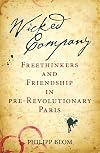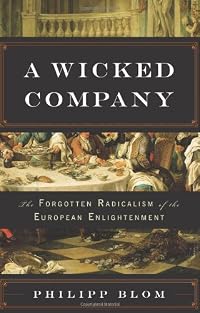
A Wicked Company: The Forgotten Radicalism of the European Enlightenment
by Philipp Blom
On This Page
Description
The flourishing of radical philosophy in Baron Thierry Holbach's Paris salon from the 1750s to the 1770s stands as a seminal event in Western history. Holbach's house was an international epicenter of revolutionary ideas and intellectual daring, bringing together such original minds as Denis Diderot, Laurence Sterne, David Hume, Adam Smith, Ferdinando Galiani, Horace Walpole, Benjamin Franklin, Guillaume Raynal, and Jean-Jacques Rousseau. In A Wicked Company, acclaimed historian Philipp Blom show more retraces the fortunes of this exceptional group of friends. All brilliant minds, full of wit, courage, show lessTags
Recommendations
















Member Recommendations
Member Reviews
I wanted to read this book as my knowledge of the Enlightenment was sketchy (it still is, to be fair). All I knew had been gleaned from references in books about the French Revolution, as well as Foucault’s thoughts on it from [b:Lectures at the College de France, 1975-76: Society Must Be Defended|771816|Lectures at the College de France, 1975-76 Society Must Be Defended|Michel Foucault|https://images.gr-assets.com/books/1316130657s/771816.jpg|3308111]. ‘Wicked Company’ is by no means an introductory book on the Enlightenment, indeed after reading I still couldn’t give you a coherent definition of what the Enlightenment was. It is a book on personalities, not socio-political trends. From the outset, Blom points out that he is show more writing with an agenda - to rehabilitate Baron d’Holbach and, to a lesser extent, Diderot as key thinkers of the time. I had never heard of Holbach, who held the influential salons attended by Diderot and company. In addition Holbach also published some radical works of his own, although these have apparently tended to lack popularity since. By contrast, Blom’s comments on Rousseau and Voltaire range from gently dismissive to openly hostile. Those two names are probably most often associated with the Enlightenment, at least in the references I’ve seen. This stated partiality initially concerned me, but did not reduce my enjoyment of the book overall. In retrospect, it is refreshing to find a historical author admitting up front who he/she likes best. (Should that be ‘whom he/she likes best’? Is ‘whom’ still used at all, or is that Enlightenment-era grammar influencing me?)
‘Wicked Company’ is certainly enjoyable, although I felt that very similar points concerning the philosophical differences between Holbach, Diderot, and Rousseau were picked over repeatedly. The most powerful message that comes across about Holbach’s circle is their staunch atheism. This is explained clearly and at length, in a highly sympathetic and appealing style. The extent of censorship and suppression that the circle worked under is also effectively conveyed. The book has a broadly but not exclusively chronological structure and a series of rather whimsical chapter titles. It thus appears to be quite a personal work - which isn’t a criticism, as it frustrates me when writers in the humanities cloak their opinions in protestations of objectivity. Rousseau certainly does not come out of it well, which encourages me to read his [b:Confessions|12649|Confessions|Jean-Jacques Rousseau|https://images.gr-assets.com/books/1388293814s/12649.jpg|6985890] as I’ve been meaning to for ages.
Although ‘Wicked Company’ is strong and evidently well-researched as an account of Holbach’s salon and the philosophical lives of its contributors, it is much weaker on the relation of the Enlightenment to the French Revolution. Admittedly, this is not meant to be the central topic of the book. Nonetheless, I found the epilogue ‘A Stolen Revolution’ rather unsatisfactory. For one thing, it unequivocally demonised Robespierre, who I have a fascination with. Characterising him as a dictator solely responsible for the Terror is unsatisfactorily simplistic. His use of Rousseau for inspiration likewise - Robespierre’s views cannot be equated with Rousseau’s work. I would also have appreciated a little more nuance in the relationship between Enlightenment thought and the anti-clerical slant of the Revolution. I get the sense that the links between the Enlightenment and the Revolution are complex and ambivalent, probably not ideally suited to a short summary chapter such as this. From Blom’s earlier chapters, it seems to me that Holbach and Diderot would have greatly appreciated parts of the Revolution. Conversely, Rousseau would surely have strongly objected to much of it - not least its resolutely urban focus, which does not fit with his canonisation of rural life.
Speculation aside, what I can say for sure is this book is very thought-provoking and piqued my curiosity regarding the Enlightenment and its thinkers. It starts slowly but fully held my interest to the end. show less
‘Wicked Company’ is certainly enjoyable, although I felt that very similar points concerning the philosophical differences between Holbach, Diderot, and Rousseau were picked over repeatedly. The most powerful message that comes across about Holbach’s circle is their staunch atheism. This is explained clearly and at length, in a highly sympathetic and appealing style. The extent of censorship and suppression that the circle worked under is also effectively conveyed. The book has a broadly but not exclusively chronological structure and a series of rather whimsical chapter titles. It thus appears to be quite a personal work - which isn’t a criticism, as it frustrates me when writers in the humanities cloak their opinions in protestations of objectivity. Rousseau certainly does not come out of it well, which encourages me to read his [b:Confessions|12649|Confessions|Jean-Jacques Rousseau|https://images.gr-assets.com/books/1388293814s/12649.jpg|6985890] as I’ve been meaning to for ages.
Although ‘Wicked Company’ is strong and evidently well-researched as an account of Holbach’s salon and the philosophical lives of its contributors, it is much weaker on the relation of the Enlightenment to the French Revolution. Admittedly, this is not meant to be the central topic of the book. Nonetheless, I found the epilogue ‘A Stolen Revolution’ rather unsatisfactory. For one thing, it unequivocally demonised Robespierre, who I have a fascination with. Characterising him as a dictator solely responsible for the Terror is unsatisfactorily simplistic. His use of Rousseau for inspiration likewise - Robespierre’s views cannot be equated with Rousseau’s work. I would also have appreciated a little more nuance in the relationship between Enlightenment thought and the anti-clerical slant of the Revolution. I get the sense that the links between the Enlightenment and the Revolution are complex and ambivalent, probably not ideally suited to a short summary chapter such as this. From Blom’s earlier chapters, it seems to me that Holbach and Diderot would have greatly appreciated parts of the Revolution. Conversely, Rousseau would surely have strongly objected to much of it - not least its resolutely urban focus, which does not fit with his canonisation of rural life.
Speculation aside, what I can say for sure is this book is very thought-provoking and piqued my curiosity regarding the Enlightenment and its thinkers. It starts slowly but fully held my interest to the end. show less
Ongelooflijk. De kant van de Verlichting die in de klassieke geschiedenislessen verwaarloosd wordt, beschreven door een Philipp Blom in grote vorm.
Het boek leest als een trein en als lezer voel je je bijna even thuis in de Parijse salons van Baron Thiry D'Holbach als hoofdrolspelers Diderot, D'Alembert, Hume en aanverwanten. Het conflict met Rousseau voel je zo onder de huid kruipen en het idealisme, de gedrevenheid en de intellectuele moed van de protagonisten is hartverwarmend. Topboek. Absoluut.
Het boek leest als een trein en als lezer voel je je bijna even thuis in de Parijse salons van Baron Thiry D'Holbach als hoofdrolspelers Diderot, D'Alembert, Hume en aanverwanten. Het conflict met Rousseau voel je zo onder de huid kruipen en het idealisme, de gedrevenheid en de intellectuele moed van de protagonisten is hartverwarmend. Topboek. Absoluut.
A Wicked Company provides new and refreshing perspectives on certain individuals of the (French) Enlightenment. The main premise, that Denis Diderot was a major intellectual figure, who has not been given his due in comparison to better known Rousseau and others, is clearly true, though I wonder if 200 years later anyone cares anymore outside of specialists - influence matters, and Rousseau won that game largely because of his wild character and skillful writing. It's hard to imagine Diderot being newly influential today, except perhaps if he were anointed Patron Saint of Wikipedia (I'd support that). As a book about Diederot and Holbach, Enlightenment philosophy, the Encyclopedie, and Parisian Salon's in the 1750s and 60s it's well show more worthwhile, but not as good as Blom's earlier Enlightening the World which covers a lot of the same ground. show less
This is an interesting book that provides some little-known connections between the larger-known set of ideas that we largely recognize as the "Enlightenment," and is especially aimed at the general reader. Those whose knowledge of the intellectual side of the Enlightenment is moderate to extensive will gain little from the book, but it was still interesting to learn about some of the private lives, loves, and feuds of the people involved therein.
Blom's ultimate emphasis here is on the so-called "radical" Enlightenment, as opposed to the moderate Enlightenment of thinkers like Voltaire. The latter still flirted with the political status quo and entertained deism. After all, Voltaire made his fortune by loaning vast sums of money to show more European monarchs; it's difficult to rock the boat of ideas when your financial security depends on it. Those of the radical Enlightenment were not afraid to take reason, science, and materialism to its ultimate limits: there are many of them, but the major figures include Baron Holbach, Diderot, d'Alembert, Buffon, Grimm, and Hume. One figure he decidedly excludes from his radical favorites is Jean-Jacques Rousseau, choosing to portray him, rightly or wrongly, as a paranoid megalomanic.
After giving some initial biographical information of the characters that loom the largest in the book - Diderot, Holbach, and Rousseau - we proceed to learn more about their thought and their circle of what are usually considered more minor friends. Blom intermittently keeps referring back to Holbach's twice-weekly dinners that would often be attended some of the greatest minds in Europe. At the table at Grandval, chez Holbach, they would sit down to delectable poulets a la Reine, cold pate, and raspberry gelee (they actually give a menu from one of the gatherings in the book) and talk about the philosophy, religion (largely their intense dislike thereof), and groundbreaking science. I thought the conceit of a big dinner party was an interesting one to tell what amounts to a group biography, and certainly helped keep things both entertaining and engaging.
Not only are the lives and ideas of the current characters discussed in context, but Blom also takes the time to discuss those people that influenced their thought, some of which I only now realized I had not fully fleshed out before. He has a very interesting chapter on Spinozist monism versus Cartesian dualism, and how that argument reverberated through the eighteenth century; later in the book, he discusses how through their thorough familiarity with the classics, Lucretius' "De Rerum Natura" and the Greek atomists Democritus and Leucippus might have been influential in a revival of materialism, too. For the first two-thirds of the book, Blom lets his sizeable bias against Rousseau get in the way of an otherwise much more objective piece of intellectual history. Because of the general nature of the book and the heavy bias toward Rousseau, I can't in all fairness give this book more than 3 stars. For a more sophisticated and nuanced treatment of the Enlightenment, I suggest Peter Gay's two-volume treatment, "The Rise of Modern Paganism" and "The Science of Freedom." The first two volumes of Jonathan Israel's trilogy, Radical Enlightenment: Philosophy and the Making of Modernity, 1650-1750 and Enlightenment Contested: Philosophy, Modernity, and the Emancipation of Man 1670-1752 are equally wonderful. show less
Blom's ultimate emphasis here is on the so-called "radical" Enlightenment, as opposed to the moderate Enlightenment of thinkers like Voltaire. The latter still flirted with the political status quo and entertained deism. After all, Voltaire made his fortune by loaning vast sums of money to show more European monarchs; it's difficult to rock the boat of ideas when your financial security depends on it. Those of the radical Enlightenment were not afraid to take reason, science, and materialism to its ultimate limits: there are many of them, but the major figures include Baron Holbach, Diderot, d'Alembert, Buffon, Grimm, and Hume. One figure he decidedly excludes from his radical favorites is Jean-Jacques Rousseau, choosing to portray him, rightly or wrongly, as a paranoid megalomanic.
After giving some initial biographical information of the characters that loom the largest in the book - Diderot, Holbach, and Rousseau - we proceed to learn more about their thought and their circle of what are usually considered more minor friends. Blom intermittently keeps referring back to Holbach's twice-weekly dinners that would often be attended some of the greatest minds in Europe. At the table at Grandval, chez Holbach, they would sit down to delectable poulets a la Reine, cold pate, and raspberry gelee (they actually give a menu from one of the gatherings in the book) and talk about the philosophy, religion (largely their intense dislike thereof), and groundbreaking science. I thought the conceit of a big dinner party was an interesting one to tell what amounts to a group biography, and certainly helped keep things both entertaining and engaging.
Not only are the lives and ideas of the current characters discussed in context, but Blom also takes the time to discuss those people that influenced their thought, some of which I only now realized I had not fully fleshed out before. He has a very interesting chapter on Spinozist monism versus Cartesian dualism, and how that argument reverberated through the eighteenth century; later in the book, he discusses how through their thorough familiarity with the classics, Lucretius' "De Rerum Natura" and the Greek atomists Democritus and Leucippus might have been influential in a revival of materialism, too. For the first two-thirds of the book, Blom lets his sizeable bias against Rousseau get in the way of an otherwise much more objective piece of intellectual history. Because of the general nature of the book and the heavy bias toward Rousseau, I can't in all fairness give this book more than 3 stars. For a more sophisticated and nuanced treatment of the Enlightenment, I suggest Peter Gay's two-volume treatment, "The Rise of Modern Paganism" and "The Science of Freedom." The first two volumes of Jonathan Israel's trilogy, Radical Enlightenment: Philosophy and the Making of Modernity, 1650-1750 and Enlightenment Contested: Philosophy, Modernity, and the Emancipation of Man 1670-1752 are equally wonderful. show less
I love the enlightenment, it is one of my favorite eras of history. this is a wonderful book about the ideas and socity of that time. it focus on diderot, the main ed. of the encyolopedie, it shows that he actually had to more modern mind. an excellent book
Bespreking:
De vriendschap en vooral samenhorigheid van Diderot en Holbach, leiden tot een praatsalon in Parijs, waar de knapste geesten van de tijd vrij kunnen debatteren en ideeën uitwisselen. De grondtoon is het geloof in de wetenschap en de afschuw voor het bij / geloof.
+ Punten
- Prachtig, schets niet alleen een filosofische denkschool, doch geeft ook een prachtig beeld van de ontstaansgeschiedenis, de historische omstandigheden, zonder oog te verliezen voor de klein menselijke aspecten.
- Fenomenaal hoe de schrijver tal van andere filosofen kan plaatsen (Cicero, Lucretius, Helvetius, La Mettrie, Spinoza, Kant …).
- Overtuigend in zijn kritische bemerkingen, bijvoorbeeld zeer hard voor Rousseau. Wordt omscherven als paranoïde, show more ondankbaar en laf. Onderstreept het belang van opvoeding, doch laat zijn bastaard kinderen als vondeling achter ….
- Punten
Besluit: Prachtig. Geeft inzicht in niet alleen de filosofie van de verlichting doch ook in de mensen die erachter stonden. show less
De vriendschap en vooral samenhorigheid van Diderot en Holbach, leiden tot een praatsalon in Parijs, waar de knapste geesten van de tijd vrij kunnen debatteren en ideeën uitwisselen. De grondtoon is het geloof in de wetenschap en de afschuw voor het bij / geloof.
+ Punten
- Prachtig, schets niet alleen een filosofische denkschool, doch geeft ook een prachtig beeld van de ontstaansgeschiedenis, de historische omstandigheden, zonder oog te verliezen voor de klein menselijke aspecten.
- Fenomenaal hoe de schrijver tal van andere filosofen kan plaatsen (Cicero, Lucretius, Helvetius, La Mettrie, Spinoza, Kant …).
- Overtuigend in zijn kritische bemerkingen, bijvoorbeeld zeer hard voor Rousseau. Wordt omscherven als paranoïde, show more ondankbaar en laf. Onderstreept het belang van opvoeding, doch laat zijn bastaard kinderen als vondeling achter ….
- Punten
Besluit: Prachtig. Geeft inzicht in niet alleen de filosofie van de verlichting doch ook in de mensen die erachter stonden. show less
Feb 6, 2014Dutch
Members
- Recently Added By
Author Information

36+ Works 2,666 Members
Philipp Blom, the best-selling author of Fracture: Life and Culture in the West and The Vertigo Years: Europe 1900-1914, lives in Vienna.
Some Editions
Awards and Honors
Awards
Common Knowledge
- Canonical title*
- Het verdorven genootschap
- Original title
- A Wicked Company : the Forgotten Radicalism of the European Enlightment; The Wicked Company; Wicked Company : Freethinkers and Friendship in pre-Revolutionary Paris
- Alternate titles*
- Het verdorven genootschap : de vergeten radicalen van de Verlichting
- Original publication date
- 2010
- People/Characters
- Denis Diderot; Thierry Holbach; Rousseau, Jean-Jacques, 1712-1778; Guillaume Thomas François Raynal; Horace Walpole; Ferdinando Galiani (show all 39); Hume, David, 1711-1776; Pierre Bayle; Voltaire "François-Marie Arouet", 1694-1778; John Wilkes; Louise-Henriette Volland; Spinoza, Baruch, 1623-1677; Laurence Sterne; Jean-Baptiste-Antoine Suard; Maximilien de Robespierre; André Morellet; Jean Meslier; Jean-François Marmontel; Jeanne Julie Éléonore de Lespinasse; Marie-Thérèse Le Vasseur; Samuel Johnson; Kant, Immanuel, 1724-1804; Julien Offray de La Mettri; Paul-Henri Thiry, Baron d'Holbach; Marie Thérèse Rodet Geoffrin; Basile Geneviève Suzanne d'Aine; Friedrich Melchior, Baron von Grimm; Claude Adrien Helvétius; Étienne Maurice Falconet; Ferdinando Galiani; David Garrick; Louise Florence Pétronille Tardieu d'Esclavelles d'Épinay; Anne-Antoinette Champion; Cesare Bonesana-Beccaria, Marquis of Gualdrasco and Villareggio; Hugh Blair; Marie Charlotte Hyppolite de Campet de Saujon, Comtesse de Boufflers-Rouvel; Nicolas Antoine Boulanger; Georges-Louis Leclerc, Comte de Buffon; Jean Le Rond d'Alembert
- Important places
- Paris, France
- Important events*
- Verlichting
- Original language*
- Engels
*Some information comes from Common Knowledge in other languages. Click "Edit" for more information.
Classifications
- Genres
- History, Nonfiction, Philosophy, General Nonfiction, Religion & Spirituality, Biography & Memoir
- DDC/MDS
- 944.034 — History & geography History of Europe France and Monaco France Bourbon 1589-1789 Louis XV 1715-74 ; XVIIIth Century
- LCC
- B802 .B56 — Philosophy, Psychology and Religion Philosophy (General) By period Modern
- BISAC
Statistics
- Members
- 441
- Popularity
- 69,235
- Reviews
- 10
- Rating
- (4.15)
- Languages
- 5 — Dutch, English, German, Spanish, Turkish
- Media
- Paper, Audiobook, Ebook
- ISBNs
- 18
- ASINs
- 10