On This Page
Description
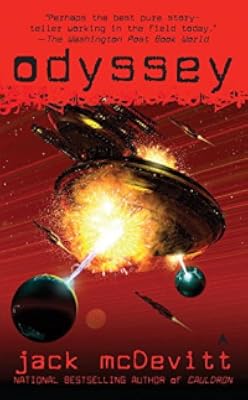
To boost waning interest in interstellar travel, a mission is sent into deep space to learn the truth about "moonriders," the strange lights supposedly being seen in nearby systems. But Academy pilot Valentina Kouros and the team of the starship Salvator will soon discover that their odyssey is no mere public-relations ploy, for the moonriders are not a harmless phenomenon. They are very, very dangerous-in a way that no one could possibly have imagined.Tags
Recommendations




Member Reviews
Odyssey, the fifth volume in Jack McDevitt’s Academy series, offers a fresh twist to some familiar space opera tropes. The premise is simple: Academy scientists on a station in another star system are building a machine to test the conditions that brought about the Big Bang. There is a non-zero chance that the experiment could destroy the entire cosmos. Mysterious aliens called moonriders seem to object.
Can Hutch and her team get the scientists off the station before they destroy the cosmos or the moonriders take them out? Hutch is now a middle-aged administrator whose piloting days are over, at least in this novel. She worries that the government may be about to defund the Academy and its space program. As one space entrepreneur show more says, in a line that makes one think of how NASA is funded, “But science doesn’t fly with the voters.” Another character notes with laudable snark, “The term congressional hearing is an oxymoron.”
The novel is also larded with fun future headlines that suggest things people worry about instead of the chances we could blow up the universe. For example, a bestselling novel has been written by an AI, and a group of religious fanatics claims to have found Noah’s ark on Mt. Ararat. The more things change … show less
Can Hutch and her team get the scientists off the station before they destroy the cosmos or the moonriders take them out? Hutch is now a middle-aged administrator whose piloting days are over, at least in this novel. She worries that the government may be about to defund the Academy and its space program. As one space entrepreneur show more says, in a line that makes one think of how NASA is funded, “But science doesn’t fly with the voters.” Another character notes with laudable snark, “The term congressional hearing is an oxymoron.”
The novel is also larded with fun future headlines that suggest things people worry about instead of the chances we could blow up the universe. For example, a bestselling novel has been written by an AI, and a group of religious fanatics claims to have found Noah’s ark on Mt. Ararat. The more things change … show less
The adventure aspect of the book was minimal. There was a lot of politics and social commentary that, to be fair, turned out to be very important to the story told. It all hangs together well. The politics and social commentary reflect things as they are today even though events take place 200 years in the future. The greenhouse effect is an accepted fact but no one is really doing anything still. People are moving north and away from the coasts, that's all. No huge programs of carbon sequestration or orbital mirrors or umbrellas. Faster than light travel is possible but the budgets for space exploration are getting cut. Politicians want to eliminate them totally. A giant super-collider has been built (in space, not Switzerland). People show more are ignorant of science and steeped in religion. They complain about science programs, the cost and how come they cannot warn people of a near miss by an asteroid? There are also worries by some people that the supercollider might create miniature black holes or destroy space-time, just like there were fears about the Broookhaven lab a few years ago. Overall, nothing new for anyone who reads today's newspapers until the last 50 pages or so. Not the best Jack McDevitt book but maybe the most "socially conscious" or "relevant". I would read some of his other books again. Not this one. show less
Summary: The Academy is running out of money. In the meantime, MacAllister, a senator's daughter, a pilot, and a PR guy from the Academy are on a tour looking for UFOs because reasons. Eventually the find some (ish), the daughter gets contacted by aliens (maybe, no one believes her at first and it's never really explained), and a bunch of people die.
As with a few other books in this series, it takes half the book to get to what feels like the main plot point, with a massive acceleration in the last 15% and a final climax in the last 5%. It's not necessarily a bad thing, it just felt a lot more obvious in this book.
Especially when half the book it feels like is spent talking about how the Academy isn't getting funded any more (mirroring show more NASA and other modern day space programs) and an oddly large amount of the second half on a trial about a guy who went to a religious school, grew up, and punched a priest. I still haven't figured out where that came from.
That being said, I still enjoy the universe that McDevitt has built here. The universe actually feels big and the technology feels right. I want to believe that life will be more common than he paints it, but if it's not, this feels like how the universe might just be.
Once again, I hope the next book has a few more answers (we still don't know what the Omegas are and now there's a real current alien race?), but given the previous four and that #6 is the last book currently out... We'll see.
ETA: The book opens with a ship 'lost' in space because it didn't go nearly as far as it should have, despite the physicists saying that shouldn't be possible. Yet that particular weirdness is dropped and never mentioned again in favor of the 'retire the old ships because funding plot'. Weird. show less
As with a few other books in this series, it takes half the book to get to what feels like the main plot point, with a massive acceleration in the last 15% and a final climax in the last 5%. It's not necessarily a bad thing, it just felt a lot more obvious in this book.
Especially when half the book it feels like is spent talking about how the Academy isn't getting funded any more (mirroring show more NASA and other modern day space programs) and an oddly large amount of the second half on a trial about a guy who went to a religious school, grew up, and punched a priest. I still haven't figured out where that came from.
That being said, I still enjoy the universe that McDevitt has built here. The universe actually feels big and the technology feels right. I want to believe that life will be more common than he paints it, but if it's not, this feels like how the universe might just be.
Once again, I hope the next book has a few more answers (we still don't know what the Omegas are and now there's a real current alien race?), but given the previous four and that #6 is the last book currently out... We'll see.
ETA: The book opens with a ship 'lost' in space because it didn't go nearly as far as it should have, despite the physicists saying that shouldn't be possible. Yet that particular weirdness is dropped and never mentioned again in favor of the 'retire the old ships because funding plot'. Weird. show less
I think McDevitt's lost this series. I think he lost it when he moved the great character, Hutch, from space ship pilot to administrator. The books since then have been bland. She's been bland. It's been a huge disappointment. I miss her fire, her leadership, everything about her missions.
In the opening of Odyssey, an Academy ship jumps out of hyperspace with a blown engine thinking they're a zillion miles from earth. Ships are sent to search for them. Turns out they're in our own solar system. Been there the whole time. Terrible embarrassment for the Academy and Hutch. People are calling for defunding the Academy, maybe even shutting it down, and it's fighting for its very existence. Turns out the ship in question is an old, obsolete show more model that Hutch feels needs to be retired from the fleet, against her boss's wishes. She does so. And faces criticisms. The weird thing about this opening sequence, though, is we see no more of this ship, this crew, this line of ships, nothing. McDevitt drops it on us and then forgets about it.
Meanwhile Hutch meets a senator from Georgia who wants to yank the Academy's funding -- and his 15 year old daughter, who wants to become an Academy pilot when she grows up. She talks Hutch into letting her go out on a mission and she gets to. Additionally, we encounter cranky editor Gregory MacAllister again and the beautiful spaceship pilot Valentina Kouros on a TV show where they debate the space program. MacAllister, who respects and likes Hutch, still wants to shut everything down while Valentina wants to keep going to the stars. They like and dislike each other after that experience. MacAllister also encounters a North Carolina man who grew up in a religious fundie school that taught hellfire and damnation and was traumatized. He saw his old priest in a store and attacked him in front of witnesses and was arrested and charged with assault. Mac takes his side and hires a good lawyer to represent him. The book then spends an inordinate amount of time on this trial through the remainder of its pages and I can't figure out why. It adds nothing to the plot. It has nothing to do with anything. It's like McDevitt threw it in there just to show his disdain for religion. I have disdain for most religion myself, but it's a stupid gimmick from an author who should know better.
There have been sightings of "moonriders," UFOs, around the galaxy and people are curious about them. Hutch commissions a mission to go put out monitors where they've been spotted recently and Val will be the pilot. Going along with her will be Amy, the senator's daughter, Eric, the Academy PR chief, and Mac, of all people. It'll be a month long trip.
I know this might all sound like a lot, but it's not. Most of the first 200 pages are taken up with politics and funding and fighting and UFO sightings and it's honestly pretty damn boring. I was going to give it a two star review at that point, but thank God, McDevitt upped the ante after the first couple hundred pages and the book improved.
Mac and Val grow close on the trip. Could it be a romance? And if so, could it be remotely believable? Amy is precocious to the point of being annoying as hell. Eric sulks about his lack of importance. They set out their monitors. And they see moonriders. They see one land on a small asteroid, change its bearings, and send it toward a planet. Everyone on earth freaks out. Hutch has a plan, though, to defeat them, and they do. So far, so good. Meanwhile, Orion Tours, which relies on Academy bases for its tours throughout the system, is building a large hotel near a planet. Two moonriders show up there and all of a sudden, a planet sized asteroid is sent lunging toward the hotel. People freak out. However, there's enough time to evacuate the hotel, which is under construction, so all is not lost. But now, after talking about shutting the space program down, people and politicians on earth are talking about creating a navy with actual weapons (there are no weapons on earth in the future).
Valentina continues to take them around to place monitors while Hutch faces a lot of heat at home. They go to a floating museum, where Val leaves the other three to go help rescue the people at the hotel. One night Amy is awake and hears footsteps. She goes to the ship's bridge and sees a large version of Hutch, who tells her he wants her to get him the Origins Blueprints and to evacuate Origins. It's a moonrider. She freaks out. She tells the two men and they don't believe her. They think she dreamed it. She's furious. She tells Val when she gets back and she's more receptive, but doesn't know what to think. They get in touch with Hutch, who actually nearly takes Amy seriously, but doesn't know whether to believe her or not. Still, she takes action. Origins is a huge outer space project being built that is a super collider that will build black holes that can show us how the Big Bang created the universe. Hutch sends everyone she can find with ships to Origins to assist with evacuation. Val and Eric head over there themselves. The others had been dropped off at home a day earlier when their original trip was over.
Meanwhile, there's a big plot twist. Big. Unexpected. And Hutch is furious. Val and Eric make it to Origins, where they've been warned they might be in danger. They don't really believe it, especially after being told the circumstances. However, two moonriders appear in the sky several kilometers away and sit there waiting. Unfortunately, most of the ships coming to save the employees won't make it in time, so it's possible the moonriders blow the hell out of Origins. You'll have to read it yourself to find out. And Valentina does something totally unexpected at the very end. Another big plot twist.
The book ends with the religious man who assaulted the priest being found guilty. Why was this even in the book again? What did it have to do with anything? People all around are possibly facing criminal charges. Hutch resigns from the Academy. And that's it. Book Five was the weakest of the five Academy books I've read. Nothing huge takes place, like in the other books. Hutch is a disappointment. Mac, as the main protagonist, is okay, but he's not her. I hope the last and sixth book will be much better, but I doubt it will. The only way it could be would be if Hutch would get out in the stars again piloting a ship. I'm not sure that's going to happen. Guess I'll have to read it to find out. This book, although part of a series, can probably be read as a stand alone book. The first half is worth two stars, the second is worth four. Overall, three stars. Cautiously recommended. show less
In the opening of Odyssey, an Academy ship jumps out of hyperspace with a blown engine thinking they're a zillion miles from earth. Ships are sent to search for them. Turns out they're in our own solar system. Been there the whole time. Terrible embarrassment for the Academy and Hutch. People are calling for defunding the Academy, maybe even shutting it down, and it's fighting for its very existence. Turns out the ship in question is an old, obsolete show more model that Hutch feels needs to be retired from the fleet, against her boss's wishes. She does so. And faces criticisms. The weird thing about this opening sequence, though, is we see no more of this ship, this crew, this line of ships, nothing. McDevitt drops it on us and then forgets about it.
Meanwhile Hutch meets a senator from Georgia who wants to yank the Academy's funding -- and his 15 year old daughter, who wants to become an Academy pilot when she grows up. She talks Hutch into letting her go out on a mission and she gets to. Additionally, we encounter cranky editor Gregory MacAllister again and the beautiful spaceship pilot Valentina Kouros on a TV show where they debate the space program. MacAllister, who respects and likes Hutch, still wants to shut everything down while Valentina wants to keep going to the stars. They like and dislike each other after that experience. MacAllister also encounters a North Carolina man who grew up in a religious fundie school that taught hellfire and damnation and was traumatized. He saw his old priest in a store and attacked him in front of witnesses and was arrested and charged with assault. Mac takes his side and hires a good lawyer to represent him. The book then spends an inordinate amount of time on this trial through the remainder of its pages and I can't figure out why. It adds nothing to the plot. It has nothing to do with anything. It's like McDevitt threw it in there just to show his disdain for religion. I have disdain for most religion myself, but it's a stupid gimmick from an author who should know better.
There have been sightings of "moonriders," UFOs, around the galaxy and people are curious about them. Hutch commissions a mission to go put out monitors where they've been spotted recently and Val will be the pilot. Going along with her will be Amy, the senator's daughter, Eric, the Academy PR chief, and Mac, of all people. It'll be a month long trip.
I know this might all sound like a lot, but it's not. Most of the first 200 pages are taken up with politics and funding and fighting and UFO sightings and it's honestly pretty damn boring. I was going to give it a two star review at that point, but thank God, McDevitt upped the ante after the first couple hundred pages and the book improved.
Mac and Val grow close on the trip. Could it be a romance? And if so, could it be remotely believable? Amy is precocious to the point of being annoying as hell. Eric sulks about his lack of importance. They set out their monitors. And they see moonriders. They see one land on a small asteroid, change its bearings, and send it toward a planet. Everyone on earth freaks out. Hutch has a plan, though, to defeat them, and they do. So far, so good. Meanwhile, Orion Tours, which relies on Academy bases for its tours throughout the system, is building a large hotel near a planet. Two moonriders show up there and all of a sudden, a planet sized asteroid is sent lunging toward the hotel. People freak out. However, there's enough time to evacuate the hotel, which is under construction, so all is not lost. But now, after talking about shutting the space program down, people and politicians on earth are talking about creating a navy with actual weapons (there are no weapons on earth in the future).
Valentina continues to take them around to place monitors while Hutch faces a lot of heat at home. They go to a floating museum, where Val leaves the other three to go help rescue the people at the hotel. One night Amy is awake and hears footsteps. She goes to the ship's bridge and sees a large version of Hutch, who tells her he wants her to get him the Origins Blueprints and to evacuate Origins. It's a moonrider. She freaks out. She tells the two men and they don't believe her. They think she dreamed it. She's furious. She tells Val when she gets back and she's more receptive, but doesn't know what to think. They get in touch with Hutch, who actually nearly takes Amy seriously, but doesn't know whether to believe her or not. Still, she takes action. Origins is a huge outer space project being built that is a super collider that will build black holes that can show us how the Big Bang created the universe. Hutch sends everyone she can find with ships to Origins to assist with evacuation. Val and Eric head over there themselves. The others had been dropped off at home a day earlier when their original trip was over.
Meanwhile, there's a big plot twist. Big. Unexpected. And Hutch is furious. Val and Eric make it to Origins, where they've been warned they might be in danger. They don't really believe it, especially after being told the circumstances. However, two moonriders appear in the sky several kilometers away and sit there waiting. Unfortunately, most of the ships coming to save the employees won't make it in time, so it's possible the moonriders blow the hell out of Origins. You'll have to read it yourself to find out. And Valentina does something totally unexpected at the very end. Another big plot twist.
The book ends with the religious man who assaulted the priest being found guilty. Why was this even in the book again? What did it have to do with anything? People all around are possibly facing criminal charges. Hutch resigns from the Academy. And that's it. Book Five was the weakest of the five Academy books I've read. Nothing huge takes place, like in the other books. Hutch is a disappointment. Mac, as the main protagonist, is okay, but he's not her. I hope the last and sixth book will be much better, but I doubt it will. The only way it could be would be if Hutch would get out in the stars again piloting a ship. I'm not sure that's going to happen. Guess I'll have to read it to find out. This book, although part of a series, can probably be read as a stand alone book. The first half is worth two stars, the second is worth four. Overall, three stars. Cautiously recommended. show less
Jack McDevitt's latest novel returns to the Academy series, home to such gems as The Engines of God, and Chindi. Unfortunately, Odyssey fails to capture the same atmosphere as his previous works.
In McDevitt's other Academy books, he does an extraordinary job of bringing alien worlds to life, and building up an underlying mystery, usually resolving itself in some surprising, thought-provoking way. In many ways, McDevitt's books are like Science-Mysteries. Odyssey contains little of the magic of his other adventures. All of the major characters return, including Hutch, but the 'odyssey' isn't much of a journey. One major plot twist--which wasn't all that surprising--helped the story along, but in the end, still failed to impress.
The show more characters in Odyssey are rich, vibrant, and well developed, especially the MacAllister character. That in and of itself is not surprising, considering they have appeared in four other novels. The new characters introduced are also quite believable, and add a nice contrast to the novel. Unfortunately, an interesting relationship isn't fully cultivated and the end result leaves little hope for resolution.
In all, Odyssey felt like a half-hearted effort from this usually fantastic author. Toward the end, it felt rushed, and a lot of plot elements remained unresolved, the most frustrating of which was the variable-speed hyperspace problem from the early chapters, that never got explored again. Indeed, it felt like it was added, only to be there for reference in future books.
McDevitt has been able to describe alien cultures from an archaeological viewpoint in his previous novels, but none of that occurs here. In fact, the book tends to portray a very pessimistic viewpoint of humanity--moreso than in his other books.
Though Odyssey is a good read, and quite entertaining, it's not up to the level of McDevitt's other works, and will likely disappoint devoted fans. show less
In McDevitt's other Academy books, he does an extraordinary job of bringing alien worlds to life, and building up an underlying mystery, usually resolving itself in some surprising, thought-provoking way. In many ways, McDevitt's books are like Science-Mysteries. Odyssey contains little of the magic of his other adventures. All of the major characters return, including Hutch, but the 'odyssey' isn't much of a journey. One major plot twist--which wasn't all that surprising--helped the story along, but in the end, still failed to impress.
The show more characters in Odyssey are rich, vibrant, and well developed, especially the MacAllister character. That in and of itself is not surprising, considering they have appeared in four other novels. The new characters introduced are also quite believable, and add a nice contrast to the novel. Unfortunately, an interesting relationship isn't fully cultivated and the end result leaves little hope for resolution.
In all, Odyssey felt like a half-hearted effort from this usually fantastic author. Toward the end, it felt rushed, and a lot of plot elements remained unresolved, the most frustrating of which was the variable-speed hyperspace problem from the early chapters, that never got explored again. Indeed, it felt like it was added, only to be there for reference in future books.
McDevitt has been able to describe alien cultures from an archaeological viewpoint in his previous novels, but none of that occurs here. In fact, the book tends to portray a very pessimistic viewpoint of humanity--moreso than in his other books.
Though Odyssey is a good read, and quite entertaining, it's not up to the level of McDevitt's other works, and will likely disappoint devoted fans. show less
I think I might have enjoyed this book more if I had read the other books in the series. On the other hand, this book did not feel like the 5th book in a series. I didn't feel like I'd jumped into the middle of the story, or that I was missing major parts of character's backstory. This is not-too-distant future scifi, where humans have developed FTL and explored the nearby stars, but haven't really branched out or settled the local galaxy. There is a good amount of commerce and space travel seems routine, but I found it a little strange that the cost of space travel was still being questioned. Various forces in this novel try to justify the cost, either through sheer economics, scientific advancement, alien scares, tourism or plots. The show more plot is subtle and really only comes out at the end. I thought this was a good book, but not a fascinating one. show less
While this novel was generally okay, I can't rank it higher than a three for a couple of important reasons.
1. MacAllister. He has a few good moments in a previous novel but he's given a LOT more time in this one, pushing Hutch out of the limelight. He's no longer just a foil for charming Atheism against all the believers in the 23rd century... he's now a romantic interest. I kinda squirmed. Plus, all the newscasts and blurbs surrounding the whole atheism side-commentary WAS ALREADY DONE in a previous novel.
2. I became embarrassed and shocked that I might have been reading the SAME novel all over again. I hunted and double checked and went... hey... okay... this ISN'T the same novel, but WAY too much is repeated. Almost or sometimes show more fully verbatim. Damn. It was good the first time, but I'm not so sure about a second time.
3. A lot of it is more long-winded and slower-paced than the previous novels. Does lackadaisical fit? Perhaps. The adventure part is kinda missing, in favor of mirrored commentary and a slightly forced "sense of wonder". This is me saying I was bored.
Well, this isn't the same as saying I hated the novel. I didn't. I just didn't fall head over heels for it. I missed some of what I appreciated a lot more in the previous novels, too. show less
1. MacAllister. He has a few good moments in a previous novel but he's given a LOT more time in this one, pushing Hutch out of the limelight. He's no longer just a foil for charming Atheism against all the believers in the 23rd century... he's now a romantic interest. I kinda squirmed. Plus, all the newscasts and blurbs surrounding the whole atheism side-commentary WAS ALREADY DONE in a previous novel.
2. I became embarrassed and shocked that I might have been reading the SAME novel all over again. I hunted and double checked and went... hey... okay... this ISN'T the same novel, but WAY too much is repeated. Almost or sometimes show more fully verbatim. Damn. It was good the first time, but I'm not so sure about a second time.
3. A lot of it is more long-winded and slower-paced than the previous novels. Does lackadaisical fit? Perhaps. The adventure part is kinda missing, in favor of mirrored commentary and a slightly forced "sense of wonder". This is me saying I was bored.
Well, this isn't the same as saying I hated the novel. I didn't. I just didn't fall head over heels for it. I missed some of what I appreciated a lot more in the previous novels, too. show less
Members
- Recently Added By
Lists

hypatian_kat to-read
429 works; 3 members
Author Information

124+ Works 20,905 Members
Jack McDevitt (born 1935) is an American science fiction author whose novels frequently deal with attempts to make contact with alien races, and with archaeology or xenoarchaeology. He attended La Salle University, where a short story of his won the annual Freshman Short Story Contest and was published in the school's literary magazine, Four show more Quarters. He received a Master's degree in literature from Wesleyan University in 1971. Before becoming a full-time author, he was an English teacher, naval officer, Philadelphia taxi driver, customs officer and motivational trainer. His first published story was The Emerson Effect in The Twilight Zone Magazine in 1981. Two years later, he published his first novel, The Hercules Text, which won the Philip K. Dick Special Award. He won the 2006 Nebula Award for Best Novel for Seeker, the UPC International Prize for his novella Ships in the Night in 1991, and the John W. Campbell Memorial Award for best SF novel for Omega in 2003. (Bowker Author Biography) show less
Some Editions
Awards and Honors
Series

Belongs to Publisher Series
Bastei Science Fiction-Special (24369)
Common Knowledge
- Canonical title
- Odyssey
- Original publication date
- 2006-09
- People/Characters
- Priscilla 'Hutch' Hutchins
- Dedication
- For Robert Dyke,
The ultimate time traveler - First words
- Ordinarily, Jerry Cavanaugh would have been asleep in his cabin while the AI took the ship closer to the Sungrazer, the gas giant at Beta Comae Berenices.
- Blurbers
- King, Stephen; Ellison, Harlan
Classifications
Statistics
- Members
- 867
- Popularity
- 31,374
- Reviews
- 27
- Rating
- (3.47)
- Languages
- English, German, Spanish
- Media
- Paper, Audiobook, Ebook
- ISBNs
- 9
- UPCs
- 1
- ASINs
- 9