
Colin Platt (1934–2015)
Author of The Atlas of Medieval Man
About the Author
Colin Platt taught history until recently at the University of Southampton.
Works by Colin Platt
The Traveller's Guide to Medieval England: Eight Tours for the Weekend & the Short Break (1985) 28 copies
The National Trust Guide to Late Medieval and Renaissance Britain: From the Black Death to the Civil War (1986) 22 copies
The Great Rebuildings Of Tudor And Stuart England: Revolutions In Architectural Taste (1994) 12 copies
Tagged
Common Knowledge
- Legal name
- Platt, Colin Peter Sherard
- Birthdate
- 1934-11-11
- Date of death
- 2015-07-23
- Gender
- male
- Education
- Collyer's grammar school, Horsham
University of Oxford (Balliol College|BA|history|1958)
University of Leeds (PhD|1966) - Occupations
- historian
archaeologist
medievalist - Organizations
- Leeds University (research assistant|lecturer in medieval archaeology)
Dartington Hall
Southampton University (head of department|history|1964)
Royal Navy - Awards and honors
- Society of Antiquaries of London (Fellow, 1968)
Royal Historical Society (Fellow, 1971) - Relationships
- Donovan, Claire (second wife)
Platt, D. C. M. (twin brother) - Nationality
- UK
- Birthplace
- Guangdong, China (as Canton)
- Places of residence
- Southampton, Hampshire, England, UK
Littlehempston, Devon, England, UK
Buenos Aires, Argentina - Associated Place (for map)
- UK
Members
Reviews
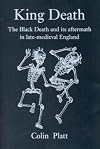
I’m not quite sure how to rate this one. The subtitle is “The Black Death and its aftermath in late-medieval England”, but it’s more of a hodge-podge about English life, ranging all the way from the 1100s to the early 1700s. Author Colin Platt makes the familiar claim that the Black Death revolutionized English society by destroying serfdom (not by killing the serfs off, but because the immense labor shorter made it lucrative for a serf to run away from the land and work for money show more somewhere). However, he doesn’t really provide much causal evidence for this, just relying on the argument as a given. I admit that it’s plausible and I’m sympathetic to it, but while reading King Death it puzzled me: why just England? Italy and Spain and France and Germany were hit just as hard as England, but serfdom seemed to go on in all those places.
Amidst the hodge and podge are a lot of other interesting things. Platt attributes the shortage of clergy after the plague partially to the plague itself and partially to the new doctrine of Purgatory, which required memorial masses for all the dead who could afford them. Thus a lot of clergy disappeared from parishes and monasteries and turned up as private chaplains to wealthy families. Less convincing is Platt’s claim for a change in architecture – a lot of grandiose building plans were abandoned when the sponsors died off. There are illustrations of churches with grand towers and tiny naves, naves with no chancels, and so on, but some of these date to 200 years after the Black Death. Similarly, there is a supposedly a change in inheritance practice from primarily jointure to primarily entailment, which gets blamed on the prevalence of widows after the plague, but why should women be favored over men? (Platt hints at the possibility that the plague was much less severe in the country than in the cities, and noblewomen were more likely to stay on their estates while their lord went to London).
Pretty good maps, references, and illustrations, but not good as a first or even second book about the Black Death.; show less
Amidst the hodge and podge are a lot of other interesting things. Platt attributes the shortage of clergy after the plague partially to the plague itself and partially to the new doctrine of Purgatory, which required memorial masses for all the dead who could afford them. Thus a lot of clergy disappeared from parishes and monasteries and turned up as private chaplains to wealthy families. Less convincing is Platt’s claim for a change in architecture – a lot of grandiose building plans were abandoned when the sponsors died off. There are illustrations of churches with grand towers and tiny naves, naves with no chancels, and so on, but some of these date to 200 years after the Black Death. Similarly, there is a supposedly a change in inheritance practice from primarily jointure to primarily entailment, which gets blamed on the prevalence of widows after the plague, but why should women be favored over men? (Platt hints at the possibility that the plague was much less severe in the country than in the cities, and noblewomen were more likely to stay on their estates while their lord went to London).
Pretty good maps, references, and illustrations, but not good as a first or even second book about the Black Death.; show less
The devastation of the plague on the way of life in medieval England was both profound and long lasting. The information provided by the author will be very helpful for me as I add the information from King Death into a novel I'm working on.
This book was generally well-researched and written, however the sexism of the author rang through loud and clear. His point of view was always that of the leading males, whether land owner or head of household, and as such, could only see the long lives show more of dowagers and "hardship" for the "family." Apparently the dowager's themselves should have just died and freed up their dowries. show less
This book was generally well-researched and written, however the sexism of the author rang through loud and clear. His point of view was always that of the leading males, whether land owner or head of household, and as such, could only see the long lives show more of dowagers and "hardship" for the "family." Apparently the dowager's themselves should have just died and freed up their dowries. show less

The English mediæval town, written by Colin Pratt in 1976, is a look at town life in the Middle Ages. Seven chapters cover the beginnings of town life in Anglo-Saxon Britain to the Reformation, with information on the town itself, government and the relationship with the crown, trades and the church. The text is written in a dense and scholarly style and there are copious endnotes, an extensive bibliography and many illustrations, plans and maps.
The author, who is a scholar studying town show more life and archaeology of Southampton, does not define the terms so a dictionary will be handy for the layman. Words do not mean the same, an example being burgess which is simply a citizen of a British borough; in the US, it is a term used for a representative in the legislatures of Virginia and Maryland. Burgage, a term new to me, was “the tenure by which real property in England and Scotland was held under the king or a lord for a yearly rent or for watching and warding.”—Webster’s ninth new collegiate dictionary. And there were many more terms for me to look up.
The illustrations were a high point of the book and I spent a lot of time with magnifying glass in hand studying the maps of many English towns by John Speed, originally published in 1611. Just as fascinating were the aerial views of the cities today, showing the medieval basis for street layout. The plans of buildings, showing the ordinary houses (or tenements) as well as churches, were very helpful in understanding the text. The photographs of existing buildings also brought the text alive. One thing that was disconcerting was the constant flipping from text in chapter 2 to illustrations in other chapters. The author also did not attribute the source of the illustrations with them; instead, you had to go to the list of illustrations in the front of the book.
This is not a book for the average layman but for those who persevere and read it, it is well worth the effort. show less
The author, who is a scholar studying town show more life and archaeology of Southampton, does not define the terms so a dictionary will be handy for the layman. Words do not mean the same, an example being burgess which is simply a citizen of a British borough; in the US, it is a term used for a representative in the legislatures of Virginia and Maryland. Burgage, a term new to me, was “the tenure by which real property in England and Scotland was held under the king or a lord for a yearly rent or for watching and warding.”—Webster’s ninth new collegiate dictionary. And there were many more terms for me to look up.
The illustrations were a high point of the book and I spent a lot of time with magnifying glass in hand studying the maps of many English towns by John Speed, originally published in 1611. Just as fascinating were the aerial views of the cities today, showing the medieval basis for street layout. The plans of buildings, showing the ordinary houses (or tenements) as well as churches, were very helpful in understanding the text. The photographs of existing buildings also brought the text alive. One thing that was disconcerting was the constant flipping from text in chapter 2 to illustrations in other chapters. The author also did not attribute the source of the illustrations with them; instead, you had to go to the list of illustrations in the front of the book.
This is not a book for the average layman but for those who persevere and read it, it is well worth the effort. show less

I have every book on the plague that I can get my hands on. Without a detailed review, my primary observation is that this is the least interesting one I've owned. It's a discussion of the economics and subsequent history of various localities in England post-plague. While the content is interesting, the author doesn't hold my attention.
Lists
Awards

You May Also Like


Associated Authors
Statistics
- Works
- 25
- Members
- 1,215
- Popularity
- #21,126
- Rating
- 3.3
- Reviews
- 10
- ISBNs
- 72
- Languages
- 2