
Martha Gellhorn (1908–1998)
Author of Travels with Myself and Another: A Memoir
About the Author
Martha Gellhorn, one of America's most important war correspondents, was the author of thirteen books of fiction and nonfiction and the third wife of Ernest Hemingway. Her reporting career spanned several decades: she covered conflicts from the Spanish Civil War to World War II to Vietnam. Gellhorn show more died in 1998 at age eighty-nine show less
Image credit: Martha Gellhorn, Chelsea, London, 21st July 1989.
Works by Martha Gellhorn
Echte Vrouwe Reizen Anders 1 copy
The Arabs of Palestine 1 copy
What mad pursuit 1 copy
A new kind of war 1 copy
Vietnam - A New Kind of War 1 copy
Cuba Revisited 1 copy
Associated Works
Reporting World War II Part One : American Journalism, 1938-1944 (1995) — Contributor — 480 copies, 3 reviews
Reporting Vietnam: American Journalism 1959-1969, Volume 1 (1998) — Contributor — 347 copies, 3 reviews
The Art of Fact: A Historical Anthology of Literary Journalism (1997) — Contributor — 225 copies, 1 review
Take My Advice: Letters to the Next Generation from People Who Know a Thing or Two (2002) — Contributor — 50 copies
Gender in Modernism: New Geographies, Complex Intersections (2007) — Contributor — 12 copies, 1 review
Best-in-Books: Tall Ships / Short Summer / Christmas with Robert E. Lee / Two by Two (1958) — Contributor — 1 copy
Tagged
Common Knowledge
- Canonical name
- Gellhorn, Martha
- Legal name
- Gellhorn, Martha Ellis (birth)
- Birthdate
- 1908-11-08
- Date of death
- 1998-02-15
- Gender
- female
- Education
- Bryn Mawr College
- Occupations
- journalist
war correspondent
Investigator, FERA
novelist
memoirist
short story writer - Organizations
- The Atlantic Monthly
Collier's
St. Louis Post-Dispatch - Relationships
- Hemingway, Ernest (husband|divorced)
Cowles, Virginia (co-author)
Jouvenel, Bertrand de (lover)
Pilger, John (friend) - Short biography
- Martha Gellhorn's parents were a physician and an advocate for women's right to vote. She attended a progressive private school her parents founded in St. Louis, then went to Bryn Mawr College, leaving in 1927 to write for The New Republic. She then got a job as a crime reporter in Albany, New York. In 1930, she went to Europe, paying for the boat trip by writing a brochure for the Holland American Line. In Paris, she met French writer Bertrand de Jouvenel, whom she may have married. She returned with him to St. Louis and then traveled the American Southwest as a reporter for the St. Louis Post-Dispatch. Her first novel, What Mad Pursuit (1934), attracted the attention of Harry Hopkins, a close advisor to President Franklin D. Roosevelt, who hired Gellhorn to travel the USA as a field investigator for the Federal Emergency Relief Administration (FERA) and write about the effects of the Great Depression. The resulting work, The Trouble I've Seen (1936), is now one of her most famous. Gellhorn met Ernest Hemingway, whose writing she admired, in Key West, Florida, in 1936. When he told her he was going to Spain to cover the Civil War there, she decided to go, too. She arrived in Madrid in 1937 on assignment for Collier's Weekly. The couple soon became lovers and married in 1940. She took Hemingway along with her to China to cover the Chinese Army's retreat from the Japanese invasion. During World War II, she covered the Soviet attack on Finland, the German Blitz attacks on London, and the Allied D-Day invasion of Europe. "She wrote passionately about the dreadful impact of war on the innocent," the Washington Post said in her obituary. She witnessed the Allied liberation of the concentration camp at Dachau, and her article became one of the most famous accounts of the discovery of the camps. After the war, Gellhorn divorced Hemingway and lived in several countries, from France and Italy to Cuba, Mexico, and Kenya, before settling in the UK. She covered the trial of Nazi war criminal Adolf Eichmann, the 1967 Arab-Israeli War, and the conflicts in Vietnam, Panama, and El Salvador. She also wrote more fiction, including The Honeyed Peace (1953) and Two by Two (1958). Her novellas were popular, and were published in collections including The Weather in Africa (1988) and The Novellas of Martha Gellhorn (1993). Her memoir Travels With Myself and Another, was published in 1978. In 1953 she married her third husband, T.S. Matthews, a former managing editor at Time Magazine. She gave birth to one son, George Alexander Gellhorn, whom she raised herself, and adopted a son from an Italian orphanage. She died by suicide at age 89. Her selected letters were published posthumously in 2006.
- Cause of death
- suicide
- Nationality
- USA
- Birthplace
- St Louis, Missouri, USA
- Places of residence
- St. Louis, Missouri, USA
Paris, France
London, England, UK - Place of death
- London, England, UK
- Associated Place (for map)
- USA
Members
Reviews
"I was in that state of grace which can rightly be called happiness, when body and mind rejoice totally together. This occurs, as a divine surprise, in travel; this is why I will never finish travelling."
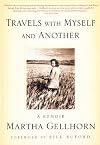
If you think Hemingway is a fearless adventurer, you must not be acquainted with Martha Gellhorn, a renowned war correspondent and his third wife. While a prolific journalist and lifelong traveler, Travels with Myself and Another is her first and only memoir which reflects on her experiences show more at any length. Spanning East Africa, Crete, Stalin-era USSR, and China during the second Sino-Japanese war, among others, and traveling via horseback, cargo planes, and ships transporting dynamite for the WWII Allied effort, Gellhorn's tales are as varied as they are ridiculous. Her reflections are evocative and inviting as she recalls endless mishaps, wrong turns, run ins with skin rot, and trash filled beaches. Gellhorn's memoir is a chronicle of her most memorable (read, disastrous) travels, often hilarious, always potently delivered. show less
If you think Hemingway is a fearless adventurer, you must not be acquainted with Martha Gellhorn, a renowned war correspondent and his third wife. While a prolific journalist and lifelong traveler, Travels with Myself and Another is her first and only memoir which reflects on her experiences show more at any length. Spanning East Africa, Crete, Stalin-era USSR, and China during the second Sino-Japanese war, among others, and traveling via horseback, cargo planes, and ships transporting dynamite for the WWII Allied effort, Gellhorn's tales are as varied as they are ridiculous. Her reflections are evocative and inviting as she recalls endless mishaps, wrong turns, run ins with skin rot, and trash filled beaches. Gellhorn's memoir is a chronicle of her most memorable (read, disastrous) travels, often hilarious, always potently delivered. show less

Martha Gellhorn was an American journalist who served as a war correspondent for most of her 60-year career. As she wrote in the afterword to A Stricken Field, “I had no qualification except eyes and ears; I learned as I went. In 1938, I became a foreign correspondent as well, again because I was on the spot. My qualification was that I had spent most of my life since 1930 in Europe, involved in politics the way a tadpole is involved in a pond.”
Gellhorn left Europe in January 1939. A show more Stricken Field represents somewhat of a catharsis, spilling her “accumulated rage and grief” by sharing her experience in Czechoslovakia. Mary Douglas, an American journalist clearly modeled on Gellhorn herself, arrives in Prague shortly after the Munich Agreement, which ceded a portion of Czechoslovakia to Germany in an attempt to avoid war. But this resulted in refugees being expelled from Prague to face concentration camps, prison, or death in their countries of origin. The situation becomes more personal when it directly impacts Mary’s friend Rita, and Mary attempts to use her journalist credentials to influence government officials.
This is an intense, dramatic, and ultimately sad book. It’s also difficult to read today, when the world is dealing with a myriad of refugee crises with so many obstacles in the way and seemingly no end in sight. A Stricken Field is well-written, but perhaps not for everyone. show less
Gellhorn left Europe in January 1939. A show more Stricken Field represents somewhat of a catharsis, spilling her “accumulated rage and grief” by sharing her experience in Czechoslovakia. Mary Douglas, an American journalist clearly modeled on Gellhorn herself, arrives in Prague shortly after the Munich Agreement, which ceded a portion of Czechoslovakia to Germany in an attempt to avoid war. But this resulted in refugees being expelled from Prague to face concentration camps, prison, or death in their countries of origin. The situation becomes more personal when it directly impacts Mary’s friend Rita, and Mary attempts to use her journalist credentials to influence government officials.
This is an intense, dramatic, and ultimately sad book. It’s also difficult to read today, when the world is dealing with a myriad of refugee crises with so many obstacles in the way and seemingly no end in sight. A Stricken Field is well-written, but perhaps not for everyone. show less

Although I've read at least one other work of fiction by Martha Gellhorn, I most often think of her as the tough-minded, fearless war correspondent, who learned something of her craft from Hemingway and lived to surpass him in the field of journalism. Yet she had a gift for story-telling as well, and in The Weather in Africa she tells three somewhat connected stories about European "settlers" in East Africa in the years immediately following WWII and just prior to Kenyan Independence. Some show more of her main characters are sympathetic on a personal level, while others are emblematic, in varying degrees of reprehensibility, of the colonial attitude toward the native people who serve them. There are only one or two fully realized African characters here, but they stand out as complex individuals, perhaps more so than the white players. Without being either predictable or unbelievable, each story moves toward an ending in which not everyone gets exactly what we may think they deserve, but the people we most hope to see happy are on a promising path. show less

I was most pleasantly surprised by this novel. A moving story of a young mulatto girl taken as a mistress, and then married by a wealthy white man on a French Caribbean island cut off from the rest of the world by World War II. It's really the classic Pygmalion tale in an exotic setting, very well told. Despite the cluelessness of the men who decide Liana's fate without consulting her wishes, their characters are not entirely unsympathetic. Sometimes, they ALMOST get the notion that their show more creation has feelings, although what to do about that is beyond their comprehension.
A quote: "Two men came in one day with a five hundred pound mako. It was amazing that two men in a skiff, using a handline, could have fought and killed that monster...He loved to fish too; he knew that beautiful harsh wonder of a man in a small boat alone on the sea." This book was written while Gellhorn was married to Hemingway, but about 10 years before the publication of The Old Man and the Sea. show less
A quote: "Two men came in one day with a five hundred pound mako. It was amazing that two men in a skiff, using a handline, could have fought and killed that monster...He loved to fish too; he knew that beautiful harsh wonder of a man in a small boat alone on the sea." This book was written while Gellhorn was married to Hemingway, but about 10 years before the publication of The Old Man and the Sea. show less
Lists
THE WAR ROOM (1)
Read These Too (1)
Awards


You May Also Like


Associated Authors
Statistics
- Works
- 30
- Also by
- 24
- Members
- 1,923
- Popularity
- #13,388
- Rating
- 4.0
- Reviews
- 32
- ISBNs
- 109
- Languages
- 8
- Favorited
- 7
