
Janice M. Del Negro
Author of Lucy Dove
About the Author
Works by Janice M. Del Negro
Engaging Teens with Story: How to Inspire and Educate Youth with Storytelling (2017) — Editor — 4 copies
Tagged
Common Knowledge
- Gender
- female
Members
Reviews

Having grown old and lost her position in the laird's household, Scottish seamstress Lucy Dove was more than willing to accept the challenge of making a set of trousers by the light of the full moon, in haunted St. Andrew's cemetery. For the laird, believing such trousers would bring him luck, had offered a great reward; and Lucy, desiring a comfortable retirement in a cottage by the sea, was determined to win it. And so she found herself sewing on a gravestone one night, while a terrible show more monster rose up beside her, bit by bit. Each time another part of him emerged, she sewed faster, until she had finally finished her task, fleeing from the cemetery with the horrifying creature at her heels...
Published in 1998, Lucy Dove appears to be librarian and storyteller Janice del Negro's authorial debut, and is a title I sought out after enjoying her subsequent picture book, Willa and the Wind. Like that other book, this is a loose adaptation of a traditional folktale, in this case, the Scottish story of The Sprightly Tailor, which can be found in Joseph Jacobs' Celtic Fairy Tales (1892), as well as in Winifred Finlay's Tales of Fantasy and Fear (1981), where it is known as The Grey Claw. I've read the Jacobs version, and del Negro's retelling is fairly faithful, save for the fact that she made the male tailor a female seamstress, and expanded upon the dialogue between the hero and the monster. In any case, I found this telling quite engaging, and think that youngsters who enjoy truly scary stories will enjoy it. The accompanying artwork from illustrator Leonid Gore, done in acrylic paint, accentuates the spooky atmosphere and terrifying adventure being described in the text, and enhance the reading pleasure. Recommended to young folklore enthusiasts, and to picture book audiences that enjoy frightening fare. show less
Published in 1998, Lucy Dove appears to be librarian and storyteller Janice del Negro's authorial debut, and is a title I sought out after enjoying her subsequent picture book, Willa and the Wind. Like that other book, this is a loose adaptation of a traditional folktale, in this case, the Scottish story of The Sprightly Tailor, which can be found in Joseph Jacobs' Celtic Fairy Tales (1892), as well as in Winifred Finlay's Tales of Fantasy and Fear (1981), where it is known as The Grey Claw. I've read the Jacobs version, and del Negro's retelling is fairly faithful, save for the fact that she made the male tailor a female seamstress, and expanded upon the dialogue between the hero and the monster. In any case, I found this telling quite engaging, and think that youngsters who enjoy truly scary stories will enjoy it. The accompanying artwork from illustrator Leonid Gore, done in acrylic paint, accentuates the spooky atmosphere and terrifying adventure being described in the text, and enhance the reading pleasure. Recommended to young folklore enthusiasts, and to picture book audiences that enjoy frightening fare. show less

When Old Windy steals her cornmeal one scorching summer day, Willa sets out to confront him and is given a magical handkerchief that produces food in compensation. Unbeknownst to her, this cloth is stolen by the innkeeper at the inn where she stops upon her journey home, and a non-magical cloth substituted. Thinking Old Windy has cheated her, Willa sets out again and is given a magical goat who produces gold when his chin is tickled, only to have this stolen by the innkeeper in the same way. show more On her third visit to Old Windy, Willa is given a magical whistle that controls the wind, and a hint that all might not be as it seems. This time, on her stop at the inn she exercises cunning and uses the whistle to regain her lost treasures...
Willa and the Wind is the first book I have read from author Janice M. Del Negro, but it will certainly not be the last! I found this loose retelling of the Norwegian folktale of The Boy and the North Wind, which can be found in more traditional form in Lise Lunge-Larsen & Betsy Bowen's The Troll With No Heart in His Body and Other Tales of Trolls from Norway, quite entertaining. I also greatly enjoyed the watercolor, collage, acrylic and oil illustrations from Heather Solomon, whose work I know from Margaret Willey's Clever Beatrice books. The vibrant color palette used here was just gorgeous, the stylized figures were beautiful, and the use of light and of white space on the page was skillful. Recommended to young folklore enthusiasts, and to those who appreciate beautiful picture book art. show less
Willa and the Wind is the first book I have read from author Janice M. Del Negro, but it will certainly not be the last! I found this loose retelling of the Norwegian folktale of The Boy and the North Wind, which can be found in more traditional form in Lise Lunge-Larsen & Betsy Bowen's The Troll With No Heart in His Body and Other Tales of Trolls from Norway, quite entertaining. I also greatly enjoyed the watercolor, collage, acrylic and oil illustrations from Heather Solomon, whose work I know from Margaret Willey's Clever Beatrice books. The vibrant color palette used here was just gorgeous, the stylized figures were beautiful, and the use of light and of white space on the page was skillful. Recommended to young folklore enthusiasts, and to those who appreciate beautiful picture book art. show less
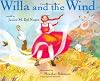
Willa is bold! When the wind takes her cornmeal, she marches right up to his house to challenge him. He gives her a magical hankerchief that should feed her whenever she pleases, but when she is sleeping, the greedy innkeeper takes it from her. Once again, she marches up to the wind to demand retribution. Wind gives her a goat that drops gold, but the innkeeper replaces it with his own goat, and when Willa gets home, what the goat is dropping is NOT gold. Finally when the wind gives her a show more flute, she catches the innkeeper and gets all of her treasures back, and goes home a richer woman. The illustrations beautifully compliment the story in their flowing, whimsical style. A gem. show less
Willa and the Wind, adapted from an old Norwegian folktale, is the tale of two sisters who live "in a windy valley in the windy middle of nowhere." Together the two tend their garden and keep their bees-as long as there's enough rain to replenish life. However, when the wind and rain disappear, the sisters fall on hot times. When Willa is carrying a bowl of cornmeal one day, Old Windy the north wind, blows the cornmeal away from her. The infuriated Willa approaches the wind at his house and show more demands that her cornmeal be returned. Begrudgingly, the wind gives her his finest handkerchief and tells her it's his finest-there isn't another in all of the world. He assures Willa it will give her plenty of food and drink whenever needed. Willa accepts. Upon her way home, she decides to stay in an inn where the innkeeper discovers Willa's magic. He steals her magical handkerchief and replaces it with his own. When Willa discovers the dud handkerchief, she marches back to the wind and demands something else. The wind gives her a goat and promises that it will provide her with two handfuls of gold. When the innkeeper discovers this, he again steals from Willa. Willa returns to the wind a third time. He then gives her a wooden whistle that will set anything a spin without end. Before he sends her off, he assures her that he is an honest wind-something she must consider. That night at the inn, Willa catches the innkeeper trying to take her whistle. Enraged she says the magic words and sets him into motion. The handkerchief falls from his pocket and the goat appears from the barn. Willa gathers her reparations and returns home to her sister. They never went without again. Willa is a strong willed woman who stops at nothing to seek justice for herself and sister. The clever phrases and funny situations leave the reader feeling as though reading the tale was time well spent. show less
Awards


You May Also Like


Associated Authors
Statistics
- Works
- 6
- Members
- 217
- Popularity
- #102,845
- Rating
- 4.1
- Reviews
- 24
- ISBNs
- 15