
Russell Freedman (1929–2018)
Author of Lincoln: A Photobiography
About the Author
Russell Freedman was born in San Francisco, California on October 11, 1929. He received a bachelor's degree in English from the University of California, Berkeley in 1951. After college, he served in the U.S. Counter Intelligence Corps during the Korean War. After his military service, he became a show more reporter and editor with the Associated Press. In 1956, he took a position at the advertising agency J. Walter Thompson in New York, where he did publicity writing for television. In 1965, he became a full-time writer. His first book, Teenagers Who Made History, was published in 1961. He went on to publish more than 60 nonfiction titles for young readers including Immigrant Kids, Cowboys of the Old West, Indian Chiefs, Martha Graham: A Dancer's Life, Confucius: The Golden Rule, Because They Marched: The People's Campaign for Voting Rights That Changed America, Vietnam: A History of the War, and The Sinking of the Vasa. He received the Newbery Medal for Lincoln: A Photobiography and three Newbery Honors for Eleanor Roosevelt: A Life of Discovery, The Wright Brothers: How They Invented the Airplane, and The Voice That Challenged a Nation: Marian Anderson and the Struggle for Equal Rights. He also received the Regina Medal, the May Hill Arbuthnot Lecture Award, the Orbis Pictus Award, the Sibert Medal, a Sibert Honor, the Laura Ingalls Wilder Medal, and the National Humanities Medal. He died on March 16, 2018 at the age of 88. (Bowker Author Biography) show less
Works by Russell Freedman
The Voice That Challenged a Nation: Marian Anderson and the Struggle for Equal Rights (2004) 678 copies, 98 reviews
We Will Not Be Silent: The White Rose Student Resistance Movement That Defied Adolf Hitler (2016) 333 copies, 18 reviews
Abraham Lincoln and Frederick Douglass: The Story Behind an American Friendship (2012) 237 copies, 13 reviews
Because They Marched: The People's Campaign for Voting Rights That Changed America (2016) 164 copies, 7 reviews
Becoming Ben Franklin: How a Candle-Maker's Son Helped Light the Flame of Liberty (2013) 142 copies, 2 reviews
How animals learn 3 copies
A Indian Winter 3 copies
Books 1 copy
One-Girl Team 1 copy
Associated Works
Tagged
Common Knowledge
- Legal name
- Freedman, Russell Bruce
- Birthdate
- 1929-10-11
- Date of death
- 2018-03-16
- Gender
- male
- Education
- San Jose State University
University of California, Berkeley (English literature) - Occupations
- children's book author
journalist
publicist - Organizations
- United States Army (Korean War)
- Awards and honors
- Laura Ingalls Wilder Medal (1998)
National Humanities Medal (2007)
May Hill Arbuthnot Lecturer (2006)
Regina Medal (1996) - Short biography
- Freedman writes non-fiction books for children which are often lavishly illustratated with photos. He is a Newbery author.
- Nationality
- USA
- Birthplace
- San Francisco, California, USA
- Places of residence
- New York, New York, USA
- Place of death
- Manhattan, New York, New York, USA
- Associated Place (for map)
- New York, USA
Members
Reviews
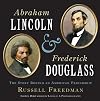
Well written, well illustrated, well constructed, and probably well-researched double biography of Abraham Lincoln and Frederick Douglass. The merits of this book are its straightforward narrative structure and its well-captioned period illustrations. Its defect is sentences that don't really make any sense, that crop up here and there. For a book published in 2012, however, it is pleasantly free of modern gimmicks.
An interesting point that can be gleaned from the book is the obvious fact show more that the system of slavery was breaking down. This was not the well-managed slavery of a contemporary science fiction movie, but a very ill-regulated institution indeed. At each step, Douglass was favored by a laxness in the system. As a child he was taught to read, and books were shared with him by local free boys. As a man, he was expected to maintain himself while working in the Baltimore docks alongside many free persons sympathetic to him. He escaped on the train headed north with papers that had been forged for him by associates he had encountered through his employment. show less
An interesting point that can be gleaned from the book is the obvious fact show more that the system of slavery was breaking down. This was not the well-managed slavery of a contemporary science fiction movie, but a very ill-regulated institution indeed. At each step, Douglass was favored by a laxness in the system. As a child he was taught to read, and books were shared with him by local free boys. As a man, he was expected to maintain himself while working in the Baltimore docks alongside many free persons sympathetic to him. He escaped on the train headed north with papers that had been forged for him by associates he had encountered through his employment. show less
We Will Not Be Silent: The White Rose Student Resistance Movement That Defied Adolf Hitler by Russell Freedman
Honestly, as I read this I was thinking how it stacked up against last year's [b:The Boys Who Challenged Hitler: Knud Pedersen and the Churchill Club|25445456|The Boys Who Challenged Hitler Knud Pedersen and the Churchill Club|Phillip M. Hoose|https://d.gr-assets.com/books/1430245146s/25445456.jpg|42246997]. And I was thinking about how those saboteur Churchill Club boys were more exciting than the pamphleteer Scholl siblings. But then I got to the end of this book and BAM. Whoa. I teared show more up. I felt awful for thinking for even a minute that the White Rose story was tame by comparison. If I had known from the beginning how it ended for Sophie and Hans I think I would've read the story in a different light.
Beyond my personal reaction, I think this story is told with admirable precision (I read it in about an hour) which makes it appealing for younger readers. But there are some very rattling, morbid parts of the story that make me think it's generally best for 6th grade and up.
You could definitely have quite a discussion around the themes, particularly how the Scholl siblings both professed to know right from wrong by looking inside themselves. Do human beings have an innate sense of good and evil? Or can we only know what we're taught? Hans Scholl: "I'm searching for myself, just myself, because this much I do know; I'll only find the truth inside me." Sophie Scholl: "We carry all our standards within ourselves, only we don't look for them closely enough. Perhaps because they are the severest standards." show less
Beyond my personal reaction, I think this story is told with admirable precision (I read it in about an hour) which makes it appealing for younger readers. But there are some very rattling, morbid parts of the story that make me think it's generally best for 6th grade and up.
You could definitely have quite a discussion around the themes, particularly how the Scholl siblings both professed to know right from wrong by looking inside themselves. Do human beings have an innate sense of good and evil? Or can we only know what we're taught? Hans Scholl: "I'm searching for myself, just myself, because this much I do know; I'll only find the truth inside me." Sophie Scholl: "We carry all our standards within ourselves, only we don't look for them closely enough. Perhaps because they are the severest standards." show less
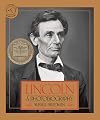
I was excited to see that Russell Freedman’s 1988 Newbery winner, Lincoln: A Photobiography was now available as an audiobook (no doubt due to the 2009 Lincoln Bicentennial). The second disc includes an interview with the author and is enhanced with a Flash slideshow of a few (but nowhere near all) of the archival photographs from the book. Broadway and movie actor Robert Petkoff narrates the book, providing variation in voices for the numerous quotations (by and about Lincoln) used show more throughout it.
This audiobook was fascinating. Freedman chose details (and quotes) that would be of interest to both children and adults, and wove them into a cohesive narrative. I thought I knew a lot about Lincoln, but I learned a lot from this book.
Despite my fondness for audiobooks, this is one that definitely should be paired with the print book. The Flash slide show only includes a few photos from the book, probably because permission could not be obtained from the various sources (listed on page 145 of the book) to use all of them in the Flash format. There are a couple of great series of photos of Lincoln, one set (pages 64-65) showing the progression of his beard growth in 1860-61, and another set (pages 116-117) showing how the strain of the Civil War aged him. The print book also includes appendices on Lincoln memorials/monuments/museums and books about Lincoln, and an index. I could definitely see a struggling reader using the audiobook along with the print version.
On the other hand, the interview with Freedman on the audiobook is valuable, with some great quotes of its own: “Biography lends itself to the art of narrative…to the fascinating spectacle of character meeting circumstance and either changing events or being changed by them—or both, as happened to Lincoln.”
Referring to the research he did for this book, which included travel to many sites relevant to Lincoln, Freedman also said, “Everything you see with your own eyes adds to your understanding of the life and times you are writing about.” Probably the best thing about Lincoln: A Photobiography is that it took me days to write this review, because I kept exploring little tidbits in it , like the photograph of 1858 Springfield on page 29 (which is part of a postcard series). A book that can inspire that kind of curiosity is rare. show less
This audiobook was fascinating. Freedman chose details (and quotes) that would be of interest to both children and adults, and wove them into a cohesive narrative. I thought I knew a lot about Lincoln, but I learned a lot from this book.
Despite my fondness for audiobooks, this is one that definitely should be paired with the print book. The Flash slide show only includes a few photos from the book, probably because permission could not be obtained from the various sources (listed on page 145 of the book) to use all of them in the Flash format. There are a couple of great series of photos of Lincoln, one set (pages 64-65) showing the progression of his beard growth in 1860-61, and another set (pages 116-117) showing how the strain of the Civil War aged him. The print book also includes appendices on Lincoln memorials/monuments/museums and books about Lincoln, and an index. I could definitely see a struggling reader using the audiobook along with the print version.
On the other hand, the interview with Freedman on the audiobook is valuable, with some great quotes of its own: “Biography lends itself to the art of narrative…to the fascinating spectacle of character meeting circumstance and either changing events or being changed by them—or both, as happened to Lincoln.”
Referring to the research he did for this book, which included travel to many sites relevant to Lincoln, Freedman also said, “Everything you see with your own eyes adds to your understanding of the life and times you are writing about.” Probably the best thing about Lincoln: A Photobiography is that it took me days to write this review, because I kept exploring little tidbits in it , like the photograph of 1858 Springfield on page 29 (which is part of a postcard series). A book that can inspire that kind of curiosity is rare. show less
A story that has been told, and must continue to be told, over and over in our American history. 'Angel Island', the "Ellis Island of the West", tells of another dark mark on the story of American immigration. During the mid-nineteenth century, lawmakers began passing discriminatory laws designed to target Chinese immigrants originating with the Foreign Miners' Tax and later the Chinese Exclusion Act of 1882. In this country, we have a history of showing aggression and lashing out at things show more we don't understand or perceived threats. We know now that economic depressions tend to be cyclical but in the depression of the nineteenth century, it was easiest for the European Americans to blame the newcomers which happened to be the Chinese. This story of discrimination against Chinese immigrants is just as relevant today in our current administration and its policy to try and 'build a wall' to keep perceived threats (real or imagined) out of this country.
The importance of saving the remnants of the Angel Island detention center was paramount and I am thrilled that Mr. Weiss was able to be the catalyst to save such an important part of our history. The authenticity of the poems, the sights and smells of the detention center, and the physical voyage to and from Angel Island all help history come alive. As the Spanish-American philosopher George Santayana once said: "Those who do not remember the past are condemned to repeat it." show less
The importance of saving the remnants of the Angel Island detention center was paramount and I am thrilled that Mr. Weiss was able to be the catalyst to save such an important part of our history. The authenticity of the poems, the sights and smells of the detention center, and the physical voyage to and from Angel Island all help history come alive. As the Spanish-American philosopher George Santayana once said: "Those who do not remember the past are condemned to repeat it." show less
Lists
Awards


The Voice That Challenged a Nation: Marian Anderson and the Struggle for Equal Rights (Nominee – Grades 6-12 Nonfiction – 2007)
In Defense of Liberty: The Story of America's Bill of Rights (Nominee – Grades 6-12 Nonfiction – 2006)


The Voice That Challenged a Nation: Marian Anderson and the Struggle for Equal Rights (Honor – 2005)


We Will Not Be Silent: The White Rose Student Resistance Movement That Defied Adolf Hitler (Twelve to Fourteen, Information Books, History – 2017)
Because They Marched: The People's Campaign for Voting Rights That Changed America (Twelve to Fourteen – 2015)


Freedom Walkers: The Story of the Montgomery Bus Boycott (Advanced Readers (Grades 6–8, Ages 11–14) – 2007)


You May Also Like


Associated Authors
Statistics
- Works
- 70
- Also by
- 5
- Members
- 20,454
- Popularity
- #1,060
- Rating
- 4.1
- Reviews
- 531
- ISBNs
- 301
- Languages
- 5
- Favorited
- 6