
Roger Duvoisin (1900–1980)
Author of White Snow, Bright Snow
About the Author
Roger Duvoisin was born in Geneva, Switzerland on August 28, 1904. Before becoming a children's book illustrator, he designed and painted murals, theatrical scenery, and posters as well as worked in the fashion industry. He immigrated with wife Louise Fatio to the United States in 1925. He created show more more than 40 books and illustrated more than 140 children's books. He created several animal characters including Petunia the foolish goose, Veronica the hippo, Crocus the crocodile, Jasmine the cow, Donkey-Donkey and Hector-Penguin. He also illustrated the Happy Lion series written by his wife. He received several awards for his works including the Caldecott Award for White Snow Bright Snow written by Alvin Tresselt in 1948 and the Caldecott Honor Award for Hide and Seek Fog also written by Tresselt in 1966. He also received the Society of Illustrators Award, the Rutgers Award, the Silver Medallion of the University of Southern Mississippi and the Kerlan Award from the University of Minnesota. He died on June 30, 1980. (Bowker Author Biography) show less
Series
Works by Roger Duvoisin
All aboard! 5 copies
Favorite stories of Roger Duvoisin : including The Crocodile in the Tree, See What I Am, Periwinkle and Snowy and Woody (2016) 3 copies
The Happy Lion in Africa 1 copy
Which is the Best Place? 1 copy
Santa's Circus 1 copy
Columbus Discovers America 1 copy
Associated Works
The 20th-Century Children's Book Treasury: Picture Books and Stories to Read Aloud (1998) — Contributor — 1,842 copies, 14 reviews
Travels with a Donkey in the Cevennes (1879) — Illustrator, some editions — 1,274 copies, 26 reviews
The Talking Cat and Other Stories of French Canada (1952) — Illustrator, some editions — 84 copies, 1 review
Mother Goose: A Comprehensive Collection of the Rhymes Made by William Rose Benét (1936) — Illustrator — 13 copies
Vavache, The Cow Who Painted Pictures — Illustrator — 2 copies
Wait Till Sunday — Illustrator — 2 copies
Zang van de koningen — Illustrator, some editions — 1 copy
The Little Church on the Big Rock — Illustrator — 1 copy
Tagged
Common Knowledge
- Legal name
- Duvoisin, Roger Antoine
- Birthdate
- 1900-08-28
- Date of death
- 1980-06-30
- Gender
- male
- Education
- École Nationale Supérieure des Arts Décoratifs, Paris, France
- Occupations
- children's book author
illustrator - Relationships
- Fatio, Louise (spouse)
- Nationality
- Switzerland
- Birthplace
- Geneva, Geneva, Switzerland
- Places of residence
- New York, New York, USA
Gladstone, New Jersey, USA - Place of death
- Morristown, New Jersey, USA
- Associated Place (for map)
- USA
Members
Reviews

First sentence" In the meadow, early one morning, Petunia, the silly goose, went strolling. She ate a bug here, clipped off a clover leaf there, and she picked at the dewdrops on the goldenrod leaves.
Premise/plot: Petunia stars in this classic picture book from 1950. Petunia doesn't like being thought of as a "silly goose." So when Petunia literally stumbles across a book--though she doesn't really know what books are really for--she becomes a proud goose, a very proud goose. Carrying this show more newfound "wise book" everywhere she goes, Petunia is convinced that she is the wisest and best. Everyone starts coming to her for advice, but, her advice tends to do more harm than good. Petunia--book or not--is a silly goose. After a near-disaster--pride goeth before a fall--Petunia realizes something--the book is for reading. Possessing a book without having read it, without really knowing it, without really experiencing all it has to offer is shortsighted at best, foolish at worst. So Petunia decides...perhaps just perhaps...it's time she learns how to read.
My thoughts: I read this one and instantly saw some spiritual insights or lessons to be learned. Were these insights intentional by the author--maybe, maybe not. But even if they weren't, I think there's much food for thought to be gleaned.
Quotes:
So Petunia picked up the Book, and off she went with it. She slept with it....she swam with it...and, knowing that she was so wise, Petunia also became proud, and prouder, and prouder...so proud that her neck stretched out several notches.
and
Now she saw that there was something written inside the Book which she could not read. So she sat down and thought and thought and thought, until at least she sighed, "Now I understand. It was not enough to carry wisdom under my wing. I must put it into my mind and in my heart. And to do that I must learn to read." show less
Premise/plot: Petunia stars in this classic picture book from 1950. Petunia doesn't like being thought of as a "silly goose." So when Petunia literally stumbles across a book--though she doesn't really know what books are really for--she becomes a proud goose, a very proud goose. Carrying this show more newfound "wise book" everywhere she goes, Petunia is convinced that she is the wisest and best. Everyone starts coming to her for advice, but, her advice tends to do more harm than good. Petunia--book or not--is a silly goose. After a near-disaster--pride goeth before a fall--Petunia realizes something--the book is for reading. Possessing a book without having read it, without really knowing it, without really experiencing all it has to offer is shortsighted at best, foolish at worst. So Petunia decides...perhaps just perhaps...it's time she learns how to read.
My thoughts: I read this one and instantly saw some spiritual insights or lessons to be learned. Were these insights intentional by the author--maybe, maybe not. But even if they weren't, I think there's much food for thought to be gleaned.
Quotes:
So Petunia picked up the Book, and off she went with it. She slept with it....she swam with it...and, knowing that she was so wise, Petunia also became proud, and prouder, and prouder...so proud that her neck stretched out several notches.
and
Now she saw that there was something written inside the Book which she could not read. So she sat down and thought and thought and thought, until at least she sighed, "Now I understand. It was not enough to carry wisdom under my wing. I must put it into my mind and in my heart. And to do that I must learn to read." show less

As spring approaches, Santa decides that he needs a break from his yearlong toy-making, and that he wants to see the world during this season of flowers. Deciding to take a trip incognito, he orders a brand new outfit, and flies south (on a plane). But when the children in the city he is visiting accuse him of stealing Santa's white beard, red nose and gay twinkle, and he then declares himself to be the real Santa Claus, our hero finds himself taken into custody by the police. Fortunately, show more Santa knows just how to convince the police captain that he is who he says he is...
Originally published in 1954, Easter Treat is a cute little Santa fantasy, one which imagines that holiday gift-giver during another season. The idea of Santa taking a holiday has been explored before, mostly notably in Raymond Briggs' Father Christmas Goes on Holiday, but author/illustrator Roger Duvoisin brings a special kind of heartwarming humor to his tale, as Santa is at first greeted with suspicion and disbelief, and then with love and warmth, loaded down with Eastertide presents, and sent back to the North Pole with the very thing he usually sets out with, on Christmas Eve. Namely: a sack full of gifts. I found this one charming, and recommend it to more advanced picture-book readers - it's quite text heavy - who enjoy unusual Santa stories. One word of caution however: although Easter provides the setting, it really isn't about that holiday at all, and although Santa is given a bunny rabbit as one of his gifts, the scene on the front cover, in which he seems to be walking the Easter Bunny, does not occur during the course of the story. show less
Originally published in 1954, Easter Treat is a cute little Santa fantasy, one which imagines that holiday gift-giver during another season. The idea of Santa taking a holiday has been explored before, mostly notably in Raymond Briggs' Father Christmas Goes on Holiday, but author/illustrator Roger Duvoisin brings a special kind of heartwarming humor to his tale, as Santa is at first greeted with suspicion and disbelief, and then with love and warmth, loaded down with Eastertide presents, and sent back to the North Pole with the very thing he usually sets out with, on Christmas Eve. Namely: a sack full of gifts. I found this one charming, and recommend it to more advanced picture-book readers - it's quite text heavy - who enjoy unusual Santa stories. One word of caution however: although Easter provides the setting, it really isn't about that holiday at all, and although Santa is given a bunny rabbit as one of his gifts, the scene on the front cover, in which he seems to be walking the Easter Bunny, does not occur during the course of the story. show less
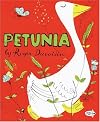
I think that I've read this before, but for some reason it didn't stick. Which isn't a good sign. But jeepers I sure did enjoy it this time. I laughed at the silly advice Petunia gave all the animals, especially the rooster who knew all along why his comb is red. And I appreciated that she figured out the lesson to be learned all by herself... inspirational, that way. I will check out the sequels that I saw on the library shelf.

A small town experiences a heavy snowfall in this Caldecott Medal-winning picture book from 1947. As a number of different townsfolk—the postman and farmer, policeman and his wife—prepare and react in their own ways, a beautiful snowy day dawns, and the local children and rabbits have great fun playing outdoors. The book concludes with the eventual melting of the snow, and the first signs of spring...
White Snow, Bright Snow is only the second book I have read from author Alvin Tresselt, show more following upon his 1964 The Mitten: An Old Ukrainian Folktale, and the third from illustrator Roger Duvoisin, following upon Easter Treat (1966) and Wobble, the Witch Cat (1958). I thought it was quite lovely, and although it isn't destined to become a personal favorite, I did enjoy both story and artwork. The initial poem was probably my favorite thing about it, as it had such a lovely cadence, and so perfectly captured the peaceful feeling of softly falling snow. It begins: "Softly, gently in the secret night, / Down from the North came the quiet white. / Drifting, sifting, silent flight, / Softly, gently in the secret night." The narrative continues in prose, after the three-stanza poem, and has a charming quality of its own. The accompanying illustrations from Duvoisin, who won the 1948 Caldecott Medal for them, have a vintage, 1940s appeal to them. I was reminded of certain childhood favorites, like Mike Mulligan and His Steam Shovel. Recommended to anyone who appreciates vintage picture books, and to those seeking engaging wintry stories for children. show less
White Snow, Bright Snow is only the second book I have read from author Alvin Tresselt, show more following upon his 1964 The Mitten: An Old Ukrainian Folktale, and the third from illustrator Roger Duvoisin, following upon Easter Treat (1966) and Wobble, the Witch Cat (1958). I thought it was quite lovely, and although it isn't destined to become a personal favorite, I did enjoy both story and artwork. The initial poem was probably my favorite thing about it, as it had such a lovely cadence, and so perfectly captured the peaceful feeling of softly falling snow. It begins: "Softly, gently in the secret night, / Down from the North came the quiet white. / Drifting, sifting, silent flight, / Softly, gently in the secret night." The narrative continues in prose, after the three-stanza poem, and has a charming quality of its own. The accompanying illustrations from Duvoisin, who won the 1948 Caldecott Medal for them, have a vintage, 1940s appeal to them. I was reminded of certain childhood favorites, like Mike Mulligan and His Steam Shovel. Recommended to anyone who appreciates vintage picture books, and to those seeking engaging wintry stories for children. show less
Lists
Sonlight Books (1)
Awards


You May Also Like


Associated Authors
Statistics
- Works
- 59
- Also by
- 65
- Members
- 6,927
- Popularity
- #3,529
- Rating
- 3.7
- Reviews
- 108
- ISBNs
- 164
- Languages
- 9
- Favorited
- 2