
Randy Olson
Author of Don't Be Such a Scientist: Talking Substance in an Age of Style
About the Author
Randy Olson earned his PhD at Harvard University and became a professor of marine biology before moving to Hollywood for his second career as a filmmaker. Since obtaining an MFA from the USC School of Cinema, he has written and directed the critically acclaimed films Flock of Dodos and Sizzle, show more cofounded The Shifting Baselines Ocean Media Project, and conducted a wide range of science communication workshops. He is the author of Houston, We have a Narrative and Connection: Hollywood Meets Critical Thinking. show less
Works by Randy Olson
Associated Works
Tagged
Common Knowledge
- Other names
- Olson, Richard Randolph (birth name)
- Birthdate
- 1955-10-03
- Gender
- male
- Education
- University of Southern California (MFA|Film Production|1997)
Harvard University (PhD|Biology|1984)
University of Washington (BA|Zoology) - Occupations
- marine biologist
filmmaker - Organizations
- University of New Hampshire
University of Southern California - Nationality
- USA (born in Germany to American parents)
- Birthplace
- Heidelberg, Germany
- Associated Place (for map)
- Heidelberg, Germany
Members
Reviews
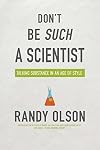
Randy Olson is a marine biologist who did his research, did his publishing, and became a tenured professor at the University of New Hampshire.
And then he resigned to become a filmmaker.
In Don't Be Such a Scientist, Olson talks about his own journey from scientist to science filmmaker, and explores the problems of communicating science to a broad audience. He finds the problems to lie mainly in a disconnect between how scientists learn to communicate with each other and the kinds of show more communication that work with the general, non-scientist public, and especially what does and does not work in the mass media.
Scientists place the highest value on accuracy; they correct inaccuracies, they question assumptions, they demand evidence. This is all vital to what scientists do; without these behaviors, real advances in knowledge can't happen. But when scientists use those same behaviors when talking to the general public, and especially when speaking on tv or making films and videos intended to reach the general public, these same behaviors come across as negative, argumentative, and unlikeable. Scientists, Olson says, work almost entirely in their heads, while reaching a broad audience--even getting the attention of a broad audience, due to how inundated we are with information--requires reaching the heart, the gut, and even, as he delicately phrases it, "the lower organs."
To illustrate the impact of an over-emphasis on being serious and relentlessly accurate, vs. presenting the information with style, heart, and even humor, he compares the reception given to two 2006 movies about global warming--HBO's April 2006 Too Hot Not Too Handle, and Al Gore's May 2006 An Inconvenient Truth. The first, he says, was "solid, relatively impersonal, objective effort featuring interviews with many top scientists." The second is a personal narrative by Al Gore, featuring his stories of long-term involvement with the issue, the tragedies involving his sister and his son, some humor, along with lots of substance. With all the emphasis on style, Gore nevertheless used PowerPoint graphs in abundance to communicate facts and data.
The HBO movie was completely accurate--but also boring and depressing. It sunk without a trace. Gore's was filled with important information, but had some inaccuracies that would never have survived in the HBO effort. But none of those errors were important enough to undermine the central point--and An Inconvenient Truth was a huge hit, and won both an Oscar and a Nobel Prize. Which was more effective in getting real knowledge of global warming to the general public?
Some of the entertaining stories Olson has to tell include his own collision with acting class (news flash: scientists are not naturals at just going with their feelings), the struggles to make his own 2006 film on evolution vs. "intelligent design," Flock of Dodos, watchable--and then the reaction of science bloggers to a movie that still wasn't accessible enough for distributors to want it for general audiences.
I'm not doing justice to the book, but it's short, pithy, and completely readable, along with providing ample food for thought on how to communicate science to the general public.
Important note: I received a free electronic galley of this book from the publisher, Island Press. show less
And then he resigned to become a filmmaker.
In Don't Be Such a Scientist, Olson talks about his own journey from scientist to science filmmaker, and explores the problems of communicating science to a broad audience. He finds the problems to lie mainly in a disconnect between how scientists learn to communicate with each other and the kinds of show more communication that work with the general, non-scientist public, and especially what does and does not work in the mass media.
Scientists place the highest value on accuracy; they correct inaccuracies, they question assumptions, they demand evidence. This is all vital to what scientists do; without these behaviors, real advances in knowledge can't happen. But when scientists use those same behaviors when talking to the general public, and especially when speaking on tv or making films and videos intended to reach the general public, these same behaviors come across as negative, argumentative, and unlikeable. Scientists, Olson says, work almost entirely in their heads, while reaching a broad audience--even getting the attention of a broad audience, due to how inundated we are with information--requires reaching the heart, the gut, and even, as he delicately phrases it, "the lower organs."
To illustrate the impact of an over-emphasis on being serious and relentlessly accurate, vs. presenting the information with style, heart, and even humor, he compares the reception given to two 2006 movies about global warming--HBO's April 2006 Too Hot Not Too Handle, and Al Gore's May 2006 An Inconvenient Truth. The first, he says, was "solid, relatively impersonal, objective effort featuring interviews with many top scientists." The second is a personal narrative by Al Gore, featuring his stories of long-term involvement with the issue, the tragedies involving his sister and his son, some humor, along with lots of substance. With all the emphasis on style, Gore nevertheless used PowerPoint graphs in abundance to communicate facts and data.
The HBO movie was completely accurate--but also boring and depressing. It sunk without a trace. Gore's was filled with important information, but had some inaccuracies that would never have survived in the HBO effort. But none of those errors were important enough to undermine the central point--and An Inconvenient Truth was a huge hit, and won both an Oscar and a Nobel Prize. Which was more effective in getting real knowledge of global warming to the general public?
Some of the entertaining stories Olson has to tell include his own collision with acting class (news flash: scientists are not naturals at just going with their feelings), the struggles to make his own 2006 film on evolution vs. "intelligent design," Flock of Dodos, watchable--and then the reaction of science bloggers to a movie that still wasn't accessible enough for distributors to want it for general audiences.
I'm not doing justice to the book, but it's short, pithy, and completely readable, along with providing ample food for thought on how to communicate science to the general public.
Important note: I received a free electronic galley of this book from the publisher, Island Press. show less
Harvard-trained marine biologist-turned-filmmaker Olson makes a passionate plea to his fellow scientists to rethink how they communicate their findings. Part media kit, part personal filmmaking history, this is a lighthearted, opinionated guide. (152)

An amazingly fair-handed and sympathetic review of all sides. Filmmaker, Olson, is an evolutionist, but dignified all angles of the debate.
Evolutionary critics attack Haeckel's embryo drawings, which theorized that ontogeny recapitulates phylogeny. No one could find that assertion in modern science texts, but it was certainly still at large when I took science classes in the 70's, and is a huge formative, if unreliable illustration for the Darwinists.
Olson concludes that Intelligent Design show more is a gut feeling that, doesn't move up to the brain, but stops at the heart. That is a good analysis of what ID presents currently, but also points to the direction ID research should go. show less
Evolutionary critics attack Haeckel's embryo drawings, which theorized that ontogeny recapitulates phylogeny. No one could find that assertion in modern science texts, but it was certainly still at large when I took science classes in the 70's, and is a huge formative, if unreliable illustration for the Darwinists.
Olson concludes that Intelligent Design show more is a gut feeling that, doesn't move up to the brain, but stops at the heart. That is a good analysis of what ID presents currently, but also points to the direction ID research should go. show less
Randy Olson, the author, has unique life lessons on communication to share with academia after resigning from a tenured position at University of New Hampshire and subsequently moving to Hollywood to begin a second career as a (science) movie maker. His book on communicating science focuses on the principles, rather than the techniques, of how to effectively reach broad audiences through video and how different this is from traditional scientific communication training. This is not a how-to show more book. It's purpose is to convince scientists of the necessity of communicating better, and to point out just how big the gulf between the scientific community and 'the masses' really is, and why outreach and talking to 'the public' has thus far been ineffective.
In a conversational first person tone, he talks about different ways to connect and communicate with an audience - through the head (eg information dump), the heart (eg religion), the gut (eg humor), and the sex organs (is an eg necessary?). He also talks about ways that scientists can learn to better connect with folks - by being less cerebral, less literal, more likeable, etc. It is somewhat ironic that he spends ample time discussing how negative and negating the scientific community can be yet many of his messages are 'Don't do x' (Perhaps he thought scientists would naturally gravitate towards this type of advice?) In any case, he argues that communicating better - and through media - can be learned like most other things scientists do. Further, he maintains that learning to do so is critical to maintain public support (both directly and via government) for scientists and science that can help to improve society.
Drawing on lessons from acting classes and from movie making experience, Olson both his successes and his failures and turning points along his scientist-turn-Hollywood career. This is a worthwhile read, particularly if you are skeptical about the usefulness and power of communicating science to a wide audience or if you are unsure how communicating science to non-scientists is different from communicating to scientists.
There's a fair bit to chew over that's subjective, opinion, and anecdotal, but considering that Dr. Olson is one of the few who have walked the talk, I think it's worthwhile to hear him out. And at the very least, it may be entertaining. Recommended, 4.5 stars. show less
In a conversational first person tone, he talks about different ways to connect and communicate with an audience - through the head (eg information dump), the heart (eg religion), the gut (eg humor), and the sex organs (is an eg necessary?). He also talks about ways that scientists can learn to better connect with folks - by being less cerebral, less literal, more likeable, etc. It is somewhat ironic that he spends ample time discussing how negative and negating the scientific community can be yet many of his messages are 'Don't do x' (Perhaps he thought scientists would naturally gravitate towards this type of advice?) In any case, he argues that communicating better - and through media - can be learned like most other things scientists do. Further, he maintains that learning to do so is critical to maintain public support (both directly and via government) for scientists and science that can help to improve society.
Drawing on lessons from acting classes and from movie making experience, Olson both his successes and his failures and turning points along his scientist-turn-Hollywood career. This is a worthwhile read, particularly if you are skeptical about the usefulness and power of communicating science to a wide audience or if you are unsure how communicating science to non-scientists is different from communicating to scientists.
There's a fair bit to chew over that's subjective, opinion, and anecdotal, but considering that Dr. Olson is one of the few who have walked the talk, I think it's worthwhile to hear him out. And at the very least, it may be entertaining. Recommended, 4.5 stars. show less
Awards


You May Also Like


Associated Authors
Statistics
- Works
- 10
- Also by
- 2
- Members
- 281
- Popularity
- #82,781
- Rating
- 3.7
- Reviews
- 15
- ISBNs
- 12
- Languages
- 1