

Arthur Koestler (1905–1983)
Author of Darkness at Noon
About the Author
Arthur Koestler was born on September 5, 1905 in Budapest, Hungary and studied at the University of Vienna. Koestler was a Middle East correspondent for several German newspapers, wrote for the Manchester Guardian, the London Times and the New York Herald Tribune. Koestler wrote Darkness at Noon, show more which centers on the destructiveness of politics, The Act of Creation, a book about creativity, and The Ghost in the Machine, which bravely attacks behaviorism. Arthur Koestler died in London on March 3, 1983. (Bowker Author Biography) show less
Image credit: Pinn Hans
Series
Works by Arthur Koestler
The Sleepwalkers: A History of Man's Changing Vision of the Universe (1959) 1,085 copies, 12 reviews
The Act of Creation: A Study of the Conscious and Unconscious in Science and Art (1964) 745 copies, 6 reviews
Dialogue with Death: The Journal of a Prisoner of the Fascists in the Spanish Civil War (1942) 220 copies, 4 reviews
Insight and Outlook: An Inquiry into the Common Foundations of Science, Art, and Social Ethics (1949) 32 copies
Kaleidoscope essays from 'Drinkers of infinity' and 'The heel of Achilles' and later pieces and stories (1981) 6 copies
Les Tribulations du camarade Lepiaf 3 copies
Rare Arthur Koestler DARKNESS AT NOON 1941 The Macmillan Company, NY Early Printing [Hardcover] unknown 3 copies, 1 review
L'atto della creazione 2 copies
LE CRI D'ARCHIMEDE 2 copies
Arthur Koestler: Autobiografía (1) 2 copies
EL MITO SOVIETICO ANTE LA REALIDAD 2 copies
Pühendatud : [romaan] 2 copies
LA FLECHA AZUL 1 copy
Hieroglyphes - Tome 2 1 copy
LE BAR DU CRÉSPUSCULE 1 copy
The Divine Within 1 copy
Noc o polednách 1 copy
Ein Gott der keiner war 1 copy
CAHIER 1 copy
Leven na de dood 1 copy
Betrayal 1 copy
Return trip to nirvana 1 copy
Sunday Telegraph 1 copy
Sonnenfisnternis 1 copy
Tuomion päivä 1 copy
Gli angeli caduti romanzo 1 copy
En busca de lo absoluto 1 copy
Der göttliche Funke 1 copy
A caballo de dos culturas 1 copy
Associated Works
The Plague, The Fall, Exile and the Kingdom, and Selected Essays (Everyman's Library) (2004) — Contributor — 780 copies, 4 reviews
Alger Hiss, Whittaker Chambers, and the Schism in the American Soul (2002) — Contributor — 25 copies, 1 review
The Logic of Personal Knowledge: Essays Presented to Michael Polanyi on his Seventieth Birthday (2015) — Contributor — 12 copies
Little Reviews Anthology 1945 — Contributor, some editions — 2 copies
Tagged
Common Knowledge
- Canonical name
- Koestler, Arthur
- Legal name
- Kösztler, Artúr
- Other names
- Kösztler Artúr, (birth name, in Hungarian name order, patronymic first)
Köstler, Arthur - Birthdate
- 1905-09-05
- Date of death
- 1983-03-01
- Gender
- male
- Education
- University of Vienna
- Occupations
- novelist
biographer
essayist
journalist - Organizations
- Communist Party of Germany (1931)
British Army (WWII)
French Foreign Legion
Jüdisch Akademische Verbindung Unitas zu Wien, Vienna, Austria (1922)
Society for Psychical Research (1952)
Koestler Foundation (show all 9)
Exit
Aliens Pioneer Corps
Ullstein-Verlag - Awards and honors
- Royal Society of Literature (Fellow, 1960)
Sonning Prize (1968)
Order of the British Empire (Commander, 1972)
American Academy of Arts and Letters (1976) - Relationships
- Hughes, Langston (friend)
Koestler, Mamaine (wife)
Zeisel, Eva (friend)
Benjamin, Walter (colleague) - Cause of death
- suicide
- Nationality
- Hungary (birth)
UK (naturalized) - Birthplace
- Budapest, Hungary, Austro-Hungarian Empire
- Places of residence
- Austria
Palestine
Germany
USSR
France
Spain (show all 8)
USA
UK - Place of death
- London, Middlesex, England, UK
- Burial location
- cremated
- Map Location
- Hungary
Members
Discussions
Since It's A Book "Blog" Huh --... in Pro and Con (September 2015)
Reviews

In the middle of our read-a-thon, I decided to pull a book from the bookslut 100 list. I ended up pulling Darkness at Noon, even though I knew hardly anything about it.
As a fan of science fiction, I have read dozens of books where the big bad was a totalitarian government that prosecutes people for thoughtcrimes and says things like "It is better to execute 10 innocent people than to let one guilty person go free." These organizations are horrible, clearly, but lost a little bit of their show more scariness for me as they seemed too unbelievable. How could anyone really believe such a horrible thing? And how could an entire government run on that principle?
Well, this book has changed all that forever. In Darkness, Rubashov, a former party leader and war hero, is imprisoned for treason. During his imprisonment, he thinks back to a past imprisonment, engages in secretive conversations with other prisoners (his wing is all solitary confinement), and is interrogated by two men, one of whom he has a history with. As they try to convince him to plead guilty to several counts of treason, there is a lot of discussion of the philosophy of such a government. Not only did this book thoroughly convince me that such governments have and do exist, but even more horrifyingly, I started to understand how people could talk themselves and others into such behaviors.
This book was so good, I was kind of in awe of it the entire time I was reading it. Definitely worthy of its place on the bookslut 100. show less
As a fan of science fiction, I have read dozens of books where the big bad was a totalitarian government that prosecutes people for thoughtcrimes and says things like "It is better to execute 10 innocent people than to let one guilty person go free." These organizations are horrible, clearly, but lost a little bit of their show more scariness for me as they seemed too unbelievable. How could anyone really believe such a horrible thing? And how could an entire government run on that principle?
Well, this book has changed all that forever. In Darkness, Rubashov, a former party leader and war hero, is imprisoned for treason. During his imprisonment, he thinks back to a past imprisonment, engages in secretive conversations with other prisoners (his wing is all solitary confinement), and is interrogated by two men, one of whom he has a history with. As they try to convince him to plead guilty to several counts of treason, there is a lot of discussion of the philosophy of such a government. Not only did this book thoroughly convince me that such governments have and do exist, but even more horrifyingly, I started to understand how people could talk themselves and others into such behaviors.
This book was so good, I was kind of in awe of it the entire time I was reading it. Definitely worthy of its place on the bookslut 100. show less

It's undoubtedly a powerfully and skillfully written novel, much as I hate to say it, "Darkness at Noon" struck me as somewhat dated. It must have been a powerful anti-Stalinist statement when it was released in 1940, but now that just about nobody attempts to live their lives by the logic of historical determinism, it mostly just seems like a message sent into the future from an era whose ideological coordinates were very different from our own. Not that the writing's bad: Rubashov's is show more often a strong and fascinating character, and the novel is often enjoyably tense, psychologically acute, and well observed. It has moments of real pathos, and it's easy to see how it influenced Orwell's "1984." But I finished "Darkness at Noon" thinking that that novel's continued relevance may come from is universally applicable science fiction setting, while the polemical content of Koestler's novel seems less immediately relevant to this reader. I suppose it's a reminder that, for much of the twentieth century, ideological struggles weren't just something for intellectuals to dither about : they decided the fates of people's lives. Koestler, to his credit, complements many of his characters' arguments with resonant, well-chose symbolism. But there's only so much musing about living a logically ordered, Marxist-informed life that I can be expected to take. Bring it up at the next Party conference, Comrade. show less
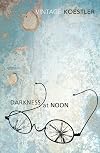
Revolutions eat their children. When revolution takes place suddenly and aims at eradicating the previous regime in totality (history, news, people, events - anything and everything that might indicate there was life before the revolution) we end up with radical dictatorships right or left - they are all the same. When the final battles are won then it is required to take care of any survivors because they are unfortunate witnesses - people that know of the world before (what a show more blasphemy).
And this is how we get to the Rubashov, our main protagonist. High functionary of the party, responsible for some pretty heinous deeds in the name of Party, he is soon declared a persona non grata, arrested and placed into the solitary confinement for his anti-revolutionary actions (aka everything they can pack on). And so travel to the inevitable destination starts.
Story is a critique of the Soviet regime under Stalin (No.1) but same as Orwell's 1984 it is not sole critique of the left but any dictatorship. In my opinion only reason left dictatorships are given as an example in books like this, is because left revolutions are more social-oriented in nature and are supposed to bring better conditions for everyone, not cause more mayhem and despair.
For these societies it does not matter who the person is, once tagged as criminal element there is no further discussion, everyone knows how this needs to end. At that moment everyone who ever knew the person needs to disavow that same person, bury it under ton of accusations and findings that were always "subliminally there". Snitches arise and tell on others just to prove the scope of ever present conspiracy. There is never any doubt, greater the purge, the better because fear is greater and danger oh ever more palpable (so last year right?). Now imagine hundreds of revolutionaries from the 1920's and 1930's giving their best for the Party, fighting for the ideals and then ending in prisons and in front of firing squads or in dark dirty yard shot in the back.They are loyal to the very end, sure that this is an error and wholeheartedly believing will be saved in the end ..... so sad.
While all of the above is nothing new and was subject of many a novel what is eternal is message of the book - if you are fighting for the cause that treats all the others like scum of the earth is that cause worth fighting for? How deep can one go before becoming the relic, something to eliminate because it has no further purpose? Is human life only valid while it is useful, can we dehumanize a human being by terror, fears fed every second of a day being so much that human being becomes just a simple-minded drone, pure statistic? Is it worth living in society where you see bad things happening but cannot talk about it for fear of death or life ruination (again so 20's right)?
Novel style is excellent, author manages to capture the emotions of all parties involved and paints a very vivid picture of a dystopian society. All of this in very concise sentences and without becoming too melodramatic about the not so likeable character like Rubashov.
Recommended. show less
And this is how we get to the Rubashov, our main protagonist. High functionary of the party, responsible for some pretty heinous deeds in the name of Party, he is soon declared a persona non grata, arrested and placed into the solitary confinement for his anti-revolutionary actions (aka everything they can pack on). And so travel to the inevitable destination starts.
Story is a critique of the Soviet regime under Stalin (No.1) but same as Orwell's 1984 it is not sole critique of the left but any dictatorship. In my opinion only reason left dictatorships are given as an example in books like this, is because left revolutions are more social-oriented in nature and are supposed to bring better conditions for everyone, not cause more mayhem and despair.
For these societies it does not matter who the person is, once tagged as criminal element there is no further discussion, everyone knows how this needs to end. At that moment everyone who ever knew the person needs to disavow that same person, bury it under ton of accusations and findings that were always "subliminally there". Snitches arise and tell on others just to prove the scope of ever present conspiracy. There is never any doubt, greater the purge, the better because fear is greater and danger oh ever more palpable (so last year right?). Now imagine hundreds of revolutionaries from the 1920's and 1930's giving their best for the Party, fighting for the ideals and then ending in prisons and in front of firing squads or in dark dirty yard shot in the back.They are loyal to the very end, sure that this is an error and wholeheartedly believing will be saved in the end ..... so sad.
While all of the above is nothing new and was subject of many a novel what is eternal is message of the book - if you are fighting for the cause that treats all the others like scum of the earth is that cause worth fighting for? How deep can one go before becoming the relic, something to eliminate because it has no further purpose? Is human life only valid while it is useful, can we dehumanize a human being by terror, fears fed every second of a day being so much that human being becomes just a simple-minded drone, pure statistic? Is it worth living in society where you see bad things happening but cannot talk about it for fear of death or life ruination (again so 20's right)?
Novel style is excellent, author manages to capture the emotions of all parties involved and paints a very vivid picture of a dystopian society. All of this in very concise sentences and without becoming too melodramatic about the not so likeable character like Rubashov.
Recommended. show less

Koestler's history of cosmology is filled with well-researched information bundled into a story so well told it reads like good fiction. Mostly it's a historical account of the work of Copernicus, Kepler and Galileo, but the early sections set the scene perfectly by describing the astonishing work of their predecessors like Ptolemy and Pythagoras.
Koestler provides plausible psychological analyses of the skywatchers as they painstakingly and erratically put their theories together with a show more foot in the past and one in the future, surrounded by chaos and intrigue and trying to hold their lives, families and minds together, often stumbling on to the truth by mistake, or forgetting or ignoring it.
Having read their works in the original, Koestler reveals jokes and theoretical nuances, and skewers much of the apocrypha that has contributed to the legends that surround these scientific giants. He also writes very well about the changing relationship between religion and science over the centuries.
All told, decades after publication this remains a breath of fresh air, and probably my favourite of the Koestler books I've read. I highly recommend it to anyone interested in cosmology, maths, alchemy, the middle ages, or the history and philosophy of science or religion. show less
Koestler provides plausible psychological analyses of the skywatchers as they painstakingly and erratically put their theories together with a show more foot in the past and one in the future, surrounded by chaos and intrigue and trying to hold their lives, families and minds together, often stumbling on to the truth by mistake, or forgetting or ignoring it.
Having read their works in the original, Koestler reveals jokes and theoretical nuances, and skewers much of the apocrypha that has contributed to the legends that surround these scientific giants. He also writes very well about the changing relationship between religion and science over the centuries.
All told, decades after publication this remains a breath of fresh air, and probably my favourite of the Koestler books I've read. I highly recommend it to anyone interested in cosmology, maths, alchemy, the middle ages, or the history and philosophy of science or religion. show less
Lists
Awards


You May Also Like


Associated Authors
Statistics
- Works
- 110
- Also by
- 16
- Members
- 13,114
- Popularity
- #1,779
- Rating
- 4.0
- Reviews
- 216
- ISBNs
- 489
- Languages
- 22
- Favorited
- 34
