
Michael E. McCullough
Author of To Forgive Is Human: How to Put Your Past in the Past
About the Author
Image credit: via Hachette Book Group
Works by Michael E. McCullough
The Kindness Of Strangers 1 copy
Associated Works
Tagged
Common Knowledge
There is no Common Knowledge data for this author yet. You can help.
Members
Reviews
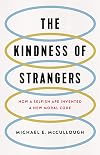
How many times have you heard some variation of the phrase, advanced by David Hume in the 18th century, that “reason is the slave of the passions”? According to this doctrine, reason is used simply as justification for the pursuit of goals dictated by our emotions. If you want to understand human behavior, therefore, you don’t have to look much further than to what we are biologically programmed to want and pursue.
The problem with this doctrine is that it can’t possibly be the show more whole, or even the most significant, part of the story. While our passions undoubtedly influence our behavior, our ideas, driven by reason, have altered human behavior more drastically over the last 10,000 years—and especially over the last 300 to 400 years—than can be accounted for by any changes in our biological makeup.
Evolution works its magic over hundreds of thousands and millions of years, so humanity has essentially the same biological makeup as our distant ancestors. The fact that we live nothing like them tells us that we have altered our behavior, not because of a change in our biology, nature, or emotional profile, but through the use of reason and ideas that modulate those tendencies.
This, essentially, is the argument of the book, applied to the specific tendency of humans to be increasingly kind to strangers. McCullough convincingly demonstrates that biological explanations for increasing human generosity—such as kin and group selection—cannot possibly account for our increasing levels of concern and material support for strangers that in some cases we will never meet—and therefore could not expect any kind of direct reciprocal benefits from.
As McCullough explains, the explanation lies in our evolving ideas and justifications, guided by reason, for why we should consider the needs of others on par with our own, and with those of our closest kith and kin. Humans have learned, through various historical confrontations with mass human suffering, to expand their own circle of empathy by advancing arguments that break down arbitrary distinctions and divisions that prevent us from caring about the needs of others.
If you’re tired of hearing that we are all slaves to our biology, this book will be a breath of fresh air for you, as it places reason back in its rightful position. We must continually defend and reaffirm the propositions that tell us that we are part of one larger human community and that there is nothing special about ourselves, or the groups to which we belong, that can rationally place our needs above the needs of others based on arbitrary physical or geographical distinctions. show less
The problem with this doctrine is that it can’t possibly be the show more whole, or even the most significant, part of the story. While our passions undoubtedly influence our behavior, our ideas, driven by reason, have altered human behavior more drastically over the last 10,000 years—and especially over the last 300 to 400 years—than can be accounted for by any changes in our biological makeup.
Evolution works its magic over hundreds of thousands and millions of years, so humanity has essentially the same biological makeup as our distant ancestors. The fact that we live nothing like them tells us that we have altered our behavior, not because of a change in our biology, nature, or emotional profile, but through the use of reason and ideas that modulate those tendencies.
This, essentially, is the argument of the book, applied to the specific tendency of humans to be increasingly kind to strangers. McCullough convincingly demonstrates that biological explanations for increasing human generosity—such as kin and group selection—cannot possibly account for our increasing levels of concern and material support for strangers that in some cases we will never meet—and therefore could not expect any kind of direct reciprocal benefits from.
As McCullough explains, the explanation lies in our evolving ideas and justifications, guided by reason, for why we should consider the needs of others on par with our own, and with those of our closest kith and kin. Humans have learned, through various historical confrontations with mass human suffering, to expand their own circle of empathy by advancing arguments that break down arbitrary distinctions and divisions that prevent us from caring about the needs of others.
If you’re tired of hearing that we are all slaves to our biology, this book will be a breath of fresh air for you, as it places reason back in its rightful position. We must continually defend and reaffirm the propositions that tell us that we are part of one larger human community and that there is nothing special about ourselves, or the groups to which we belong, that can rationally place our needs above the needs of others based on arbitrary physical or geographical distinctions. show less
Awards


You May Also Like


Associated Authors
Statistics
- Works
- 6
- Also by
- 1
- Members
- 195
- Popularity
- #112,376
- Rating
- 3.8
- Reviews
- 1
- ISBNs
- 16