
Henry Cloud
Author of Boundaries: When to Say Yes, When to Say No, To Take Control of Your Life
About the Author
Cofounder of Cloud/Townsend Communications, Henry Cloud is a popular speaker and licensed psychologist. Cloud graduated with a doctorate in clinical psychology from Rosemead Graduate School of Psychology and maintains a private practice in Newport Beach, California. Also a cohost of the nationally show more broadcast "Minirth Meier New Life Clinic," Cloud has written numerous books with his business partner John Townsend, including Safe People, Twelve Christian Beliefs That Can Drive You Crazy, The Mom Factor, and the Gold Medallion award-winning Boundaries. On his own, Cloud, who specializes in individual adult psychotherapy, has written the books Changes That Heal: How to Understand Your Past to Ensure a Healthier Future and Secrets of Your Family Tree. (Bowker Author Biography) show less
Image credit: Zondervan Publishing
Series
Works by Henry Cloud
Boundaries: When to Say Yes, When to Say No, To Take Control of Your Life (1992) 4,976 copies, 53 reviews
Boundaries, Updated and Expanded Edition: When to Say Yes, How to Say No to Take Control of Your Life (2017) 1,307 copies, 9 reviews
Safe People: How to Find Relationships That Are Good for You and Avoid Those That Aren't (1995) 777 copies, 4 reviews
Boundaries Face to Face: How to Have That Difficult Conversation You've Been Avoiding (2003) 483 copies, 4 reviews
9 Things You Simply Must Do to Succeed in Love and Life: A Psychologist Probes the Mystery of Why Some Lives Really Work and Others Don't (2004) 440 copies, 2 reviews
Boundaries Participant's Guide---Revised: When To Say Yes, How to Say No to Take Control of Your Life (1999) 242 copies, 1 review
The Power of the Other: The startling effect other people have on you, from the boardroom to the bedroom and beyond-and what to do about it (2016) 226 copies, 1 review
The One-Life Solution: Reclaim Your Personal Life While Achieving Greater Professional Success (2008) 182 copies, 3 reviews
How To Get A Date Worth Keeping: Be Dating In Six Months Or Your Money Back (2005) 178 copies, 1 review
Rescue Your Love Life: Changing Those Dumb Attitudes & Behaviors That Will Sink Your Marriage (2005) 141 copies
9 Things a Leader Must Do: How to Go to the Next Level—and Take Others with You (2006) 118 copies, 1 review
Trust: Knowing When to Give It, When to Withhold It, How to Earn It, and How to Fix It When It Gets Broken (2023) 111 copies
The Law of Happiness: How Spiritual Wisdom and Modern Science Can Change Your Life (The Secret Things of God) (2011) 101 copies
Secrets of Your Family Tree: Healing for Adult Children of Dysfunctional Families (1995) 100 copies, 1 review
How to Have That Difficult Conversation: Gaining the Skills for Honest and Meaningful Communication (2007) 94 copies, 2 reviews
Secrets of Your Family Tree: Healing the Present in Light of the Past (Healing for the Heart) (1991) 94 copies
Discouragement & Depression: God Will Make a Way (What to Do When You Don't Know What to Do) (2005) 32 copies
Our Mothers, Ourselves: How Understanding Your Mother's Influence Can Set You on a Path to a Better Life (2015) 30 copies
Boundaries in Marriage: An 8-Session Focus on Understanding the Boundaries That Make or Break a Marriage [DVD] (2007) 28 copies, 1 review
God Will Make a Way Personal Discovery Guide: What to Do When You Don't Know What to Do (2004) 20 copies, 1 review
Boundaries with Kids: An 8-Sessions Focus on How Healthy Boundaries Grow Healthy Children (2007) 18 copies, 1 review
Why I Believe: A Psychologist's Thoughts on Suffering, Miracles, Science, and Faith (2024) 17 copies
Trust Study Guide: Knowing When to Give It, When to Withhold It, How to Earn It, and How to Fix It When It Gets Broken (2023) 10 copies
Divorce & Love Lost: God Will Make a Way (What to Do When You Don't Know What to Do) (2005) 9 copies
Limites para lideres: Resultados, relaciones y estar ridículamente a cargo (Spanish Edition) (2014) 3 copies
DVD: Boundaries with Kids 3 copies
Chave do Crescimento, A 2 copies
Mamo to moje zycie (Polish Edition) 2 copies
Свидания: нужны ли границы? 1 copy
带出健康的小组 1 copy
職場軟實力 1 copy
Workbook Boundaries 1 copy
為工作立界線 1 copy
為婚姻立界線--下個男人/女人會更好嗎? 1 copy
過猶不及--如何建立你的心理界線 1 copy
Boundaries in Marriage - International Edition: An 8-Session Focus on Boundaries and Marriage (2002) 1 copy
Брак: где проходит граница? 1 copy
One-Life Solution: Reclaim Your Personal Life While Achieving Greater Professional Success (2021) 1 copy
Надежные люди 1 copy
Limite 1 copy
Warum ich glaube: Gedanken eines Psychologen über Leid, Wunder, Wissenschaft und Glaube. Ein bewegendes, persönliches Buch über ein außergewöhnliche Lebens- und… (2025) 1 copy, 1 review
La fonte della felicità 1 copy
Cambios necesarios: Empleados, negocios y relaciones de los que debemos desprendernos para seguir adelante (Spanish Edition) (2012) 1 copy
为婚姻立界线 1 copy
O SEGREDO DE DEUS 1 copy
Addiction 1 copy
Boundaries Video Series 1 copy
Boundary worksheets 1 copy
Safe People Video Series 1 copy
Solutions: Who's the Boss? 1 copy
Kweek Karaktervolle Kinders 1 copy
Boundaries with Kids Guide 1 copy
Změna přináší uzdravení : jak pochopit svou minulost a tím si zajistit zdravou budoucnost? (2000) 1 copy
Die een oplossing vir die lewe : Waardevolle strategieë om 'n balans te handhaaf tussen jou en jou werk, gesin & geloof (2012) 1 copy
Réussir sa vie 1 copy
The Secret und die Geheimnisse Gottes: Ihre Wünsche - und wie sie in Erfüllung gehen können (2009) 1 copy
Свидания: нужны ли границы? 1 copy
Associated Works
Tagged
Common Knowledge
- Legal name
- Cloud, Henry
- Other names
- 亨利·克勞德
- Birthdate
- 1956
- Gender
- male
- Education
- Southern Methodist University (BA)
Biola University (PhD)
Talbot Theological Seminary - Occupations
- self-help author
- Relationships
- Cloud, Tori (wife)
Cloud, Olivia (daughter)
Cloud, Lucy (daughter) - Nationality
- USA
- Birthplace
- Vicksburg, Mississippi, USA
Members
Reviews
The Power of the Other: The startling effect other people have on you, from the boardroom to the bedroom and beyond-and what to do about it by Henry Cloud
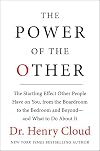
Modern leadership is often contrasted with healthy relationships. Leaders, we are told, have to be a lonely and isolated genius, like Steve Jobs. However, in truth, no one can lead without relying on other people. Getting things done requires healthy relationships, and most key advances just cannot be made without others’ influence. In this book, leadership psychologist Henry Cloud examines how to best take advantage of others’ help by identifying mutually beneficial show more relationships.
Cloud’s main idea is that relationships of respect and growth yield the most productive results. Key insights have only happened because other people have become involved in another person’s life. Other people can inspire us to do things that we simply can’t achieve in isolation. This trait is grounded in the neuroscience of how mirror neurons act in our brains.
Although this book is written primarily for the workplace, this central idea has contains a very religious, spiritual core. Not only does this work reference Cloud’s Christianity multiple times, but also it contains common insights of religion, that no one is an island and that humans do better in loving, respectful relationships. This motif goes against the grain that selfish jerks end up first. Indeed, Cloud speaks directly against such a premise in his conclusion and contends that these jerks could have had greater impact with better relationships.
This book still faces a few limits. He consistently uses the term “corner four relationships” to describe the healthiest, most generative relationships. This concept clearly refers to a chart in the book, but I was not able to view this graphic because I listened to an audiobook. This repeated abstraction is, well, a little too abstract for me. I wish he would have just coined a more descriptive phrase for it that wouldn’t be so vague and distracting.
Further, Cloud never discusses the area of difficult choices. He presumes that relationships should always come first. How do we tell if someone is, say, taking advantage of us? How do we psychologically balance our need for subjective trust with an objective evaluation? These and other confusing areas are simply not addressed in this text. That’s unfortunate because the values of any principles are most clearly seen in the required trade offs.
This book’s audience focuses on organizational leaders and those aspiring to grow. The message can encompass a wide variety of organizations and leaders. The book broadly addresses businesses, non-profits, educators, and family leaders. In particular, mentors can benefit from Cloud’s focus on cultivating synergistic relationships, and their mentees can benefit from figuring out how to make their other relationships yield more fruit. Throughout, he consistently reminds us that individual success always rests on the shoulders of other people, and the greatest leaders bring out the best in other individuals, not just their own greatness. show less
Cloud’s main idea is that relationships of respect and growth yield the most productive results. Key insights have only happened because other people have become involved in another person’s life. Other people can inspire us to do things that we simply can’t achieve in isolation. This trait is grounded in the neuroscience of how mirror neurons act in our brains.
Although this book is written primarily for the workplace, this central idea has contains a very religious, spiritual core. Not only does this work reference Cloud’s Christianity multiple times, but also it contains common insights of religion, that no one is an island and that humans do better in loving, respectful relationships. This motif goes against the grain that selfish jerks end up first. Indeed, Cloud speaks directly against such a premise in his conclusion and contends that these jerks could have had greater impact with better relationships.
This book still faces a few limits. He consistently uses the term “corner four relationships” to describe the healthiest, most generative relationships. This concept clearly refers to a chart in the book, but I was not able to view this graphic because I listened to an audiobook. This repeated abstraction is, well, a little too abstract for me. I wish he would have just coined a more descriptive phrase for it that wouldn’t be so vague and distracting.
Further, Cloud never discusses the area of difficult choices. He presumes that relationships should always come first. How do we tell if someone is, say, taking advantage of us? How do we psychologically balance our need for subjective trust with an objective evaluation? These and other confusing areas are simply not addressed in this text. That’s unfortunate because the values of any principles are most clearly seen in the required trade offs.
This book’s audience focuses on organizational leaders and those aspiring to grow. The message can encompass a wide variety of organizations and leaders. The book broadly addresses businesses, non-profits, educators, and family leaders. In particular, mentors can benefit from Cloud’s focus on cultivating synergistic relationships, and their mentees can benefit from figuring out how to make their other relationships yield more fruit. Throughout, he consistently reminds us that individual success always rests on the shoulders of other people, and the greatest leaders bring out the best in other individuals, not just their own greatness. show less
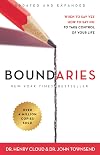
Many of us have boundary issues in our lives - some more than others, and some in different areas than others. But if you have any sort of issue with guilt, anger, overwhelm, or other negative emotions, it may be because you are not placing the proper boundaries in your life. Everyone should read this book, because I believe everyone can get some use out of it.
I think it really is a good read, but if you do have issues setting boundaries in your life, it is absolutely essential. It is very show more biblically based, so some may have an issue with that. But if you are able to get past that (or embrace that depending on how you are inclined), there is so much in this book that you can take away. The power of an emphatic but loving "no" is one tool that everyone deserves to be able to use in their life. show less
I think it really is a good read, but if you do have issues setting boundaries in your life, it is absolutely essential. It is very show more biblically based, so some may have an issue with that. But if you are able to get past that (or embrace that depending on how you are inclined), there is so much in this book that you can take away. The power of an emphatic but loving "no" is one tool that everyone deserves to be able to use in their life. show less
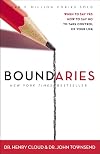
I'm surprised to be giving this a full five stars, seeing as Dr. Cloud is an evangelical Christian - and writes like one! - and I'm agnostic/atheist. But it earns the full five stars. What he says about boundaries (and the way to sanity) is something pretty much everyone in the modern world needs to hear in some form. If you can deal with a bit of Christianity without it driving you totally nuts (and, really, it's not all that strong, doesn't sound like a Bible study or anything), then I'd show more highly recommend this book. show less
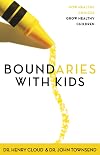
I think this is one of those books that is going to take me a while to see if I actually liked it or not, depending on how well I remember its lessons, and how useful it is to implement them. It took me two months to get through a 223-page book, not a good sign in and of itself.
There feels like a lot good here, emphasizing not punishment, but boundaries with consequences. We don't need to yell at our kids, we don't need to make them feel bad. Kids are responsible for their own fun. Kids are show more NOT responsible for their parents' feelings, etc. Parents are responsible for setting boundaries and sticking to them. It is better not to have a boundary at all than to have a wishy-washy one that sometimes has consequences and sometimes doesn't.
At times I felt it was a bit too harsh. For example, I think assumptions that entitlement is always bad sets one up for a life to be made a doormat. Claims that someone feels they have earned what their boss has, or being "envious of the upper class" is someone being a classist themselves. Why do they only call it class warfare when we fight back? I also didn't like their referral too frequently to "real life" as if the life of young people is somehow fake. They also seem to make some harsh assumptions that childhood always ends the day they turn 18. While many lessons are universal there was no reference to homeschooling and seemed to assume your kids go to public school. show less
There feels like a lot good here, emphasizing not punishment, but boundaries with consequences. We don't need to yell at our kids, we don't need to make them feel bad. Kids are responsible for their own fun. Kids are show more NOT responsible for their parents' feelings, etc. Parents are responsible for setting boundaries and sticking to them. It is better not to have a boundary at all than to have a wishy-washy one that sometimes has consequences and sometimes doesn't.
At times I felt it was a bit too harsh. For example, I think assumptions that entitlement is always bad sets one up for a life to be made a doormat. Claims that someone feels they have earned what their boss has, or being "envious of the upper class" is someone being a classist themselves. Why do they only call it class warfare when we fight back? I also didn't like their referral too frequently to "real life" as if the life of young people is somehow fake. They also seem to make some harsh assumptions that childhood always ends the day they turn 18. While many lessons are universal there was no reference to homeschooling and seemed to assume your kids go to public school. show less
Lists
Awards


You May Also Like


Associated Authors
Statistics
- Works
- 219
- Also by
- 1
- Members
- 22,564
- Popularity
- #940
- Rating
- 4.0
- Reviews
- 157
- ISBNs
- 517
- Languages
- 18
- Favorited
- 7