
About the Author
Series
Works by Larry Gonick
The Cartoon History of the Universe I, Volumes 1-7: From the Big Bang to Alexander the Great (1990) 1,452 copies, 17 reviews
The Cartoon History of the Universe II, Volumes 8-13: From the Springtime of China to the Fall of Rome (1994) 950 copies, 5 reviews
The Cartoon History of the Universe III, Volumes 14-19: From the Rise of Arabia to the Renaissance (2002) 697 copies, 3 reviews
The Cartoon History of the Modern World, Part I: From Columbus to the U.S. Constitution (2007) 470 copies, 7 reviews
The Cartoon History of the Modern World, Part II: From the Bastille to Baghdad (2009) 286 copies, 1 review
The Cartoon Guide to (Non) Communication : The Use and Misuse of Information in the Modern World (1990) 81 copies, 3 reviews
Cartoon Guide To The Statistics The 2 copies
Cartoon Guide To The Sex The 2 copies
Cartoon Guide To The Environment The 2 copies
Cartoon Guide To The Genetics The 2 copies
Cartoon Guide To The Physics The 2 copies
Cartoon Guide To The Chemistry The 2 copies
Science Classics: Scat Song 1 copy
Science Classics: Filler Up! 1 copy
Science Classics: Swell Gel 1 copy
Science Classics: Roar! 1 copy
Science Classics: Speed 1 copy
Science Classics: Escape Rat 1 copy
Science Classics: Lumps 1 copy
Historia do Universo em Quadrinhos: Do Surgimento do Homem Ate a Invencao da Escrita - Vol.2 (2016) 1 copy
Science Classics: Prime Time 1 copy
Science Classics: Tooth Pix 1 copy
Science Classics: Seagels 1 copy
Associated Works
Tagged
Common Knowledge
- Canonical name
- Gonick, Larry
- Birthdate
- 1946-08-24
- Gender
- male
- Education
- Harvard University
- Occupations
- cartoonist
- Nationality
- USA
- Birthplace
- San Francisco, California, USA
- Places of residence
- San Francisco, California, USA
- Associated Place (for map)
- San Francisco, California, USA
Members
Reviews

This book was responsible for rekindling my love of history and for me eventually returning to university and getting a degree. it is one of the funniest, most erudite and most charming books in my whole collection, and sits proudly beside more 'respectable' histories.
The cartoon style is just the right side of wacky without trivialising its subjects and humour runs off every page. More surprising are the things you can learn (The institutionalised weirdness of the Spartans! Minoan flush show more toilets! Persians disrupted enemy cavalry with camels!) that Gonick happily shares.
Enjoy - it's a marvellous historical primer and a solid base for further reading. Five Stars show less
The cartoon style is just the right side of wacky without trivialising its subjects and humour runs off every page. More surprising are the things you can learn (The institutionalised weirdness of the Spartans! Minoan flush show more toilets! Persians disrupted enemy cavalry with camels!) that Gonick happily shares.
Enjoy - it's a marvellous historical primer and a solid base for further reading. Five Stars show less

In graphic novel form, this book attempts nothing less than an accessible explanation of capitalism. It also shows how present-day worship of markets harms a person's well-being and the planet's health.
The five commandments of hypercapitalism are: Thou Shalt Consume, Thou Shalt Operate Globally, Thou Shalt Not Regulate, Thou Shalt Spend Less on Labor and Thou Shalt Privatize. How can the average person afford all this consumption when wages have generally stagnated over the past couple of show more decades? The answer is: credit cards, the overall debt of which is about $700 billion. That does not include student loan debt, which is another trillion dollars. Are obsessed consumers really happier than the average person, or do they get a momentary "high" from their purchase?
Is there anything the average person can do about it? Before buying, here are some questions to ask yourself. Can I afford it? Do I need it, or do I want it? Will it improve my life? What company makes it? There are tool banks and seed banks and time banks, where such items can be shared. If your town or neighborhood does not have one, consider starting it. Get to know your local library. It is possible for a business, like an employee-owned business or a non-profit, to be more socially responsible than average. For some people, more direct methods are the way to go. These include boycott/buycott, advocating for a better deal for workers and publicly funded political campaigns or taking to the streets and protesting.
This book deserves six stars. It is very easy to read, and does a wonderful job at explaining capitalism, even for those who "hate" capitalism. It also gives a number of alternatives that anyone can adopt. This is extremely highly recommended. show less
The five commandments of hypercapitalism are: Thou Shalt Consume, Thou Shalt Operate Globally, Thou Shalt Not Regulate, Thou Shalt Spend Less on Labor and Thou Shalt Privatize. How can the average person afford all this consumption when wages have generally stagnated over the past couple of show more decades? The answer is: credit cards, the overall debt of which is about $700 billion. That does not include student loan debt, which is another trillion dollars. Are obsessed consumers really happier than the average person, or do they get a momentary "high" from their purchase?
Is there anything the average person can do about it? Before buying, here are some questions to ask yourself. Can I afford it? Do I need it, or do I want it? Will it improve my life? What company makes it? There are tool banks and seed banks and time banks, where such items can be shared. If your town or neighborhood does not have one, consider starting it. Get to know your local library. It is possible for a business, like an employee-owned business or a non-profit, to be more socially responsible than average. For some people, more direct methods are the way to go. These include boycott/buycott, advocating for a better deal for workers and publicly funded political campaigns or taking to the streets and protesting.
This book deserves six stars. It is very easy to read, and does a wonderful job at explaining capitalism, even for those who "hate" capitalism. It also gives a number of alternatives that anyone can adopt. This is extremely highly recommended. show less
The Cartoon History of the Universe II, Volumes 8-13: From the Springtime of China to the Fall of Rome (Pt.2) by Larry Gonick
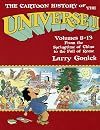
I've read this book before, a long, long time ago, but my brother-in-law, Josh, didn't know that when he bought it for me for my birthday. What he did know is that I own (and love) The Cartoon History of the Universe I (especially for its cartoon depiction of the process of evolution), so this was a good bet, and even though I'd read it before, I devoured it fairly quickly after receiving it.
The subtitle of this book is From the Springtime of China to the Fall of Rome, and it is primarily show more about these two civilizations. Certainly, I am much more interested in learning about China these days now that Jefferson is learning the language. This was a fabulous primer on early Chinese history, though there were a few places where the plots were involved enough with so many names that I got a little lost. This may be a function of my primarily reading this book while "supervising" the kids playing outside.
The history of Rome was easier, as it is more familiar, and strengthening the connections in my brain between late Roman history and early Christian history is always satisfying. Just because it's something I feel I ought to know, I suppose.
One of my favorite things about these volumes is the frequent use of asides for the author to confess his biases, his degree of confidence in his sources, etc. Add in his obvious love of his subject, and the entertainment value of the comics format, and it's obvious why I'm a Gonick fan. show less
The subtitle of this book is From the Springtime of China to the Fall of Rome, and it is primarily show more about these two civilizations. Certainly, I am much more interested in learning about China these days now that Jefferson is learning the language. This was a fabulous primer on early Chinese history, though there were a few places where the plots were involved enough with so many names that I got a little lost. This may be a function of my primarily reading this book while "supervising" the kids playing outside.
The history of Rome was easier, as it is more familiar, and strengthening the connections in my brain between late Roman history and early Christian history is always satisfying. Just because it's something I feel I ought to know, I suppose.
One of my favorite things about these volumes is the frequent use of asides for the author to confess his biases, his degree of confidence in his sources, etc. Add in his obvious love of his subject, and the entertainment value of the comics format, and it's obvious why I'm a Gonick fan. show less

Larry Gonick's Cartoon Histories are roadmaps to history; like Wikipedia, they're not something to use as a primary source, but they are an excellent starting point for looking up more detailed information. Gonick gives a good overview of the flow of events leading up to 1991, targeting some of his most pointed snarkiness at the unwholesome behavior of even the most iconic figures of history.
Lists
Awards


You May Also Like


Associated Authors
Statistics
- Works
- 83
- Also by
- 2
- Members
- 8,989
- Popularity
- #2,671
- Rating
- 4.1
- Reviews
- 94
- ISBNs
- 152
- Languages
- 17
- Favorited
- 20