
John Allen Paulos
Author of Innumeracy: Mathematical Illiteracy and Its Consequences
About the Author
John Allen Paulos is professor of mathematics at Temple University and the author of eight previous books, including the bestselling Innumeracy and A Mathematician Reads the Newspaper.
Image credit: by Leah Paulos
Works by John Allen Paulos
Irreligion: A Mathematician Explains Why the Arguments for God Just Don't Add Up (2007) 546 copies, 13 reviews
A Numerate Life: A Mathematician Explores the Vagaries of Life, His Own and Probably Yours (2013) 51 copies, 1 review
Associated Works
Flatland: A Romance of Many Dimensions (1884) — Afterword, some editions — 10,844 copies, 203 reviews
What Is Your Dangerous Idea? Today's Leading Thinkers on the Unthinkable (2007) — Contributor — 668 copies, 8 reviews
Tagged
Common Knowledge
- Birthdate
- 1945-07-04
- Gender
- male
- Education
- University of Wisconsin-Madison (PhD|Mathematics)
- Occupations
- mathematician
professor (Mathematics) - Organizations
- Temple University
- Awards and honors
- AAAS Award for Public Understanding of Science and Technology (2003)
University Creativity Award (2002) - Nationality
- USA
- Birthplace
- Denver, Colorado, USA
- Places of residence
- Chicago, Illinois, USA
Milwaukee, Wisconsin, USA
Madison, Wisconsin, USA
Philadelphia, Pennsylvania, USA - Associated Place (for map)
- USA
Members
Reviews

My reactions to reading this book in 1993.
An entertaining, funny, and very informative book.
There were some things I did know like the difference between correlation and causality, the filtering effect of pseudosciences (only remembering your seemingly pre-cognitive feelings and dreams – not all the ones that didn’t come true), and a lot of things I didn’t know (mainly all sorts of mathematical paradoxes which are demonstrably true but go against common sense), and some things I show more always wondered about (like just how many “precognitive” dreams you’d get in the U.S. if only 1 dream in 10,000 came “true”?).
Paulos is straightforward and full of witty, relevant examples which show the relevance of law to politics (the non-transistive situations of voting such as A>B>C but C beats A in the election), the law (probability in polygraphs, drug tests, and trials), medicine, and psychology (for instance, should you get discouraged when the doctor says you test positive for a fatal disease). Paulos exposes innumeracy in a wide variety of areas, highlights misuse of statistics and shows how vital a seemingly dry subject can be. I also think he’s right on in denouncing the way math is taught (with elementary school teachers being particularly bad). I also think he’s right to scoff at people who want to be called educated but can’t reason even a little bit mathematically.
My only quibble with this book is oddly, even though I’m only seminummerate, I would have liked some equations formally showing a principle. I can understand, given his audience, why he didn’t put any in though. show less
An entertaining, funny, and very informative book.
There were some things I did know like the difference between correlation and causality, the filtering effect of pseudosciences (only remembering your seemingly pre-cognitive feelings and dreams – not all the ones that didn’t come true), and a lot of things I didn’t know (mainly all sorts of mathematical paradoxes which are demonstrably true but go against common sense), and some things I show more always wondered about (like just how many “precognitive” dreams you’d get in the U.S. if only 1 dream in 10,000 came “true”?).
Paulos is straightforward and full of witty, relevant examples which show the relevance of law to politics (the non-transistive situations of voting such as A>B>C but C beats A in the election), the law (probability in polygraphs, drug tests, and trials), medicine, and psychology (for instance, should you get discouraged when the doctor says you test positive for a fatal disease). Paulos exposes innumeracy in a wide variety of areas, highlights misuse of statistics and shows how vital a seemingly dry subject can be. I also think he’s right on in denouncing the way math is taught (with elementary school teachers being particularly bad). I also think he’s right to scoff at people who want to be called educated but can’t reason even a little bit mathematically.
My only quibble with this book is oddly, even though I’m only seminummerate, I would have liked some equations formally showing a principle. I can understand, given his audience, why he didn’t put any in though. show less
A Numerate Life: A Mathematician Explores the Vagaries of Life, His Own and Probably Yours by John Allen Paulos
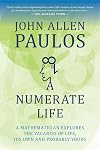
I had a four hour flight for the final leg home from Paris and decided to finally devote the time to reading this, as it's been on my shelf for a few years. I've liked all of Paulos's book that I've read, and this didn't disappoint. Less about numbers and math- oh, they're there, as they've been an integral part of his life, so not really much less - and more about parts of his life, it's also a look at biographies and autobiographies in general. Memory is tricky, and despite the courts' show more acceptance of it, eyewitness accounts are inherently flawed...even if it's yours. Some readers were thrown off by the less than linear flow and dinged Paulos...more's the pity, and I do pity them for their myopia. Oh, I'm on record more than once railing at incoherent stream-of-consciousness fictions, but while this is a story, there is still a logical transition between vignettes and semi-order to it.
So Paulos, at the age of 70 - he's older than I had in my head, despite reading him for nearly 30 years - sets out to collect some of his life observations and flesh them out to a larger examination of the life worth living. It's not a long book - 192 pages plus cites and an index, but there is a lot here. I'll just list the chapter titles and subtitles in case that prompts an interest.
1) Bully Teacher, Childhood Math: some early estimates, speculations
2) Bias, Biography, and Why We're All a Bit Far-out and Bizarre: bias mindsets, statistics and biography
3) Ambition vs. Nihilism: infinity, sets , and immortality
4) Life's Shifting Shapes: primitive math, life trajectories, and curve fitting
5) Moving Toward the Unexpected Middle: a few touchstone memories
6) Pivots - Past to Present: Kovalevsky, prediction, and my gramdmother's petty larceny
7) Romance Among the Trans-humans and us Cis-humans: roboromance and the end of biography
8) Chances Are the Chances Are: if only...probability and coincidences, good, bad, and ugly
9) Lives in the Era of Numbers and Networks: how many e-mails, where did we buy that- the quantified life
10) My Stock Loss, Hypocrisy, and A Card Trick: my stock loss and a few pitfalls of narrative logic
11) Biographies: Verstehen or Superficial: consciousness, biographies, and shmata
12) Trips, Memories, and Becoming Jaded: topology, travel, and a Thai taxi driver
A few of the many parts I marked and margin-noted...
One part I won't detail here, for it's a bit long, demonstrated an interesting aspect of probability - something humans have a difficult time with, but I'll summarize: if one has two people with a tendency to not always tell the truth, the probability of them both telling a lie independently is easily calculated (after assuming some factors of truthiness). But...and this is important in 2017/18...particularly early October 2018, if the second person says something in support of something the first said, the probability that whatever that first person said is true goes way down! On mortality
So, the non-linearity did not bother me, and the maths are always stimulating - even if I don't share his love of topology (Martin Gardner was another aficionado) or have ever really understood Gödel's Incompleteness Theorem - and I enjoyed the story, connected with many of the revelations, and found a few more books to add to my List.
Recommended. show less
So Paulos, at the age of 70 - he's older than I had in my head, despite reading him for nearly 30 years - sets out to collect some of his life observations and flesh them out to a larger examination of the life worth living. It's not a long book - 192 pages plus cites and an index, but there is a lot here. I'll just list the chapter titles and subtitles in case that prompts an interest.
1) Bully Teacher, Childhood Math: some early estimates, speculations
2) Bias, Biography, and Why We're All a Bit Far-out and Bizarre: bias mindsets, statistics and biography
3) Ambition vs. Nihilism: infinity, sets , and immortality
4) Life's Shifting Shapes: primitive math, life trajectories, and curve fitting
5) Moving Toward the Unexpected Middle: a few touchstone memories
6) Pivots - Past to Present: Kovalevsky, prediction, and my gramdmother's petty larceny
7) Romance Among the Trans-humans and us Cis-humans: roboromance and the end of biography
8) Chances Are the Chances Are: if only...probability and coincidences, good, bad, and ugly
9) Lives in the Era of Numbers and Networks: how many e-mails, where did we buy that- the quantified life
10) My Stock Loss, Hypocrisy, and A Card Trick: my stock loss and a few pitfalls of narrative logic
11) Biographies: Verstehen or Superficial: consciousness, biographies, and shmata
12) Trips, Memories, and Becoming Jaded: topology, travel, and a Thai taxi driver
A few of the many parts I marked and margin-noted...
The so-called conjunction fallacy, or Linda problem, suggests a related pitfall of just-so stories with little evidentiary value. [...]That last paragraph speaks to me. And sometimes I am labeled "negative" or "curmudgeon" for it. On observed moments in our lives:
As with the Texas sharpshooter foible, approaches to biography or even everyday storytelling that depend on the conjunction fallacy are quite common. It's interesting watching how some people effortlessly embroider, exaggerate, gerrymander, and invent details to concoct a compelling little anecdote out of the sparsest and most ordinary incidents. [this book was published in 2015...before Prince Twit-terer was promoted to King Twit-terer] Munchausen syndrome, whereby healthcare providers and/or patients exaggerate reports and add false details to obtain sympathy, attract attention, or portray themselves as heroes, is an extreme example. [see previous insert observation]
My predilection has usually been just the opposite. I find excessive enthusiasm suspect and often feel compelled to report neutral facts that undermine the tendentious slant of any story I read and thereby drain it of much of its. drama.
I'll end with a common set of usually faux turning points: milestone multiples-of-ten birthdays, thirty, forty, fifty, and so on. To underline their artificiality and lessen the dread that often accompanies them, I sometimes point out to people that their age can be expressed less traumatically in a numeral system with a different base. Happy 40th Birthday, for example, becomes Happy 34th Birthday in a base-12 system...I've mused and groused about artificial milestones many times! (...knowing full well the artificiality of "mile"stones!)
One part I won't detail here, for it's a bit long, demonstrated an interesting aspect of probability - something humans have a difficult time with, but I'll summarize: if one has two people with a tendency to not always tell the truth, the probability of them both telling a lie independently is easily calculated (after assuming some factors of truthiness). But...and this is important in 2017/18...particularly early October 2018, if the second person says something in support of something the first said, the probability that whatever that first person said is true goes way down! On mortality
Becoming a grandparent or simply getting older usually brings about a keener sense of mortality. Few unasked questions are more human than: How much longer do I have? How many more times will I travel here, eat there, do this or that thing I've enjoyed (or simply endured) doing?To which I always add my question: "How many more books can I read?"
So, the non-linearity did not bother me, and the maths are always stimulating - even if I don't share his love of topology (Martin Gardner was another aficionado) or have ever really understood Gödel's Incompleteness Theorem - and I enjoyed the story, connected with many of the revelations, and found a few more books to add to my List.
Recommended. show less
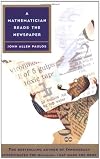
I love mathematics. I love newspapers. I also love facts, and separating those from fiction, and clarity, and healthy skeptical thinking, and a vigorous dose of humor. This book satisfies all those interests. What's fascinating is that each chapter could be exploded not into just into an entire book, but volumes of books. His brevity though, keeps your interest, although he runs way too short on some very interesting topics (only four pages on baseball? Criminal!). Great fun. I have to read show more more of his work. show less
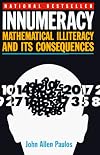
An incredibly fun read, especially considering the subject and my own mathematical deficiencies. This was on my "to read" list for far too long; many less deserving books made it to the top of the pile, probably because I was uncomfortable facing my own shortcomings. I really had only one problem with it, a nitpick, I suppose, but enough of one to rob it of a full fifth star. It was just one passage in the course of dismissing charlatanism of one sort or another where Paulos off-handedly show more dismisses "simpleminded atheism." He does so in the context of advocating agnosticism as the more reasonable position. It was the kind of dismissal made by the smug and self-righteous. Perhaps he meant something specific by "simpleminded atheism"? Since he doesn't distinguish it from perfectly reasonable simple atheism, it's hard to know. A predilection for agnosticism, insufficiently justified, indicates a kind of insidious, mush-brained tolerance for magical bullshit that is particularly out of place in this book.
That one passage aside, I was bucked up and more than a little inspired to hone those limited mathematical chops I do possess. show less
That one passage aside, I was bucked up and more than a little inspired to hone those limited mathematical chops I do possess. show less
Lists
Awards


You May Also Like


Associated Authors
Statistics
- Works
- 14
- Also by
- 2
- Members
- 6,270
- Popularity
- #3,910
- Rating
- 3.7
- Reviews
- 90
- ISBNs
- 121
- Languages
- 13
- Favorited
- 8