
Philip J. Davis (1923–2018)
Author of The Mathematical Experience
About the Author
Philip J. Davis is Professor Emeritus (1963-1992) of Applied Mathematics at Brown University.
Works by Philip J. Davis
Associated Works
Tagged
Common Knowledge
- Birthdate
- 1923-01-02
- Date of death
- 2018-03-14
- Gender
- male
- Education
- Harvard University (PhD - Pure Mathematics)
- Occupations
- mathematician
professor emeritus (Applied Mathematics) - Organizations
- Brown University
- Awards and honors
- Chauvenet Prize (1963)
Lester R. Ford Award (1982)
George Pólya Award (1986)
Guggenheim Award (1956) - Nationality
- USA
- Birthplace
- Lawrence, Massachusetts, USA
- Places of residence
- Providence, Rhode Island, USA
- Associated Place (for map)
- USA
Members
Reviews
Descartes' Dream: The World According to Mathematics (Dover Books on Mathematics) by Philip J. Davis
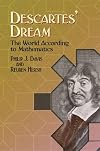
Like many Dover editions, this is a reprint. It is a chance to enjoy a book that was maybe missed the first time around. The original text appeared in 1987. The collection of pieces in the compendium encourages thought. The first thought I took from this book was, “is there anywhere else that uses this verb ‘mathematize’?” Well, just as surely as Robert Anton Wilson (R.I.P.) said that by synchronicity merely thinking about quarters will make them appear to me on the ground, I see now show more the verb is here in the article “Galileo’s Construction of Idealized Fall in the Void” in number xliii of History of Science (2005).
Appropriate enough, since much of the articles contained in the collection that is Descartes’ Dream strike us now as historical. This is because the “mathematization” explored in this book tends more toward computerization than even it tends toward Descartes. The breathless pace of change since this work’s inception has left it considering the implications of COBOL but unable to foresee the impact of the Internet. The fact that some references are dated does not diminish much the value of this book. There is as value here as in other ostensibly dated works on applied computer science, such as Programming Pearls (Jon Bentley) or The Cuckoo’s Egg (Clifford Stoll).
Following on the heels of their success with The Mathematical Experience (reissued by Springer), the authors compiled another book on mathematics, as opposed to being a mathematics book. Specific to applied mathematics, this volume focuses a lot on application of computer technology, applied statistics and the like. The articles are grouped in such categories as “Cognitions and Computation” and “Mathematics and Ethics”. The piece take a very high level, even philosophical, view.
Many of the pieces are much too short and superficial to make much headway in the weighty topic, they examine, but some among the longer ones succeed particularly well. Among the strongest offerings is “The Stochastized World: A Matter of Style?” Beside the suspicious inclusion of another apparent neologism, this article is an interesting look at the basic application of probability and enlightens through a simple example where the outcome of a basic coin toss can be modeled probabilistically in contradictory ways that are each are sound in isolation. It all depends on what premises are allowed. “Feedback and Control: The Equilibrium Machine” is a blueprint for the workshop hobbyist to exhibit Torricelli’s Law and model other fluid dynamics principals. Comedic relief occurs during the lively “Social Tyranny in Numbers” article, particularly the section “Mathematics and Rhetoric”. If you want to sound profound in ridiculing a pompous lecture or devalue the label “refereed”, you will find ample ammunition here. Maybe the better to be ready to defend yourself!
File this between Clifford Pickover and Douglas R. Hofstadter, but it gets there topically, not by quality or as memorably. Still, reading this text, which can be started anywhere, will inspire conversations in the mathematically inclined and in that perhaps the authors have succeeded in their goal with a book that still stirs thought two decades after its birth. show less
Appropriate enough, since much of the articles contained in the collection that is Descartes’ Dream strike us now as historical. This is because the “mathematization” explored in this book tends more toward computerization than even it tends toward Descartes. The breathless pace of change since this work’s inception has left it considering the implications of COBOL but unable to foresee the impact of the Internet. The fact that some references are dated does not diminish much the value of this book. There is as value here as in other ostensibly dated works on applied computer science, such as Programming Pearls (Jon Bentley) or The Cuckoo’s Egg (Clifford Stoll).
Following on the heels of their success with The Mathematical Experience (reissued by Springer), the authors compiled another book on mathematics, as opposed to being a mathematics book. Specific to applied mathematics, this volume focuses a lot on application of computer technology, applied statistics and the like. The articles are grouped in such categories as “Cognitions and Computation” and “Mathematics and Ethics”. The piece take a very high level, even philosophical, view.
Many of the pieces are much too short and superficial to make much headway in the weighty topic, they examine, but some among the longer ones succeed particularly well. Among the strongest offerings is “The Stochastized World: A Matter of Style?” Beside the suspicious inclusion of another apparent neologism, this article is an interesting look at the basic application of probability and enlightens through a simple example where the outcome of a basic coin toss can be modeled probabilistically in contradictory ways that are each are sound in isolation. It all depends on what premises are allowed. “Feedback and Control: The Equilibrium Machine” is a blueprint for the workshop hobbyist to exhibit Torricelli’s Law and model other fluid dynamics principals. Comedic relief occurs during the lively “Social Tyranny in Numbers” article, particularly the section “Mathematics and Rhetoric”. If you want to sound profound in ridiculing a pompous lecture or devalue the label “refereed”, you will find ample ammunition here. Maybe the better to be ready to defend yourself!
File this between Clifford Pickover and Douglas R. Hofstadter, but it gets there topically, not by quality or as memorably. Still, reading this text, which can be started anywhere, will inspire conversations in the mathematically inclined and in that perhaps the authors have succeeded in their goal with a book that still stirs thought two decades after its birth. show less
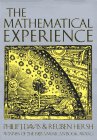
Over a few chapters, I warmed to this book. The first couple on the "What is Mathematics" theme and mathematicians-at-work felt rather fluffy and did not engage me. As the content grew and built on this to consider the evolution of ideas I found it more interesting. For instance, the evolution in description and description of the Chinese Remainder Theorem was very interesting. The final chapters explore a trichotomy of mathematical philosophy: Platonism (math objects are real), Formalism show more (it is just the formula etc. we make up) and the marginal Constructivism view (Only what is derived directly from the natural numbers matters). show less

This strange and whimsical story of a by-gone age of Cambridge academics and a young cat from a Fenland village is charming, if a little rambly and odd in places.

This is the portuguese translation of The Mathematical Experience. An interesting attempt to convey the nature and importance of Mathematics to the lay reader, the text digresses through a variety of topics in a clear and, at times, inspired prose. It is not a mathematical text though, and apart from Chapter 5 and some examples spread through Chapters 4 and 6, not much mathematical culture is required from the reader, although someone lacking a mathematical education at the level of the show more first two years at the University will probably miss the better parts of the arguments and is likely not to make much sense of the rest. In spite of some odd choices (such as the emphasis in the example of Non-standard Analysis, a clearly marginal subject in present day mathematics) this is a book worth reading that tries to portrait the mathematical activity as part of the large human effort to understand and make sense of ourselves and the world. show less
Lists
Awards

You May Also Like


Associated Authors
Statistics
- Works
- 23
- Also by
- 1
- Members
- 1,985
- Popularity
- #12,951
- Rating
- 4.0
- Reviews
- 17
- ISBNs
- 95
- Languages
- 9
- Favorited
- 3