
William Poundstone
Author of Prisoner's Dilemma: John Von Neumann, Game Theory, and the Puzzle of the Bomb
About the Author
William Poundstone has been nominated twice for the Pulitzer Prize. Among his seven books are "The Recursive Universe," "Labyrinths of Reason," and "Big Secrets." He has also written extensively for network television and major magazines. He lives in Los Angeles. (Publisher Provided)
Series
Works by William Poundstone
Prisoner's Dilemma: John Von Neumann, Game Theory, and the Puzzle of the Bomb (1992) 1,031 copies, 11 reviews
How Would You Move Mount Fuji?: Microsoft's Cult of the Puzzle -- How the World's Smartest Companies Select the Most Creative Thinkers (2003) 759 copies, 4 reviews
Fortune's Formula: The Untold Story of the Scientific Betting System That Beat the Casinos and Wall Street (2005) 587 copies, 5 reviews
Are You Smart Enough to Work at Google?: Trick Questions, Zen-like Riddles, Insanely Difficult Puzzles, and Other Devious Interviewing Techniques You ... Know to Get a Job… (2012) 414 copies, 11 reviews
Big Secrets: The Uncensored Truth About All Sorts of Stuff You Are Never Supposed to Know (1983) 343 copies, 4 reviews
The Recursive Universe: Cosmic Complexity and the Limits of Scientific Knowledge (1985) 340 copies, 1 review
Gaming the Vote: Why Elections Aren't Fair (and What We Can Do About It) (2008) 201 copies, 6 reviews
Rock Breaks Scissors: A Practical Guide to Outguessing and Outwitting Almost Everybody (2014) 152 copies, 8 reviews
Head in the Cloud: Why Knowing Things Still Matters When Facts Are So Easy to Look Up (2016) 141 copies, 5 reviews
Biggest Secrets: More Uncensored Truth About All Sorts of Stuff You Are Never Supposed to Know (1993) 131 copies, 1 review
The Big Book of Big Secrets: The Uncensored Truth About All Sorts Of Stuff You Are Never Supposed To Know (1993) 118 copies
The Doomsday Calculation: How an Equation that Predicts the Future Is Transforming Everything We Know About Life and the Universe (2019) 101 copies, 2 reviews
How to Predict Everything: The Formula Transforming What We Know About Life and the Universe (2019) 23 copies, 2 reviews
Tagged
Common Knowledge
- Canonical name
- Poundstone, William
- Birthdate
- 1955-03-29
- Gender
- male
- Occupations
- author
columnist
skeptic - Agent
- John Brockman
- Relationships
- Poundstone, Paula (cousin)
- Nationality
- USA
- Places of residence
- New York, New York, USA
Los Angeles, California, USA - Associated Place (for map)
- USA
Members
Reviews
Head in the cloud : why knowing things still matters when facts are so easy to look up by William Poundstone
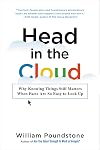
The author produced and analyzed internet surveys to reveal connections between knowledge (education) and, to my mind, ethics and morality. This aligns wit my personal philosophy that promoting education and increasing access to, especially higher, education betters society. Much is made here of income, a natural scale of success and life and the observation that learning causes higher brain function which leads to higher income. The Dunning–Kruger effect, a cognitive bias in which people show more with limited competence in a particular domain overestimate their abilities, is oft referred to. Other biases in popular knowledge explored include Churchillian Drift, coined by British writer Nigel Rees, which describes the widespread misattribution of quotes by obscure figures to more famous figures, such as Winston Churchill. Also covered is the "Google effect," or digital amnesia, the psychological phenomenon where people tend to forget information they know they can easily find again online through a search engine.
For me, the most profound insight here is how obtaining, maintaining, and developing an education secures commendable morality through such correlations as:
For me, the most profound insight here is how obtaining, maintaining, and developing an education secures commendable morality through such correlations as:
Ignorance…: Not being able to find Nebraska on a mapshow less
Correlates with…: Refusal to vaccinate children for measles, mumps, and rubella
Ignorance…: Thinking the United States has more people than India
Correlates with…: Refusal to eat genetically modified foods
Ignorance…: Thinking shrimp is kosher
Correlates with…: Objecting to reusable bags in supermarkets
Ignorance…: Not knowing which way to turn a screw to loosen it
Correlates with…: Refusing to buy a $100 lightbulb that would save $300
Ignorance…: Not knowing what kind of creature says “Nevermore” in a famous Edgar Allan Poe poem
Correlates with…: Being willing to throw your pet off a cliff for $1 million
Another question asked,
Would you push a button that made you a billionaire but killed a random stranger? No one else would know you were responsible for the death, and you could not be charged with a crime.
Nearly one in five Americans said they’d push that button. Those who scored low on a general-knowledge quiz were more likely to push the button, and yes answers were almost twice as common (36 percent) among those who couldn’t name the year of the 9/11 World Trade Center attacks.
...We are given digital tools that enable headfirst dives into deep pools of interest while excluding everything else. The promise is that “everything else” will always be in the cloud, available on demand. Lost in this seductive pitch is that being well informed is about context as much as it is about factoids. It is the overview that permits the assessment of the particular, that offers all-important insight into what we don’t know.
A broad and lifelong education is not just a means to achieving wealth and health (though it has a lot to do with that). The act of learning shapes our intuitions and imaginations. Known facts are the shared points of reference that connect individuals, cultures, and ideologies. They are the basis of small talk, opinions, and dreams; they make us wiser as citizens and supply the underrated gift of humility—for only the knowledgeable can appreciate how much they don’t know.
The one thing you can’t Google is what you ought to be looking up.
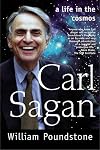
Sagan is my least favourite thinker for behind his smiling face and potent intellect there hid a womanizing wife abuser who disinherited some of his children, was estranged from his children, stole his best friend’s fiancé, held grudges, and was a self-centered, egotistical, high maintenance husband and father. I wish everyone would look behind the pretty memes with their Saganisms and see the psychologically abusive personality lurking behind. Poundstone’s book is filled with examples show more of Sagan’s abusive, caustic, abrasive personality with the best comment coming from Lynn Margulis who described her marriage to Sagan as “a torture chamber shared with children.” show less
Head in the Cloud: Why Knowing Things Still Matters When Facts Are So Easy to Look Up by William Poundstone
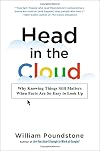
Why should I learn anything when I can just look it up on Google? That's the question this book attempts to answer.
Many areas of knowledge correlate with the quality of our lives, including areas like health, wealth and happiness. The author is not suggesting that everyone should be smart enough to appear on a TV show like "Jeopardy." It's totally fine if a person's knowledge is "a mile wide and an inch deep." The author found strong correlations between income and scores on general show more knowledge quizzes (even if they are multiple choice). It's possible that learning improves cognitive abilities that are useful almost anywhere, including in a career.
How bad is the ignorance of the average American? Less that 10 percent of Americans don't know what country New Mexico is in. About the same percentage of younger Americans can find Afghanistan on a map, according to a 2006 National Geographic poll. More than half could not find Delaware on a map.
People who don't know which city has an airport called LaGuardia correlates with thinking that there are at least twice as many Asians in America than there actually are. Not knowing that the Sun is bigger than Earth correlates with supporting bakers who refuse to make wedding cakes for same-sex couples. Thinking that America has more people has more people than India correlates with refusing to eat genetically modified food. Not knowing how many US Senators there are, or thinking that early humans hunted dinosaurs, correlates with refusing to vaccinate children for measles, mumps and rubella.
According to a 2015 report from the Educational Testing Service (the people behind the SAT's), more than half of Millennials don't know the poison that killed Socrates; they can't name the Virginia home of Thomas Jefferson; they don't know who recorded "All Shook Up" and "Heartbreak Hotel"; they don't know who (in popular myth) designed and sewed the first American flag; they can't name the secret project that built the first atomic bomb; they can't name the largest ocean on Earth, the longest river in South America or the city whose airport is Heathrow.
Wow (and not in a good way). These people are going to be running America in the near future? This is a very disheartening book, and is extremely highly recommended. show less
Many areas of knowledge correlate with the quality of our lives, including areas like health, wealth and happiness. The author is not suggesting that everyone should be smart enough to appear on a TV show like "Jeopardy." It's totally fine if a person's knowledge is "a mile wide and an inch deep." The author found strong correlations between income and scores on general show more knowledge quizzes (even if they are multiple choice). It's possible that learning improves cognitive abilities that are useful almost anywhere, including in a career.
How bad is the ignorance of the average American? Less that 10 percent of Americans don't know what country New Mexico is in. About the same percentage of younger Americans can find Afghanistan on a map, according to a 2006 National Geographic poll. More than half could not find Delaware on a map.
People who don't know which city has an airport called LaGuardia correlates with thinking that there are at least twice as many Asians in America than there actually are. Not knowing that the Sun is bigger than Earth correlates with supporting bakers who refuse to make wedding cakes for same-sex couples. Thinking that America has more people has more people than India correlates with refusing to eat genetically modified food. Not knowing how many US Senators there are, or thinking that early humans hunted dinosaurs, correlates with refusing to vaccinate children for measles, mumps and rubella.
According to a 2015 report from the Educational Testing Service (the people behind the SAT's), more than half of Millennials don't know the poison that killed Socrates; they can't name the Virginia home of Thomas Jefferson; they don't know who recorded "All Shook Up" and "Heartbreak Hotel"; they don't know who (in popular myth) designed and sewed the first American flag; they can't name the secret project that built the first atomic bomb; they can't name the largest ocean on Earth, the longest river in South America or the city whose airport is Heathrow.
Wow (and not in a good way). These people are going to be running America in the near future? This is a very disheartening book, and is extremely highly recommended. show less
This is Carl Sagan: astronomer, planetary scientist, writer, political activist, popularizer of science for the public, and the driving force that led lots of 80s kids, including me, to decide that astronomy looked so awesome they wanted to do it, too. (Me, I never got beyond a bachelor's degree and a job as scientific support staff, but I'm not blaming Sagan for that. Well, OK, maybe I am, but I forgive him.)
This biography covers both Sagan's personal and professional life, but the emphasis show more is definitely on the latter, making it a pretty good read for those who are interested in the idea of searching for life in the solar system and beyond. Among other things, it features a very detailed description of the 1970s Viking mission to Mars and the complicated tests it used to attempt to detect life in the soil. (Although it wasn't until 2008, well after the book's publication, that the strange and inconsistent results from those tests were finally properly explained.)
Sagan was something of a controversial figure, and Poundstone does a very good job of dealing with that in an even-handed way. He certainly makes no attempt to whitewash the man. The character flaws that people who knew him agreed on are presented pretty frankly, but his positive qualities are also very much acknowledged and respected. And where there was disagreement -- and there was a lot of disagreement -- both his critics and his admirers are allowed to offer their own perspectives. The result is a portrait of a very human guy.
My one complaint is that the book is a little choppy, being divided up into short -- usually 1-3 page -- segments that sometimes follow on naturally from one to another and sometimes don't. I sort of get the impression that the author couldn't be bothered coming up with any decent segues. Definitely worth reading, though, for those of us on whom Sagan had an impact. You know who you are. show less
This biography covers both Sagan's personal and professional life, but the emphasis show more is definitely on the latter, making it a pretty good read for those who are interested in the idea of searching for life in the solar system and beyond. Among other things, it features a very detailed description of the 1970s Viking mission to Mars and the complicated tests it used to attempt to detect life in the soil. (Although it wasn't until 2008, well after the book's publication, that the strange and inconsistent results from those tests were finally properly explained.)
Sagan was something of a controversial figure, and Poundstone does a very good job of dealing with that in an even-handed way. He certainly makes no attempt to whitewash the man. The character flaws that people who knew him agreed on are presented pretty frankly, but his positive qualities are also very much acknowledged and respected. And where there was disagreement -- and there was a lot of disagreement -- both his critics and his admirers are allowed to offer their own perspectives. The result is a portrait of a very human guy.
My one complaint is that the book is a little choppy, being divided up into short -- usually 1-3 page -- segments that sometimes follow on naturally from one to another and sometimes don't. I sort of get the impression that the author couldn't be bothered coming up with any decent segues. Definitely worth reading, though, for those of us on whom Sagan had an impact. You know who you are. show less
Lists
Awards


You May Also Like


Associated Authors
Statistics
- Works
- 28
- Members
- 6,006
- Popularity
- #4,099
- Rating
- 3.8
- Reviews
- 72
- ISBNs
- 139
- Languages
- 10
- Favorited
- 13
