
Williamson Murray (1941–2023)
Author of A War To Be Won: Fighting the Second World War
About the Author
Williamson Murray is an American historian and author. He served in the United States Air Force, taught at a variety of universities, worked as a consultant, and has authored numerous works on history and strategic studies, the most recent being the highly acclaimed: A Savage War: A Military show more History of the Civil War (Princeton University Press). show less
Image credit: Williamson Murray [credit: Hoover Institution]
Series
Works by Williamson Murray
The Past as Prologue: The Importance of History to the Military Profession (2002) — Editor — 80 copies
Brassey's Mershon American Defense Annual 1996-1997: Current Issues and the Asian Challenge (American Defense Annual) (1995) 9 copies
Conflicting Currents: Japan and the United States in the Pacific (Praeger Security International) (2009) 4 copies
Strategy for Chaos: Revolutions in Military Affairs and the Evidence of History (Strategy and History) (2004) 1 copy
Ruler, nation, war - the formation of the strategy (2007) ISBN: 4120038866 [Japanese Import] (2007) 1 copy
Inside Hitler's High Command 1 copy
Associated Works
What If? The World's Foremost Military Historians Imagine What Might Have Been (1999) — Contributor — 1,939 copies, 27 reviews
What If? 2: Eminent Historians Imagine What Might Have Been (2001) — Contributor — 1,089 copies, 11 reviews
MHQ: The Quarterly Journal of Military History — Spring 1996 (1996) — Author "Did Strategic Bombing Work?" and "Tactical Exercises: The First Night" — 29 copies
MHQ: The Quarterly Journal of Military History — Spring 1995 (1995) — Author "Armageddon Revisited" — 23 copies
MHQ: The Quarterly Journal of Military History — Spring 1992 (1992) — Author "Barbarossa" — 22 copies
MHQ: The Quarterly Journal of Military History — Summer 1989 (1989) — Author "What Took the North So Long" and "Strategic View: Thueydides on Strategy" — 20 copies
MHQ: The Quarterly Journal of Military History — Autumn 1989 (1989) — Author "Hitler's Uncontained Revolution" and "The Strategic View: Napoleon's Flawed Legacy" — 18 copies
MHQ: The Quarterly Journal of Military History — Summer 1990 (1990) — Author "The Battle of Britain: How Did "The Few" Win?" — 18 copies
MHQ: The Quarterly Journal of Military History — Spring 1998 (1998) — Author "What a Taxi Driver Wrought" — 17 copies
MHQ: The Quarterly Journal of Military History — Spring 1991 (1991) — Author "In Review: The Athenian Churchill" — 16 copies
Alexanders langes Leben, Stalins früher Tod und andere abwegige Geschichten. Erzählungen und Berichte aus Parallelwelten. (1999) — Contributor — 15 copies
MHQ: The Quarterly Journal of Military History — Autumn 2008 (2008) — Author "In Review: To the Threshold of Power, 1922/33" — 14 copies
MHQ: The Quarterly Journal of Military History — Spring 1997 (1997) — Author "Dien Bien Phu" and "Strategic View: There Goes Brussels . . ." — 14 copies
MHQ: The Quarterly Journal of Military History — Winter 1993 (1992) — Author "The Strategic View: Misreading Mahan" — 14 copies
MHQ: The Quarterly Journal of Military History — Spring 1990 (1990) — Author "The Strategic View: Dismantling Bismark" — 14 copies
MHQ: The Quarterly Journal of Military History — Autumn 1997 (1997) — Author "The Gulf War as History" — 13 copies
MHQ: The Quarterly Journal of Military History — Spring 2006 (2006) — Author "In Review: Armageddon: The Battle for Germany, 1944-1945" — 12 copies
MHQ: The Quarterly Journal of Military History — Autumn 1990 (1990) — Author "The Strategic View: The Wehrmacht's Wishful Thinking" — 12 copies
MHQ: The Quarterly Journal of Military History — Summer 2006 (2006) — Author "In Praise of Sam Grant" — 11 copies, 1 review
MHQ: The Quarterly Journal of Military History — Spring 2003 (2003) — Author "Needless D-Day Slaughter" — 10 copies
MHQ: The Quarterly Journal of Military History — Spring 2007 (2007) — Author "In Review: Absolute Destruction" — 10 copies
MHQ: The Quarterly Journal of Military History — Summer 2003 (2003) — Author "In Review: An Army at Dawn" — 10 copies
MHQ: The Quarterly Journal of Military History — Spring 2002 (2002) — Author "Ultra: Misunderstood Allied Secret Weapon" — 9 copies
MHQ: The Quarterly Journal of Military History — Autumn 2000 (2000) — Author "A World in the Balance" — 9 copies
MHQ: The Quarterly Journal of Military History — Winter 2002 (2001) — Author "Churchill's Lonely Campaign" — 8 copies
MHQ: The Quarterly Journal of Military History — Summer 2004 (2004) — Author "Flawed Triumph" — 7 copies
MHQ: The Quarterly Journal of Military History — Autumn 2013 (2013) — Co-author "Conquer or Die!" — 4 copies
MHQ: The Quarterly Journal of Military History — Summer 2014 (2014) — Author "Who Lost World War II?" — 4 copies
MHQ: The Quarterly Journal of Military History — Spring 2015 (2015) — Author "Flawed From the Start" — 3 copies
MHQ: The Quarterly Journal of Military History — Winter 2016 (2015) — Author "Israel's Closest Call", some editions — 2 copies
Tagged
Common Knowledge
- Canonical name
- Murray, Williamson
- Birthdate
- 1941-11-23
- Date of death
- 2023-08-01
- Gender
- male
- Education
- Yale University
- Occupations
- military historian
professor emeritus (History) - Organizations
- Ohio State University
Air War College
United States Military Academy
Naval War College
United States Air Force - Nationality
- USA
- Birthplace
- New York, New York, USA
- Place of death
- Fairfax, Virginia, USA
- Associated Place (for map)
- USA
Members
Reviews

The book analyzes in some detail the effectiveness of the entire German Military, which includes mainly the Luftwaffe and the Heer. The author did not discuss the Kriegsmarine much at all. That being said, the majority of the book focuses on the Luftwaffe, and their overall strategy, which the author claims (I think rightly) that the main Luftwaffe strategy was strategic in character, and he makes a good argument that tactical bombing only became important to the Luftwaffe during the Spanish show more Civil War. In fact, when WWII started, the Luftwaffe had very few tactical bombers, as most of their bombers could be considered short range Strategic bombers. The author only focuses a couple of chapters on the Heer, and mostly he agrees that the Germans were absolutely head and shoulders above anyone else in terms of operational strategy and tactics. He especially focuses on the extensive reports that the Heer wrote after the end of the Polish campaign as the Heer tried to fix the many glaring faults that popped up during the campaign. Needless to the say, the Heer was then that much more effective during the next campaigns. Where the author excoriates the Germans was on their lack of a coherent strategic strategy, which only makes sense if one realizes that the Germans were holding out hope that the Allies would NOT declare war on the Germans when they invaded Poland. When France and Great Britain did declare war on the Germans, every decision from then on was a quick decision, and not planned out in depth. Overall, this is an excellent book, and the author backs up his analysis with tons of data and evidence, much of it found in the original German archives. Highly, highly recommended!! show less

“Moment of Battle” is a tour de force of military history. Covering 2500 years of history, it singles out 20 major battles that the authors consider to have most significantly changed the world. It offers a useful corrective to a bizarre and naïve perspective voiced by US defense analysts in the 1990s, that the US military was about to create capabilities that would leave it unchallenged for the forseeable future. After two lost wars, a crippled economy, and a failing infrastructure, show more such a view can be seen as yet the latest example of the hubris of many a previous empire.
Each of the 20 battles is examined in terms of its historical backdrop, the goals of the warring parties, the military tactics, the factors that determined the outcome, and the lasting significance. For many of the battles, the placement and movement of troops are illustrated with diagrams that (despite their simplicity) usefully supplement the text.
The book begins with “Marathon”, the astonishing victory of Athens against the might of the Persian Empire, a battle with great consequence for the historical legacy of democratic traditions and ancient Greek thought. Next comes “Gaugamela”, key to Alexander the Great’s establishment of empire, which in turn set the stage for the later spread of Christianity among Greek- influenced Jews. Another early chapter focuses on the Roman Empire’s failure to conquer the Germanic tribes, which prefigured the East- West divide of Europe that contributed in the 20th century to two world wars. Yet another momentous battle is that of Yarmuk (630 CE), in which the followers of Mohammed established an Arab – Islamic civilization that dominates northern Africa and Arab territories.
Likewise there is Francis Drake’s destruction of the Spanish Armada (1588), without which the English would likely have never been able to colonize North America. Yet another explored episode (represented by three battles) by the authors is the Annus Mirabilis (the “year of miracles”) of 1759, in which the British established supremacy over Canada and made inroads towards success in the West Indies and in India. A lasting consequence is that English is the dominant global language when it comes to trade and intellectual exchange, not to mention the lasting legacy of a democratic (and secular) India. Other battles explored are taken from the American Revolution, Napoleon’s defeat at Waterloo, the US Civil War, the first World War, World War II (represented in three battles). The choice of several of the battles reflects the authors’ American (US) perspective and particular expertise. Thus, there are no battles in South America, Africa, or Asia (outside of World War II).
Naturally, one can quarrel with particular choices of battles. For my part, I was surprised at the inclusion of Dien Bien Phu, which signaled the withdrawal of the French from Indochina. However, far more momentous, one would think, was the US debacle in Southeast Asia, the last attempt by Western powers to dominate in east Asia. However, understandably, neither the Tet Offensive nor the fall of Saigon constitutes a momentous battle in the sense that this book explores. An even more peculiar choice is the 2003 US attack on Baghdad, a battle arguably of no lasting significance in light of everything that has happened since. In an interview on Book TV, author James Lacey explained that they included the attack on Baghdad because they wanted some recent military action; he further argued that we can never predict what might turn out to be significant in the future. (The latter point undermines, rather than justifies, the authors’ choice to include it).
Lacey and Murray make no secret of their strong opinions on issues of controversy. In fact, they clearly enjoy presenting themselves as iconoclasts against the views of professional historians and other military analysts. Thus, in opposition to other historian’s views, they make statements like “nothing could be further from the truth” (p. 230 and once again on p. 265), and “the experts could not have been more wrong” (p 266). In a particular show of contempt, they assert “Only academics who have spent their entire lives sequestered in school and with scant knowledge of the real world could gin up such nonsense” (p 85). A prospective reader should be prepared to take such tendentious statements in stride.
I recommend this book for aficionados of military history – they will find much here to think about and most likely, much to argue over. This book also is ideal for readers who enjoy the “What Ifs” of counterfactual history – the key episodes which, had they come out differently, would have led to a very different sort of world today. show less
Each of the 20 battles is examined in terms of its historical backdrop, the goals of the warring parties, the military tactics, the factors that determined the outcome, and the lasting significance. For many of the battles, the placement and movement of troops are illustrated with diagrams that (despite their simplicity) usefully supplement the text.
The book begins with “Marathon”, the astonishing victory of Athens against the might of the Persian Empire, a battle with great consequence for the historical legacy of democratic traditions and ancient Greek thought. Next comes “Gaugamela”, key to Alexander the Great’s establishment of empire, which in turn set the stage for the later spread of Christianity among Greek- influenced Jews. Another early chapter focuses on the Roman Empire’s failure to conquer the Germanic tribes, which prefigured the East- West divide of Europe that contributed in the 20th century to two world wars. Yet another momentous battle is that of Yarmuk (630 CE), in which the followers of Mohammed established an Arab – Islamic civilization that dominates northern Africa and Arab territories.
Likewise there is Francis Drake’s destruction of the Spanish Armada (1588), without which the English would likely have never been able to colonize North America. Yet another explored episode (represented by three battles) by the authors is the Annus Mirabilis (the “year of miracles”) of 1759, in which the British established supremacy over Canada and made inroads towards success in the West Indies and in India. A lasting consequence is that English is the dominant global language when it comes to trade and intellectual exchange, not to mention the lasting legacy of a democratic (and secular) India. Other battles explored are taken from the American Revolution, Napoleon’s defeat at Waterloo, the US Civil War, the first World War, World War II (represented in three battles). The choice of several of the battles reflects the authors’ American (US) perspective and particular expertise. Thus, there are no battles in South America, Africa, or Asia (outside of World War II).
Naturally, one can quarrel with particular choices of battles. For my part, I was surprised at the inclusion of Dien Bien Phu, which signaled the withdrawal of the French from Indochina. However, far more momentous, one would think, was the US debacle in Southeast Asia, the last attempt by Western powers to dominate in east Asia. However, understandably, neither the Tet Offensive nor the fall of Saigon constitutes a momentous battle in the sense that this book explores. An even more peculiar choice is the 2003 US attack on Baghdad, a battle arguably of no lasting significance in light of everything that has happened since. In an interview on Book TV, author James Lacey explained that they included the attack on Baghdad because they wanted some recent military action; he further argued that we can never predict what might turn out to be significant in the future. (The latter point undermines, rather than justifies, the authors’ choice to include it).
Lacey and Murray make no secret of their strong opinions on issues of controversy. In fact, they clearly enjoy presenting themselves as iconoclasts against the views of professional historians and other military analysts. Thus, in opposition to other historian’s views, they make statements like “nothing could be further from the truth” (p. 230 and once again on p. 265), and “the experts could not have been more wrong” (p 266). In a particular show of contempt, they assert “Only academics who have spent their entire lives sequestered in school and with scant knowledge of the real world could gin up such nonsense” (p 85). A prospective reader should be prepared to take such tendentious statements in stride.
I recommend this book for aficionados of military history – they will find much here to think about and most likely, much to argue over. This book also is ideal for readers who enjoy the “What Ifs” of counterfactual history – the key episodes which, had they come out differently, would have led to a very different sort of world today. show less
“Moment of Battle” is a tour de force of military history. Covering 2500 years of history, it singles out 20 major battles that the authors consider to have most significantly changed the world. It offers a useful corrective to a bizarre and naïve perspective voiced by US defense analysts in the 1990s, that the US military was about to create capabilities that would leave it unchallenged for the forseeable future. After two lost wars, a crippled economy, and a failing infrastructure, show more such a view can be seen as yet the latest example of the hubris of many a previous empire.
Each of the 20 battles is examined in terms of its historical backdrop, the goals of the warring parties, the military tactics, the factors that determined the outcome, and the lasting significance. For many of the battles, the placement and movement of troops are illustrated with diagrams that (despite their simplicity) usefully supplement the text.
The book begins with “Marathon”, the astonishing victory of Athens against the might of the Persian Empire, a battle with great consequence for the historical legacy of democratic traditions and ancient Greek thought. Next comes “Gaugamela”, key to Alexander the Great’s establishment of empire, which in turn set the stage for the later spread of Christianity among Greek- influenced Jews. Another early chapter focuses on the Roman Empire’s failure to conquer the Germanic tribes, which prefigured the East- West divide of Europe that contributed in the 20th century to two world wars. Yet another momentous battle is that of Yarmuk (630 CE), in which the followers of Mohammed established an Arab – Islamic civilization that dominates northern Africa and Arab territories.
Likewise there is Francis Drake’s destruction of the Spanish Armada (1588), without which the English would likely have never been able to colonize North America. Yet another explored episode (represented by three battles) by the authors is the Annus Mirabilis (the “year of miracles”) of 1759, in which the British established supremacy over Canada and made inroads towards success in the West Indies and in India. A lasting consequence is that English is the dominant global language when it comes to trade and intellectual exchange, not to mention the lasting legacy of a democratic (and secular) India. Other battles explored are taken from the American Revolution, Napoleon’s defeat at Waterloo, the US Civil War, the first World War, World War II (represented in three battles). The choice of several of the battles reflects the authors’ American (US) perspective and particular expertise. Thus, there are no battles in South America, Africa, or Asia (outside of World War II).
Naturally, one can quarrel with particular choices of battles. For my part, I was surprised at the inclusion of Dien Bien Phu, which signaled the withdrawal of the French from Indochina. However, far more momentous, one would think, was the US debacle in Southeast Asia, the last attempt by Western powers to dominate in east Asia. However, understandably, neither the Tet Offensive nor the fall of Saigon constitutes a momentous battle in the sense that this book explores. An even more peculiar choice is the 2003 US attack on Baghdad, a battle arguably of no lasting significance in light of everything that has happened since. In an interview on Book TV, author James Lacey explained that they included the attack on Baghdad because they wanted some recent military action; he further argued that we can never predict what might turn out to be significant in the future. (The latter point undermines, rather than justifies, the authors’ choice to include it).
Lacey and Murray make no secret of their strong opinions on issues of controversy. In fact, they clearly enjoy presenting themselves as iconoclasts against the views of professional historians and other military analysts. Thus, in opposition to other historian’s views, they make statements like “nothing could be further from the truth” (p. 230 and once again on p. 265), and “the experts could not have been more wrong” (p 266). In a particular show of contempt, they assert “Only academics who have spent their entire lives sequestered in school and with scant knowledge of the real world could gin up such nonsense” (p 85). A prospective reader should be prepared to take such tendentious statements in stride.
I recommend this book for aficionados of military history – they will find much here to think about and most likely, much to argue over. This book also is ideal for readers who enjoy the “What Ifs” of counterfactual history – the key episodes which, had they come out differently, would have led to a very different sort of world today. show less
Each of the 20 battles is examined in terms of its historical backdrop, the goals of the warring parties, the military tactics, the factors that determined the outcome, and the lasting significance. For many of the battles, the placement and movement of troops are illustrated with diagrams that (despite their simplicity) usefully supplement the text.
The book begins with “Marathon”, the astonishing victory of Athens against the might of the Persian Empire, a battle with great consequence for the historical legacy of democratic traditions and ancient Greek thought. Next comes “Gaugamela”, key to Alexander the Great’s establishment of empire, which in turn set the stage for the later spread of Christianity among Greek- influenced Jews. Another early chapter focuses on the Roman Empire’s failure to conquer the Germanic tribes, which prefigured the East- West divide of Europe that contributed in the 20th century to two world wars. Yet another momentous battle is that of Yarmuk (630 CE), in which the followers of Mohammed established an Arab – Islamic civilization that dominates northern Africa and Arab territories.
Likewise there is Francis Drake’s destruction of the Spanish Armada (1588), without which the English would likely have never been able to colonize North America. Yet another explored episode (represented by three battles) by the authors is the Annus Mirabilis (the “year of miracles”) of 1759, in which the British established supremacy over Canada and made inroads towards success in the West Indies and in India. A lasting consequence is that English is the dominant global language when it comes to trade and intellectual exchange, not to mention the lasting legacy of a democratic (and secular) India. Other battles explored are taken from the American Revolution, Napoleon’s defeat at Waterloo, the US Civil War, the first World War, World War II (represented in three battles). The choice of several of the battles reflects the authors’ American (US) perspective and particular expertise. Thus, there are no battles in South America, Africa, or Asia (outside of World War II).
Naturally, one can quarrel with particular choices of battles. For my part, I was surprised at the inclusion of Dien Bien Phu, which signaled the withdrawal of the French from Indochina. However, far more momentous, one would think, was the US debacle in Southeast Asia, the last attempt by Western powers to dominate in east Asia. However, understandably, neither the Tet Offensive nor the fall of Saigon constitutes a momentous battle in the sense that this book explores. An even more peculiar choice is the 2003 US attack on Baghdad, a battle arguably of no lasting significance in light of everything that has happened since. In an interview on Book TV, author James Lacey explained that they included the attack on Baghdad because they wanted some recent military action; he further argued that we can never predict what might turn out to be significant in the future. (The latter point undermines, rather than justifies, the authors’ choice to include it).
Lacey and Murray make no secret of their strong opinions on issues of controversy. In fact, they clearly enjoy presenting themselves as iconoclasts against the views of professional historians and other military analysts. Thus, in opposition to other historian’s views, they make statements like “nothing could be further from the truth” (p. 230 and once again on p. 265), and “the experts could not have been more wrong” (p 266). In a particular show of contempt, they assert “Only academics who have spent their entire lives sequestered in school and with scant knowledge of the real world could gin up such nonsense” (p 85). A prospective reader should be prepared to take such tendentious statements in stride.
I recommend this book for aficionados of military history – they will find much here to think about and most likely, much to argue over. This book also is ideal for readers who enjoy the “What Ifs” of counterfactual history – the key episodes which, had they come out differently, would have led to a very different sort of world today. show less
 This review was written for LibraryThing Early Reviewers.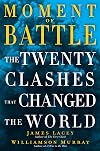
This is a disappointing book. The military analysts James Lacey and Willaimson Murray set out to write a corrective for all those stuffy academic historians who don't understand that battles are really important. While battles are important, wars and the peace made after them are more important, a fact that Lacey and Murray seem to forget.
We can argue endlessly over why the authors included some battles but not others. They don't include Cannae, Hannibal's greatest victory, because it show more wasn't decisive--a very sound point. Instead they discuss Zama, where Scipio Africanus defeated Hannibal and put an end to the Second Punic War. Yet the battles matter ONLY because the Romans were able to hold their confederation of allies together over many years and under intense pressure. Without that social/political/cultural/military ability, Zama never happens. But that diplomatic/political/social stuff isn't really important in the authors' eyes.
We see the same shortcoming in the discussion of Trafalgar. What allowed the British navy to maintain itself over the years of the continental blockade? What forms of public finance, of press-ganging, of leadership enabled Nelson to do what he did? Who were the poor men press-ganged into service and how did the navy transform them into the dauntless sailors who beat the Spanish? Yes, yes, the manuevers are so fascinating, if your view of history starts and stops with toy soldiers on a map.
The authors do a better job on the battle of Hastings, which surely deserves to be in a volume like this. But again, we find them narrowly concentrating on formations and tactics, rather than on the underlying "sinews of war." And they believe that the Normans faked retreats in order to lure the English out from behind their shield wall, although most historians doubt that the Normans could intentionally feint even once, let alone several times.
Finally, the authors' narrow view of history is fully revealed in the chapter on Objective Peach, the drive on Baghdad during the second Gulf War. Really? This is one of the twenty most decisive battles in the history of mankind?
I cannot recommend this book. show less
We can argue endlessly over why the authors included some battles but not others. They don't include Cannae, Hannibal's greatest victory, because it show more wasn't decisive--a very sound point. Instead they discuss Zama, where Scipio Africanus defeated Hannibal and put an end to the Second Punic War. Yet the battles matter ONLY because the Romans were able to hold their confederation of allies together over many years and under intense pressure. Without that social/political/cultural/military ability, Zama never happens. But that diplomatic/political/social stuff isn't really important in the authors' eyes.
We see the same shortcoming in the discussion of Trafalgar. What allowed the British navy to maintain itself over the years of the continental blockade? What forms of public finance, of press-ganging, of leadership enabled Nelson to do what he did? Who were the poor men press-ganged into service and how did the navy transform them into the dauntless sailors who beat the Spanish? Yes, yes, the manuevers are so fascinating, if your view of history starts and stops with toy soldiers on a map.
The authors do a better job on the battle of Hastings, which surely deserves to be in a volume like this. But again, we find them narrowly concentrating on formations and tactics, rather than on the underlying "sinews of war." And they believe that the Normans faked retreats in order to lure the English out from behind their shield wall, although most historians doubt that the Normans could intentionally feint even once, let alone several times.
Finally, the authors' narrow view of history is fully revealed in the chapter on Objective Peach, the drive on Baghdad during the second Gulf War. Really? This is one of the twenty most decisive battles in the history of mankind?
I cannot recommend this book. show less
This review was written for LibraryThing Early Reviewers.Awards


You May Also Like


Associated Authors
Statistics
- Works
- 39
- Also by
- 33
- Members
- 2,425
- Popularity
- #10,577
- Rating
- 3.6
- Reviews
- 25
- ISBNs
- 172
- Languages
- 6
- Favorited
- 1


