
David Haward Bain
Author of Empire Express: Building the First Transcontinental Railroad
About the Author
David Haward Bain is a teacher at Middlebury College and the Bread Loaf Writers' Conference, Bain lives in Orwell, Vermont
Works by David Haward Bain
Tagged
Common Knowledge
- Legal name
- Bain, David Haward
- Birthdate
- 1949-02-23
- Gender
- male
- Occupations
- historian
- Nationality
- USA
- Associated Place (for map)
- USA
Members
Reviews

No survey of the history of the USA is complete without a photograph of the "golden spike" ceremony that marked the meeting of the Union Pacific and Central Pacific construction teams in Utah in May 1869, establishing the first transcontinental railway route across North America. It's a great symbolic moment, easily represented as marking the country's post-Civil-War transition from a loosely-aligned coalition of quarrelsome postcolonial European settlements dotted around the place to a show more monolithic imperial power in its own right ("one nation under Canada...").
I've read quite a few accounts of the building of the transcontinental railroad, some of which focus on the physical and technical challenges of finding a route over the mountains and deserts, others on the shameless way the promoters of the line corrupted politicians and enriched themselves at the expense of taxpayers and small investors, or on the way that the construction projects forced the displacement of Native Americans and effectively ended their ability to live as free nomadic hunters.
Bain does all this (and more) in this detailed, 750-page monster, but he also adds a lot of new insights into what was really going on, through a mass of detailed original research into the business and private correspondence of some of the key players. In many cases official accounts and reports were doctored or mysteriously went missing in advance of court cases or congressional enquiries, but it's still possible to retrace something of the devious plots of the railway promoters from the letters people on the spot sent to friends and family members back home.
I was also interested by the summary of earlier schemes that opens the book: apparently the idea of a transcontinental connection is almost as old as railway technology itself, and significantly older than a formal US presence on the Pacific coast. The first really developed plan was put forward by Asa Whitney in 1845 — he knew nothing about railways and little about the country west of the Missouri River when he put his initial proposal before Congress, but he had sailed to China and back and knew all about the disadvantages of the sea route to Asia. He envisioned cheap Chinese goods (tea and silk, not sports shoes and smartphones) speeding across the continent at up to ten miles an hour, cutting weeks off the shipping time.
Squabbles between politicians from North and South about suitable routes and their start and end points, as well as doubts about the viability of the new technology, kept Whitney's scheme from getting anywhere. A new scheme developed by Theodore Judah (an actual engineer who knew something about building railways!) found more fertile ground in the new politics of the Civil War era — with the South out of the picture — and construction started in Sacramento and Omaha in 1863. Bain contrasts the different organisational styles of the Central Pacific — set up by a tightly-knit group of Sacramento tradesmen who had got rich selling shovels and jeans to gold miners — and the Union Pacific, a more typical Wall Street entity, whose directors were almost as happy to cut each others' throats as those of the competition. The UP vice-president, Dr T C Durant, in particular, was a notorious wild-card whose schemes for personal enrichment frequently slowed down the progress of the railway. He created the most famous business tool to come out of the project, the Crédit Mobilier, a limited liability company secretly owned by the UP directors, which contracted for the construction work at suitably inflated rates, and then sub-contracted it to other companies owned by relatives of the directors, keeping the vast construction profits (and the government subsidies that went with them) nicely off the books and within the family. Durant also did his best to introduce extra wiggles into the line, since they were being paid by the mile.
Both companies, of course, had to do a lot of lobbying in Washington to keep the legislature and executive on their side, and both kept full-time lobbyists at work there, making sure in advance of important votes that elected representatives were well-supplied with railroad stock, whether or not they had the cash to pay for it. Fatally, the UP's man in Washington also kept a little brown notebook, and this later gave Mark Twain some of the inspiration for his satire in The Gilded Age.
The actual construction is fascinating, too, especially on the Californian side, with the technically very difficult line over the Sierra Nevada to build, and the logistical nightmare of getting all their iron — especially rails, spikes, locomotive and cars — from East Coast manufacturers, shipped by sea round Cape Horn or in emergencies over the Isthmus. If you forgot to order something, it could be three months before new supplies arrived. And of course the CP dealt with labour shortages by importing Chinese workers, whilst the UP employed mostly Irishmen and the railhead was followed across the plains by a portable "Hell on wheels" town that kept them supplied with opportunities for drinking, gambling, whoring and shooting each other. Naturally, it all got even more interesting when both companies got to Utah and started to employ Mormon crews as well...
A fascinating story, altogether. Possibly more detail than really necessary, but engagingly written. A few more maps would have been nice, perhaps, but that's really all I could find to quibble with. show less
I've read quite a few accounts of the building of the transcontinental railroad, some of which focus on the physical and technical challenges of finding a route over the mountains and deserts, others on the shameless way the promoters of the line corrupted politicians and enriched themselves at the expense of taxpayers and small investors, or on the way that the construction projects forced the displacement of Native Americans and effectively ended their ability to live as free nomadic hunters.
Bain does all this (and more) in this detailed, 750-page monster, but he also adds a lot of new insights into what was really going on, through a mass of detailed original research into the business and private correspondence of some of the key players. In many cases official accounts and reports were doctored or mysteriously went missing in advance of court cases or congressional enquiries, but it's still possible to retrace something of the devious plots of the railway promoters from the letters people on the spot sent to friends and family members back home.
I was also interested by the summary of earlier schemes that opens the book: apparently the idea of a transcontinental connection is almost as old as railway technology itself, and significantly older than a formal US presence on the Pacific coast. The first really developed plan was put forward by Asa Whitney in 1845 — he knew nothing about railways and little about the country west of the Missouri River when he put his initial proposal before Congress, but he had sailed to China and back and knew all about the disadvantages of the sea route to Asia. He envisioned cheap Chinese goods (tea and silk, not sports shoes and smartphones) speeding across the continent at up to ten miles an hour, cutting weeks off the shipping time.
Squabbles between politicians from North and South about suitable routes and their start and end points, as well as doubts about the viability of the new technology, kept Whitney's scheme from getting anywhere. A new scheme developed by Theodore Judah (an actual engineer who knew something about building railways!) found more fertile ground in the new politics of the Civil War era — with the South out of the picture — and construction started in Sacramento and Omaha in 1863. Bain contrasts the different organisational styles of the Central Pacific — set up by a tightly-knit group of Sacramento tradesmen who had got rich selling shovels and jeans to gold miners — and the Union Pacific, a more typical Wall Street entity, whose directors were almost as happy to cut each others' throats as those of the competition. The UP vice-president, Dr T C Durant, in particular, was a notorious wild-card whose schemes for personal enrichment frequently slowed down the progress of the railway. He created the most famous business tool to come out of the project, the Crédit Mobilier, a limited liability company secretly owned by the UP directors, which contracted for the construction work at suitably inflated rates, and then sub-contracted it to other companies owned by relatives of the directors, keeping the vast construction profits (and the government subsidies that went with them) nicely off the books and within the family. Durant also did his best to introduce extra wiggles into the line, since they were being paid by the mile.
Both companies, of course, had to do a lot of lobbying in Washington to keep the legislature and executive on their side, and both kept full-time lobbyists at work there, making sure in advance of important votes that elected representatives were well-supplied with railroad stock, whether or not they had the cash to pay for it. Fatally, the UP's man in Washington also kept a little brown notebook, and this later gave Mark Twain some of the inspiration for his satire in The Gilded Age.
The actual construction is fascinating, too, especially on the Californian side, with the technically very difficult line over the Sierra Nevada to build, and the logistical nightmare of getting all their iron — especially rails, spikes, locomotive and cars — from East Coast manufacturers, shipped by sea round Cape Horn or in emergencies over the Isthmus. If you forgot to order something, it could be three months before new supplies arrived. And of course the CP dealt with labour shortages by importing Chinese workers, whilst the UP employed mostly Irishmen and the railhead was followed across the plains by a portable "Hell on wheels" town that kept them supplied with opportunities for drinking, gambling, whoring and shooting each other. Naturally, it all got even more interesting when both companies got to Utah and started to employ Mormon crews as well...
A fascinating story, altogether. Possibly more detail than really necessary, but engagingly written. A few more maps would have been nice, perhaps, but that's really all I could find to quibble with. show less
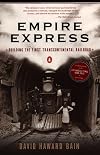
Bain used an extraordinary list of sources for his epic history of the birth of the transcontinental railroad. Everything from autobiographies, essays, letters, biographies, trial transcripts, historical pamphlets, pioneer atlases, private papers, railroad reports, manuscripts, government documents, and periodicals...just to name a few sources. Not quite doorstop heft, Empire Express is an impressive true life, detail-dense, historical adventure, just shy of 800 pages. It covers thirty years show more of savvy entrepreneurship and brilliant engineering. He describes how Robert Mills proposed something resembling a steam train in 1819 while Asa Whitney was a firm believer in the 2,400 mile railway. The end of the Civil War brought a hunger to connect the East with the wild western plains. The Rocky Mountains proved to be a formidable obstacle so military topographical engineers sent out expeditions to solve the problem. These were the days of gold rush frenzies. By 1842 imaginations fused with innovation and the iron rails began to span the country. Bain included details of a buffalo hunt gone awry and white men wanting to witness a fight between "the hostiles" as if it is was a farcical Broadway musical. [Sometimes history is just ridiculous.] There was even a first hand description of a scalping. [As an aside, who in their right mind would tan a scalp and then put it on display in the public library in the children's section?] show less

Over twenty-five years ago Bain decided he needed to take his family on a two month epic journey from Vermont to California. He previously written the very successful Empire Express, researching thirty years of American train history, and the endeavor had taken fourteen years of his life. What better way to thank his family for their patience than to take them on a cross-country journey? Using the first transcontinental railroad route as a guide, the family made their way from Orwell, show more Vermont to San Francisco, California.
This isn't any typical memoir about a family trip. Along the way Bain paints a vivid picture of the pioneers who went before him with mini biographies of the more famous characters like Mark Twain, Butch Cassidy and Willa Cather. He paints romantic images of the pioneers who traveled his same routes, staying in the very same towns. Bain supplies his readers with history of every region he and his family visit. Readers are apt to learn way more than they bargained for. For example, Wyoming is the Equality State because it was the first territory in the world to introduce legislation giving equal rights to women in December of 1869. Richard Francis Burton visited Chimney Rock in Nebraska. Bain revisits the Donner tragedy again and again.
The best parts were when Bain interacted with his family and shared their adventures. His family sounded wonderful. show less
This isn't any typical memoir about a family trip. Along the way Bain paints a vivid picture of the pioneers who went before him with mini biographies of the more famous characters like Mark Twain, Butch Cassidy and Willa Cather. He paints romantic images of the pioneers who traveled his same routes, staying in the very same towns. Bain supplies his readers with history of every region he and his family visit. Readers are apt to learn way more than they bargained for. For example, Wyoming is the Equality State because it was the first territory in the world to introduce legislation giving equal rights to women in December of 1869. Richard Francis Burton visited Chimney Rock in Nebraska. Bain revisits the Donner tragedy again and again.
The best parts were when Bain interacted with his family and shared their adventures. His family sounded wonderful. show less

Finally done - 6 months' reading, off and on. I'm glad I read it - I learned a lot - but I didn't particularly _enjoy_ reading it. I suspect that much of the author's primary source material was the transcripts for the fraud and corruption investigations that started very shortly after the triumphal connecting of the two lines - so that was a lot of his focus, and it's something I find utterly uninteresting. The actual building was fascinating, but every time he started to discuss the show more building he'd veer off into the financial and political shenanigans going on behind that section of the line. My overall impression is that the Transcontinental Railroad was built more or less by accident by greedy, venal men using it as a cash cow in so many ways (from simple theft of materials to altering the route to get more or higher subsidies from the federal government). The (few) visionaries who truly wanted the railroad built seemed to get turfed out pretty quickly (Whitney, Judah...). I did gain a lot of information about the Transcontinental Railroad - what I had before was vague images of the Golden Spike and some old photos of two trains standing nose to nose. That ceremony is described, but now I also have knowledge of the long, long road that got them there. If the Gilded Age and the financial and political shenanigans thereof are an interest of yours, this is the book you want to read. If you want to know about the railroad itself - the routes it took, the structures built to support it (from towns to snow sheds to bridges and tunnels)...well, there's information on that here too, but it's not the focus. A few more maps, showing some of the surveyed routes and how the final routes were changed, might have been interesting - there were some maps, but they tended to be more of the grand sweep than details. Glad I read it, won't reread. show less
Awards


You May Also Like


Statistics
- Works
- 8
- Members
- 938
- Popularity
- #27,379
- Rating
- 3.8
- Reviews
- 7
- ISBNs
- 18