
Byron Katie
Author of Loving What Is: Four Questions That Can Change Your Life
About the Author
Image credit: Photo courtesy of Hay House, Inc.
Works by Byron Katie
I Need Your Love - Is That True?: How to Stop Seeking Love, Approval, and Appreciation and Start Finding Them Instead (2005) 317 copies, 8 reviews
A Mind at Home with Itself: How Asking Four Questions Can Free Your Mind, Open Your Heart, and Turn Your World Around (2017) 80 copies
Your Inner Awakening: The Work of Byron Katie: Four Questions That Will Transform Your Life (2007) 20 copies, 1 review
The Work of Byron Katie: 35 Judge-Your-Neighbor Worksheets, 35 Self-Facilitation Worksheets (Byron Katie) (2004) 10 copies
A Thousand Names for Joy: A Life in Harmony with the Way Things Are [Abridged 5-CD Set] (2007) 2 copies
Kłamstwa o miłości. Jak przestać zabiegać o miłość, aprobatę i uznanie, aby je w końcu znaleźć (2025) 1 copy
Yeu thuc tai bo lai noi dau 1 copy
J'ai besoin que tu m'aimes : est-ce vrai ? - Ne plus chercher l'amour, mais le trouver... (2006) 1 copy, 1 review
THIS BODY, The Work Of Byron Katie, Set Of 4 Audio Cassettes (the work of byron katie, THE BODY) 1 copy
Houden van wat er is 1 copy
Ama a vida como ela é 1 copy
Associated Works
Tagged
Common Knowledge
- Canonical name
- Katie, Byron
- Legal name
- Mitchell, Byron Kathleen
- Birthdate
- 1942-12-06
- Gender
- female
- Occupations
- writer
speaker - Relationships
- Mitchell, Stephen (spouse)
- Short biography
- Byron Katie a fait une dépression sévère à la trentaine. Pendant presque dix ans elle sombra dans la dépression, la colère, la haine d'elle-même, obsédée par des idées suicidaires. Puis un matin en février 1986, du plus profond de son désespoir, elle vécut une expérience de réalisation qui transforma sa vie. Elle est la fondatrice du Travail {The Work), reposant sur une démarche de questionnement personnel ayant pour objet d’apprendre aux gens à mettre fin à leur propre souffrance.
Ouvrages de Byron Katie : Aimer ce qui est - Vers la fin de la souffrance, avec Stephen Mitchell (Ed. Ariane) ; J'ai besoin que tu m'aimes : est-ce vrai ? - Ne plus chercher l'amour, mais le trouver…, avec Michael Katz (Ed. Guy Trédaniel) ; Investiguez vos pensées, changez le monde… (Ed. Guy Trédaniel). Et pour les enfants, Tigrou-Tigrou, Est-Ce Bien Vrai ? avec des illustrations de Hans Wilhelm.
Voir aussi la revue 3e millénaire, n°53, 75 & 96.
Site internet : www.thework.com/.
Voir aussi pour les activités en France : www.thework.over-blog.com/ - Nationality
- USA
- Birthplace
- Breckenridge, Texas, USA
- Places of residence
- Needles, California, USA
Fresno, California, USA
Barstow, California, USA - Associated Place (for map)
- California, USA
Members
Reviews
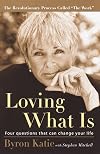
Contains triggers for victim-blaming, rape apologia, child sexual abuse, misogyny, gaslighting and others I'm forgetting.
This is a "spiritual" book that I'd be willing to bet was brought on by a severe mental health episode. It is absolutely disgusting. I could barely get past the introduction, when Byron Katie calls someone "sweetheart," and the full sentence is "Do you think you covered it all, sweetheart?" after a woman poured out her utter hatred of her husband for a few paragraphs of show more speech. But no, the book continues. Byron Katie...makes me think...why is her last name Katie? Especially if everyone calls her Katie? Why not just flip the names around and legally have it changed by a judge? This bothered me a lot more than it should.
Bryon Katie is celebrated as having launched this whole spiritual movement, and is compared often to mystics who are of different ethnicities than her, and of wildly different cultures than 2000's America as experienced by a white woman, is. These mystics came up with their worldviews and spirituality -way- before she did, and she's modifying some of their work and calling it her own. This made me uncomfortable. She's not brilliant. She clearly enjoys being in a high position of power and victim-blaming others for horrific things that happened to them. She doesn't want anyone to change, except when she's dictating it. This reminded me a -lot- of a cult I got out of a few years ago. Parts of it also reminded me of a therapy that is used on some people, "I have this thought of whatever. Is my thought true?" This practice is essentially your therapist hitting you over the head with a "live love laugh" sign. Not too far of aspects of what Byron Katie is claiming she came up with.
She doesn't help people take active steps to change their lives, like asking the woman who hated her husband so much what the marriage contained for her anymore. She doesn't ask anyone questions about their situation that could guide them to make a concrete decision. Instead, she gaslights them, blames them, and convinces them to stay in annoying, bad, or horrifying situations because she said so. It's in the title of the book.
I was convinced the first time I read this that these thoughts were brought on by a severe mental health episode. I am absolutely convinced now of it. The book's synopsis and Katie's perspective say it: that she was depressed, enraged, and not leaving her house for months. Suddenly, one day, she laughed and was filled with joy, and came up with this.
That sounds like she might be bipolar. I'm bipolar. She desperately needed a functioning medication regimen, like I have had since I was fourteen. She desperately needs therapy from someone certified, so she can try to rein in some of her wilder ideas. She needs to read the histories of saints and mystics so she can realize her ideas aren't original. She needs to listen to people who have been hurt to realize her own worldviews are absolutely horrifying. She needs to work through whatever "demons" she's clearly "overcome" to "become more spiritual" because she clearly has not. She doesn't say that last sentence in the book, but I know the type of people who do. They -do not- like being criticized. They want absolute adoration and for everything to happen immediately. And they are often in positions of power: teachers; therapists; nurses.
Katie is not a spiritual leader; she's an insanely creepy motivational speaker with serious delusions of grandeur. I hope she gets the mental health services she needs, and changes her worldviews on sexual abuse victims and everyone else she was so condescending, insulting, and syrupy to. Ugh. show less
This is a "spiritual" book that I'd be willing to bet was brought on by a severe mental health episode. It is absolutely disgusting. I could barely get past the introduction, when Byron Katie calls someone "sweetheart," and the full sentence is "Do you think you covered it all, sweetheart?" after a woman poured out her utter hatred of her husband for a few paragraphs of show more speech. But no, the book continues. Byron Katie...makes me think...why is her last name Katie? Especially if everyone calls her Katie? Why not just flip the names around and legally have it changed by a judge? This bothered me a lot more than it should.
Bryon Katie is celebrated as having launched this whole spiritual movement, and is compared often to mystics who are of different ethnicities than her, and of wildly different cultures than 2000's America as experienced by a white woman, is. These mystics came up with their worldviews and spirituality -way- before she did, and she's modifying some of their work and calling it her own. This made me uncomfortable. She's not brilliant. She clearly enjoys being in a high position of power and victim-blaming others for horrific things that happened to them. She doesn't want anyone to change, except when she's dictating it. This reminded me a -lot- of a cult I got out of a few years ago. Parts of it also reminded me of a therapy that is used on some people, "I have this thought of whatever. Is my thought true?" This practice is essentially your therapist hitting you over the head with a "live love laugh" sign. Not too far of aspects of what Byron Katie is claiming she came up with.
She doesn't help people take active steps to change their lives, like asking the woman who hated her husband so much what the marriage contained for her anymore. She doesn't ask anyone questions about their situation that could guide them to make a concrete decision. Instead, she gaslights them, blames them, and convinces them to stay in annoying, bad, or horrifying situations because she said so. It's in the title of the book.
I was convinced the first time I read this that these thoughts were brought on by a severe mental health episode. I am absolutely convinced now of it. The book's synopsis and Katie's perspective say it: that she was depressed, enraged, and not leaving her house for months. Suddenly, one day, she laughed and was filled with joy, and came up with this.
That sounds like she might be bipolar. I'm bipolar. She desperately needed a functioning medication regimen, like I have had since I was fourteen. She desperately needs therapy from someone certified, so she can try to rein in some of her wilder ideas. She needs to read the histories of saints and mystics so she can realize her ideas aren't original. She needs to listen to people who have been hurt to realize her own worldviews are absolutely horrifying. She needs to work through whatever "demons" she's clearly "overcome" to "become more spiritual" because she clearly has not. She doesn't say that last sentence in the book, but I know the type of people who do. They -do not- like being criticized. They want absolute adoration and for everything to happen immediately. And they are often in positions of power: teachers; therapists; nurses.
Katie is not a spiritual leader; she's an insanely creepy motivational speaker with serious delusions of grandeur. I hope she gets the mental health services she needs, and changes her worldviews on sexual abuse victims and everyone else she was so condescending, insulting, and syrupy to. Ugh. show less
I Need Your Love - Is That True?: How to Stop Seeking Love, Approval, and Appreciation and Start Finding Them Instead by Byron Katie
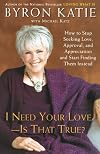
I've become so cynical of self help books in the past few years that I almost didn't pick this one up, despite countless people recommending it to me. I'm so glad I was able to overcome my skepticism of the industry as a whole to grab "I Need Your Love - Is That True?" As a perpetual people pleaser, I didn't just read this book; I devoured it!
Full disclosure: a few years ago, I learned a version of "The Work" from another coach. I see now that what she was teaching was a diluted and much show more less impactful version of Byron Katie's inquiry.
Reading this book felt like I was having a heart-to-heart conversation with a wise friend who isn't afraid to ask some very tough questions, but in a loving and understanding manner. Katie doesn't tiptoe around the uncomfortable realities of seeking validation and love. Instead, she asks: "Do you really need someone else's approval to feel worthy?" Spoiler alert: The journey to answering that question is transformative.
I love that this book didn't just preach about compassion; it showed me how to be truly compassionate with myself, which, in turn, transforms my interactions with others. It's one thing to be told to practice self-love and acceptance, but it's another to be handed the tools to do so effectively and to see immediate, applicable changes in your life. This book does just that, making it an invaluable companion for anyone on the path to self-discovery. show less
Full disclosure: a few years ago, I learned a version of "The Work" from another coach. I see now that what she was teaching was a diluted and much show more less impactful version of Byron Katie's inquiry.
Reading this book felt like I was having a heart-to-heart conversation with a wise friend who isn't afraid to ask some very tough questions, but in a loving and understanding manner. Katie doesn't tiptoe around the uncomfortable realities of seeking validation and love. Instead, she asks: "Do you really need someone else's approval to feel worthy?" Spoiler alert: The journey to answering that question is transformative.
I love that this book didn't just preach about compassion; it showed me how to be truly compassionate with myself, which, in turn, transforms my interactions with others. It's one thing to be told to practice self-love and acceptance, but it's another to be handed the tools to do so effectively and to see immediate, applicable changes in your life. This book does just that, making it an invaluable companion for anyone on the path to self-discovery. show less
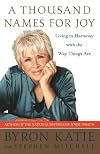
In her first two books, Byron Katie showed how suffering can be ended by questioning the stressful thoughts that create it, through a process of self-inquiry she calls The Work. Now, in A Thousand Names for Joy, she encourages us to discover the freedom that lives on the other side of inquiry.Stephen Mitchell—the renowned translator of the Tao Te Ching—selected provocative excerpts from that ancient text as a stimulus for Katie to talk about the most essential issues that face us all: show more life and death, good and evil, love, work, and fulfillment. The result is a book that allows the timeless insights of the Tao Te Ching to resonate anew for us today, while offering a vivid and illuminating glimpse into the life of someone who for twenty years—ever since she “woke up to reality” one morning in 1986—has been living what Lao-tzu wrote more than 2,500 years ago.Katie’s profound, lighthearted wisdom is not theoretical; it is absolutely authentic. That is what makes this book so compelling. It’s a portrait of a woman who is imperturbably joyous, whether she is dancing with her infant granddaughter or finds that her house has been emptied out by burglars, whether she stands before a man about to kill her or embarks on the adventure of walking to the kitchen, whether she learns that she is going blind, flunks a “How Good a Lover Are You?” test, or is diagnosed with cancer. With her stories of total ease in all circumstances, Katie does more than describe the awakened mind; she lets you see it, feel it, in action. And she shows you how that mind is yours as well. show less
Byron Katie invites us to try out self-discovery. It introduces “The Work,” a simple meditative process noticing our thoughts.
This process works by writing out our thoughts and working through the ideas we wrote down, either through more writing or with another person familiar with the process. Note that the other person is someone we consent to go through the process, trust to support us, and who we truly know we are safe with.
The book presents the idea that we can use guided questions show more to better understand our beliefs and initial assumptions. While we might know intellectually that beliefs, thoughts, and assumptions are different from physical reality, it can help to slow down and look at more details.
When we slow down, the book gives us ideas for what we what our ideas might mean. This can help us to notice what our thoughts miss in our experiences. When we are stressed, our thoughts overfocus on certain details and forget others.
While listening, one might have certain reservations. It’s understandable to think that questioning our thoughts could lead to blaming ourselves for our own suffering.
When we accept that we're not to blame, we can seek our own understanding and our own innocence. This helps to notice our reactions to external events and notice the thoughts we have during our pain.
The audiobook is filled with recordings of real practical examples and real-life situations, making the concepts accessible and relatable. It doesn’t promise instant solutions but offers a pathway to understanding and accepting ‘what is.’
If we’re constantly questioning our thoughts, could we end up denying our experiences? The discussion in the book isn’t encouraging us to look away from reality; instead, we slow down to note every detail of our reality. Then we can see the difference of our the thoughts and beliefs that cause suffering.
We can accept ‘what is’ real for ourselves–and not anyone else. It's also not encouraging other people to override or push us into their beliefs. We have to know what we think of ourselves.
The audiobook also includes dialogues from people who have done “The Work” with Katie at public events—people dealing with cancer diagnoses, job loss, relationship problems, and other real-world issues.
Those of us who are activists might worry that “The Work” could stifle efforts for social change. Could this discourage us from working towards societal change? By promoting self-awareness and personal growth, this can empower individuals to effect change in their lives and, by extension, in society.
We look for possibilities and options that we didn't think of. How could we do more than we're doing? When we learn how to spend less energy on the stress of our world's problems, we can make real changes.
While it’s true that “The Work” can be practiced by anyone, it’s important for individuals to approach it responsibly and consider seeking professional guidance if needed. Including other methods that might work better for your situation
“The Work” itself involves four questions and a turnaround, which is a way of experiencing the opposite of what you believe. It doesn't mean that this opposite is true, it's just looking at if part of it might be true. Our thoughts can be all or nothing, and this is a way of seeing if there's a middle ground. And it's okay if you don't find middle ground! You just are looking to see possible new perspectives and insights into our own minds.
I would recommend it to anyone seeking to understand themselves better. Only you can know “what is” for you. show less
This process works by writing out our thoughts and working through the ideas we wrote down, either through more writing or with another person familiar with the process. Note that the other person is someone we consent to go through the process, trust to support us, and who we truly know we are safe with.
The book presents the idea that we can use guided questions show more to better understand our beliefs and initial assumptions. While we might know intellectually that beliefs, thoughts, and assumptions are different from physical reality, it can help to slow down and look at more details.
When we slow down, the book gives us ideas for what we what our ideas might mean. This can help us to notice what our thoughts miss in our experiences. When we are stressed, our thoughts overfocus on certain details and forget others.
While listening, one might have certain reservations. It’s understandable to think that questioning our thoughts could lead to blaming ourselves for our own suffering.
When we accept that we're not to blame, we can seek our own understanding and our own innocence. This helps to notice our reactions to external events and notice the thoughts we have during our pain.
The audiobook is filled with recordings of real practical examples and real-life situations, making the concepts accessible and relatable. It doesn’t promise instant solutions but offers a pathway to understanding and accepting ‘what is.’
If we’re constantly questioning our thoughts, could we end up denying our experiences? The discussion in the book isn’t encouraging us to look away from reality; instead, we slow down to note every detail of our reality. Then we can see the difference of our the thoughts and beliefs that cause suffering.
We can accept ‘what is’ real for ourselves–and not anyone else. It's also not encouraging other people to override or push us into their beliefs. We have to know what we think of ourselves.
The audiobook also includes dialogues from people who have done “The Work” with Katie at public events—people dealing with cancer diagnoses, job loss, relationship problems, and other real-world issues.
Those of us who are activists might worry that “The Work” could stifle efforts for social change. Could this discourage us from working towards societal change? By promoting self-awareness and personal growth, this can empower individuals to effect change in their lives and, by extension, in society.
We look for possibilities and options that we didn't think of. How could we do more than we're doing? When we learn how to spend less energy on the stress of our world's problems, we can make real changes.
While it’s true that “The Work” can be practiced by anyone, it’s important for individuals to approach it responsibly and consider seeking professional guidance if needed. Including other methods that might work better for your situation
“The Work” itself involves four questions and a turnaround, which is a way of experiencing the opposite of what you believe. It doesn't mean that this opposite is true, it's just looking at if part of it might be true. Our thoughts can be all or nothing, and this is a way of seeing if there's a middle ground. And it's okay if you don't find middle ground! You just are looking to see possible new perspectives and insights into our own minds.
I would recommend it to anyone seeking to understand themselves better. Only you can know “what is” for you. show less
Lists
You May Also Like


Associated Authors
Statistics
- Works
- 60
- Also by
- 1
- Members
- 2,392
- Popularity
- #10,728
- Rating
- 3.9
- Reviews
- 46
- ISBNs
- 151
- Languages
- 13
- Favorited
- 4