

About the Author
Robert J. Lang has been an avid student of origami for over fifty years and is now recognized as one of the world's leading masters of the art. He is noted for designs of great detail and realism, and his repertoire includes some of the most complex origami designs ever created. His work combines show more aspects of the Western school of mathematical origami design with the Eastern emphasis upon line and form to yield designs that are at once distinctive, elegant, and challenging to fold, They have been shown in exhibitions in New York (Museum of Modern Art), Paris (Carrousel du Louvre), Salem (Peabody Essex Museum), San Diego (Mingei Museum of World Folk Art), and Kaga, Japan (Nippon Museum of Origami), among others. He is one of the pioneers of computational origami techniques, and has published widely on the theory and mathematics of folding. Dr. Lang was born in Ohio and raised in Atlanta, Georgia. Along the way to his current career as a fulltime origami artist and consultant, he worked as a physicist, engineer, and RD manager, during which time he authored or co-authored over 80 technical publications and 50 patents on semiconductor lasers, optics, and integrated optoelectronics. He was elected a Fellow of the Optical Society of America and served as Editor-in-Chief of the IEEE Journal of Quantum Electronics from 2007-2010. After switching his primary focus to origami, he authored or co-authored numerous technical articles on the mathematics of folding and on design techniques for folding in technological applications. In 2009, he received Caltech's Distinguished Alumni Award for his origami work, and in 2013 was elected a Fellow of the American Mathematical Society. Dr. Lang resides in Alamo, California. show less
Works by Robert J. Lang
The Complete Book of Origami: Step-by Step Instructions in Over 1000 Diagrams (Dover Origami Papercraft) (1989) 239 copies, 5 reviews
The Complete Book of Origami: Step-by-Step Instructions in Over 1000 Diagrams/37 Original Models (Dover Crafts: Origami & Papercrafts) (2023) 58 copies
Associated Works
Fabrigami: The Origami Art of Folding Cloth to Create Decorative and Useful Objects (2013) — Contributor — 24 copies, 1 review
Tagged
Common Knowledge
- Canonical name
- Lang, Robert J.
- Birthdate
- 1961-05-04
- Gender
- male
- Education
- California Institute of Technology (BS|Electrical Engineering)
Stanford University (MS|Electrical engineering ∙ 1983)
California Institute of Technology (PhD|Applied Physics) - Organizations
- Jet Propulsion Laboratory
- Nationality
- USA
- Birthplace
- Dayton, Ohio, USA
- Places of residence
- Atlanta, Georgia, USA
Alamo, California, USA - Associated Place (for map)
- USA
Members
Reviews
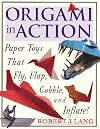
This is an amazing book. Every model does something: glide, flap, inflate, or otherwise move. It's an outstanding reference book and will provide hours of family entertainment if parental patience can stay the course. (Now make a butterfly that flaps! Now make one for me too! And a barking wolf! And a pecking woodpecker!)
For me, any origami book containing the balloon (also known as waterbomb) is a good one. There's also an inflatable rabbit directly based on it, and a further refinement to show more the rabbit pattern. More fun! The only action origami figure that I would have liked to see here and did not, was the jumping frog. But there is so much else, including a bassist who bows his instrument (start with a very big piece of paper!).
The directions are (so far, having tried about half a dozen of the "easy" and one of the "intermediate" models) pretty good. Sometimes towards the end they seem to try to put two or three folds into one step. This may be why our wagging dog did not wag, but the 4-year-old could easily and enthusiastically wag it himself so it was all good. I am definitely in the market for a copy of this book to delight our family. show less
For me, any origami book containing the balloon (also known as waterbomb) is a good one. There's also an inflatable rabbit directly based on it, and a further refinement to show more the rabbit pattern. More fun! The only action origami figure that I would have liked to see here and did not, was the jumping frog. But there is so much else, including a bassist who bows his instrument (start with a very big piece of paper!).
The directions are (so far, having tried about half a dozen of the "easy" and one of the "intermediate" models) pretty good. Sometimes towards the end they seem to try to put two or three folds into one step. This may be why our wagging dog did not wag, but the 4-year-old could easily and enthusiastically wag it himself so it was all good. I am definitely in the market for a copy of this book to delight our family. show less
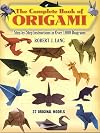
This is not a "complete book of origami" it is a handbook for advanced students. A complete book would include the classic bases and traditional models. This book contains only original models and these models are not easy. Lang issues several warnings at the beginning: you must read the instructions as well as look at the pictures; you must start at the beginning and work your way up to the harder models.
Lang warns the reader that he does not repeat detailed instructions. If he told you show more once he won't tell you again. Unless you are very skilled already, don't try any model until you have *mastered* all the previous models.
Lang adheres to the standard of using a single piece of paper for each model and not using any cuts or slits. But he uses several different shapes of paper. He gives ratios for rectangles such as 1:1.294 (8.5"x11) and and 1:2.360 (a dollar bill). But he doesn't give recommended sizes. Some of these models should be attempted with larger sheets than others but he gives no clue as to recommended sheet size.
Most of these models are three dimensional and will not fold flat without being crushed and destroyed. They are also more rounded and smooshed than traditional Japanese origami. Sometimes the instruction is just to pull on a part and "form new creases as necessary". Lang prefers the more "realistic" rounded shapes characteristic of Western origami to the sharper crisper patterns of Japanese models.
There is a mistake on page 12, in the Swan pattern. Illustrations 15 and 16 should be switched.
This is not a book for beginners or casual paper folders. This is a book for serious hobbyists who want to improve their skills. show less
Lang warns the reader that he does not repeat detailed instructions. If he told you show more once he won't tell you again. Unless you are very skilled already, don't try any model until you have *mastered* all the previous models.
Lang adheres to the standard of using a single piece of paper for each model and not using any cuts or slits. But he uses several different shapes of paper. He gives ratios for rectangles such as 1:1.294 (8.5"x11) and and 1:2.360 (a dollar bill). But he doesn't give recommended sizes. Some of these models should be attempted with larger sheets than others but he gives no clue as to recommended sheet size.
Most of these models are three dimensional and will not fold flat without being crushed and destroyed. They are also more rounded and smooshed than traditional Japanese origami. Sometimes the instruction is just to pull on a part and "form new creases as necessary". Lang prefers the more "realistic" rounded shapes characteristic of Western origami to the sharper crisper patterns of Japanese models.
There is a mistake on page 12, in the Swan pattern. Illustrations 15 and 16 should be switched.
This is not a book for beginners or casual paper folders. This is a book for serious hobbyists who want to improve their skills. show less

I spent hundreds of hours of my childhood folding the fish, crustaceans and other sea life of this book. The shark exhibited on the front cover is a particular favorite of mine: it's one of those models that pretty much folds itself, perfectly balanced and eminently satisfying when completed. Some of these models are really hard. There is a deep sea angler fish with a full set of teeth that I made once on a family road trip, and I was pretty excited about that. Some of these models I've show more never made successfully. The crabs and the lobster at the end may be just a bit beyond me, although I always tell myself that I just haven't found the right paper. I think if you're willing and able to go beyond commercial origami paper, make your own paper or figure out exactly what paper works for you in the folding of complex origami models, you would be able to make any of these models. Lang and Montroll are two of the giants of the origami world, and this collaborative effort is well worth the purchase price. I just noticed that Robert J. Lang has a web site, http://www.langorigami.com/, where you can see pictures of a lot of these models, folded by their creator. Check it out! show less
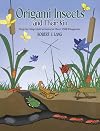
I´ve had this book for many years, and it´s got some really neat models. They´re quite hard, and for many of them you´ll want to find (or make your own) origami paper that is very thin and larger than ten inches square. You simply can´t make some of these insects with paper smaller than ten inches. I really like the dragonfly, the scarab beetle and the stag beetle from this book. I think Montroll has some better insects, like the grasshopper and the moth, in one of his Origami for the show more Enthusiast books. But I like Lang´s style, and I enjoy the high complexity of these models. I would recommend this book to the serious origami aficionado. I don´t think it´s really appropriate for beginners. show less
You May Also Like


Associated Authors
Statistics
- Works
- 14
- Also by
- 1
- Members
- 1,096
- Popularity
- #23,435
- Rating
- 4.0
- Reviews
- 12
- ISBNs
- 26
- Favorited
- 1