
M. Daniel Carroll R.
Author of Christians at the Border
About the Author
M. Daniel Carroll R. (Rodas) (PhD, University of Sheffield) is Blanchard Professor of Old Testament at Wheaton College Graduate School and an adjunct professor at El Seminario Teolgico Centroamericano in Guatemala.
Image credit: Used by permission of Baker Publishing Group, copyright © 2008. All rights to this material are reserved. Materials are not to be distributed to other web locations for retrieval, published(see © info.)
Works by M. Daniel Carroll R.
The Book of Amos (New International Commentary on the Old Testament (NICOT)) (2020) 55 copies, 1 review
The Lord Roars: Recovering the Prophetic Voice for Today (Theological Explorations for the Church Catholic) (2022) 49 copies
Character Ethics and the Old Testament: Moral Dimensions of Scripture (2007) — Editor; Contributor — 42 copies
Rethinking contexts, rereading texts : contributions from the social sciences to biblical interpretation (2000) 18 copies
The Bible in Human Society: Essays in Honour of John Rogerson (JSOT Supplement) (1995) — Editor; Contributor — 14 copies
Theory and Practice in Old Testament Ethics: The Contribution of John Rogerson (The Library of Hebrew Bible/Old Testament Studies) (2009) — Editor — 3 copies
Thinking Christianly About Immigration (Grounds Institute of Public Ethics Monograph Series) 2 copies
Associated Works
Globalizing Theology: Belief and Practice in an Era of World Christianity (2006) — Contributor — 156 copies, 1 review
A Royal Priesthood? The Use of the Bible Ethically and Politically: A Dialogue with Oliver O'Donovan (Scripture and Hermeneutics Series, V. 3) (2002) — Contributor — 144 copies
Keeping God's Earth: The Global Environment in Biblical Perspective (2010) — Contributor — 50 copies
The Bible in Ethics: The Second Sheffield Colloquium (The Library of Hebrew Bible/Old Testament Studies) (1995) — Contributor; Editor — 13 copies
Tagged
Common Knowledge
There is no Common Knowledge data for this author yet. You can help.
Members
Reviews
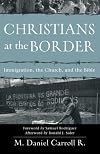
If this is the best that Evangelical Christianity can do in urging Christians to abandon any thought of thinking there is something wrong with immigrants crossing into this country illegally, the argument will not be won biblically. This is a horribly one-sided approach, full of poor logic. From the opener where Carroll states that he doesn't want to use the phrase illegal alien because it is pejorative, but then turns around and calls groups he disagrees with "fringe" groups—as well as show more other pejorative titles—to the end where he basically shrugs off Romans 13 and says, "My argument up to this point makes that passage a moot point," the book is full of logical problems and sub-par exegesis. Granted it is for a lay audience, but I am unconvinced by his arguments.
That said, I am not unconvinced that Christians should be in the forefront of working on effective legislation in dealing with the immigrant issue in the U.S. Christians should be looking for ways to serve those around us, be hospitable, and share the gospel—something Carroll never seems to get around to. Instead he keeps talking about how many of these illegal immigrants (sorry, undocumented workers) are Christians and how that should make a difference. Why?
I am hoping for a better argument out of the next book I read on this issue. show less
That said, I am not unconvinced that Christians should be in the forefront of working on effective legislation in dealing with the immigrant issue in the U.S. Christians should be looking for ways to serve those around us, be hospitable, and share the gospel—something Carroll never seems to get around to. Instead he keeps talking about how many of these illegal immigrants (sorry, undocumented workers) are Christians and how that should make a difference. Why?
I am hoping for a better argument out of the next book I read on this issue. show less

I had really mixed feelings about this book. One the one hand it was incredibly well documented and spoke to where so many Christians are, including those currently or recently migrating. On the other hand whilst reading it was the first time I ever recall reading several pages and then realized I was thinking about something else completely the whole time I read it. I'm not sure how that's actually possible. It also has the same problem I see about many Christian works, even left leaning show more ones, that it just doesn't feel radical enough.
Carrol is a professor of Old Testament studies at a Christian university and it shows in his writing. Something like 3/4 of the book was the chapter on what the Old Testament says. That's unusual for a Christian book, but then again the Old Testament is 3/4 of the Bible. He shows all the people that were forced to migrate both within a country and across borders. The reasons they moved were the same reasons people do today. All through the Bible God shows that His people are the ones on the move, and in the promised land they are supposed to care for those that are traveling or reside about you that are different. He does a good job arguing against the right-wing talking points, particularly those based on Romans 13.
I did have a hard time accepting some things, like how whilst a Christian can fight for 100% open borders, he doesn't have to. In particular I found frightening his statement in the intro that if you do identify the horrible treatment of immigrants in the U.S. Americans should still love their country, particularly as he doesn't expand on that in the rest of the book.
I identify that a lot of the problems I see here may well be problems with me and not with Mr. Carrol. show less
Carrol is a professor of Old Testament studies at a Christian university and it shows in his writing. Something like 3/4 of the book was the chapter on what the Old Testament says. That's unusual for a Christian book, but then again the Old Testament is 3/4 of the Bible. He shows all the people that were forced to migrate both within a country and across borders. The reasons they moved were the same reasons people do today. All through the Bible God shows that His people are the ones on the move, and in the promised land they are supposed to care for those that are traveling or reside about you that are different. He does a good job arguing against the right-wing talking points, particularly those based on Romans 13.
I did have a hard time accepting some things, like how whilst a Christian can fight for 100% open borders, he doesn't have to. In particular I found frightening his statement in the intro that if you do identify the horrible treatment of immigrants in the U.S. Americans should still love their country, particularly as he doesn't expand on that in the rest of the book.
I identify that a lot of the problems I see here may well be problems with me and not with Mr. Carrol. show less
Before joining in the current national immigration dispute—whether at the water cooler or on a more significant legislative platform—one should read "Christians at the Border". This short, but power-packed, work by M. Daniel Carroll R. provides incredible insight into the current debate our country is wrestling through, especially with regards to the mass emigration from Mexico and other Hispanic countries. As a Guatemalan-American Christian, one who is, in his own words, “living in show more the hyphen”, this author sheds unique light on this controversial topic.
Carroll R. begins his discourse with a brief but comprehensive history of immigration in the US, focusing on the cultural identity and economic factors that fuel the emotions of parties on both sides of this volatile issue. His writing avoids the typical dryness of statistics, however. After all, “It is ideas and feelings” that he is after, “not numbers.” Even in this historical discussion, Carroll R. seeks to reach “beyond the usual boundaries” of one’s point of view. And he eloquently shows us that “American identity has never been a static entity.”
"Christians at the Border" then reveals what the Bible has to say about foreigners and their host country. It is here that one can start to formulate an opinion towards outsiders that reflects God’s love and concern: “This book attempts to offer…a biblical and theological framework from which Christians, as Christians, might participate in the ongoing debate.” The author starts with the core belief, found in Genesis 1, that all of us are created in God’s image. He then follows a beautiful progression of virtues that arise from this profound foundational Truth.
What particularly pulled on my heart, though, was Carroll R.’s description of Jesus’ love for others, especially those who are marginalized. He says, “Jesus models a new and different way of looking at persons who are outside the circle of the known and beyond acceptability.” The reader is then treated to a fresh look at two of Jesus’ famous encounters: the Samaritan woman at the well and the healed leper who came back to express his gratitude to his Savior.
While this author avoids doling out unsolicited advice on how loving one’s neighbor plays out logistically, he does provide a strong, biblical basis for moving, as representatives of Christ, into our world. A world that increasingly brings us face-to-face with those from far-away lands and cultures. show less
Carroll R. begins his discourse with a brief but comprehensive history of immigration in the US, focusing on the cultural identity and economic factors that fuel the emotions of parties on both sides of this volatile issue. His writing avoids the typical dryness of statistics, however. After all, “It is ideas and feelings” that he is after, “not numbers.” Even in this historical discussion, Carroll R. seeks to reach “beyond the usual boundaries” of one’s point of view. And he eloquently shows us that “American identity has never been a static entity.”
"Christians at the Border" then reveals what the Bible has to say about foreigners and their host country. It is here that one can start to formulate an opinion towards outsiders that reflects God’s love and concern: “This book attempts to offer…a biblical and theological framework from which Christians, as Christians, might participate in the ongoing debate.” The author starts with the core belief, found in Genesis 1, that all of us are created in God’s image. He then follows a beautiful progression of virtues that arise from this profound foundational Truth.
What particularly pulled on my heart, though, was Carroll R.’s description of Jesus’ love for others, especially those who are marginalized. He says, “Jesus models a new and different way of looking at persons who are outside the circle of the known and beyond acceptability.” The reader is then treated to a fresh look at two of Jesus’ famous encounters: the Samaritan woman at the well and the healed leper who came back to express his gratitude to his Savior.
While this author avoids doling out unsolicited advice on how loving one’s neighbor plays out logistically, he does provide a strong, biblical basis for moving, as representatives of Christ, into our world. A world that increasingly brings us face-to-face with those from far-away lands and cultures. show less
The Book of Amos (New International Commentary on the Old Testament (NICOT)) by M. Daniel Carroll R.
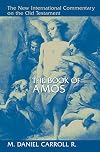
M. Daniel Carroll R. dates Amos’ ministry in the latter years during the second quarter of the eighth century BC. The Biblical book that bears the prophet’s name was his message that heralded Yahweh’s sovereign judgment against the nations, and repudiated the distorted piety and societal injustice of Jeroboam II’s Israel. Carroll demonstrates particular sensitivity to the book’s literary design, thereby argues convincingly for the authenticity of the canonical text.
The commentary show more is preceded by 100-plus pages of introduction, itself an invaluable primer to understand the book and related latest research. Every verse of the text is given careful, even prodigious, exegetical and expository treatments. Different approaches and viewpoints are presented, and the preferred interpretations are judiciously elucidated. The theological imports of Amos’ message are reinforced throughout. Another helpful feature of this commentary is the copious bibliographic notes. There, Carroll scrupulously tabulates works of scholars, from the reformers to those of modern time, that represent different perspectives on almost every pericope. Consummate knowledge of available literature is apparent, a feat not unexpected from a scholar who has devoted close to 30 years to Amos research.
Carroll’s commentary on the book of Amos sits amongst the pinnacle of modern Biblical scholarship. What lies behind the exemplary erudition is a punctilious intellectual enterprise, one for which researchers, teachers, and students of generations to come should be grateful. show less
The commentary show more is preceded by 100-plus pages of introduction, itself an invaluable primer to understand the book and related latest research. Every verse of the text is given careful, even prodigious, exegetical and expository treatments. Different approaches and viewpoints are presented, and the preferred interpretations are judiciously elucidated. The theological imports of Amos’ message are reinforced throughout. Another helpful feature of this commentary is the copious bibliographic notes. There, Carroll scrupulously tabulates works of scholars, from the reformers to those of modern time, that represent different perspectives on almost every pericope. Consummate knowledge of available literature is apparent, a feat not unexpected from a scholar who has devoted close to 30 years to Amos research.
Carroll’s commentary on the book of Amos sits amongst the pinnacle of modern Biblical scholarship. What lies behind the exemplary erudition is a punctilious intellectual enterprise, one for which researchers, teachers, and students of generations to come should be grateful. show less
You May Also Like


Associated Authors
Statistics
- Works
- 21
- Also by
- 9
- Members
- 556
- Popularity
- #44,899
- Rating
- 3.5
- Reviews
- 10
- ISBNs
- 28