
Gilbert Lawall
Author of Athenaze: An Introduction to Ancient Greek: Book I
About the Author
Image credit: via University of Massachusetts
Series
Works by Gilbert Lawall
Athenaze. Introduzione al greco antico. Con espansione online. Per il Liceo classico: 2 (2013) 18 copies
Ecce Romani : a Latin reading program 15 copies
Ecce Romani: Meeting the Family/Rome at Last/Home and School (Ecce Romani, Set, Bks. 1-3) (1990) 15 copies
Greek lyric poetry 6 copies
Ecce Romani 2 copies
Plautus' Aulularia: The Pot of Gold; An Adaptation for Production by High School Latin Students (1992) 2 copies
Latin in Its Context 1 copy
Associated Works
Ritchie's Fabulae Faciles: Latin Text with Facing Vocabulary and Commentary (1884) — Editor, some editions — 179 copies, 3 reviews
Arktouros : Hellenic studies presented to Bernard M. W. Knox on the occasion of his 65th birthday (1979) — Contributor — 3 copies
Tagged
Common Knowledge
- Gender
- male
Members
Reviews

Good old Dicaeopolis! Lazy Xanthias! Brave Philip! How we students enjoyed snickering at the "Dick and Jane" approach to classical Greek that is to be found in this introductory text, and what an effective teaching tool it turned out to be...
This was the book used in the beginning Greek class I took in college, Book I the first semester, and Book II the second. Each unit contains a list of vocabulary, a text in Greek, a Word Study, a section on Grammar, and a list of exercises. Taken show more sequentially, the texts tell the story of Attic farmer Dicaeopolis and his family, living in Greece at the beginning of the Peloponnesian War. Interspersed throughout are various passages explaining some of the cultural background of the story. This first volume has 16 units, each divided into two lessons. The book also contains a reference grammar at the back , a brief dictionary, and an index.
These books are ideally suited, I think, for introducing students to this ancient language. They allow one to jump into textual passages right from the beginning, even though very little grammar or vocabulary has been learned. While I can think of any number of things more interesting than Dicaeopolis digging stones out of a field, it would be impossible to jump right into Homer, Plato, or any of the other greats. Nor would it be especially pleasant to spend an entire year doing nothing but memorizing lists of vocabulary and tables of grammar paradigms. Here is a noble compromise: and though my classmates and I may have groaned, I look back now with nostalgic fondness... show less
This was the book used in the beginning Greek class I took in college, Book I the first semester, and Book II the second. Each unit contains a list of vocabulary, a text in Greek, a Word Study, a section on Grammar, and a list of exercises. Taken show more sequentially, the texts tell the story of Attic farmer Dicaeopolis and his family, living in Greece at the beginning of the Peloponnesian War. Interspersed throughout are various passages explaining some of the cultural background of the story. This first volume has 16 units, each divided into two lessons. The book also contains a reference grammar at the back , a brief dictionary, and an index.
These books are ideally suited, I think, for introducing students to this ancient language. They allow one to jump into textual passages right from the beginning, even though very little grammar or vocabulary has been learned. While I can think of any number of things more interesting than Dicaeopolis digging stones out of a field, it would be impossible to jump right into Homer, Plato, or any of the other greats. Nor would it be especially pleasant to spend an entire year doing nothing but memorizing lists of vocabulary and tables of grammar paradigms. Here is a noble compromise: and though my classmates and I may have groaned, I look back now with nostalgic fondness... show less

I look upon Balme & Lawall's introductory classical Greek text, Athenaze, as a single work that happens to be published in two volumes. Nothing expresses my feelings about Book II better than my review of Book I, which I have duplicated below (with some minor adjustments):
Good old Dicaeopolis! Lazy Xanthias! Brave Philip! How we students enjoyed snickering at the "Dick and Jane" approach to classical Greek that is to be found in this introductory text, and what an effective teaching tool it show more turned out to be...
This was the book used in the beginning Greek class I took in college, Book I the first semester, and Book II the second. Each unit contains a list of vocabulary, a text in Greek, a Word Study, a section on Grammar, and a list of exercises. Taken sequentially, the texts tell the story of Attic farmer Dicaeopolis and his family, living in Greece at the beginning of the Peloponnesian War. Interspersed throughout are various passages explaining some of the cultural background of the story. This second volume has 15 units, each divided into two lessons. The book also contains a reference grammar at the back , a brief dictionary, and an index.
These books are ideally suited, I think, for introducing students to this ancient language. They allow one to jump into textual passages right from the beginning, even though very little grammar or vocabulary has been learned. While I can think of any number of things more interesting than Dicaeopolis digging stones out of a field, it would be impossible to jump right into Homer, Plato, or any of the other greats. Nor would it be especially pleasant to spend an entire year doing nothing but memorizing lists of vocabulary and tables of grammar paradigms. Here is a noble compromise: and though my classmates and I may have groaned, I look back now with nostalgic fondness. show less
Good old Dicaeopolis! Lazy Xanthias! Brave Philip! How we students enjoyed snickering at the "Dick and Jane" approach to classical Greek that is to be found in this introductory text, and what an effective teaching tool it show more turned out to be...
This was the book used in the beginning Greek class I took in college, Book I the first semester, and Book II the second. Each unit contains a list of vocabulary, a text in Greek, a Word Study, a section on Grammar, and a list of exercises. Taken sequentially, the texts tell the story of Attic farmer Dicaeopolis and his family, living in Greece at the beginning of the Peloponnesian War. Interspersed throughout are various passages explaining some of the cultural background of the story. This second volume has 15 units, each divided into two lessons. The book also contains a reference grammar at the back , a brief dictionary, and an index.
These books are ideally suited, I think, for introducing students to this ancient language. They allow one to jump into textual passages right from the beginning, even though very little grammar or vocabulary has been learned. While I can think of any number of things more interesting than Dicaeopolis digging stones out of a field, it would be impossible to jump right into Homer, Plato, or any of the other greats. Nor would it be especially pleasant to spend an entire year doing nothing but memorizing lists of vocabulary and tables of grammar paradigms. Here is a noble compromise: and though my classmates and I may have groaned, I look back now with nostalgic fondness. show less
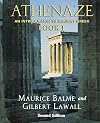
This is the only textbook I have ever used so I can't compare it with any others. I found it engaging. I usually like more drills and paradigms in language books but I found the storyline amusing. It helped me remember vocabulary because I could link it to a funny passage in the text. The characters are from The Acharnians.
In short, I thought it was a good language textbook for ancient Greek.
In short, I thought it was a good language textbook for ancient Greek.

This slender title is the teacher's companion to the first volume of the Athenaze text on ancient Greek, and contains the answers to that book's questions and exercises, as well as some helpful hints for the instructor.
The utility of such a book for teachers need hardly be commented upon. But this companion to the Athenaze text on ancient Greek is also of value to the independent student, or someone (like me), who returns to their studies after a significant absence, and wishes to review show more some basics before progressing to the next level. show less
The utility of such a book for teachers need hardly be commented upon. But this companion to the Athenaze text on ancient Greek is also of value to the independent student, or someone (like me), who returns to their studies after a significant absence, and wishes to review show more some basics before progressing to the next level. show less
You May Also Like


Associated Authors
Statistics
- Works
- 62
- Also by
- 5
- Members
- 2,713
- Popularity
- #9,467
- Rating
- 3.4
- Reviews
- 10
- ISBNs
- 77
- Languages
- 4