
Karl Shaw
Author of Royal Babylon: The Alarming History of European Royalty
About the Author
Image credit: The Susijin Agency
Works by Karl Shaw
Mad, Bad and Dangerous to Know: The Extraordinary Exploits of the British and European Aristocracy (2017) 29 copies
The Giant Bathroom Reader : Dip into a Compendium of Useless Knowledge, Hilarious Facts, and Bizarre Trivia (2006) 28 copies
The Killing of Lord George: a tale of murder and deceit in Edwardian England (2022) 12 copies, 1 review
Tagged
Common Knowledge
- Gender
- male
- Occupations
- author
- Nationality
- UK
- Places of residence
- Staffordshire, England, UK
- Associated Place (for map)
- England, UK
Members
Reviews
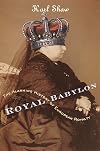
That many members of royalty over the years are mad as cut snakes should be of no surprise to us. Karl Shaw takes us on a journey of mostly European royalty and their eccentricities/stark raving looniness. Often entertaining and you can’t help but feel sorry for poor Mad King Ludwig of Bavaria. He built the famous Neuschwanstein Castle which was seen at the time by many as a symptom of madness, and possibly murdered. Now the castle is one of the most visited tourist sites in the world and show more brings in large amounts of dosh for the local area. Perhaps he should be known as King Ludwig the visionary. show less
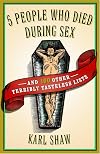
Until I read “5 People Who Died During Sex: and 100 Other Terribly Tasteless Lists” I did not know that Elizabethans relieved toothache by applying sweat from the anus of a cat that had been chased across a ploughed field. Nor did I know that Lorne Greene (the bloke from “Bonanza”) had one of his nipples bitten off by an alligator. And similarly I was completely in the dark about the fact that anyone in the ancient civilisation of Manu who farted in front of the monarch would have show more their anus amputated.
While I was very happy to learn of these vital facts, I couldn’t help but notice this book seemed thrown together, with segments originally from other Shaw books. My Kindle version was also missing some pages, which does tend to annoy somewhat. However, whenever I started to get peeved about issues like this, I read that King Ferdinand I of Naples described his new wife Queen Caroline thus: “She leeps like the dead and sweats like a pig” or that Elijah Upjohn, the man who hanged Ned Kelly, was once arrested for unnatural practices with a chicken, and forgive Shaw for everything. show less
While I was very happy to learn of these vital facts, I couldn’t help but notice this book seemed thrown together, with segments originally from other Shaw books. My Kindle version was also missing some pages, which does tend to annoy somewhat. However, whenever I started to get peeved about issues like this, I read that King Ferdinand I of Naples described his new wife Queen Caroline thus: “She leeps like the dead and sweats like a pig” or that Elijah Upjohn, the man who hanged Ned Kelly, was once arrested for unnatural practices with a chicken, and forgive Shaw for everything. show less
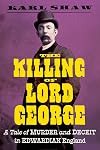
Retired circus impresario, George Sanger, is found dead of a violent blow to his head in his rural London home in 1911; two other household members also show signs of injury. Herbert Cooper, a recently disgraced household employee, is quickly identified as the culprit and a police dragnet is assembled to track him down. The manhunt ends within a couple of days when Cooper’s mangled body is found alongside railroad tracks with a suicide note in his pocket. George Sanger was clearly murdered show more by his disgruntled employee and Cooper took the coward’s way out. The case is finished…or is it? Using statements made by Sanger’s own grandson and a reexamination of the evidence and eyewitness testimonies, Karl Shaw draws a very different conclusion and argues that Herbert Cooper is actually not guilty of murder at all.
Karl Shaw’s credentials for writing a scholarly history are dubious, to say the least. His biography identifies him only as an author and a journalist; if he has any sort of rigorous education as a serious historian, he is keeping it to himself. Many of his previous titles such as The Mammoth Book of Tasteless and Outrageous Lists and 10 Ways to Recycle a Corpse: and 100 More Dreadfully Distasteful Lists could only be described as salacious, pseudo-historical schlock usually found in the discount bins of dollar stores. For this reason I would hesitate to recommend this book to anyone interested in doing any legitimate scholarly research. For scholars who would like to use this as a reference, I would definitely recommend independently verifying any of the information with more reliable resources before including it in your own research.
That having been said, this book is clearly intended for the entertainment of a general reading audience, and it suits that goal admirably. The Killing of Lord George is an extremely engaging and highly interesting read. A word of warning, however: there are instances of brutality to animals recounted in the book which are extremely disturbing.
Shaw alternates between writing about Sanger’s life pre-birth through retirement to writing about the investigation of Sanger’s violent death and the hunt for his supposed killer. Shaw chronicles Sanger’s early life in a traveling caravan with his family and their off-seasons as London street hawkers, to his rise to success as a world-renowned circus owner and promoter, to his increasingly erratic behavior after his retirement from show business. Sanger comes across as a highly manipulative and unscrupulous man whose ambitions and narcissism trump any sort of notions of morality or even family affections. His violent death doesn’t really come as any great surprise; the most surprising thing about it is that it didn’t happen sooner!
Shaw’s analysis of Sanger’s death and the police investigation surrounding it is methodical and persuasive. Shaw’s examination of the newspaper accounts, police evidence, and inquest testimonies seem to make it clear that the final verdict probably did not accurately reflect what actually transpired. His conclusions about official ineptitude and the conspiracy to stick a phony murder charge on Cooper by certain members of the Sanger household are highly plausible, if not completely definitive.
Overall, this book is a very entertaining page turner.
Unfortunately, it suffers from a couple of problems. The first is the slapdash, rambling ‘Epilogue’ that concludes the book with a sad little whimper. It consists of a lot of random comments about what happened to various people who appeared throughout the narrative. People dying, remarrying, retiring, disappearing from the annals of history, etc. None of it is relevant to the main story. It comes across as a hastily slapped together chapter that was just tacked on to provide a rather clumsy ending to the book.
Even worse are all of the typographical errors that occur—most of which have to do with dates. For instance, on page 162, we are informed that “Lord” George’s daughter Laurina Sanger Coleman dies on 14 October 1982 at the age of 29. 1982! Really? And there is a lot of that in this book…events that actually took place in the late 1800s described as taking place in the 1980s and 1990s. It’s just sloppy and lazy nonsense on the part of the author, editor (did the book even have one?), and the publisher. There is no legitimate excuse for it. All of the errors simply reflect the fact that the author just isn’t a qualified professional historian, and readers should absolutely take that into account when reading this book.
So, if this is purely a pleasure read—read it & enjoy it. It genuinely is an interesting book.
But, if you’re reading this in the course of academic pursuits, take the facts with a grain of salt & double-check everything independently. show less
Karl Shaw’s credentials for writing a scholarly history are dubious, to say the least. His biography identifies him only as an author and a journalist; if he has any sort of rigorous education as a serious historian, he is keeping it to himself. Many of his previous titles such as The Mammoth Book of Tasteless and Outrageous Lists and 10 Ways to Recycle a Corpse: and 100 More Dreadfully Distasteful Lists could only be described as salacious, pseudo-historical schlock usually found in the discount bins of dollar stores. For this reason I would hesitate to recommend this book to anyone interested in doing any legitimate scholarly research. For scholars who would like to use this as a reference, I would definitely recommend independently verifying any of the information with more reliable resources before including it in your own research.
That having been said, this book is clearly intended for the entertainment of a general reading audience, and it suits that goal admirably. The Killing of Lord George is an extremely engaging and highly interesting read. A word of warning, however: there are instances of brutality to animals recounted in the book which are extremely disturbing.
Shaw alternates between writing about Sanger’s life pre-birth through retirement to writing about the investigation of Sanger’s violent death and the hunt for his supposed killer. Shaw chronicles Sanger’s early life in a traveling caravan with his family and their off-seasons as London street hawkers, to his rise to success as a world-renowned circus owner and promoter, to his increasingly erratic behavior after his retirement from show business. Sanger comes across as a highly manipulative and unscrupulous man whose ambitions and narcissism trump any sort of notions of morality or even family affections. His violent death doesn’t really come as any great surprise; the most surprising thing about it is that it didn’t happen sooner!
Shaw’s analysis of Sanger’s death and the police investigation surrounding it is methodical and persuasive. Shaw’s examination of the newspaper accounts, police evidence, and inquest testimonies seem to make it clear that the final verdict probably did not accurately reflect what actually transpired. His conclusions about official ineptitude and the conspiracy to stick a phony murder charge on Cooper by certain members of the Sanger household are highly plausible, if not completely definitive.
Overall, this book is a very entertaining page turner.
Unfortunately, it suffers from a couple of problems. The first is the slapdash, rambling ‘Epilogue’ that concludes the book with a sad little whimper. It consists of a lot of random comments about what happened to various people who appeared throughout the narrative. People dying, remarrying, retiring, disappearing from the annals of history, etc. None of it is relevant to the main story. It comes across as a hastily slapped together chapter that was just tacked on to provide a rather clumsy ending to the book.
Even worse are all of the typographical errors that occur—most of which have to do with dates. For instance, on page 162, we are informed that “Lord” George’s daughter Laurina Sanger Coleman dies on 14 October 1982 at the age of 29. 1982! Really? And there is a lot of that in this book…events that actually took place in the late 1800s described as taking place in the 1980s and 1990s. It’s just sloppy and lazy nonsense on the part of the author, editor (did the book even have one?), and the publisher. There is no legitimate excuse for it. All of the errors simply reflect the fact that the author just isn’t a qualified professional historian, and readers should absolutely take that into account when reading this book.
So, if this is purely a pleasure read—read it & enjoy it. It genuinely is an interesting book.
But, if you’re reading this in the course of academic pursuits, take the facts with a grain of salt & double-check everything independently. show less
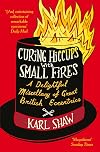
This book was a Christmas present and provided a few hours of solid entertainment. It is a compendium of anecdotes about British eccentrics of 17th to 20th centuries, with a particular focus on politicians and scientific pioneers of the 19th who seem to have been an especially peculiar bunch. Unsurprisingly, some 95% of them are male. Whilst men who behave weirdly have long been allowed their eccentricities, women who do the same are generally institutionalised. The author also acknowledges show more a class difference: if you’re aristocratic you’re eccentric; if you’re poor you’re just mentally ill. Serious social points aside, I found the book incredibly funny and repeatedly read anecdotes aloud to whoever in the house happened to be listening. An example, concerning a Victorian Poet Laureate:
Sick burn. Other highlights include Charles Babbage’s long-running feud with organ grinders, William Gladstone’s extraordinary dull conversation, and Aleister Crowley’s judgement that L. Ron Hubbard was ‘an idiot’. Although some of the characters featured appear to merely be tiresome bigots, the majority are amusing nonsense-mongers. An ideal book for the Christmas holidays. show less
When it was pointed out to him that his poems were full of basic grammatical errors, Austin replied, “I dare not alter these things. They come to me from above.” Austin complained to Lord Young that he was always broke, but added, “I manage to keep the wolf from the door.”
“How?” Young enquired, “By reading your poems to him?”
Sick burn. Other highlights include Charles Babbage’s long-running feud with organ grinders, William Gladstone’s extraordinary dull conversation, and Aleister Crowley’s judgement that L. Ron Hubbard was ‘an idiot’. Although some of the characters featured appear to merely be tiresome bigots, the majority are amusing nonsense-mongers. An ideal book for the Christmas holidays. show less
You May Also Like


Statistics
- Works
- 22
- Members
- 985
- Popularity
- #26,139
- Rating
- 3.6
- Reviews
- 31
- ISBNs
- 52
- Languages
- 4