

O. E. Rølvaag (1876–1931)
Author of Giants in the Earth
About the Author
Norwegian-born Rolvaag emigrated to the United States at age 20 in 1896. Following a college education in Minnesota and Norway, he began the writing and teaching career (at St. Olaf College, Minnesota) that was to bring him fame as an interpreter of the Norwegian-American cultural experience. show more Rolvaag's understanding of immigrant life on the prairie was the source of novels that have given his name a solid place in both national literatures. His first, highly autobiographical work, The Third Life of Per Smevik (1912), was published under the pseudonym Paal Morck. Rolvaag's masterpiece, Giants in the Earth (1924--25), is his own translation, with Lincoln Colcord, of the first two of four novels dealing with the family of Per Hansa. Peder Victorious (1928) and Their Fathers' God (1931) complete the epic, although these two novels are less compelling. show less
Image credit: NNDB
Series
Works by O. E. Rølvaag
Deklamationsboken 2 copies
Peder Victorias 1 copy
Associated Works
Reader's Digest Best of the West: A Treasury of Western Adventure Volumes 1 & 2 (1976) — Contributor — 38 copies
A Very Scandinavian Christmas: The Greatest Nordic Holiday Stories of All Time (2019) — Contributor — 25 copies, 1 review
Reader's Digest Best of the West: A Treasury of Western Adventure Volume 1 (1975) — Contributor — 12 copies
Furrow's End: An Anthology of Great Farm Stories — Contributor — 2 copies
The Ethnic Image in Modern American Literature, 1900-1950, Volumes 1-2 (1984) — Contributor — 1 copy
Tagged
Common Knowledge
- Canonical name
- Rølvaag, O. E.
- Other names
- Rølvaag, Ole Edvart (birth name)
- Birthdate
- 1876-04-22
- Date of death
- 1931-11-05
- Gender
- male
- Education
- St. Olaf College
- Occupations
- college professor
scholar of Norwegian language and literature - Nationality
- Norway (birth)
- Birthplace
- Dønna, Norway
- Places of residence
- Northfield, Minnesota, USA
Canton, South Dakota, USA - Place of death
- Northfield, Minnesota, USA
- Burial location
- Oaklawn Cemetery, Northfield, Minnesota, USA
- Map Location
- USA
Members
Reviews
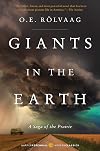
A book about Norwegians settling the vast open prairies of early America. This is a much darker version of the same subject as the Little House books. I didn't care for it, it had little action, but I found myself reading it compulsively until the end, at which point I wanted to throw the whole book out the window. This is a classic in Norway where I am led to understand, such a gloomy drama was popular.
Volume One of Giants in the Earth was published in Norway in 1924. The second volume was published a year later. Vern Lewis Parrington (editor) wrote an introduction. Rolvaag wrote the foreword. Forty-six pages later we begin the story...Per Hansa is moving his family from Minnesota to the the Great Plains of the Dakota Territory in the hopes of putting down roots.
A lot of comments have been made about Beret and her mental illness. Her uncontrolled fear of the Midwest was justified. She was show more in a strange land without the comfort of true community. There was an underlying fear of Indians - fear and fascination in equal measure. I am reminded of the 10,000 Maniacs' song, "Gold Rush Brides" written by Natalie Merchant. The lines, "The land was free and the prices was right", and "Who were the homestead wives? Who were the gold rush brides? Does anybody know?...Accounts of madness, childbirth, loneliness, and grief" are particularly poignant. When Beret uncovers an evil secret wrongdoing her husband committed she starts to question their entire relationship. She fears that evil everywhere and her husband seems oblivious to her growing concerns. No one in the community notices her distress until it is beyond breaking. They even make fun of her nonsense. Were they distracted by opportunity? Were they preoccupied with adversities such as the strain of long, harsh winters and plagues of locusts in the summers? Did they want to slough off their old world identities identities in the new world by choosing new names? The question becomes how does one honor traditions of Norway while forging a new existence in America? show less
A lot of comments have been made about Beret and her mental illness. Her uncontrolled fear of the Midwest was justified. She was show more in a strange land without the comfort of true community. There was an underlying fear of Indians - fear and fascination in equal measure. I am reminded of the 10,000 Maniacs' song, "Gold Rush Brides" written by Natalie Merchant. The lines, "The land was free and the prices was right", and "Who were the homestead wives? Who were the gold rush brides? Does anybody know?...Accounts of madness, childbirth, loneliness, and grief" are particularly poignant. When Beret uncovers an evil secret wrongdoing her husband committed she starts to question their entire relationship. She fears that evil everywhere and her husband seems oblivious to her growing concerns. No one in the community notices her distress until it is beyond breaking. They even make fun of her nonsense. Were they distracted by opportunity? Were they preoccupied with adversities such as the strain of long, harsh winters and plagues of locusts in the summers? Did they want to slough off their old world identities identities in the new world by choosing new names? The question becomes how does one honor traditions of Norway while forging a new existence in America? show less

I read this book because my aunt told me it was my grandfather's favorite book. It had been described as an adult version of little house on the prairie, and I think that's a fine description. Originally written in Norwegian Rolvaag writes in a very attractive manner quite different from his contemporaries. He writes a lot more how people talk a lot less of ":We need to harvest the potatoes,' said Per Hands" and a lot more "Per Hands said they needed to harvest the potatoes" sometimes it show more took 20 pages to describe events of an hour and sometimes 6 years passed in two paragraphs. I really fell in love with these characters and their struggle to make it on the edge of the prairie in North Dakota. I particularly felt for Beret the mentally ill wife of our PROTAGONIST Per Hansa, thought they didn't call he mentally ill back then. My biggest disappointment was the ending. Only further increased the predjudice that Norwegians can never be happy and have to find a way to be depressed. I also would have preferred if I had read the original first edition published as two separate books, the nearly 600 page omnibus became a bit unruly. show less
This was beautifully evocative of the 1870's prairie life of Norwegian-American immigrants in the Dakota Territories in the 1870's. Although there are lots of hardships to overcome and there is an ever increasing tension between the depressed inner life of the wife Beret and the can-do exuberance of her husband Per Hansa there wasn't enough real drama and suspense until the final "The Great Plain Drinks the Blood of Christian Men and is Satisfied." Previously each crisis seemed to be show more bypassed relatively easily and several years of locust plagues pass by in only a few pages. But in the last section the life and death stakes are more nakedly on display. show less
Lists
Awards


You May Also Like


Associated Authors
Statistics
- Works
- 15
- Also by
- 9
- Members
- 2,119
- Popularity
- #12,147
- Rating
- 3.9
- Reviews
- 35
- ISBNs
- 39
- Languages
- 2
- Favorited
- 6