
Bernard Mandeville (1670–1733)
Author of The Fable of the Bees: Or Private Vices, Publick Benefits
About the Author
Image credit: Stop NATO
Works by Bernard Mandeville
Associated Works
Lapham's Quarterly - Lines of Work: Volume IV, Number 2, Spring 2011 (2011) — Contributor — 32 copies, 2 reviews
Tagged
Common Knowledge
- Birthdate
- 1670-11-15
- Date of death
- 1733-01-21
- Gender
- male
- Education
- Erasmus School, Rotterdam
Leiden University - Occupations
- physician
philosopher - Nationality
- Netherlands
- Birthplace
- Rotterdam, Netherlands
- Places of residence
- Leiden, Netherlands
England, UK - Place of death
- Hackney, London, England, UK
- Associated Place (for map)
- Netherlands
Members
Reviews
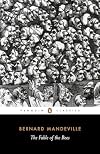
A friend recommended ‘The Fable of the Bees’ to me and early 18th century political philosophy sounded interesting, so I read it. I’m glad I did, although parts of it were a bit of an effort. The structure of the book is somewhat odd and the title rather misleading. The fable itself is a short doggerel verse of only 12 pages, which in itself isn’t terribly enlightening. The substance of the book consists of several essays and many ‘remarks’ that embroider considerably on the show more themes of the fable, as well as expanding into other matters that Mandeville thought it necessary to discuss. I found the 18th century manner of writing easier to read than expected. The only major difference to modern writing is the consistent Capitalisation of Nouns. That I came to rather enjoy, as it gave the whole thing a nice emphatic cast, as of a speech being given at a crowded coffee house. Mandeville’s rather sardonic and irreverent style of writing is quite often funny, although he can sometimes become repetitious.
I found the remarks section of the book most appealing and the essay on charity school least. Nonetheless, the totality of the book proved to be a fascinating insight into pre-industrialisation economics and its uncomfortable relationship with religion and morality. In some ways, Mandeville is a free market economist radically ahead of his time. Current economic theory, at its simplest, claims that individual’s self-interested behaviour operates within the structure of markers to produce an efficient outcome overall. (This is not only a massive oversimplification but also frequently untrue, but economics students have it beaten into their brains.) Mandeville comments that pride, greed, and luxury (then considered a vice, how times change!) create economic activity and thus wealth. Indeed, one can infer here and there in the book an embryonic critique of GDP as a measure of a country’s wealth and success. The Great Fire of London is cited as an example of a disaster that created work for many. This economic paradox continues to be a major fault of GDP; all activity is valued the same way, whether it consists of repairing destruction or not. In many other ways, I should emphasise, Mandeville takes a much more subtle approach to human behaviour than free market economic theory. One of the first things that struck me, though, was his definition of rationality as virtuous self-denial. Today, economics has turned this on its head. Rationality according to the neoliberal definition is maximisation of personal utility, the unfettered pursuit of self-interest. The use and abuse of the word rationality is incredible, really.
The essay on charity schools is difficult to read, at least it was to me, as it is pragmatic to the point of cruelty. Mandeville argues that educating the children of the labouring poor is pointless and will only make them dissatisfied, as their lives need to be spent wearing out their bodies rather than using their minds. Whilst there is a valid point in there about hypocrisy, overall it is an indictment of the time when it was written. In the early 18th century, agriculture and manufacturing were extremely labour-intensive. The Agricultural and Industrial Revolutions, which got underway some half a century later, would shift Britain to a capital-intensive economy and transform the working lives of the poor. A pre-industrial economy does require a huge pool of uneducated labour, nonetheless Mandeville appears unsympathetic in the extreme by dismissing all efforts to improve the lot of those labourers. As well as charging charity schools with many ills, he is also scathing about putative trade unions.
When reading a book that is nearly three hundred years old, I tend to find a mixture of the incredibly dated and the oddly contemporary. This mixture is notable in Mandeville’s comments on sexuality. He ascribes gender roles to social norms rather than biological inevitability, which surprised me. For instance, ‘A Girl who is modestly educated, may, before she is two Years old, begin to observe how careful the Women, she converses with, are of covering themselves before Men; and the same Caution being inculcated to her by precept, as well as by Example...’ He then plainly states, ‘The Multitude will hardly believe the excessive Force of Education, and in the Difference of Modesty between Men and Women, ascribe that to Nature, which is altogether owing to early Instruction...’ I was also amused to find what appears to be a comment on asexuals: ‘Those, who are really such Platonick Lovers are commonly the pale faced weakly People of cold and phlematick Constitutions of either Sex...’ Yet despite noting that men and women both experience carnal desires, which women are required to entirely disavow, he seems to consider this social construct inevitable. Mandeville may cast a sharply satirical eye on society’s hypocritical ways, but for the most part he does not suggest that they should change. The bitter criticism of charity schools forms the main exception.
I get the impression that one of the main reasons for Mandeville’s being considered so shocking when published was his pervasive moral relativity. He consistently refuses to fully condemn vices or fully acclaim virtues, accusing those who do of hypocrisy and woolly thinking. I can see why at the time this edged close to blasphemy. An example: ‘Because Impudence is a Vice, it does not follow that Modesty is a Virtue; it is built upon Shame, a Passion in our Nature, and may be either Good or Bad according to the Actions perform’d from that Motive’. Whilst there is much within the book that I disagree with, his refusal to uncritically accept moral absolutes is praiseworthy.
To end this meandering review, it is clear that I found ‘The Fable of the Bees’ thought-provoking. There is much else in there that is worth discussing, as well as some memorable phrases worth quoting. The book's greatest strength, though, is as an insight into the period prior to the Agricultural and Industrial Revolutions. Mandeville displays foresight in expounding the contradictions and hypocrisies between morality and economics. Yet he obviously could not foresee how technology would transform the economy and society, as well as politics and morality. For a contemporary contrast to this book, I suggest The Honest Truth About Dishonesty, although to be honest I think Mandeville has a much better grasp of complex human motivations than current economists. show less
I found the remarks section of the book most appealing and the essay on charity school least. Nonetheless, the totality of the book proved to be a fascinating insight into pre-industrialisation economics and its uncomfortable relationship with religion and morality. In some ways, Mandeville is a free market economist radically ahead of his time. Current economic theory, at its simplest, claims that individual’s self-interested behaviour operates within the structure of markers to produce an efficient outcome overall. (This is not only a massive oversimplification but also frequently untrue, but economics students have it beaten into their brains.) Mandeville comments that pride, greed, and luxury (then considered a vice, how times change!) create economic activity and thus wealth. Indeed, one can infer here and there in the book an embryonic critique of GDP as a measure of a country’s wealth and success. The Great Fire of London is cited as an example of a disaster that created work for many. This economic paradox continues to be a major fault of GDP; all activity is valued the same way, whether it consists of repairing destruction or not. In many other ways, I should emphasise, Mandeville takes a much more subtle approach to human behaviour than free market economic theory. One of the first things that struck me, though, was his definition of rationality as virtuous self-denial. Today, economics has turned this on its head. Rationality according to the neoliberal definition is maximisation of personal utility, the unfettered pursuit of self-interest. The use and abuse of the word rationality is incredible, really.
The essay on charity schools is difficult to read, at least it was to me, as it is pragmatic to the point of cruelty. Mandeville argues that educating the children of the labouring poor is pointless and will only make them dissatisfied, as their lives need to be spent wearing out their bodies rather than using their minds. Whilst there is a valid point in there about hypocrisy, overall it is an indictment of the time when it was written. In the early 18th century, agriculture and manufacturing were extremely labour-intensive. The Agricultural and Industrial Revolutions, which got underway some half a century later, would shift Britain to a capital-intensive economy and transform the working lives of the poor. A pre-industrial economy does require a huge pool of uneducated labour, nonetheless Mandeville appears unsympathetic in the extreme by dismissing all efforts to improve the lot of those labourers. As well as charging charity schools with many ills, he is also scathing about putative trade unions.
When reading a book that is nearly three hundred years old, I tend to find a mixture of the incredibly dated and the oddly contemporary. This mixture is notable in Mandeville’s comments on sexuality. He ascribes gender roles to social norms rather than biological inevitability, which surprised me. For instance, ‘A Girl who is modestly educated, may, before she is two Years old, begin to observe how careful the Women, she converses with, are of covering themselves before Men; and the same Caution being inculcated to her by precept, as well as by Example...’ He then plainly states, ‘The Multitude will hardly believe the excessive Force of Education, and in the Difference of Modesty between Men and Women, ascribe that to Nature, which is altogether owing to early Instruction...’ I was also amused to find what appears to be a comment on asexuals: ‘Those, who are really such Platonick Lovers are commonly the pale faced weakly People of cold and phlematick Constitutions of either Sex...’ Yet despite noting that men and women both experience carnal desires, which women are required to entirely disavow, he seems to consider this social construct inevitable. Mandeville may cast a sharply satirical eye on society’s hypocritical ways, but for the most part he does not suggest that they should change. The bitter criticism of charity schools forms the main exception.
I get the impression that one of the main reasons for Mandeville’s being considered so shocking when published was his pervasive moral relativity. He consistently refuses to fully condemn vices or fully acclaim virtues, accusing those who do of hypocrisy and woolly thinking. I can see why at the time this edged close to blasphemy. An example: ‘Because Impudence is a Vice, it does not follow that Modesty is a Virtue; it is built upon Shame, a Passion in our Nature, and may be either Good or Bad according to the Actions perform’d from that Motive’. Whilst there is much within the book that I disagree with, his refusal to uncritically accept moral absolutes is praiseworthy.
To end this meandering review, it is clear that I found ‘The Fable of the Bees’ thought-provoking. There is much else in there that is worth discussing, as well as some memorable phrases worth quoting. The book's greatest strength, though, is as an insight into the period prior to the Agricultural and Industrial Revolutions. Mandeville displays foresight in expounding the contradictions and hypocrisies between morality and economics. Yet he obviously could not foresee how technology would transform the economy and society, as well as politics and morality. For a contemporary contrast to this book, I suggest The Honest Truth About Dishonesty, although to be honest I think Mandeville has a much better grasp of complex human motivations than current economists. show less


Review from The Case of Enlightenment by John Robertson

You May Also Like


Associated Authors
Statistics
- Works
- 22
- Also by
- 6
- Members
- 825
- Popularity
- #30,924
- Rating
- 3.7
- Reviews
- 7
- ISBNs
- 81
- Languages
- 9
- Favorited
- 2